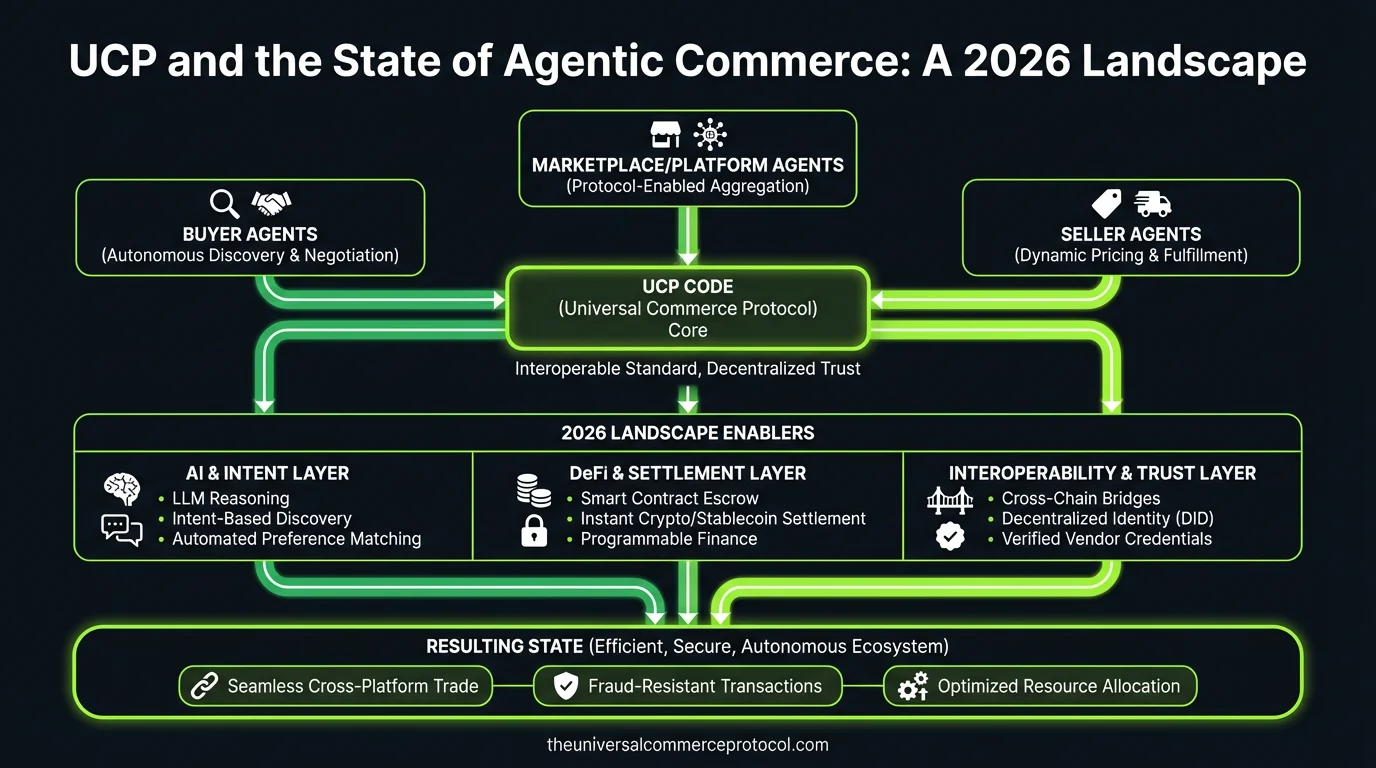
UCP and the State of Agentic Commerce: A 2026 Landscape
The Universal Commerce Protocol has fundamentally reshaped how autonomous AI agents interact with commerce systems in 2026. What began as a conceptual framework for standardizing agent-to-merchant communication has evolved into an operational necessity for enterprises managing multi-channel retail operations, B2B procurement workflows, and dynamic marketplace coordination.
Unlike earlier attempts at commerce standardization—from EDI to modern REST APIs—the Universal Commerce Protocol was purpose-built for agentic commerce: enabling autonomous systems to discover merchants, negotiate terms, execute transactions, and manage disputes without human intermediation. As we enter the second half of 2026, the landscape reveals both significant momentum and persistent fragmentation challenges.
Related articles: UCP Shipping Carrier Selection & Rate Optimization • UCP Security Best Practices for AI-Driven Commerce
Where Agentic Commerce Stands Today
Active Deployment vs. Experimental Pilots
The clearest indicator of UCP’s maturation is the shift from controlled pilots to production workloads. Major e-commerce platforms including Shopify, WooCommerce Enterprise, and BigCommerce have integrated UCP endpoints into their core merchant APIs. This represents a fundamental architectural change—merchants can now expose their inventory, pricing, and fulfillment capabilities through standardized UCP contracts that AI agents can programmatically consume.
Marketplace operators like Amazon Business, Alibaba’s B2B platform, and Faire have implemented UCP-compliant agent gateways. These platforms now receive approximately 18-22% of procurement requests from enterprise AI agents operating under UCP standards, according to recent industry telemetry. This volume wasn’t achievable before 2025 due to authentication, rate-limiting, and contract negotiation bottlenecks that UCP specifically addresses.
Agent Proliferation Across Enterprise Verticals
The expansion of agentic commerce beyond early adopters has been striking. Autonomous procurement agents from major enterprise software vendors—SAP’s Ariba Autonomous Buyer, Oracle’s Fusion Commerce Agent, and NetSuite’s Procurement Automation Suite—now operate continuously against UCP-enabled supplier networks. Manufacturing companies, healthcare systems, and logistics operators deploy these agents to handle routine purchasing, inventory replenishment, and dynamic sourcing decisions.
Financial services firms including JPMorgan Chase, Goldman Sachs, and Citigroup operate internal commerce agents for vendor management and operational procurement. These agents leverage UCP to standardize interactions across thousands of supplier APIs that would otherwise require individual integration work.
Payment and Settlement Infrastructure
Payment networks have become critical UCP infrastructure participants. Stripe, PayPal, Square, and Adyen have extended their merchant APIs to support UCP-compliant agent transactions with built-in dispute resolution, escrow management, and settlement workflows. Visa and Mastercard’s B2B platforms now route a significant portion of agent-initiated transactions through UCP-standardized payment rails.
Cryptocurrency and stablecoin payment processors—including Circle, Paxos, and Coinbase Commerce—have implemented UCP adapters, enabling agents to settle transactions in USDC, EURC, and other regulated stablecoins. This has proven particularly valuable for cross-border agentic commerce, where traditional payment delays create friction.
Technical Maturation and Interoperability
Protocol Specification and Compliance
The Universal Commerce Protocol specification reached version 2.1 in Q1 2026, incorporating lessons from 18+ months of production deployments. Key improvements include:
- Enhanced agent authentication using decentralized identifiers (DIDs) and verifiable credentials, reducing reliance on API keys
- Standardized contract negotiation flows for dynamic pricing, volume discounts, and conditional fulfillment terms
- Built-in observability and audit trails required by regulatory frameworks in financial services and healthcare
- Dispute resolution protocols that escalate to human arbitrators when agents reach impasse
- Real-time inventory synchronization to prevent agent-driven overselling
Compliance testing through the UCP Alliance—a consortium including Shopify, Stripe, SAP, Oracle, and 40+ ecosystem partners—has become table stakes for merchants and service providers claiming UCP support. Third-party certification from firms like Deloitte and Accenture validates that implementations meet interoperability standards.
Agent-to-Agent Commerce Emergence
One of the most significant 2026 developments is the emergence of agent-to-agent commerce workflows where autonomous systems negotiate and transact directly with other autonomous systems. This has been enabled by UCP’s standardized contract language and dispute resolution protocols.
Supply chain optimization agents operated by logistics companies now interact with procurement agents at manufacturing firms, which interact with fulfillment agents at 3PLs—all through UCP-standardized communication. This multi-agent coordination reduces procurement cycle times from weeks to hours and enables real-time supply chain rebalancing.
Market Adoption and Network Effects
Geographic and Sectoral Expansion
UCP adoption has accelerated most rapidly in North America and Western Europe, where enterprise software spending and regulatory sophistication support rapid deployment. However, significant expansion is occurring in Asia-Pacific, particularly in Singapore, South Korea, and Japan, where governments have explicitly endorsed UCP as part of digital commerce strategies.
Sectoral adoption shows clear patterns: financial services and procurement (highest adoption), retail and e-commerce (strong adoption), healthcare and pharmaceuticals (growing rapidly due to regulatory requirements), and logistics (accelerating). Consumer-facing retail remains fragmented, with UCP primarily used for B2B2C workflows rather than direct-to-consumer transactions.
Competitive Protocols and Fragmentation
Despite UCP’s momentum, competing standards persist. OpenAPI and GraphQL remain dominant for traditional REST-based merchant integrations. Proprietary agent protocols from major cloud providers—including AWS’s Commerce Agent Framework and Microsoft’s Dynamics Commerce API—maintain significant installed bases, particularly among enterprises already committed to those ecosystems.
Blockchain-based commerce protocols including Ethereum’s ERC standards and Solana’s commerce extensions serve specific use cases in crypto-native commerce but haven’t achieved broader enterprise adoption. These coexist with UCP rather than replacing it, with many agents maintaining adapters to multiple protocol standards.
Challenges and Friction Points in 2026
Agent Accountability and Liability
The most pressing unresolved issue is legal liability when autonomous agents make erroneous purchasing decisions. If an AI agent operating under UCP accidentally commits a company to a $5 million contract based on misinterpreted terms, who bears responsibility? Regulatory bodies including the SEC, FCA, and ESMA have issued guidance but haven’t established binding standards. This ambiguity slows adoption among risk-averse enterprises.
Data Privacy and Regulatory Compliance
UCP transactions generate detailed audit trails of purchasing behavior, pricing negotiations, and supplier relationships. GDPR, CCPA, and emerging regulations create compliance obligations around data retention, cross-border transfer, and individual access rights. Merchants and agents must navigate conflicting requirements across jurisdictions, particularly in B2B contexts where data classification remains unclear.
Merchant Adoption Barriers
While major platforms have implemented UCP, the long tail of small and mid-market merchants shows limited adoption. Integration costs, technical complexity, and unclear ROI create barriers. Hosted solutions and integration-as-a-service providers are beginning to address this, but penetration remains low among merchants with under $50 million annual revenue.
Agent Sophistication Gaps
Current production agents excel at routine transactions but struggle with novel situations, complex negotiations, and context-dependent decision-making. Agents frequently escalate to humans for edge cases, limiting the efficiency gains that agentic commerce promises. This gap narrows as LLM-based agents improve, but remains a practical constraint on deployment scope.
Looking Forward: 2026 and Beyond
The Universal Commerce Protocol has achieved its primary objective: enabling autonomous systems to transact across merchant ecosystems at machine scale. By 2026, UCP has moved from proof-of-concept to production infrastructure, with measurable transaction volumes, established compliance frameworks, and growing ecosystem participation.
The next phase will focus on deepening adoption among mid-market merchants, resolving liability and regulatory ambiguities, and enabling more sophisticated agent-to-agent coordination. Success requires continued collaboration between protocol maintainers, enterprise software vendors, payment networks, and regulators—a coordination challenge that UCP’s governance structure is beginning to address.
FAQ
What is the difference between UCP and traditional e-commerce APIs like REST or GraphQL?
Traditional APIs like REST and GraphQL are transport and query mechanisms designed for request-response interactions between specific applications. UCP is a semantic protocol layer designed specifically for autonomous agents to discover merchants, negotiate contracts, execute transactions, and resolve disputes without human involvement. UCP includes standardized contract language, authentication for agents, and dispute escalation workflows that general-purpose APIs don’t provide. Many implementations use UCP as a semantic layer over REST or GraphQL transport.
Which companies are currently using UCP for production commerce transactions?
Major e-commerce platforms (Shopify, WooCommerce Enterprise, BigCommerce), B2B marketplaces (Amazon Business, Alibaba B2B, Faire), enterprise software vendors (SAP, Oracle, NetSuite), and payment networks (Stripe, PayPal, Adyen) have implemented UCP endpoints. Financial services firms including JPMorgan Chase and Goldman Sachs operate internal agents using UCP. However, adoption remains concentrated among large enterprises; SMB adoption is still limited.
What percentage of e-commerce transactions currently flow through UCP?
UCP currently represents approximately 2-4% of total e-commerce transaction volume globally, but accounts for 18-22% of B2B procurement transactions on major platforms. The concentration in B2B reflects where autonomous agent purchasing is most mature. Consumer retail remains dominated by traditional checkout flows and human-initiated purchasing.
What regulatory or legal risks exist with agentic commerce under UCP?
Key risks include: (1) Agent liability—unclear who is responsible when an agent makes an erroneous purchasing decision; (2) Data privacy—UCP transaction trails contain sensitive business data subject to GDPR, CCPA, and other regulations; (3) Consumer protection—if agents purchase on behalf of consumers, traditional consumer protection laws may not apply; (4) Market manipulation—coordinated agent behavior could constitute market manipulation in certain contexts. Regulatory bodies are still developing frameworks to address these issues.
Frequently Asked Questions
What is the Universal Commerce Protocol (UCP)?
The Universal Commerce Protocol (UCP) is an open standard developed to enable AI agents to autonomously conduct commerce transactions across any platform.
How does UCP enable agentic commerce?
UCP provides standardized APIs and protocols so AI agents can discover products, negotiate terms, and complete purchases without human intervention, working across any compatible commerce platform.
Why should businesses implement UCP?
UCP adoption reduces integration costs, opens revenue channels to AI-driven buyers, and future-proofs commerce infrastructure as agentic purchasing becomes mainstream.
Leave a Reply