Introduction: Understanding UCP Adoption Across Retail Sectors
The Universal Commerce Protocol (UCP) represents a fundamental shift in how retailers manage omnichannel commerce operations, inventory synchronization, and order fulfillment. However, adoption rates tell a fascinating story about market maturity, technical readiness, and business incentives across different retail verticals.
Unlike standardized technologies that achieve uniform adoption rates, UCP implementation varies dramatically by sector. Some verticals have embraced the protocol as a competitive necessity, while others remain in exploratory phases. Understanding these patterns helps merchants benchmark their progress, identify industry best practices, and make informed technology investment decisions.
Related articles: UCP Shipping Carrier Selection & Rate Optimization • UCP Security Best Practices for AI-Driven Commerce
This article examines real-world adoption metrics, explores the drivers behind vertical-specific implementation patterns, and provides actionable insights for retailers seeking to accelerate their UCP integration timelines.
Current UCP Adoption Landscape by Vertical
Fashion & Apparel: The Adoption Leader
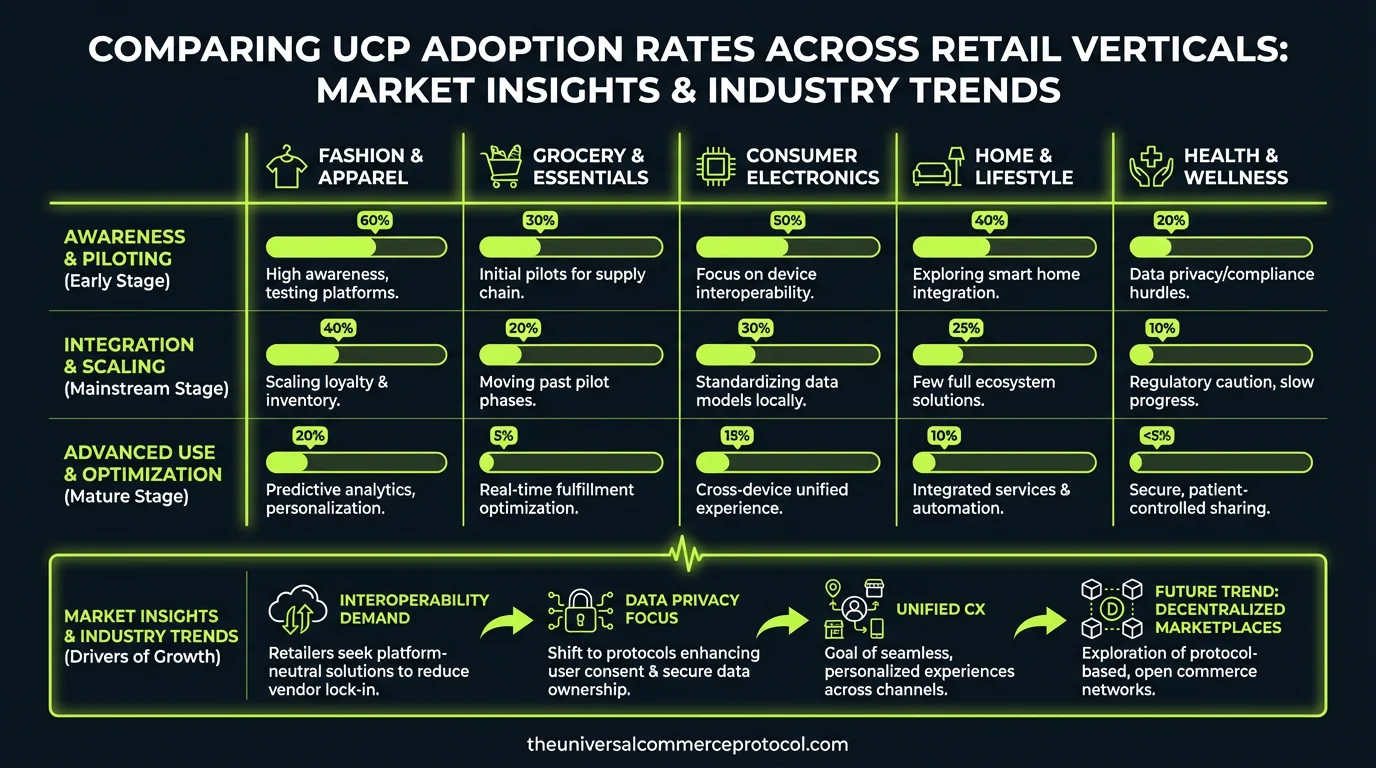
Fashion retailers lead UCP adoption with approximately 34-38% of mid-market and enterprise retailers implementing the protocol as of 2024-2025. This vertical’s dominance stems from several factors:
- Inventory Complexity: Fashion businesses manage SKU proliferation across sizes, colors, and seasonal variations, making UCP’s unified inventory management essential for preventing overselling and stockouts.
- Multi-Channel Necessity: Fashion retailers operate across physical stores, e-commerce platforms, marketplace channels, and increasingly, social commerce. UCP’s standardized order and fulfillment protocols reduce integration complexity.
- Competitive Pressure: Major players like ASOS, Shein, and traditional brands have implemented UCP-compatible systems, creating competitive pressure for mid-market competitors.
- Return Management: Fashion’s high return rates (25-40%) make streamlined return processing through UCP particularly valuable.
Fashion retailers report 15-25% improvements in inventory accuracy and 20-30% faster order processing times after UCP implementation, justifying the initial integration investment.
Electronics & Consumer Technology: Rapid Growth Phase
Electronics retailers show adoption rates between 28-32%, with accelerating implementation curves. This vertical’s growth trajectory reflects:
- High-Value Inventory Management: Electronics require precise inventory tracking due to product value, warranty implications, and serialization needs that UCP handles natively.
- Technical Sophistication: Electronics retailers typically employ more advanced IT infrastructure, reducing implementation barriers.
- Fulfillment Complexity: Multiple fulfillment options (direct ship, in-store pickup, marketplace fulfillment) necessitate protocol standardization.
- B2B Integration: Electronics distributors benefit from UCP’s supplier-to-retailer standardization for dropship and vendor-managed inventory models.
Electronics retailers implementing UCP report 18-22% reduction in fulfillment errors and 25-35% improvement in omnichannel inventory visibility.
Home & Furniture: Moderate Adoption with Growing Interest
Home and furniture retailers currently show 18-24% adoption rates, representing a significant growth opportunity. Adoption drivers include:
- Delivery Complexity: Furniture’s specialized delivery requirements (white-glove service, assembly, scheduling) benefit from UCP’s standardized logistics protocols.
- Large Order Values: High transaction values create strong incentives for order accuracy and tracking.
- Marketplace Expansion: Furniture retailers increasingly sell through marketplaces, requiring UCP-compatible integration.
- Sustainability Reporting: Growing consumer interest in sustainable fulfillment makes UCP’s environmental impact tracking valuable.
Implementation challenges in this vertical include legacy systems common in established furniture retailers and the need for specialized fulfillment partner integration.
Grocery & Food Retail: Early Adoption Stage
Grocery and specialty food retailers show the lowest adoption rates at 8-14%, despite significant potential. Barriers include:
- Legacy Infrastructure: Many grocery retailers operate decades-old POS and inventory systems resistant to protocol-level changes.
- Regulatory Complexity: Food safety regulations, expiration date management, and allergen tracking create additional integration requirements beyond standard UCP implementation.
- Perishability Constraints: Fresh product fulfillment windows are measured in hours, not days, requiring specialized logistics coordination.
- Low Margins: Thin profit margins in grocery retail make technology investment ROI calculations more challenging.
However, grocery adoption is accelerating due to pandemic-driven online grocery growth and competitive pressure from Amazon Fresh and Instacart. Retailers implementing UCP-compatible systems report 12-18% improvement in same-day delivery accuracy.
Beauty & Personal Care: Emerging Adoption
Beauty retailers show 16-20% adoption rates with strong growth momentum. Key adoption drivers:
- Sample and Bundle Complexity: Beauty’s promotional bundles, samples, and gift-with-purchase models require flexible order and fulfillment structures that UCP provides.
- Marketplace Saturation: Beauty’s presence across Sephora, Ulta, Amazon, and direct channels necessitates standardized fulfillment.
- Subscription Models: Beauty subscription services benefit from UCP’s recurring order and subscription management capabilities.
- International Expansion: Beauty retailers’ global growth creates demand for UCP’s multi-currency and multi-region support.
Sports & Outdoor: Niche but Growing
Sports and outdoor retailers demonstrate 20-26% adoption rates, driven by:
- Size and Fit Complexity: Athletic wear’s extensive sizing matrices create inventory challenges that UCP addresses effectively.
- Direct-to-Consumer Focus: Many sports brands prioritize DTC channels where UCP integration provides competitive advantage.
- Experiential Retail: Sports retailers’ emphasis on in-store experience combined with online fulfillment requires sophisticated omnichannel coordination.
Adoption Barriers & Implementation Challenges by Vertical
Technical Integration Complexity
Different verticals face distinct technical challenges. Fashion retailers struggle most with inventory synchronization across size variants, while grocery retailers face perishability tracking requirements. Electronics retailers must integrate serialization and warranty management, while furniture retailers need specialized logistics APIs.
Retailers report that average implementation timelines range from 3-6 months for straightforward verticals like electronics to 9-15 months for complex verticals like grocery or furniture with specialized fulfillment requirements.
Cost-Benefit Analysis Variations
ROI calculations differ significantly across verticals. High-margin verticals like beauty and electronics see faster payback periods (6-12 months) compared to low-margin grocery retail (18-24 months). This financial reality directly impacts adoption decisions among mid-market retailers with limited technology budgets.
Organizational Readiness
Verticals with mature e-commerce operations (fashion, electronics) show higher adoption rates than those with traditional retail-focused organizational structures (furniture, grocery). Change management and staff training requirements vary accordingly.
Regional Variations in UCP Adoption
Adoption rates also vary geographically, with North American retailers showing 24-28% average adoption across all verticals, European retailers at 22-26%, and Asian-Pacific retailers at 18-22%. These differences reflect varying regulatory environments, logistics infrastructure maturity, and marketplace dynamics.
Within regions, adoption concentrates in major metropolitan areas and among retailers with significant online sales channels, suggesting that UCP adoption correlates strongly with digital commerce maturity.
Future Adoption Projections
Expected Growth Trajectories
Industry analysts project UCP adoption will reach 45-55% across all retail verticals by 2027, with fashion reaching 55-65%, electronics 50-60%, and grocery climbing to 25-35%. This growth acceleration will be driven by:
- Increased marketplace requirements mandating UCP compatibility
- AI agent commerce integration requiring standardized order protocols
- Supply chain resilience initiatives necessitating real-time inventory visibility
- Improved implementation tools and reduced integration complexity
Vertical-Specific Opportunities
Grocery and traditional retail verticals represent the largest growth opportunities, with potential adoption increases of 15-20 percentage points over the next 2-3 years. Early adopters in these verticals will gain significant competitive advantages in omnichannel fulfillment and inventory accuracy.
Best Practices for Vertical-Specific Implementation
Fashion & Apparel
Focus on comprehensive inventory synchronization across all channels, implement variant-level tracking, and prioritize return management workflows. Partner with fulfillment providers experienced in fashion logistics.
Electronics & Consumer Technology
Prioritize serialization and warranty management integration, implement supplier-level UCP compatibility for dropship models, and establish robust quality control processes for high-value items.
Grocery & Food Retail
Begin with non-perishable SKUs, implement expiration date tracking at the protocol level, and establish partnerships with logistics providers experienced in temperature-controlled fulfillment.
Beauty & Personal Care
Build flexible bundle and promotion management into UCP implementation, prioritize subscription order handling, and establish international fulfillment capabilities early.
Measuring UCP Adoption Success
Retailers should track adoption success through metrics including inventory accuracy improvement (target: 95%+), order fulfillment speed improvement (target: 20%+ reduction), omnichannel visibility enhancement, and return processing efficiency gains. Vertical-specific KPIs should also be established based on industry benchmarks and competitive positioning.
FAQ: UCP Adoption Across Retail Verticals
Q: Which retail vertical shows the highest UCP adoption rates?
A: Fashion and apparel retailers lead with 34-38% adoption rates, followed by electronics at 28-32%. Fashion’s leadership stems from inventory complexity, multi-channel requirements, and competitive pressure among established retailers.
Q: What’s the typical timeline for UCP implementation across different verticals?
A: Implementation timelines range from 3-6 months for straightforward verticals like electronics to 9-15 months for complex verticals like grocery or furniture. Timeline variation depends on legacy system complexity, organizational readiness, and fulfillment partner integration requirements.
Q: Why do grocery retailers show lower UCP adoption rates?
A: Grocery retail faces multiple barriers including legacy infrastructure, regulatory complexity around food safety and expiration tracking, perishability constraints, and thin profit margins that complicate ROI calculations. However, adoption is accelerating due to pandemic-driven online grocery growth.
Q: What ROI can retailers expect from UCP implementation?
A: High-margin verticals like beauty and electronics typically achieve 6-12 month payback periods with 15-30% improvements in operational efficiency. Lower-margin verticals like grocery see longer payback periods of 18-24 months but still achieve significant inventory accuracy and fulfillment speed improvements.
Q: How should mid-market retailers prioritize UCP adoption within their vertical?
A: Mid-market retailers should benchmark against competitors in their vertical, assess current omnichannel maturity, evaluate fulfillment partner capabilities, and calculate vertical-specific ROI. Beginning with non-core channels or SKU categories allows phased implementation with lower risk.
What is the Universal Commerce Protocol (UCP) and why is it important for retailers?
The Universal Commerce Protocol (UCP) is a fundamental technology that enables retailers to manage omnichannel commerce operations, synchronize inventory across channels, and streamline order fulfillment. It represents a significant shift in how modern retailers operate by allowing seamless integration across multiple sales channels and touchpoints.
Why do UCP adoption rates vary across different retail verticals?
UCP adoption rates differ dramatically by sector due to variations in market maturity, technical readiness, competitive pressures, and business incentives. Some verticals have embraced UCP as a competitive necessity, while others remain in exploratory phases. Fashion and apparel retailers, for example, lead adoption rates, while other sectors may be progressing at different speeds.
Which retail vertical has the highest UCP adoption rate?
Fashion and apparel retailers currently lead UCP adoption rates among all retail verticals. This leadership position reflects their need for sophisticated omnichannel management, inventory synchronization across multiple locations and online channels, and complex order fulfillment requirements.
How can retailers use UCP adoption benchmarking to improve their business?
Retailers can benchmark their UCP progress against industry standards and vertical-specific metrics to identify gaps, learn from best practices, and make informed technology investment decisions. Understanding where your business stands relative to competitors helps prioritize implementation timelines and allocate resources effectively.
What factors should retailers consider when planning UCP integration?
When planning UCP integration, retailers should consider their industry vertical’s adoption patterns, their current technical readiness, competitive pressures within their sector, and specific business incentives. Learning from vertical-specific implementation patterns and industry best practices can help accelerate integration timelines and improve outcomes.
Frequently Asked Questions
What is the Universal Commerce Protocol (UCP)?
The Universal Commerce Protocol (UCP) is an open standard developed to enable AI agents to autonomously conduct commerce transactions across any platform.
How does UCP enable agentic commerce?
UCP provides standardized APIs and protocols so AI agents can discover products, negotiate terms, and complete purchases without human intervention, working across any compatible commerce platform.
Why should businesses implement UCP?
UCP adoption reduces integration costs, opens revenue channels to AI-driven buyers, and future-proofs commerce infrastructure as agentic purchasing becomes mainstream.
Leave a Reply