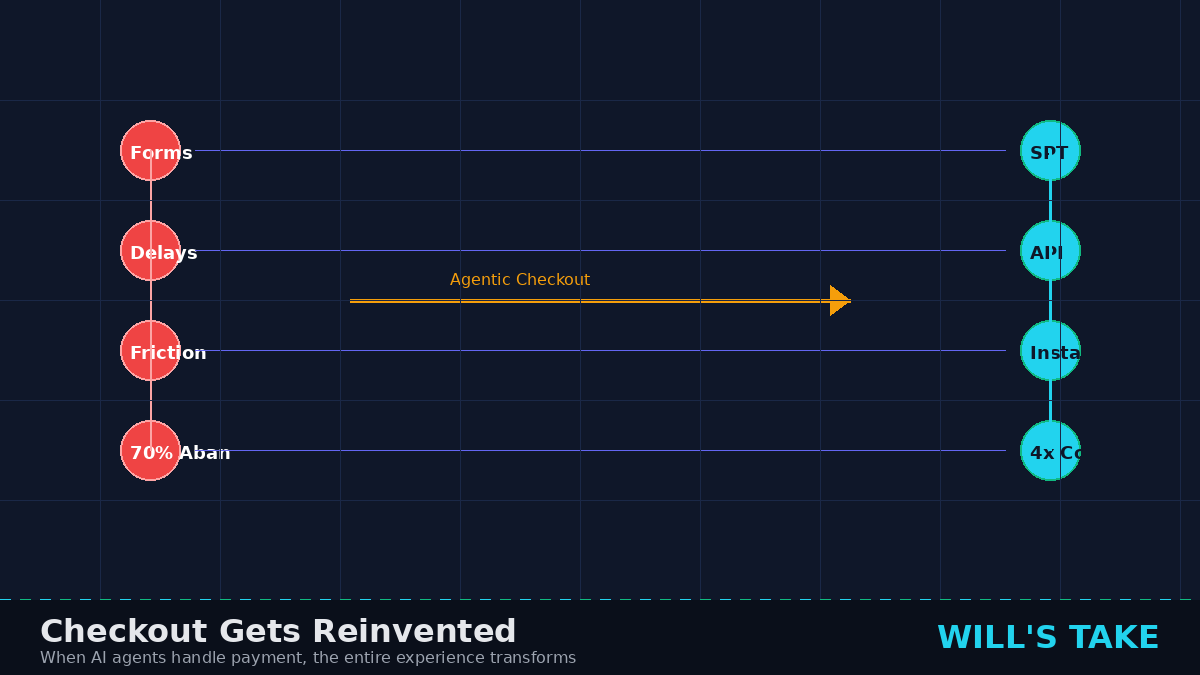
Stripe just made it possible for AI agents to pay for things directly through their API, and the implications for ecommerce are bigger than most people realize. This isn’t about chatbots getting slightly faster at checkout. This is about removing the final friction point between desire and purchase—and in doing so, fundamentally changing what “checkout” means.
The Checkout Friction We’ve Accepted for 30 Years
Checkout hasn’t meaningfully changed since the first web store went live. A human visitor lands on a product page, adds it to a cart (sometimes), navigates to checkout, fills out billing and shipping forms (with pre-fill if they’re lucky), enters payment details, waits for processing, and hopefully completes the transaction. Global cart abandonment sits at 70.19%—a number so persistent that the industry has essentially accepted it as inevitable.
The friction points are relentless. Unexpected shipping costs appear at the last second. Account creation is forced before purchase. The average mobile site loads in 6.3 seconds, but 53% of users abandon sites that take longer than three seconds. Payment method diversity boosts conversion by 12–15%, yet most sites offer only a handful of options. Trust signals are often buried in sidebars instead of adjacent to the payment form, where they’d actually reduce checkout anxiety. One-page checkout reduces abandonment by 20% on average, yet it remains uncommon.
Merchants have optimized around this friction for three decades because the alternative—allowing direct API access to payment processing—was a security nightmare. You can’t give an untrusted actor access to your payment credentials without exposure. So we’ve built increasingly elaborate forms, validation flows, and trust-building theater. The entire UX category of “conversion rate optimization” exists because checkout is so burdensome.
What Changed: Shared Payment Tokens Without Exposed Credentials
Stripe’s new capability solves the core problem: AI agents can now initiate payments without ever touching a customer’s payment credentials. It works through Shared Payment Tokens (SPTs)—a payment primitive where the customer provides permission and payment method details once, and the token can be used for subsequent transactions without re-exposure.
Here’s the technical elegance. A customer gives an AI agent permission to charge them. Stripe issues an SPT that is scoped to a single transaction, time-limited, usage-limited, and vendor-specific—meaning even if an attacker stole the token, it couldn’t be used by another seller. SPTs are powered by Stripe Radar, which relays fraud signals including the likelihood of disputes, card testing, stolen cards, and issuer declines. The token remains within Stripe’s system; it’s never exposed to the merchant or the AI agent. The agent can execute a charge using plain English instructions to the Stripe API: “Process a $47 payment to customer token XYZ.” Done.
Stripe rolled this out as part of the Agentic Commerce Suite in late 2025, then expanded it through partnerships with Mastercard, Visa, Affirm, and Klarna. By March 2026, Stripe also enabled x402 protocol payments, allowing agents to make automated USDC transactions on Base for micropayments and API usage billing—essentially making it possible for agents to pay for their own compute, data, or API calls without human intermediation.
The Behavioral Shift: From Friction to Frictionlessness
When an agent handles checkout instead of a human, the entire interaction changes. An agent doesn’t need a form. It doesn’t experience choice paralysis. It doesn’t second-guess decisions. An agent that decides to purchase has immediate access to Stripe’s payment infrastructure and can complete the transaction in milliseconds, contingent only on fraud detection and risk signals.
Data backs this. Early studies show that users engaging with AI shopping assistants convert at 4x the rate of unassisted browsers. AI agents autonomously reduce cart abandonment by 15–30% through real-time behavioral analysis and predictive interventions. One reported case study shows an AI agent testing different offer types and delivery methods recovered a 20% reduction in abandonment during seasonal campaigns. These aren’t incremental gains—they’re a different category of conversion efficiency.
The $260 billion opportunity in recoverable abandoned cart revenue shifts when agents can complete checkout in a single interaction. Recovering even a 10–20% slice of that becomes 5–15% revenue lift for merchants. Stripe’s infrastructure—previously built for human-initiated transactions—now becomes the backend for agent-driven commerce.
Market Scale: This Is Happening at Meaningful Volume
Agentic commerce isn’t speculative anymore. Morgan Stanley projects $190–$385 billion in agentic spending by 2030. Bain forecasts 15–25% of U.S. ecommerce will flow through agents by 2030, amounting to $300–$500 billion. McKinsey projects $3–$5 trillion globally by 2030. These aren’t fringe scenarios—they represent 10–20% of total retail market share.
The early numbers are already showing traction. Salesforce reported that AI agents influenced $3 billion of Black Friday sales in 2025 alone. Stripe’s early partners include Microsoft Copilot, Anthropic, Perplexity, Vercel, OpenAI, and Lovable. The Agentic Commerce Suite onboarded brands like Etsy, Urban Outfitters, URBN, Ashley Furniture, Coach, Kate Spade, Nectar, Revolve, and Halara immediately upon launch. These aren’t experimental integrations—they’re major retailers preparing to distribute through agent channels.
The Reinvention: Checkout as an API, Not a UI
The deeper pattern here is that checkout is being abstracted from user experience into pure transaction infrastructure. For a human, checkout is a necessary evil—a form, a wait, a moment of anxiety before confirmation. For an agent, checkout is an API endpoint. It’s a function call. It’s synchronous computation indistinguishable from product discovery or shipping calculation.
This means the entire category of checkout optimization as we know it becomes obsolete. Form validation, progress indicators, trust badges, mobile optimization, payment method diversity—all of these UX patterns were designed for human uncertainty. An agent doesn’t need them. An agent needs fast, reliable access to payment processing and fraud detection. Stripe’s Radar integration and SPT architecture provide exactly that.
The second implication is that shopping experience design shifts away from the transaction moment and toward the recommendation, discovery, and communication layers. If checkout is now instant and frictionless, the competitive moat isn’t “whose checkout flow loses fewer people”—it’s “whose agent gives better product recommendations” and “whose agent understands customer intent most accurately.”
This mirrors a previous architectural inversion: the shift from server-side rendering to client-side computation. Twenty years ago, every interaction required a round trip to the server, and performance optimization meant optimizing those trips. Once client-side computation became viable, the bottleneck moved to the network, then to application design, then to UX. Now the bottleneck in ecommerce is recommendation quality, not checkout efficiency. Stripe’s API just made that possible.
The Open Standard Problem
Stripe is pushing the Agentic Commerce Protocol (ACP) as an open standard, co-developed with OpenAI, and supported by major payment networks. This is wise and necessary. If Stripe were the only provider of agentic payment infrastructure, we’d see a repeat of the Stripe dominance pattern in traditional fintech—increasing consolidation around a single API. Instead, by open-sourcing the standard and integrating Mastercard Agent Pay, Visa Intelligent Commerce, Affirm, and Klarna, Stripe is positioning the capability as infrastructure, not a proprietary moat.
The risk, of course, is interoperability failure. SPTs only work with merchants who’ve integrated Stripe. If different payment networks implement different token standards, agents will need to understand multiple protocols and fallback behaviors. But the fact that Stripe is leading with openness suggests they believe the market is large enough that specialization and quality matter more than lock-in.
What I Am Watching
Agent shopping preference data. Once agents control 10–15% of ecommerce transactions, we’ll see behavioral data on what agents buy differently than humans. Do agents buy premium options more often? Do they price-optimize across retailers? Are cart values higher because agents don’t have decision fatigue? The next competitive advantage in retail will be understanding agent purchasing behavior at scale.
Cross-merchant checkout stickiness. If an agent can buy from Etsy, then Urban Outfitters, then Halara in a single conversation, does that lower the switching cost for agents to move between retailers? Conversely, if agents develop preferences for specific merchants because their product data is richer or more reliable, does that create new lock-in? Shared Payment Tokens are meant to be portable, but in practice, the merchant with the best data integration will win.
Regulatory response to agent-initiated payments. Payment networks have fraud detection built for human behavior patterns. An agent making 100 purchases in 30 seconds from a single account will look like fraud until systems are retrained. The regulatory and compliance layer around agentic payments—how liability flows, how disputes are resolved, what threshold of agent misbehavior triggers account restrictions—is still being written. Merchants who move fastest will also be the ones absorbing the most regulatory uncertainty.
This article was produced as part of the Will’s Take Pipeline skill test. Test code: #WTP-EVAL-002
Leave a Reply