Tag: Data Scientist Perspective
-
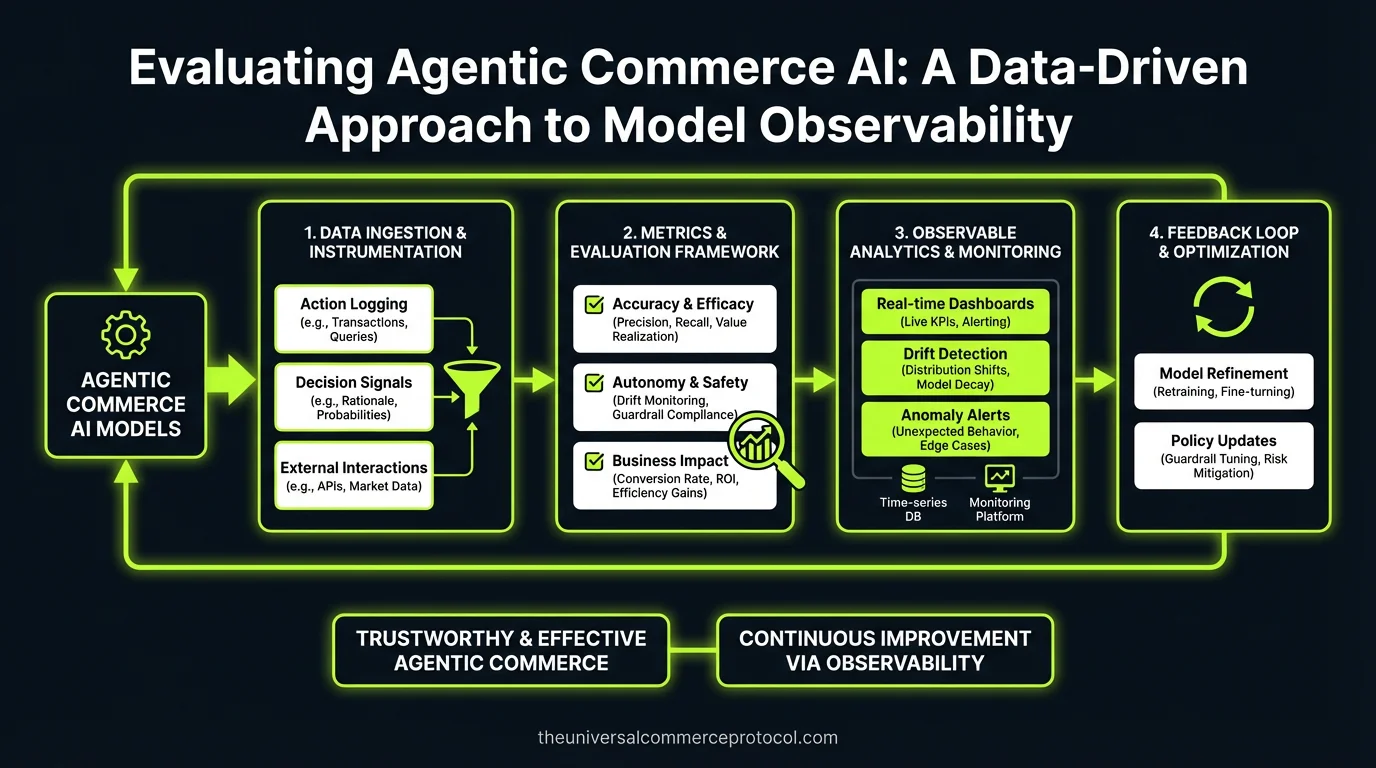
Agentic Commerce AI: Data-Driven Model Observability
Commerce AI agents processing 1,000+ daily transactions require continuous observability through data-driven monitoring frameworks employing drift detection algorithms, prediction confidence scoring, and behavioral anomaly analysis to identify machine learning model performance degradation in non-stationary e-commerce environments. Observability systems must track feature distributions, decision latency (measured in milliseconds), and conversion impact metrics—key performance indicators for maintaining…
-

Training and Evaluating Commerce Agents: An Observability Framework for Model Performance
How to structure training data, evaluate agent decision-making, and monitor model performance in production commerce AI systems.
-

Modeling Cart Abandonment: Training AI Agents for Real-Time Commerce Recovery
Explore the data architecture, model design, and evaluation frameworks needed to train commerce AI agents for real-time cart abandonment recovery.
-

Modeling Purchase Decisions in Voice-Driven Agentic Commerce Systems
Voice commerce presents unique challenges for modeling agent behavior, from sparse conversational signals to multi-turn decision processes.
-

Multi-Agent Reinforcement Learning for E-commerce Fulfillment: Modeling Sequential Decision Problems in Order-to-Delivery Systems
Designing RL agents for fulfillment requires modeling sequential warehouse selection, carrier assignment, and exception handling as a multi-objective MDP.
-
UCP vs MCP: Choose the Right Commerce AI Protocol
Google’s Unified Commerce Protocol (UCP) implements centralized feature normalization across omnichannel retail infrastructure—including e-commerce platforms, point-of-sale terminals, and inventory management systems—while Anthropic’s Model Context Protocol (MCP) enables distributed context windows optimized for multi-agent AI reasoning in supply chain orchestration and demand forecasting workflows. Protocol selection directly determines feature engineering dimensionality, training data stratification across transaction…
-
UCP vs MCP: Commerce AI Protocol Architecture
Universal Commerce Protocol (UCP) implements REST/GraphQL hybrid routing with JSON serialization for cross-platform transaction interoperability, while Model Context Protocol (MCP) employs stateful message queuing with Protocol Buffers for context-aware model integration in enterprise systems. UCP prioritizes transaction atomicity and multi-vendor payment gateway compatibility, whereas MCP optimizes for reduced integration latency through asynchronous message handling and…
-
Feature Engineering Commerce Agents: UCP vs Claude
Feature engineering for commerce agents on Anthropic Claude Marketplace and the Unified Commerce Platform (UCP) diverges in architecture: UCP implementations normalize heterogeneous features across ERP systems, POS terminals, and supply chain data sources to resolve multi-source inventory fragmentation, while Claude Marketplace agents enforce cross-tenant data isolation that limits training dataset size and statistical representativeness. Evaluation…
-
UCP vs Claude: AI Commerce Platform Investment Analysis
Anthropic’s Claude 3.5 Sonnet API pricing operates at $0.003 per 1M input tokens and $0.015 per 1M output tokens through consumption-based billing, while Salesforce Unified Commerce Platform (UCP) within Commerce Cloud requires fixed annual enterprise licensing starting at $50,000+ USD with integrated CRM, order management, and Einstein AI capabilities. Claude’s variable-cost structure optimizes for inference-heavy…
-
Commerce Agent Performance: Data Science Testing
Commerce agent performance frameworks evaluate NLP-driven conversational AI systems using precision metrics including conversion rate optimization (CRO), cart abandonment rates, and session-level accuracy across unified commerce platforms spanning e-commerce, omnichannel retail, and mobile commerce channels. Data science testing methodologies quantify recommendation engine performance via click-through rates (CTR) and revenue per session (RPS) metrics, while validating…