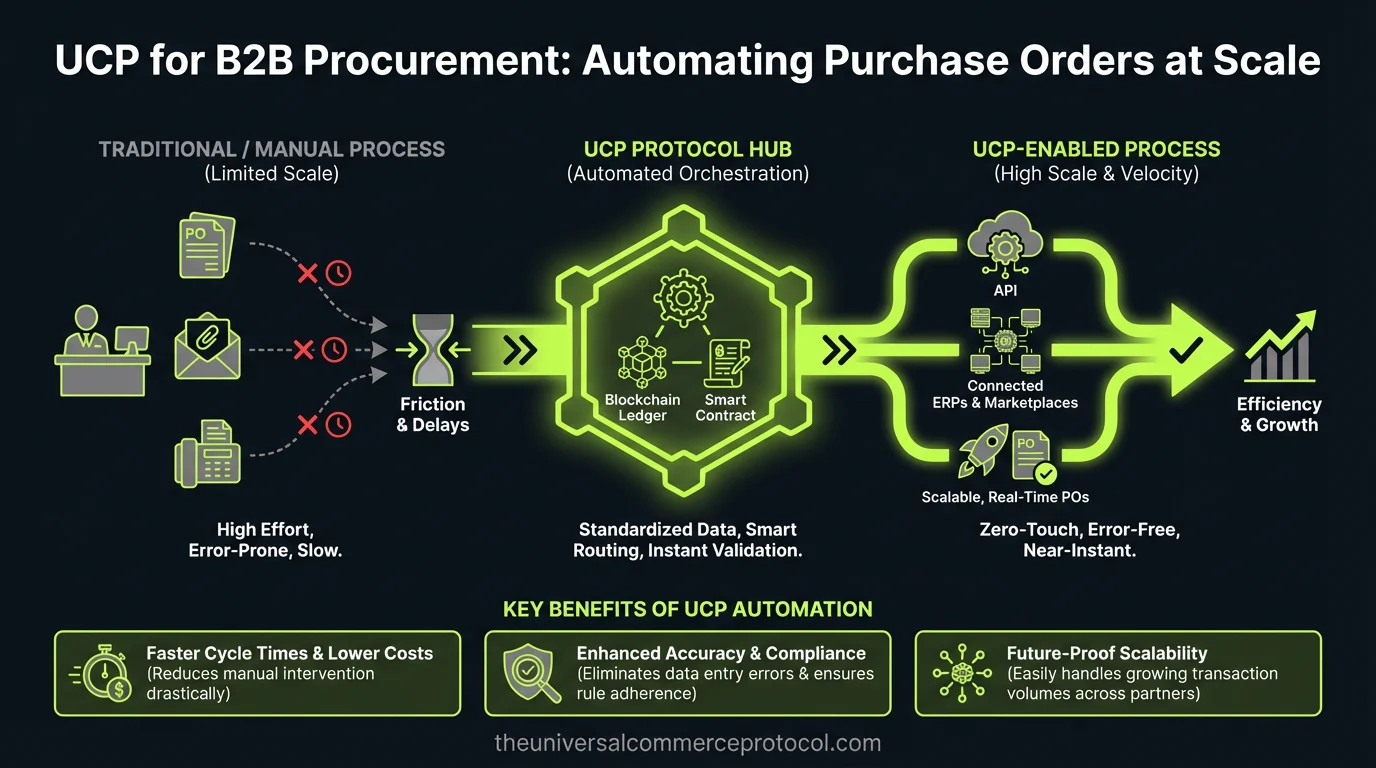
B2B procurement has traditionally been a manual, time-consuming process involving email exchanges, spreadsheet management, and multiple approval workflows. Universal Commerce Protocol (UCP) is transforming this landscape by enabling automated purchase order creation, validation, and fulfillment at enterprise scale. This comprehensive guide explores how organizations can leverage UCP to streamline their procurement operations and achieve measurable efficiency gains.
Understanding UCP in B2B Procurement Context
Universal Commerce Protocol provides a standardized framework for commerce transactions that extends far beyond traditional retail. In B2B procurement, UCP enables buyers and suppliers to establish automated, machine-readable purchase order workflows that eliminate manual data entry and reduce processing errors.
Related articles: UCP Shipping Carrier Selection & Rate Optimization • UCP Security Best Practices for AI-Driven Commerce
Unlike EDI (Electronic Data Interchange) systems that require expensive infrastructure and custom mappings, UCP offers a modern, API-first approach that integrates seamlessly with existing ERP systems while maintaining flexibility for complex B2B scenarios. The protocol standardizes how purchase orders are structured, validated, and communicated between systems.
Key Differences from Traditional B2B Systems
Traditional B2B procurement relies on:
- Manual PO creation in spreadsheets or proprietary systems
- Email-based communication with suppliers
- Multiple data re-entry points across systems
- Delayed visibility into order status and fulfillment
- Limited integration between buyer and supplier systems
UCP-enabled procurement provides:
- Automated PO generation triggered by inventory thresholds or demand signals
- Real-time, machine-to-machine communication
- Single source of truth across integrated systems
- Immediate visibility into order status, shipment tracking, and invoicing
- Standardized data formats that reduce mapping complexity
Core Components of UCP Purchase Order Automation
Purchase Order Creation and Validation
UCP standardizes purchase order structure with required fields including buyer identification, supplier information, line items with SKU and quantity, pricing, delivery terms, and payment terms. The protocol enables automatic validation against supplier catalogs, pricing agreements, and inventory policies before transmission.
Organizations can configure business rules that automatically generate purchase orders based on:
- Inventory levels falling below reorder points
- Demand forecasts from sales systems
- Seasonal purchasing patterns
- Supplier lead times and minimum order quantities
- Budget allocation and approval thresholds
The validation layer checks for compliance with corporate purchasing policies, ensures supplier agreements are current, and verifies budget availability before PO transmission.
Supplier Integration and Order Transmission
UCP provides multiple transmission mechanisms for purchase orders. Suppliers can receive orders via:
- REST API endpoints for real-time integration
- Webhook notifications for event-driven processing
- SFTP for batch file transfers
- Web portal access for manual review and confirmation
The protocol includes acknowledgment mechanisms where suppliers confirm receipt and provide commitment dates. This creates an audit trail and enables buyers to track PO lifecycle from creation through fulfillment.
Order Status and Fulfillment Tracking
UCP enables real-time visibility into purchase order status through standardized status codes and events. Suppliers update orders with information including:
- Order confirmation with committed delivery dates
- Partial shipment notifications
- Backorder alerts with expected availability dates
- Shipment tracking information
- Invoice and payment status
Buyers receive these updates through webhooks or API queries, enabling automatic updates to inventory management and accounting systems.
Implementation Strategy for Enterprise Buyers
Phase 1: Assessment and Planning
Begin by auditing current procurement processes, identifying bottlenecks, and quantifying manual effort. Key assessment areas include:
- Volume of purchase orders processed annually
- Number of suppliers and product categories
- Current systems and integration points (ERP, inventory management, accounting)
- Approval workflows and authorization limits
- Supplier readiness and technical capabilities
Organizations typically see the greatest ROI by starting with high-volume, standardized product categories where suppliers are technically capable of UCP integration.
Phase 2: ERP Integration and Data Mapping
UCP implementation requires integration with existing ERP systems to enable automated PO generation. This involves:
- Mapping internal product codes to standardized SKU formats
- Establishing supplier master data with UCP endpoints and authentication
- Configuring approval workflows and authorization matrices
- Setting up reorder triggers based on inventory thresholds
- Defining pricing and terms agreements in machine-readable format
This phase typically requires collaboration between procurement, IT, and finance teams to ensure business rules are accurately translated into system configuration.
Phase 3: Supplier Onboarding
Successful implementation requires suppliers to support UCP. Onboarding activities include:
- Providing supplier documentation and technical specifications
- Assisting suppliers with API implementation or integration platform setup
- Testing PO transmission and receipt in sandbox environments
- Validating order acknowledgment and status update workflows
- Training supplier teams on new processes and systems
Many organizations provide incentives for supplier adoption, including volume discounts or improved payment terms for suppliers who implement UCP integration.
Phase 4: Pilot and Optimization
Launch with a subset of suppliers and product categories to validate processes and identify optimization opportunities. Monitor metrics including:
- PO processing time (days from trigger to transmission)
- Manual intervention rate
- Order accuracy and error rates
- Supplier acknowledgment time
- On-time delivery performance
Use pilot results to refine business rules, improve data quality, and identify additional automation opportunities before enterprise-wide rollout.
Benefits and ROI Metrics
Operational Efficiency Gains
Organizations implementing UCP for B2B procurement report significant efficiency improvements:
- Processing time reduction: Manual PO creation typically requires 15-30 minutes per order. Automated PO generation reduces this to seconds.
- Error reduction: Manual data entry introduces errors at 2-5% rates. Automated validation reduces errors to less than 0.1%.
- Staff productivity: Procurement teams shift from data entry to strategic sourcing and supplier management activities.
- Faster order fulfillment: Automated POs reach suppliers immediately, reducing lead times by 1-2 days on average.
Financial Impact
Cost savings from UCP procurement automation include:
- Labor cost reduction: Processing fewer manual orders reduces procurement staff requirements by 20-30%.
- Working capital improvement: Faster order cycles and better inventory visibility reduce inventory carrying costs.
- Discount capture: Automated compliance with payment terms enables organizations to capture early payment discounts.
- Supplier consolidation: Improved visibility enables better supplier negotiations and volume consolidation.
Strategic Advantages
Beyond immediate cost savings, UCP procurement automation provides strategic benefits:
- Real-time visibility into supply chain and inventory status
- Data-driven insights for demand planning and supplier performance
- Flexibility to respond quickly to market changes and demand shifts
- Foundation for advanced capabilities like AI-driven demand forecasting
- Improved supplier relationships through reliable, automated ordering
Best Practices for Procurement Automation
Data Quality Management
Successful automation depends on high-quality master data. Implement processes to:
- Maintain accurate product master data with current pricing and availability
- Keep supplier information current with correct contact points and delivery addresses
- Validate inventory data before triggering automated PO generation
- Regularly audit and clean historical transaction data
Exception Handling
Even well-designed automation encounters exceptions. Establish clear processes for:
- Handling out-of-stock items and backorder scenarios
- Managing price changes and contract updates
- Escalating urgent or non-standard orders to procurement staff
- Reviewing and approving high-value or unusual orders
Continuous Monitoring and Optimization
Regularly review automation performance and optimize business rules:
- Track metrics on PO cycle time, accuracy, and supplier performance
- Identify patterns in manual interventions and exceptions
- Adjust reorder thresholds based on demand trends
- Expand automation to additional product categories and suppliers as confidence increases
Challenges and Mitigation Strategies
Supplier Adoption
Challenge: Not all suppliers have technical capability or willingness to implement UCP integration.
Mitigation: Start with largest suppliers by volume, provide technical support and incentives, and maintain fallback processes for non-integrated suppliers.
Legacy System Integration
Challenge: Many organizations operate legacy ERP systems that require custom development for UCP integration.
Mitigation: Use middleware or integration platforms that provide pre-built connectors, or prioritize ERP modernization as part of digital transformation initiatives.
Process Standardization
Challenge: Different business units may have varying procurement processes and approval workflows.
Mitigation: Establish enterprise procurement standards and governance, align business units on common processes, and provide configuration flexibility for justified exceptions.
Future Directions: Advanced Procurement Capabilities
Organizations that successfully implement UCP for basic purchase order automation can build toward more advanced capabilities:
- AI-driven demand forecasting: Use historical data to predict demand and automatically adjust reorder parameters
- Dynamic pricing: Integrate real-time market data to optimize purchasing decisions
- Supplier collaboration: Enable suppliers to provide real-time capacity and availability information
- Sustainability tracking: Automatically capture and report environmental metrics for supplier performance
- Autonomous procurement: Extend automation to contract negotiation and supplier selection decisions
Frequently Asked Questions
Q: How long does UCP B2B procurement implementation typically take?
Implementation timelines vary based on organization size and complexity, but typically range from 3-6 months for initial deployment with a pilot set of suppliers. Full enterprise rollout may require 12-18 months depending on the number of suppliers and product categories involved. Organizations with modern ERP systems and fewer suppliers generally experience faster implementation.
Q: What is the typical ROI for UCP procurement automation?
Most organizations see payback within 12-24 months through labor cost reduction, error elimination, and working capital improvements. High-volume procurement operations may achieve ROI within 6-12 months. Long-term benefits include improved supplier relationships, better supply chain visibility, and strategic flexibility.
Q: Can UCP handle complex procurement scenarios like consignment inventory or drop-shipping?
Yes, UCP’s flexible structure supports advanced procurement models. The protocol can accommodate consignment arrangements through specialized order types and inventory management flags, and drop-shipping through supplier-to-customer fulfillment configurations. Implementation requires additional business rule configuration and supplier coordination.
Q: What happens if a supplier doesn’t support UCP integration?
Organizations can maintain hybrid approaches where UCP-enabled suppliers receive automated orders while non-integrated suppliers continue using traditional methods. Many organizations use this as a transition strategy, gradually expanding UCP adoption as more suppliers implement integration capabilities.
Q: How does UCP procurement automation affect supplier relationships?
When implemented correctly, UCP improves supplier relationships through reliable, predictable ordering patterns and faster payment cycles. Suppliers gain visibility into demand trends and can better plan production. However, successful implementation requires clear communication about changes and support for supplier integration efforts.
What is UCP and how does it differ from EDI for B2B procurement?
Universal Commerce Protocol (UCP) is a standardized framework for commerce transactions that offers a modern, API-first approach to B2B procurement. Unlike traditional EDI (Electronic Data Interchange) systems that require expensive infrastructure and custom mappings, UCP integrates seamlessly with existing ERP systems while maintaining flexibility for complex B2B scenarios. UCP eliminates the need for extensive custom development and provides a more accessible solution for automating purchase orders at scale.
How does UCP automate the purchase order process?
UCP enables automated purchase order creation, validation, and fulfillment by providing a standardized, machine-readable framework that connects buyers and suppliers. The protocol eliminates manual data entry, reduces processing errors, and automates multiple approval workflows that traditionally involved email exchanges and spreadsheet management. This automation streamlines the entire procurement operation from order creation through fulfillment.
What are the main benefits of implementing UCP for B2B procurement?
Organizations can achieve measurable efficiency gains through UCP implementation, including reduced manual processing time, lower error rates in purchase order data, faster approval workflows, and seamless integration with existing ERP systems. By automating purchase orders at enterprise scale, businesses can significantly decrease the time and resources spent on traditional procurement tasks while improving accuracy and visibility across the supply chain.
Can UCP integrate with existing ERP systems?
Yes, UCP’s API-first approach is designed to integrate seamlessly with existing ERP systems. This compatibility makes it easier for organizations to adopt UCP without requiring a complete overhaul of their current infrastructure, allowing businesses to modernize their procurement processes while protecting their existing investments in enterprise software.
Is UCP suitable for complex B2B procurement scenarios?
Yes, UCP maintains the flexibility needed for complex B2B scenarios. The protocol is designed to handle sophisticated procurement requirements while still providing the standardization and automation benefits that simplify typical purchasing processes. This balance makes UCP adaptable to various business needs regardless of procurement complexity.
Leave a Reply