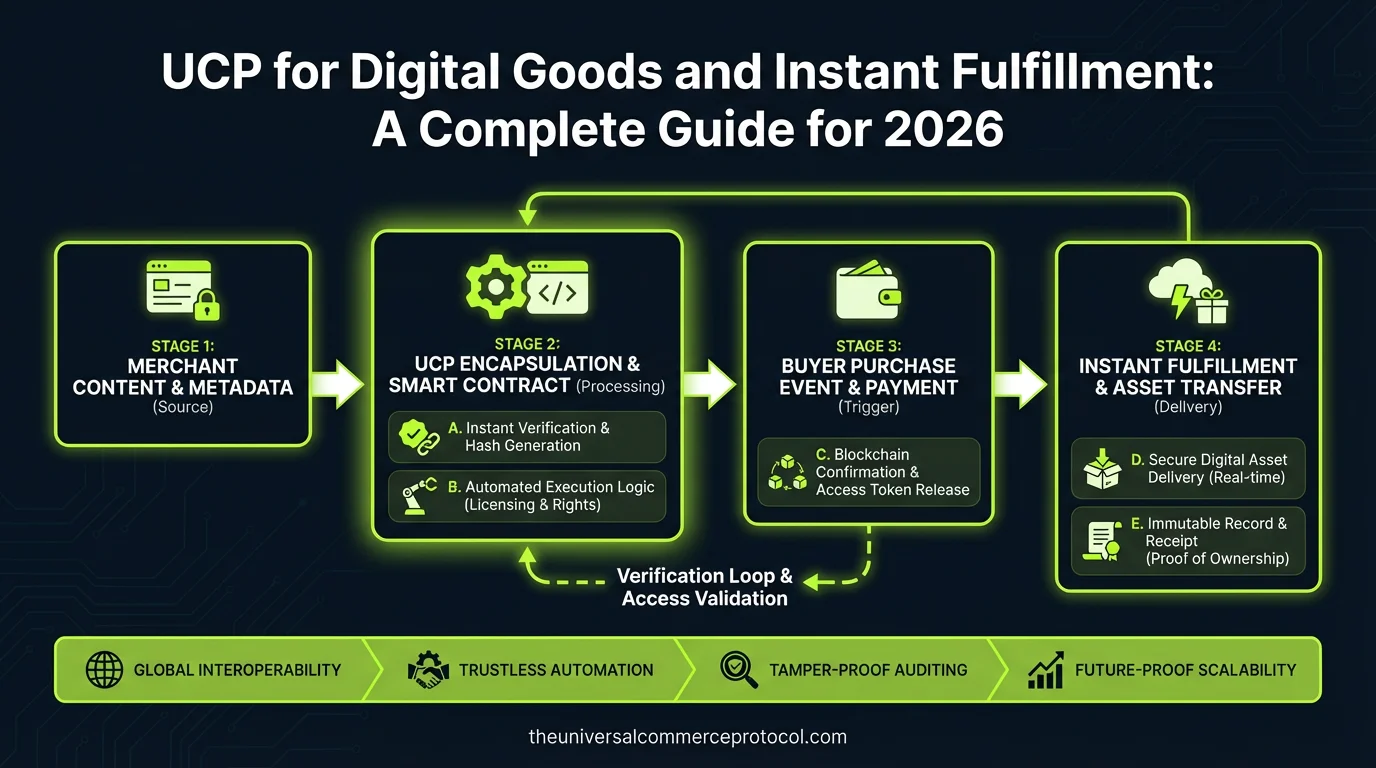
Understanding UCP for Digital Goods Delivery
The Universal Commerce Protocol (UCP) represents a fundamental shift in how digital goods and services are delivered to customers. Unlike traditional commerce where physical products require shipping logistics, digital goods demand a different fulfillment paradigm—one built on speed, automation, and seamless integration between purchase and delivery.
Digital goods fulfillment through UCP eliminates the traditional gap between transaction completion and product access. Whether you’re selling software licenses, digital media, in-game items, or access credentials, UCP enables instant delivery through standardized protocols that work across multiple platforms and AI agents.
Related articles: UCP Shipping Carrier Selection & Rate Optimization • UCP Security Best Practices for AI-Driven Commerce
What Makes Digital Goods Different
Digital goods present unique fulfillment challenges that traditional commerce systems weren’t designed to handle:
- Instant Delivery Requirements: Customers expect immediate access upon purchase, not next-day or next-week fulfillment
- Scalability Without Inventory: Digital goods don’t deplete inventory in traditional ways; they scale infinitely
- License Management: Many digital products require activation codes, license keys, or authentication tokens
- Access Control: Merchants need granular control over who accesses what and for how long
- Multi-Platform Distribution: The same digital good might need to be delivered across web, mobile, email, and AI shopping interfaces
How UCP Enables Instant Digital Fulfillment
Real-Time Inventory and Availability
UCP connects your digital goods catalog directly to AI shopping agents and commerce interfaces. When a customer initiates a purchase through voice commerce, a shopping app, or ChatGPT, the UCP layer immediately confirms availability and reserves the digital asset.
Unlike traditional inventory systems that batch-update every few hours, UCP provides real-time synchronization. If you’re selling limited digital licenses (such as premium software seats), the system instantly reflects current availability across all sales channels. This prevents overselling and ensures customers know exactly what they’re purchasing.
Automated Fulfillment Workflows
UCP implements standardized fulfillment workflows that trigger automatically upon transaction completion. The protocol defines:
- License key generation and delivery mechanisms
- Access token creation and expiration policies
- Download link provisioning and expiration windows
- Account activation sequences
- Subscription initialization and billing cycle management
These workflows execute server-to-server without customer intervention. A customer completes a purchase at 2:47 PM, and by 2:48 PM they’ve received a download link, license key, and account credentials through their preferred channel—email, SMS, push notification, or directly within the purchasing interface.
Multi-Channel Delivery Orchestration
Digital goods often need delivery through multiple channels simultaneously. UCP standardizes this orchestration:
- Email delivery of license keys and download links
- SMS notifications with access codes
- In-app notifications and dashboard access
- API callbacks to customer account systems
- Webhook triggers for downstream systems
Merchants define delivery preferences once, and UCP handles multi-channel distribution automatically. This is particularly valuable for merchants operating across web storefronts, mobile apps, and AI shopping assistants.
Practical Implementation: Digital Goods Categories
Software and SaaS Licenses
For software merchants, UCP enables instant license provisioning. When a customer purchases a software license through an AI agent:
- The UCP system validates payment completion
- A unique license key is generated or retrieved from your license pool
- An account is provisioned in your SaaS platform
- Activation instructions are delivered via email and SMS
- The customer receives immediate access to the software
For subscription software, UCP manages billing cycles, renewal notifications, and access revocation when subscriptions lapse—all automatically through the protocol’s lifecycle management features.
Digital Media and Content
E-books, music, videos, and other media benefit from UCP’s instant delivery model. Upon purchase:
- Download links are generated with expiration windows (preventing indefinite sharing)
- DRM credentials are provisioned if needed
- Content is added to customer libraries or accounts
- Recommendations for similar content are triggered
UCP also handles content delivery network (CDN) integration, ensuring downloads originate from geographically optimal servers for faster delivery.
In-Game Items and Virtual Goods
Gaming merchants use UCP to deliver virtual items instantly. When a player purchases an in-game item through voice commerce or a shopping assistant:
- The item is instantly added to their game inventory
- Account synchronization occurs across all devices
- In-game notifications alert the player
- The transaction is recorded for analytics and fraud detection
UCP’s webhook system (detailed in our companion article on webhooks) enables real-time game server updates, ensuring the virtual item appears in-game within seconds of purchase.
Credentials and Access Services
For merchants selling API access, database credentials, or service accounts, UCP manages secure delivery:
- API keys are generated with appropriate scopes and rate limits
- Credentials are delivered through secure channels
- Access is logged and monitored for abuse
- Revocation is handled automatically upon cancellation
Technical Architecture for Digital Fulfillment
Fulfillment Service Integration
UCP defines standard endpoints for fulfillment services. Your digital goods platform implements these endpoints:
/fulfillment/provision– Provision a digital good for a customer/fulfillment/verify– Verify fulfillment status/fulfillment/revoke– Revoke access (for cancellations or refunds)/fulfillment/status– Check fulfillment status
These standardized endpoints enable any UCP-compatible shopping agent to trigger fulfillment without custom integration work. Whether it’s ChatGPT, a voice assistant, or a mobile app, they all use the same protocol.
Webhook-Based Delivery Confirmation
UCP uses webhooks to confirm fulfillment completion. Your fulfillment service sends:
{
  "event": "fulfillment.completed",
  "order_id": "ord_12345",
  "sku": "software_license_pro",
  "customer_id": "cust_67890",
  "fulfillment_data": {
    "license_key": "XXXX-XXXX-XXXX-XXXX",
    "download_url": "https://cdn.example.com/download/...",
    "expiration": "2026-02-15T23:59:59Z"
  },
  "timestamp": "2026-01-15T14:32:00Z"
}
This webhook triggers downstream processes: email delivery, customer account updates, analytics recording, and AI agent feedback (so the agent can confirm delivery to the customer).
Inventory Management for Digital Assets
Digital goods inventory differs from physical inventory. UCP manages:
- License Pool Management: Tracking available licenses and their allocation
- Capacity Limits: Enforcing seat limits for team licenses
- Expiration Tracking: Managing time-limited digital goods
- Concurrent Access: Limiting simultaneous users for certain products
For example, if you sell a 10-seat team license, UCP tracks which 10 seats are active and prevents the 11th user from accessing the product without purchasing an additional seat.
Benefits of UCP-Based Digital Fulfillment
Reduced Friction and Cart Abandonment
Instant fulfillment eliminates post-purchase friction. Customers don’t wait for confirmation emails or navigate complex activation processes. They purchase and immediately access their digital good, dramatically reducing abandonment rates for digital products.
Enhanced Customer Experience
Seamless, instant delivery creates delightful customer experiences. Purchasing through voice commerce, receiving instant access, and being able to use the product immediately increases customer satisfaction and encourages repeat purchases.
Operational Efficiency
Automated fulfillment eliminates manual processes. Your team doesn’t manually generate license keys, send activation emails, or provision accounts. This reduces operational overhead and human error.
Fraud Prevention
UCP’s standardized protocols enable sophisticated fraud detection. The system can identify suspicious purchase patterns, enforce velocity limits, and require additional verification for high-risk transactions—all automatically.
Scalability Without Infrastructure Overhead
Digital goods scale infinitely without additional fulfillment infrastructure. Whether you sell 10 licenses or 10,000 today, UCP handles the fulfillment load without requiring you to hire additional staff or build custom systems.
Best Practices for Digital Goods Fulfillment
Implement Redundancy and Failover
Ensure your fulfillment service has backup systems. If your primary license generation service fails, UCP should automatically failover to a secondary system. This prevents customers from purchasing products they can’t immediately access.
Monitor Fulfillment Latency
Track fulfillment completion times. Aim for sub-second delivery for most digital goods. If fulfillment regularly takes more than a few seconds, investigate the bottleneck—it might be your license generation service, email delivery, or API response times.
Implement Comprehensive Logging
Log every fulfillment event for debugging and compliance. When a customer claims they didn’t receive their digital good, you need audit trails showing exactly what happened and when.
Handle Edge Cases Gracefully
Plan for scenarios like:
- License pool exhaustion (no more licenses available)
- Fulfillment service timeouts
- Customer refunds and access revocation
- Subscription cancellations mid-billing-cycle
Define clear policies for each scenario and implement them in your UCP integration.
Test End-to-End Workflows
Before going live, test complete purchase-to-fulfillment workflows. Simulate purchases through different channels (web, mobile, AI agent) and verify that digital goods are delivered correctly through all paths.
FAQ: UCP Digital Goods and Instant Fulfillment
Q: What’s the typical fulfillment latency for digital goods through UCP?
A: Most UCP-based digital goods are fulfilled within 1-5 seconds of payment completion. This includes license generation, email delivery, and account provisioning. The primary latency factors are email delivery (typically 1-3 seconds) and your fulfillment service response time. For critical applications, you can deliver access immediately through in-app notifications while email confirmation follows asynchronously.
Q: How does UCP handle refunds for digital goods that have already been accessed?
A: UCP implements refund policies you define. You can specify whether digital goods are refundable, non-refundable, or refundable only within a time window. When a refund is processed, UCP automatically revokes access (revoking license keys, disabling accounts, or removing download links). You define the revocation behavior—whether it’s immediate, delayed, or conditional.
Q: Can UCP handle subscription-based digital goods with recurring billing?
A: Yes. UCP integrates with payment processors to manage recurring billing cycles. For subscription digital goods, UCP provisions access at subscription start, manages renewal fulfillment at each billing cycle, and automatically revokes access if payment fails or the subscription is canceled. Webhook notifications keep your systems synchronized with subscription status.
Q: How do I integrate my existing digital goods platform with UCP?
A: Implement the standard UCP fulfillment endpoints on your platform. At minimum, you need `/fulfillment/provision` (to create access), `/fulfillment/revoke` (to remove access), and `/fulfillment/status` (to check status). Your fulfillment service receives requests from UCP-compatible shopping agents and returns standardized responses. See our UCP Developer Guide for detailed integration documentation.
Q: What happens if the customer’s email delivery fails after the digital good is provisioned?
A: UCP implements retry logic for delivery failures. If the initial email delivery fails, the system retries with exponential backoff. Additionally, the digital good remains accessible through the customer’s account dashboard and can be re-delivered on-demand. You can also implement SMS as a fallback delivery channel. The key principle: the digital good is always provisioned and accessible, even if email delivery encounters issues.
Frequently Asked Questions
What is UCP (Universal Commerce Protocol) for digital goods?
The Universal Commerce Protocol (UCP) is a standardized framework that enables instant delivery of digital goods and services to customers. Unlike traditional commerce systems designed for physical products, UCP facilitates immediate access to digital products upon purchase through automated, seamless integration between purchase completion and product delivery across multiple platforms and AI agents.
How does UCP enable instant fulfillment for digital goods?
UCP eliminates the traditional gap between transaction completion and product access by using standardized protocols and automation. This means customers receive immediate access to software licenses, digital media, in-game items, or access credentials instantly upon purchase, without waiting for processing or shipping logistics.
What types of products can be delivered through UCP?
UCP supports various digital goods including software licenses, digital media, in-game items, access credentials, ebooks, online courses, music, videos, and any other products that don’t require physical shipment. These products can be instantly delivered upon purchase without traditional inventory constraints.
What are the key differences between digital goods fulfillment and traditional commerce fulfillment?
Digital goods fulfillment differs in three main ways: (1) Instant Delivery Requirements—customers expect immediate access upon purchase rather than shipping delays, (2) Scalability Without Inventory—digital goods don’t deplete inventory traditionally and can scale infinitely, and (3) No physical logistics needed, making the fulfillment process entirely automated.
How can businesses implement UCP for their digital goods in 2026?
Businesses can implement UCP by adopting standardized protocols that integrate their commerce systems with automated delivery mechanisms. This involves setting up infrastructure that connects purchase transactions directly to product delivery systems, ensuring compliance with UCP standards, and integrating with multiple platforms and AI agents for seamless customer access.
Leave a Reply