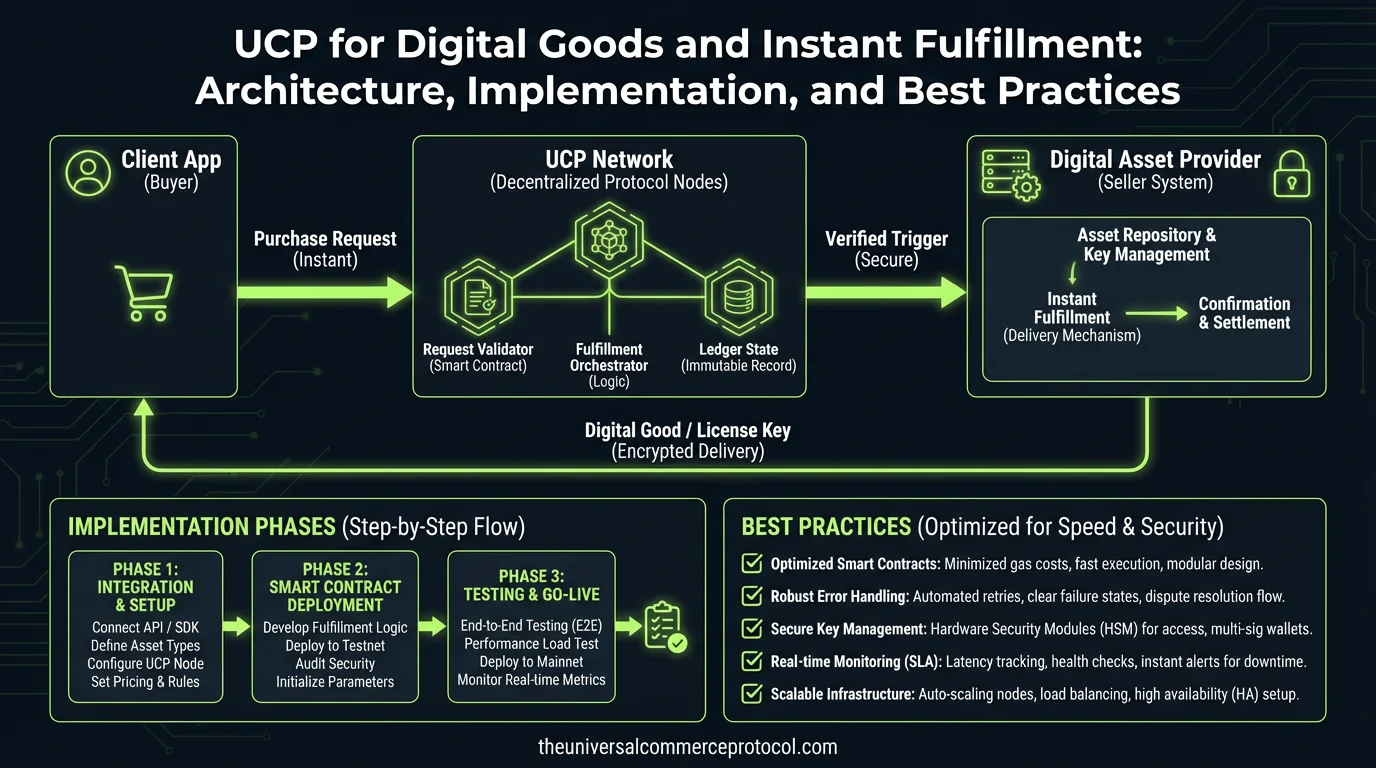
Understanding UCP for Digital Goods Delivery
The Universal Commerce Protocol (UCP) represents a fundamental shift in how digital goods are purchased, fulfilled, and delivered in modern commerce ecosystems. Unlike physical products that require warehousing, logistics, and shipping infrastructure, digital goods demand a different fulfillment model entirely—one built on instant delivery, zero inventory costs, and automated provisioning.
UCP provides merchants with a standardized framework for managing the complete lifecycle of digital product transactions, from purchase initiation through instant delivery. This protocol eliminates the traditional gap between payment authorization and product access, enabling customers to receive software licenses, digital media, in-game currency, ebooks, and cloud services within milliseconds of completing checkout.
Related articles: UCP Shipping Carrier Selection & Rate Optimization • UCP Security Best Practices for AI-Driven Commerce
Why Digital Goods Require Different Commerce Infrastructure
Digital goods present unique challenges that physical commerce protocols cannot adequately address. Traditional e-commerce platforms were built around inventory management, shipping coordination, and warehouse operations. These systems introduce unnecessary complexity and latency for products that exist as data rather than physical items.
UCP eliminates this friction by recognizing that digital fulfillment operates on fundamentally different principles: instantaneous availability, zero marginal reproduction costs, and the ability to deliver to unlimited customers simultaneously without inventory depletion. The protocol standardizes how payment systems communicate with fulfillment engines, ensuring that authorization and delivery occur as a single atomic transaction.
UCP Architecture for Instant Fulfillment
Core Components of the UCP Digital Goods Stack
The UCP architecture for digital goods consists of several interconnected layers that work in concert to enable instant fulfillment:
Payment Authorization Layer: This component handles transaction validation, fraud detection, and payment method verification. UCP standardizes how payment processors communicate authorization status to downstream fulfillment systems, eliminating the need for merchants to build custom integrations with multiple payment gateways.
Fulfillment Orchestration Layer: Once payment authorization completes, the fulfillment orchestrator routes the transaction to the appropriate delivery mechanism. For software licenses, this might be a license key generation service. For digital media, it could be a CDN delivery system. UCP abstracts these differences behind a unified interface.
Delivery Mechanism Layer: This layer contains the actual delivery systems—license servers, API endpoints, download managers, or provisioning services that transfer the digital good to the customer. UCP defines standardized request/response formats that these systems must implement.
Customer Access Layer: The final layer manages how customers access their purchased digital goods. This includes account provisioning, credential generation, download link creation, and service activation. UCP ensures customers receive access credentials within their transaction confirmation.
Synchronous Fulfillment Model
UCP implements a synchronous fulfillment model for digital goods, meaning the fulfillment process completes before the transaction response returns to the customer. This differs from physical goods, where fulfillment occurs hours or days after purchase.
In practice, this means:
- Payment authorization completes
- Fulfillment service generates delivery credentials (license keys, download links, API tokens)
- Delivery credentials are embedded in the transaction response
- Customer receives access immediately upon checkout completion
This synchronous model requires that fulfillment services maintain sub-100-millisecond response times. Merchants must architect their fulfillment systems to handle peak transaction volumes without introducing latency that could disrupt the customer experience.
Implementation Strategies for Merchants
Designing Your Digital Product Catalog
Effective UCP implementation begins with how you structure your digital product catalog. Each digital product must be associated with a fulfillment handler—the service responsible for generating and delivering the product.
Consider a software company selling multiple license tiers. Each tier requires different fulfillment logic:
- Trial Licenses: 30-day expiration, limited feature access, immediate activation
- Standard Licenses: Perpetual access, full features, immediate activation
- Enterprise Licenses: Custom terms, volume pricing, account provisioning required
UCP allows you to define these variations as distinct products with associated fulfillment rules. When a customer purchases a Standard License, the fulfillment handler automatically generates a license key and sends it to the customer’s email within seconds.
Building Resilient Fulfillment Services
The critical infrastructure requirement for UCP digital goods is building fulfillment services that maintain availability and performance under peak load. A single failing fulfillment service can disrupt your entire sales operation.
Best practices include:
Service Redundancy: Deploy fulfillment services across multiple availability zones. If one service instance fails, requests automatically route to healthy instances. UCP supports configuring multiple fulfillment endpoints for the same product, enabling automatic failover.
Caching and Pre-generation: For license-based products, pre-generate license keys before they’re needed. Store them in a distributed cache layer (Redis, Memcached) so fulfillment requests simply retrieve pre-generated keys rather than generating them on-demand. This reduces fulfillment latency to single-digit milliseconds.
Circuit Breakers: Implement circuit breaker patterns in your fulfillment layer. If a service begins failing, the circuit breaker temporarily routes requests to fallback handlers or queues them for asynchronous processing, preventing cascading failures.
Monitoring and Alerting: Track fulfillment latency, error rates, and success rates in real-time. Configure alerts that trigger when fulfillment services degrade, enabling rapid incident response.
Handling Asynchronous Scenarios
While UCP emphasizes synchronous fulfillment, some digital goods require asynchronous processing. For example, a custom software build might need 5-10 minutes to compile before delivery.
UCP handles these scenarios through a two-phase fulfillment pattern:
Phase 1 (Synchronous): Payment authorization completes, and the customer receives a fulfillment ticket or tracking ID. This confirms the transaction succeeded.
Phase 2 (Asynchronous): The fulfillment service processes the order in the background. Once complete, it sends the customer a notification with download links or access credentials.
This pattern maintains the customer’s expectation of immediate payment confirmation while accommodating products requiring extended fulfillment times.
Technical Implementation Patterns
UCP Fulfillment API Specification
Merchants implement fulfillment services as HTTP endpoints that comply with the UCP fulfillment API specification. A basic fulfillment request includes:
POST /fulfill
Content-Type: application/json

{
  "transaction_id": "txn_abc123",
  "product_id": "prod_software_standard",
  "customer_email": "user@example.com",
  "quantity": 1,
  "metadata": {
    "license_tier": "standard",
    "seat_count": 5
  }
}
The fulfillment service responds with delivery credentials:
HTTP/1.1 200 OK
Content-Type: application/json

{
  "transaction_id": "txn_abc123",
  "status": "fulfilled",
  "delivery": {
    "license_key": "XXXX-XXXX-XXXX-XXXX",
    "download_url": "https://cdn.example.com/software/v1.0.exe",
    "expiration": "2026-12-31T23:59:59Z"
  }
}
This specification enables merchants to integrate any fulfillment backend—legacy systems, custom services, or third-party fulfillment providers—as long as they implement this standard interface.
Idempotency and Retry Logic
Network failures can cause fulfillment requests to be retried multiple times. Without proper idempotency handling, a customer might receive multiple license keys for a single purchase.
UCP requires fulfillment services to implement idempotency using transaction IDs. The service stores a mapping of transaction ID to fulfillment result. When a retry request arrives with the same transaction ID, it returns the cached result rather than generating new credentials.
// Pseudocode for idempotent fulfillment
function fulfill(request) {
  const cached = fulfillmentCache.get(request.transaction_id)
  if (cached) {
    return cached
  }

  const result = generateFulfillment(request)
  fulfillmentCache.set(request.transaction_id, result)
  return result
}
This pattern ensures customers receive exactly one fulfillment per transaction, regardless of network conditions or system retries.
Operational Considerations
Scaling for Peak Demand
Digital goods often experience unpredictable demand spikes—a viral product launch, holiday sales, or media coverage can multiply transaction volume 10x in minutes. UCP fulfillment services must scale elastically to handle these peaks.
Container orchestration platforms like Kubernetes enable automatic scaling based on fulfillment latency or queue depth. When fulfillment requests begin backing up, additional service instances spin up automatically. As demand normalizes, instances scale down, reducing infrastructure costs.
Fraud Prevention for Digital Goods
Digital goods present unique fraud risks. Stolen payment methods can be used to purchase licenses, which are then resold or distributed. Unlike physical goods, there’s no shipping address verification to catch fraud.
UCP integrates with fraud detection services that analyze transaction patterns. Characteristics flagged as high-risk include:
- Bulk purchases of the same product from a single account
- Purchases using multiple payment methods with the same customer email
- Transactions from high-risk geographic regions
- Velocity-based anomalies (multiple purchases in rapid succession)
When fraud is detected, UCP can delay fulfillment pending manual review, preventing fraudulent credentials from being distributed while legitimate customers experience only brief delays.
License Management and Revocation
Unlike physical goods that can’t be returned, digital licenses can be revoked if disputes arise. UCP integrates with license management systems that track license status and enable revocation.
When a customer initiates a chargeback, the merchant can revoke the associated license through UCP’s license management API. The customer loses access to the product, and the license becomes available for reallocation.
Performance Optimization Techniques
Content Delivery Network Integration
For digital goods involving file downloads (software, ebooks, media), CDN integration is essential. UCP enables merchants to generate signed download URLs that point to CDN edge locations nearest the customer.
When a customer completes checkout, the fulfillment service generates a URL like: https://edge-us-west.cdn.example.com/products/software-v1.0.exe?token=signed_token
The CDN serves the file from the geographically closest edge location, minimizing latency and maximizing download speed. Signed tokens expire after a short period, preventing unauthorized distribution of download links.
Batch Processing for High-Volume Products
Some merchants sell digital goods in bulk—corporate software licenses, API credits, or in-game currency bundles. Processing hundreds of fulfillment requests individually creates unnecessary overhead.
UCP supports batch fulfillment endpoints that process multiple items in a single request:
POST /fulfill-batch
Content-Type: application/json

{
  "items": [
    {"transaction_id": "txn_001", "product_id": "prod_api_credits", "quantity": 100},
    {"transaction_id": "txn_002", "product_id": "prod_api_credits", "quantity": 500}
  ]
}
This approach reduces fulfillment latency and database load compared to processing items individually.
FAQ Section
How quickly can UCP deliver digital goods after payment authorization?
UCP is designed for sub-second fulfillment. In practice, most digital goods are delivered within 100-500 milliseconds of payment authorization. This includes the time for the fulfillment service to generate credentials and return them to the customer. The actual delivery time depends on your fulfillment service’s implementation and infrastructure, but well-architected services consistently achieve single-digit millisecond response times.
What happens if a fulfillment service fails during a transaction?
UCP implements automatic retry logic with exponential backoff. If a fulfillment service fails, the payment system retries the request several times over a 30-second window. If all retries fail, the transaction is marked for manual review, and the customer receives a notification explaining the delay. The payment is not charged until fulfillment succeeds, ensuring customers don’t pay for products they don’t receive.
Can UCP handle digital goods with variable fulfillment requirements?
Yes. UCP’s product configuration system allows you to specify different fulfillment handlers for different product variations. A software company could have one handler for standard licenses (instant key generation) and another for enterprise licenses (account provisioning requiring manual review). The same UCP infrastructure routes each transaction to the appropriate handler based on the product configuration.
How does UCP prevent duplicate fulfillment due to network retries?
UCP requires fulfillment services to implement idempotency using transaction IDs. Each transaction has a unique ID that the fulfillment service uses as a cache key. If the same transaction is retried, the service returns the cached fulfillment result rather than generating new credentials. This ensures customers receive exactly one fulfillment per transaction.
What digital product types does UCP support?
UCP supports any digital product that can be delivered via API or download link, including software licenses, API credentials, digital media (ebooks, music, video), in-game currency and items, cloud service credits, and SaaS subscription activations. The protocol is agnostic to product type—it only requires that your fulfillment service can generate and deliver the product within the specified time window.
What is the Universal Commerce Protocol (UCP)?
The Universal Commerce Protocol (UCP) is a standardized framework that manages the complete lifecycle of digital product transactions, from purchase initiation through instant delivery. It enables merchants to deliver digital goods such as software licenses, ebooks, in-game currency, and cloud services within milliseconds of checkout completion.
How does UCP differ from traditional e-commerce protocols?
Unlike traditional e-commerce platforms built around inventory management and shipping logistics, UCP is specifically designed for digital goods delivery. It eliminates the gap between payment authorization and product access, enabling instant fulfillment without the need for warehousing, shipping coordination, or inventory management.
What types of digital goods can be fulfilled using UCP?
UCP supports various types of digital goods including software licenses, digital media, in-game currency, ebooks, and cloud services. The protocol is designed to handle any product that can be instantly delivered and provisioned electronically.
What are the key benefits of using UCP for digital goods?
Key benefits of UCP include instant delivery to customers, zero inventory costs, automated provisioning, elimination of fulfillment delays, and a standardized framework for managing digital transactions. This results in improved customer experience and reduced operational overhead.
Why is specialized infrastructure needed for digital goods commerce?
Digital goods require specialized infrastructure because they present unique challenges that traditional e-commerce systems cannot adequately address. Unlike physical products, digital goods don’t require warehousing, shipping coordination, or inventory management, necessitating a completely different fulfillment model focused on instant, automated delivery.
Leave a Reply