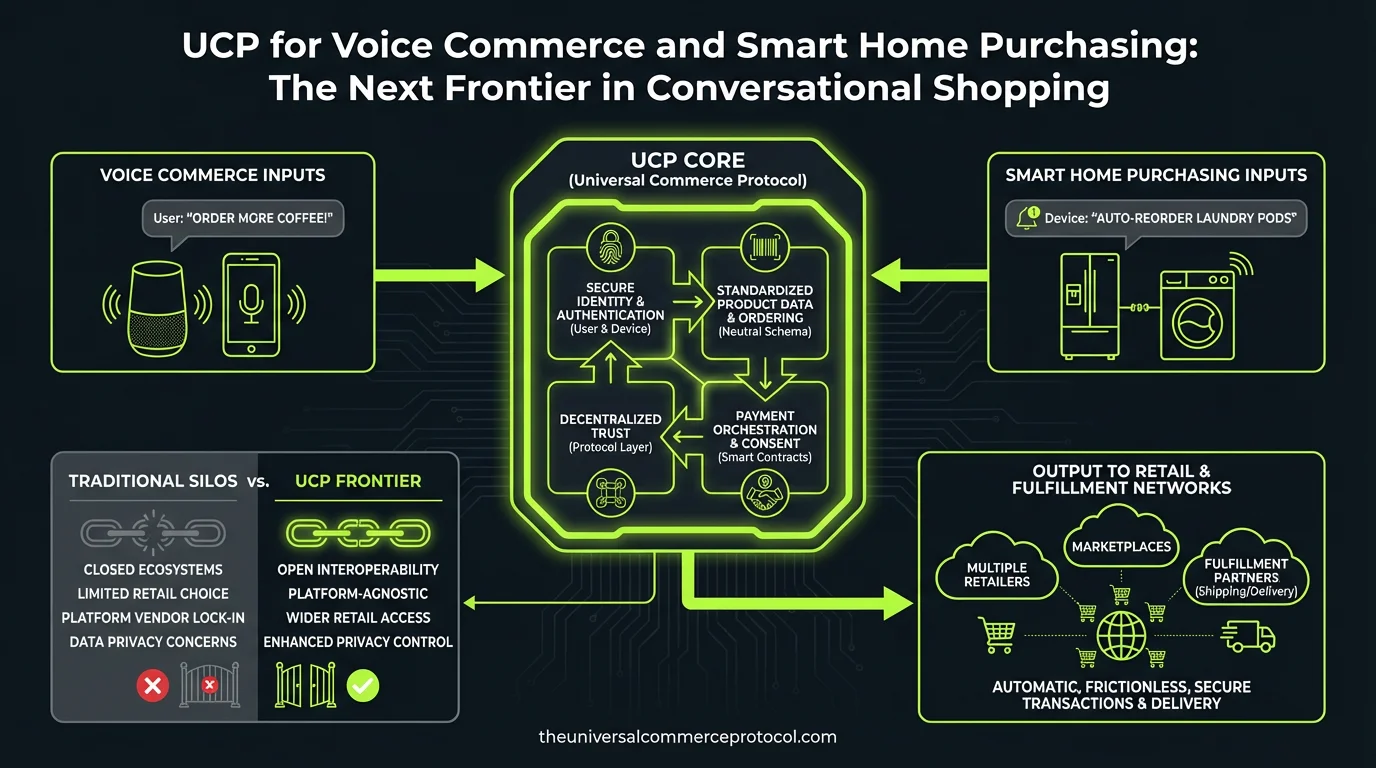
Introduction: The Rise of Voice-Activated Shopping
Voice commerce is no longer a novelty—it’s becoming a primary shopping channel for millions of consumers. According to recent market data, voice shopping transactions have grown 200% year-over-year, with smart speakers and voice assistants now integrated into over 70% of U.S. households. The Universal Commerce Protocol (UCP) has emerged as the critical infrastructure enabling this transformation, providing a standardized framework for voice-first purchasing experiences across diverse ecosystems.
Unlike traditional e-commerce interfaces that rely on visual browsing and clicking, voice commerce requires a fundamentally different approach to product discovery, selection, and transaction completion. UCP addresses these challenges by creating a protocol-agnostic system where voice agents can authenticate users, understand intent, retrieve product information, and execute purchases with minimal friction.
Related articles: UCP Shipping Carrier Selection & Rate Optimization • UCP Security Best Practices for AI-Driven Commerce
Understanding Voice Commerce Within the UCP Framework
How UCP Enables Voice-First Transactions
The Universal Commerce Protocol provides several critical capabilities that make voice commerce viable at scale. First, UCP establishes a standardized interface for voice agents to query merchant catalogs, pricing, and inventory in real-time. This eliminates the need for merchants to build custom integrations with every voice platform—Amazon Alexa, Google Assistant, Apple Siri, and emerging platforms like Meta’s voice commerce initiatives.
Second, UCP includes built-in natural language processing (NLP) optimization that allows voice agents to disambiguate customer intent. When a customer says “I need a new charger,” the UCP protocol enables the voice agent to ask clarifying questions about device type, wattage, connector type, and brand preference without requiring the merchant to implement this logic separately.
Third, UCP standardizes the authentication and authorization flow for voice transactions. This is critical because voice commerce presents unique security challenges—users cannot visually confirm recipient addresses or payment methods. UCP implements voice biometrics, device-level authentication, and transaction confirmation protocols that balance security with convenience.
The Technical Architecture of Voice Commerce with UCP
Voice commerce transactions using UCP follow a distinct flow pattern. When a customer makes a voice request, their smart speaker or voice assistant captures the audio, processes it through speech-to-text conversion, and passes the intent to a UCP-compatible commerce agent. This agent queries the merchant’s UCP endpoint to retrieve relevant product data, availability, and pricing.
The commerce agent then engages in multi-turn dialogue with the customer to refine their selection. UCP enables this dialogue by providing structured data about product attributes, variants, and availability that the voice agent can reference when asking clarifying questions. Once the customer confirms their selection, the agent uses UCP’s payment and fulfillment APIs to complete the transaction.
Critically, this entire flow happens through voice—no visual interface required. The merchant’s UCP implementation must therefore provide comprehensive product metadata, clear pricing information, and robust error handling for scenarios where voice communication might be ambiguous.
Smart Home Integration: Beyond Simple Voice Orders
Contextual Shopping in Connected Environments
Smart home integration represents a significant evolution beyond simple voice ordering. With UCP, merchants can enable contextual commerce where smart home devices proactively suggest purchases based on environmental conditions, usage patterns, and customer preferences. For example, a smart thermostat integrated with UCP could detect that a customer’s HVAC filter needs replacement and offer to order a replacement automatically, with the customer confirming via voice.
This contextual purchasing capability requires UCP implementations that can receive data from IoT devices and translate that data into product recommendations. A smart refrigerator might detect low milk levels and suggest ordering from the customer’s preferred grocery delivery service. A smart laundry system might recommend detergent based on recent wash cycles. These scenarios require merchants to extend their UCP catalogs with IoT-compatible product data that includes usage metrics, compatibility information, and automated reordering logic.
Inventory Management and Real-Time Availability
Smart home purchasing at scale introduces new challenges for inventory management. When multiple smart devices can independently initiate orders, merchants must ensure their UCP implementations provide real-time inventory visibility. UCP includes inventory synchronization protocols that allow merchants to update product availability across all voice channels simultaneously, preventing overselling and ensuring consistent customer experiences.
Additionally, merchants implementing voice commerce must consider how inventory constraints affect the customer experience. If a product is out of stock, the voice agent needs to offer alternatives quickly. UCP’s product recommendation APIs enable merchants to define fallback products and substitution rules that voice agents can apply during the conversation, allowing customers to make alternative purchasing decisions without ending the interaction.
Practical Implementation: Getting Started with UCP Voice Commerce
API Endpoints Required for Voice Commerce
Merchants implementing voice commerce through UCP must expose several critical API endpoints. The product catalog endpoint must return comprehensive metadata including product names, descriptions, prices, variants, and availability. Unlike web interfaces where customers can browse images and read reviews, voice commerce requires more detailed verbal descriptions and structured attribute data.
The intent disambiguation endpoint allows voice agents to confirm customer selections when multiple products match a voice query. This endpoint receives a customer’s natural language request and returns ranked product matches with confidence scores, enabling the voice agent to present options conversationally.
The transaction initiation endpoint handles the actual purchase flow. This endpoint must support voice-specific confirmation mechanisms, such as requiring customers to verbally confirm their shipping address and payment method before completing the transaction. UCP includes voice confirmation protocols that merchants can implement to ensure customers explicitly authorize each purchase.
Optimizing Product Catalogs for Voice Discovery
Voice commerce success depends heavily on catalog optimization. Merchants must ensure their product data includes natural language descriptions that voice agents can reference when describing products to customers. Technical specifications should be translated into conversational language—instead of “2.4A USB-C PD charger,” voice agents need “fast charger that works with your phone and laptop.”
Merchants should also implement synonym mapping within their UCP implementations. When customers ask for a “phone charger,” the system should recognize this maps to “mobile device power adapter” in the catalog. UCP’s natural language optimization features enable merchants to define these mappings, improving voice search accuracy.
Additionally, merchants should prioritize voice-friendly products in their catalogs. Items with simple specifications, clear value propositions, and low return rates perform better in voice commerce. Complex products requiring detailed comparison or customization remain challenging for voice-first purchasing.
Voice Biometrics and Security Implementation
UCP implementations for voice commerce must integrate voice biometric authentication. This technology analyzes unique characteristics of a customer’s voice to verify their identity, enabling secure transactions without requiring customers to recite account numbers or PINs. Merchants must implement UCP’s voice biometric APIs, which typically require customers to enroll their voice profiles during initial setup.
Beyond voice biometrics, merchants should implement multi-factor confirmation for high-value transactions. UCP supports requiring customers to confirm purchases through additional channels—a text message confirmation, a push notification to their phone, or a visual confirmation on a paired device. These safeguards protect both merchants and customers from fraudulent voice orders.
Use Cases and Real-World Applications
Grocery and Household Goods Delivery
Grocery retailers have emerged as early leaders in voice commerce, with customers using voice assistants to reorder frequently purchased items. UCP enables these retailers to implement smart reordering workflows where customers can say “order my usual groceries,” and the system retrieves their previous purchase history, confirms the order, and schedules delivery. This use case particularly benefits from smart home integration—refrigerators and pantry sensors can trigger automatic reorders when stock runs low.
Pharmacy and Health Products
Pharmacy retailers are leveraging UCP voice commerce for prescription refills and over-the-counter medication ordering. Voice commerce in this vertical requires additional security measures—UCP implementations must verify customer identity more rigorously and may require pharmacist consultation for certain products. The contextual nature of smart home integration is particularly valuable here, as medication reminders can be integrated with voice ordering.
Smart Home Maintenance and Supplies
Home improvement and maintenance retailers are using UCP voice commerce to enable customers to order supplies for smart home devices. When a smart security system detects a low battery, it can offer to order replacement batteries through voice commerce. Similarly, smart home monitoring systems can order maintenance supplies proactively based on usage patterns.
Challenges and Considerations for Merchants
The Return and Dispute Management Problem
Voice commerce introduces unique challenges for returns and disputes. Customers cannot visually verify products before delivery, and voice descriptions may not capture all product details. Merchants implementing UCP voice commerce should establish clear return policies and implement easy voice-based return initiation workflows. UCP includes return management APIs that enable customers to initiate returns through voice commands.
Maintaining Brand Experience Across Voice Platforms
With UCP, merchants’ products appear through multiple voice assistants and smart home platforms. This creates challenges in maintaining consistent branding and customer experience. Merchants must ensure their product descriptions, pricing, and policies remain consistent across all voice channels. UCP provides centralized management capabilities, but merchants must actively maintain this consistency.
Analytics and Attribution
Tracking customer behavior and attribution in voice commerce is more challenging than traditional e-commerce. Merchants need UCP implementations that provide detailed analytics about voice commerce interactions—which products are most frequently ordered via voice, what clarifying questions customers ask most often, and where conversations drop off. This data is critical for optimizing voice commerce performance.
Future Trends in UCP Voice Commerce
Proactive Shopping Agents
The next evolution of UCP voice commerce involves proactive shopping agents that initiate conversations with customers. Rather than waiting for customers to make voice requests, these agents will recognize patterns in customer behavior and proactively suggest purchases. A smart home system might notice a customer’s coffee consumption pattern and proactively offer to order coffee beans before supplies run out.
Multi-Device Coordination
Future UCP implementations will enable seamless handoff between devices. A customer might start a shopping conversation on their smart speaker, pause it, and resume on their phone or smart display. UCP’s session management protocols will enable this cross-device continuity, creating more flexible shopping experiences.
Ambient Commerce
As UCP matures, voice commerce will become increasingly ambient—integrated so deeply into daily smart home routines that customers barely notice they’re shopping. Purchases will happen automatically based on preset rules, preferences, and environmental conditions, with voice confirmation reserved only for significant or unusual transactions.
Frequently Asked Questions
Q: What’s the minimum product catalog size needed for successful voice commerce?
A: While there’s no hard minimum, merchants typically see meaningful voice commerce volume starting around 500-1,000 SKUs. However, success depends more on catalog optimization than size. A well-optimized 100-SKU catalog will outperform a poorly optimized 10,000-SKU catalog in voice commerce. Focus on products with clear names, simple specifications, and strong voice-search optimization.
Q: How does UCP voice commerce handle product variants and customization?
A: UCP includes variant management APIs that allow voice agents to guide customers through selection of variants through conversational dialogue. For simple variants (size, color), this works well. Complex customization remains challenging for voice commerce—merchants should consider offering pre-configured options rather than unlimited customization for voice-ordered products.
Q: What are the compliance requirements for voice commerce transactions?
A: Voice commerce transactions are subject to the same regulatory requirements as other e-commerce channels, including PCI DSS compliance for payment processing and FTC regulations regarding clear pricing and terms. Additionally, merchants should implement COPPA compliance if voice commerce might be used by children. UCP implementations should include audit trails of all voice transactions for compliance verification.
Q: How can merchants measure ROI on voice commerce investments?
A: Track voice commerce-specific metrics including voice order frequency, average order value, customer acquisition cost through voice channels, and lifetime value of voice commerce customers. Compare these metrics to other channels. Many merchants find voice commerce has lower customer acquisition costs but different customer profiles than web or mobile commerce.
Q: Can UCP voice commerce work for B2B purchasing?
A: Yes, UCP voice commerce is increasingly used in B2B scenarios, particularly for repeat ordering of supplies and inventory management. B2B voice commerce often includes additional authentication and approval workflows, but UCP’s extensible architecture supports these requirements. B2B voice commerce typically focuses on high-volume, low-complexity products.
What is the Universal Commerce Protocol (UCP) and how does it relate to voice commerce?
The Universal Commerce Protocol (UCP) is a standardized framework that enables voice-first purchasing experiences across diverse ecosystems. It provides protocol-agnostic infrastructure that allows voice agents to authenticate users, understand intent, retrieve product information, and execute purchases with minimal friction—making voice commerce viable and seamless.
How much has voice commerce grown in recent years?
Voice shopping transactions have grown 200% year-over-year according to recent market data. Additionally, smart speakers and voice assistants are now integrated into over 70% of U.S. households, making voice commerce a primary shopping channel for millions of consumers.
How is voice commerce different from traditional e-commerce?
Unlike traditional e-commerce that relies on visual browsing and clicking, voice commerce requires a fundamentally different approach to product discovery, selection, and transaction completion. Voice-first shopping eliminates visual interfaces and requires systems that can understand conversational intent and execute purchases through voice commands alone.
What are the key capabilities UCP provides for voice commerce?
UCP provides several critical capabilities for voice commerce including user authentication, intent understanding, product information retrieval, and transaction execution. These features work together to create a seamless, frictionless voice shopping experience across different platforms and devices.
Is voice commerce really becoming mainstream?
Yes, voice commerce has transitioned from being a novelty to becoming a primary shopping channel. With smart speakers and voice assistants now present in over 70% of U.S. households and 200% year-over-year growth in voice transactions, voice commerce is firmly established as a mainstream shopping method.
Leave a Reply