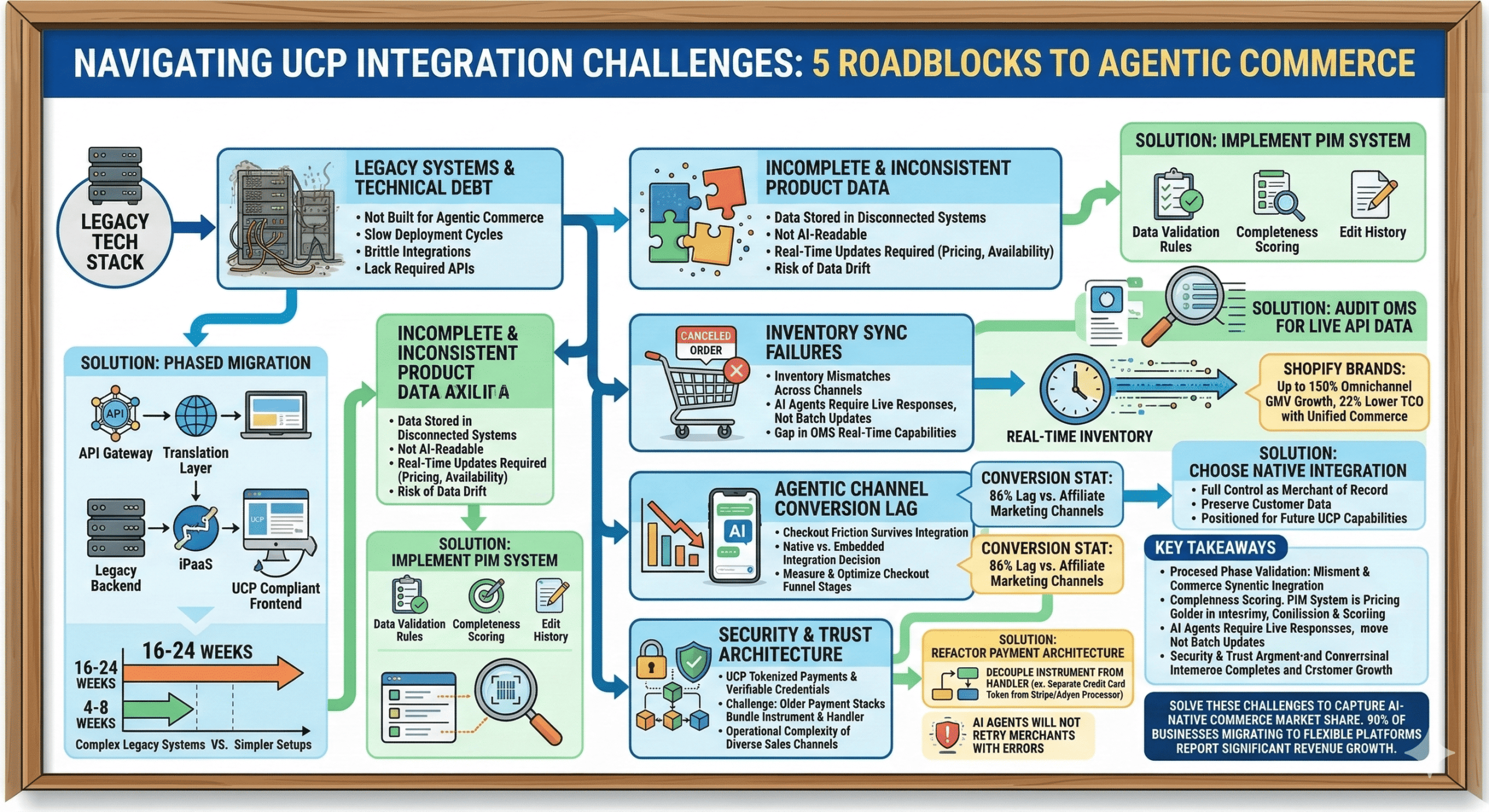
UCP integration fails most e-commerce brands before it starts — not because the protocol is flawed, but because existing tech stacks were never built for agentic commerce. The Universal Commerce Protocol (UCP), developed by Google in collaboration with Shopify, Walmart, Etsy, and Target, solves the N×N integration bottleneck by collapsing every commerce connection into a single, standardized abstraction layer. Google Developers The five challenges below are the most common reasons that integration stalls, and what to do about each one.
UCP is the open-source standard defining how AI agents, storefronts, payment providers, and fulfillment systems communicate. Rather than every AI platform building a custom integration with every retailer, UCP collapses that complexity into a single, reusable abstraction layer. CodeConductor Brands that integrate successfully unlock access to AI-native shopping surfaces including Google AI Mode and Gemini. Brands that fail are invisible to the next generation of buyers.
Challenge 1: Legacy Systems That Cannot Speak UCP’s Language
Legacy infrastructure is the single biggest UCP integration blocker for mid-to-enterprise retailers. 35% of executives report no active initiatives to replace outdated infrastructure, and heavily customized ERP and POS deployments across multiple retail locations create system integration challenges that directly impede unification efforts. BSPK
Technical debt manifests as slow deployment cycles, brittle integrations that frequently break, and older systems that lack the APIs required for rapid connection to third-party services essential for modern composable commerce. Abbacus Technologies
UCP does not require rebuilding your platform from scratch. The recommended path is a phased migration using an Integration Platform as a Service (iPaaS) or a custom API gateway that acts as a translation layer — allowing legacy backends to surface UCP-compliant capabilities without a full system overhaul. Complex integrations involving legacy systems typically take 16–24 weeks to complete, while simpler integrations with standard checkout logic complete in 4–8 weeks. ALM Corp
Challenge 2: Product Data That Is Not AI-Ready
UCP-powered AI agents do not browse your website the way a human does. They query structured capability endpoints. If your product data is incomplete, inconsistent, or stored across disconnected systems, AI agents cannot read it — and cannot complete transactions on your behalf.
UCP is built for real-time commerce, which means pricing and availability must be accurate and easy to maintain at scale. Even if you clean up product data once, it will drift again unless you implement ongoing data governance controls. Bluestone PIM
The fix is a Product Information Management (PIM) system with validation rules, completeness scoring, and edit history — not a one-time clean-up exercise. Maintaining pristine data quality across multiple sales channels represents a significant hurdle, as each new integration introduces complexity in attribute mapping and increases the risk of data anomalies affecting inventory accuracy and customer orders. BSPK
Challenge 3: Inventory Sync Failures Across Channels
Inventory mismatches are the most customer-visible symptom of a failed unified commerce integration. A shopper completes a purchase through an AI agent, only to receive a cancellation because the item was already sold through a different channel. Brands already using Shopify’s unified commerce capabilities report up to 150% omnichannel GMV growth and 22% lower total cost of ownership when stock, pricing, and customer profiles stay in sync across every channel. Shopify
The problem is structural. Despite 80% of retailers investing in real-time inventory management, only 42% of executives believe their physical stores adequately support unified commerce initiatives. BSPK UCP integration exposes this gap because AI agents require real-time inventory responses at the capability level — not batch updates or end-of-day syncs. Brands must audit their order management system (OMS) and confirm it can return live inventory data via API before UCP goes live.
Challenge 4: Conversion Rates Lagging on Agentic Channels
Getting UCP integrated does not automatically convert. Agentic commerce conversion rates currently lag traditional channels by 86% compared to affiliate marketing channels, highlighting the nascent infrastructure stage and the significant opportunity for improvement. ALM Corp
The root cause is usually checkout friction that survives the integration. UCP offers two integration paths — Native and Embedded — and choosing the wrong one for your audience compounds the drop-off. Native integration routes checkout logic directly through UCP APIs and unlocks full agentic potential. Embedded integration renders your existing checkout UI inside the AI surface, preserving complex checkout flows but adding friction. Brands that choose Native integration maintain full control as the Merchant of Record, preserve customer data and relationships, and are best positioned to benefit as UCP’s agentic capabilities expand. Google
Treat your UCP checkout as a conversion funnel. Measure drop-off at each capability stage — discovery, cart, payment, confirmation — and optimize exactly as you would a standard e-commerce checkout.
Challenge 5: Security and Trust Architecture
UCP addresses security through tokenized payments and verifiable credentials, creating a transparent accountability trail between merchants, credential providers, and payment services to ensure each transaction is cryptographically verified. Google Developers
The challenge is not the protocol’s security design — it is the implementation gap between UCP’s security model and existing payment infrastructure. UCP’s most significant payment innovation is the decoupling of payment instruments from payment handlers — separating what the consumer uses (a credit card or digital wallet token) from the processor that settles the transaction (such as Stripe or Adyen). Medium Brands with older payment stacks that bundle these two layers together must refactor their payment architecture before UCP transactions can pass through cleanly.
Additionally, introducing diverse sales channels adds operational complexity to delivering a consistent experience across touchpoints, with increased risk for inconsistent pricing, inaccurate product availability, or user interfaces that do not meet expectations during a sale. Salesforce Each of these failures erodes the trust that agentic commerce depends on — because AI agents will not retry a merchant that returns errors.
Key Takeaways
- Legacy infrastructure is the primary blocker — use an API gateway as a translation layer rather than attempting full platform migration upfront
- Product data quality is not a one-time fix — build governance processes that prevent drift after initial clean-up
- Inventory sync must be real-time at the API level, not batched — audit your OMS before go-live
- Conversion on agentic channels lags by 86% vs traditional channels — choose Native integration and treat checkout as a funnel
- Payment architecture must decouple instruments from handlers to pass UCP’s security model cleanly
Brands that resolve these five challenges before competitors will capture disproportionate share of AI-native commerce. According to Commercetools, 90% of businesses that migrate to flexible, scalable platforms report significant revenue and sales growth FTx POS — UCP integration is the next migration that matters.
Frequently Asked Questions
- What is UCP and why do e-commerce brands need it?
- UCP (Universal Commerce Protocol) is an open-source standard developed by Google in collaboration with Shopify, Walmart, Etsy, and Target. It enables AI agents, storefronts, payment providers, and fulfillment systems to communicate through a single standardized abstraction layer. Brands that integrate UCP successfully gain access to AI-native shopping surfaces like Google AI Mode and Gemini, while those that don’t risk being invisible to the next generation of buyers.
- Why do most UCP integrations fail?
- UCP integration failures typically occur because existing tech stacks were never built for agentic commerce. The protocol itself is not flawed; rather, brands struggle because their legacy systems and infrastructure weren’t designed to work with modern AI-driven commerce standards, leading to integration stalls before implementation even begins.
- What problem does UCP solve for e-commerce?
- UCP solves the N×N integration bottleneck by eliminating the need for every AI platform to build custom integrations with every retailer. Instead of managing countless point-to-point connections, brands can use a single, reusable abstraction layer that standardizes all commerce communications.
- What are the main challenges in implementing UCP?
- The post outlines five common challenges that cause integration to stall, with the first being legacy systems that cannot speak UCP’s language. Other challenges typically involve technical compatibility, resource allocation, and architectural mismatches between old infrastructure and new protocol requirements.
- How does successful UCP integration benefit e-commerce brands?
- Successful UCP integration unlocks access to AI-native shopping surfaces, including Google AI Mode and Gemini. This allows brands to reach and serve the next generation of AI-powered buyers, ensuring visibility in emerging commerce channels and maintaining competitive advantage in the evolving digital marketplace.
Leave a Reply