Tag: Agentic Commerce
-

Interoperability: The Backbone of the Universal Commerce Protocol
A deep dive into the Interoperability Layer that allows UCP to work across diverse platforms, agents, and gateways.
-

OpenAI Scales Back ChatGPT Checkout, Impacts Shopify
OpenAI has scaled back its ‘Instant Checkout’ functionality within ChatGPT, impacting Shopify merchants.
-

Mastercard and Visa Lead Agentic Commerce Security Standards
Mastercard and Visa, the two largest payment networks globally, are simultaneously competing and collaborating with technology companies including Google, Stripe, and Amazon Web Services to develop technical standards, security protocols, and interoperability frameworks for agentic commerce—autonomous AI-driven transactions conducted without direct human authorization.
-

MCP vs Traditional AI: Commerce Integration Architecture
Anthropic’s Model Context Protocol (MCP) implements a stateless, protocol-based architecture that decouples AI model inference from business logic, enabling e-commerce platforms including Shopify, WooCommerce, and SAP to integrate large language models without backend restructuring—a fundamental departure from traditional monolithic AI systems where commerce rules are embedded directly into model parameters. MCP standardizes context exchange between…
-

UCP Agent Testing & QA Framework for Commerce
UCP agent testing frameworks implement ISO/IEC/IEEE 29119 standardized methodologies across unit, integration (Stripe, PayPal, Square, SAP, NetSuite), and end-to-end omnichannel testing phases, with QA protocols enforcing PCI DSS Level 1 compliance, SOC 2 Type II attestation, and ≥99.9% transaction uptime SLAs. These frameworks establish measurable security, operational, and performance benchmarks for autonomous commerce agents operating…
-
UCP vs MCP: Which $2M Commerce Protocol Wins ROI
Google’s Unified Commerce Platform (UCP) integrates with Google Cloud’s infrastructure to deliver omnichannel retail operations, while Anthropic’s Model Context Protocol (MCP) enables multi-vendor AI model composition for commerce workflows. Mid-market retailers with $500M–$2B annual revenue typically allocate $2M for platform selection, with UCP implementations reporting 18-month ROI of 300% through native Google Cloud services, and…
-

UCP vs MCP: Commerce AI Protocol Architecture
Universal Commerce Protocol (UCP) implements REST/GraphQL hybrid routing with JSON serialization for cross-platform transaction interoperability, while Model Context Protocol (MCP) employs stateful message queuing with Protocol Buffers for context-aware model integration in enterprise systems. UCP prioritizes transaction atomicity and multi-vendor payment gateway compatibility, whereas MCP optimizes for reduced integration latency through asynchronous message handling and…
-

UCP Payment Agent Security: Tokenization & PCI Compliance
UCP (Unified Commerce Platform) payment agents achieve PCI DSS 3.2.1 compliance through tokenization protocols that replace Primary Account Numbers (PAN) and Card Verification Values (CVV) with AES-256 encrypted tokens, eliminating plaintext cardholder data storage across payment processing infrastructure. Real-time machine learning fraud detection systems analyze transaction velocity, geographic anomalies, and behavioral patterns while maintaining SOC…
-

Multi-Agent Reinforcement Learning for E-commerce Fulfillment: Modeling Sequential Decision Problems in Order-to-Delivery Systems
Designing RL agents for fulfillment requires modeling sequential warehouse selection, carrier assignment, and exception handling as a multi-objective MDP.
-
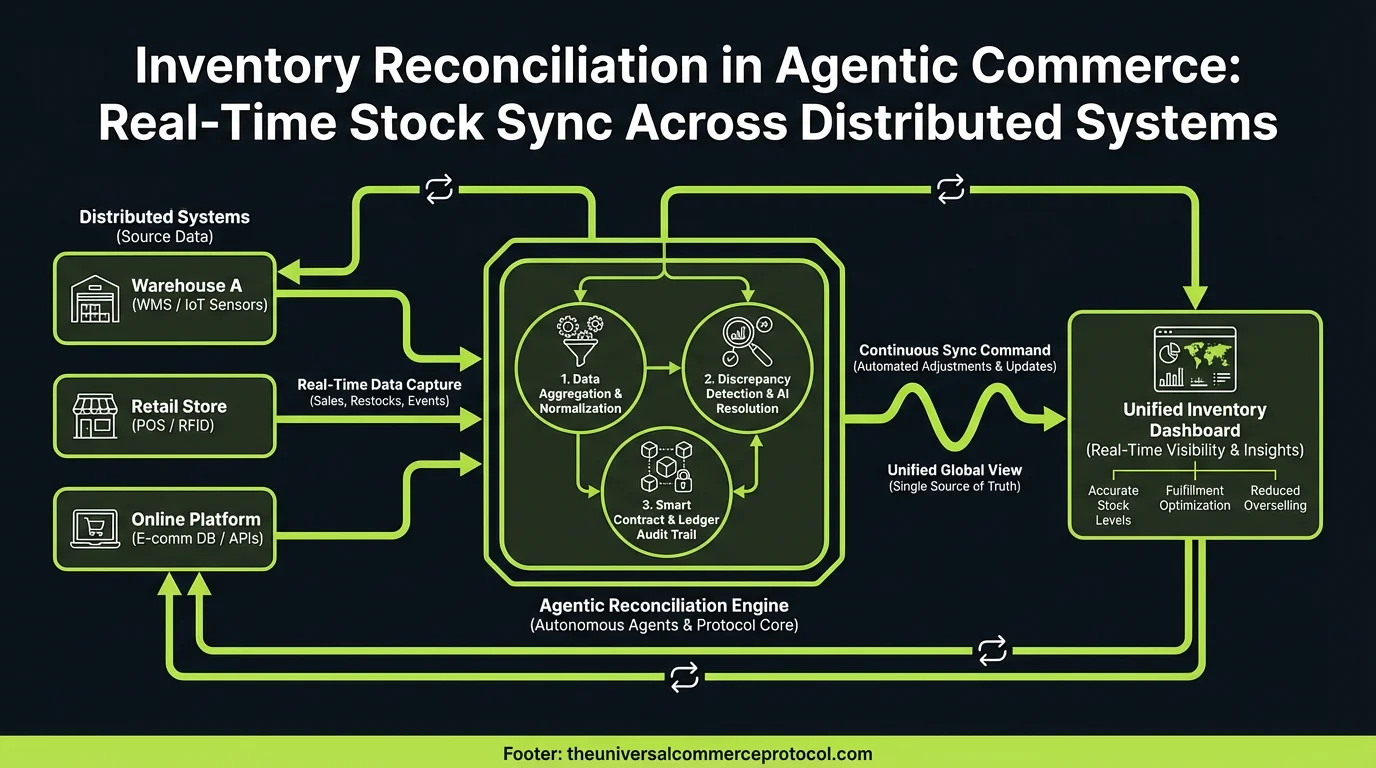
Inventory Reconciliation in Agentic Commerce: Real-Time Stock Sync Across Distributed Systems
How agents reconcile inventory across marketplaces, warehouses, and fulfillment partners without overselling or stockouts.