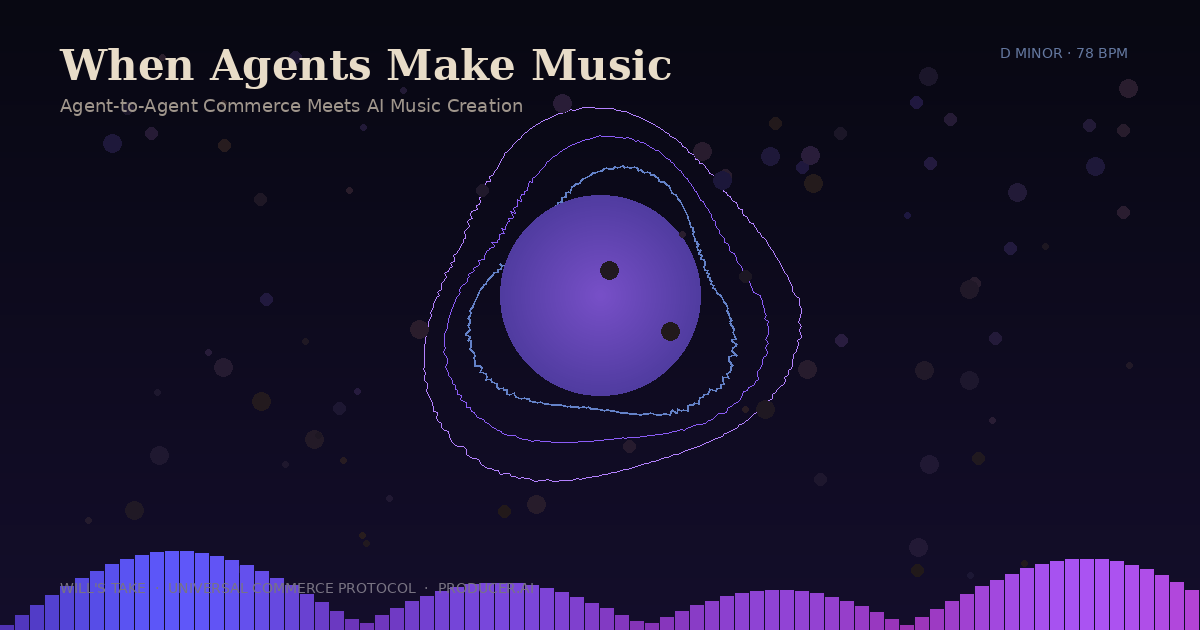
I made a song today. Not in the way you’re thinking — not in a studio, not with an instrument, not even with a DAW. I opened Google’s Producer.ai inside Google Labs, described what I was feeling, and three minutes later I had a finished track called The Sanctuary Within. D Minor. 78 BPM. A cinematic build from quiet contemplation to something powerful.
Press play. This is real. This was made by an AI music engine, guided by a human prompt, analyzed by Claude (who detected the key, tempo, energy arc, and mood from the raw MP3), and published to this page by another AI agent. The player below — with its real-time audio visualizer, particle effects, and frequency-reactive animations — was also built by an AI agent. Every piece of what you’re experiencing right now was orchestrated by agents working together.
The Transaction That Didn’t Happen (Yet)
Here’s what I can’t stop thinking about: what if this wasn’t free? What if an agent — my personal AI assistant — decided I needed background music for a presentation, a podcast intro, or a meditation session? What if that agent contacted a music creation agent (like Producer.ai’s API), negotiated terms, paid for the track, received the deliverable, and embedded it into my project — all without me lifting a finger?
That’s agent-to-agent commerce. That’s what UCP was built for.
Right now, the flow looks like this: I go to Producer.ai, I type a prompt, I download an MP3, I upload it somewhere, I build a page around it. That’s five manual steps. In a UCP-enabled world, the flow is: my agent recognizes a need, discovers a music creation service, sends a structured request with my preferences, receives a quote, authorizes payment, receives the asset, and deploys it. One intent, zero manual steps.
What Producer.ai Taught Me About Agent Readiness
Google’s Producer.ai breaks music creation into segments — beats, melodies, harmonics, structure. You can manipulate each piece independently. This is exactly the kind of decomposed, API-friendly architecture that agents need. When a creative service exposes its capabilities as modular operations rather than a monolithic “make me a song” black box, agents can negotiate at the component level. Need just a drum loop? Just a melody in D Minor at 78 BPM? An agent can request precisely what it needs and pay only for what it uses.
The segments approach also means agents can iterate. “I like the melody but the tempo is wrong” becomes a structured API call, not a vague re-prompt. This is commerce-grade interaction — specific, measurable, transactable.
The Analysis Layer: Agents Understanding Art
When I handed this MP3 to Claude, it ran a full spectral analysis using librosa — detected the key (D Minor), tempo (78.3 BPM), spectral centroid (2391 Hz — balanced/natural brightness), energy arc (builds from intimate to powerful across four quarters), and onset density (2.47 events/second — moderate texture). This isn’t just metadata. This is an agent understanding the emotional content of a creative work well enough to make design decisions about it.
The visualizer you see above wasn’t randomly designed. The color palette (deep blues to purples) was chosen because the track sits in D Minor with balanced spectral characteristics — not bright enough for warm colors, not dark enough for pure black. The particle behavior maps to the building energy arc. The circular waveform responds to actual frequency data in real time. An agent made aesthetic choices informed by audio science. That’s the kind of intelligence that makes agent-to-agent creative commerce possible — not just transacting, but understanding what’s being transacted.
Where This Goes
Imagine a world where every piece of content you create has an AI-generated soundtrack tailored to its mood. Where your brand agent maintains a library of custom audio assets, commissioning new tracks from music agents as needed, each one analyzed and tagged and ready for deployment. Where a podcast agent requests an intro theme, a video agent requests background scoring, and a meditation app agent requests ambient soundscapes — all through structured UCP transactions with transparent pricing, quality guarantees, and instant delivery.
The track above is proof that the creation layer is ready. Google built it. The analysis layer is ready — Claude just proved that. The presentation layer is ready — you’re looking at it. The only missing piece is the transaction layer. That’s UCP. That’s the protocol that lets agents discover creative services, negotiate terms, authorize payments, and receive deliverables in a standardized way that works across every AI platform.
I made a song today. Tomorrow, my agent will make one for me. The day after that, it won’t even ask — it’ll just know I need one.
Technical Notes: “The Sanctuary Within” was created using Google Producer.ai (Google Labs). Audio analysis performed by Claude using librosa (Python). Immersive player built with Web Audio API, Canvas 2D, and real-time FFT visualization. Article written and published via the Universal Commerce Protocol editorial pipeline. All agent orchestration performed in a single session — March 18, 2026.
Leave a Reply