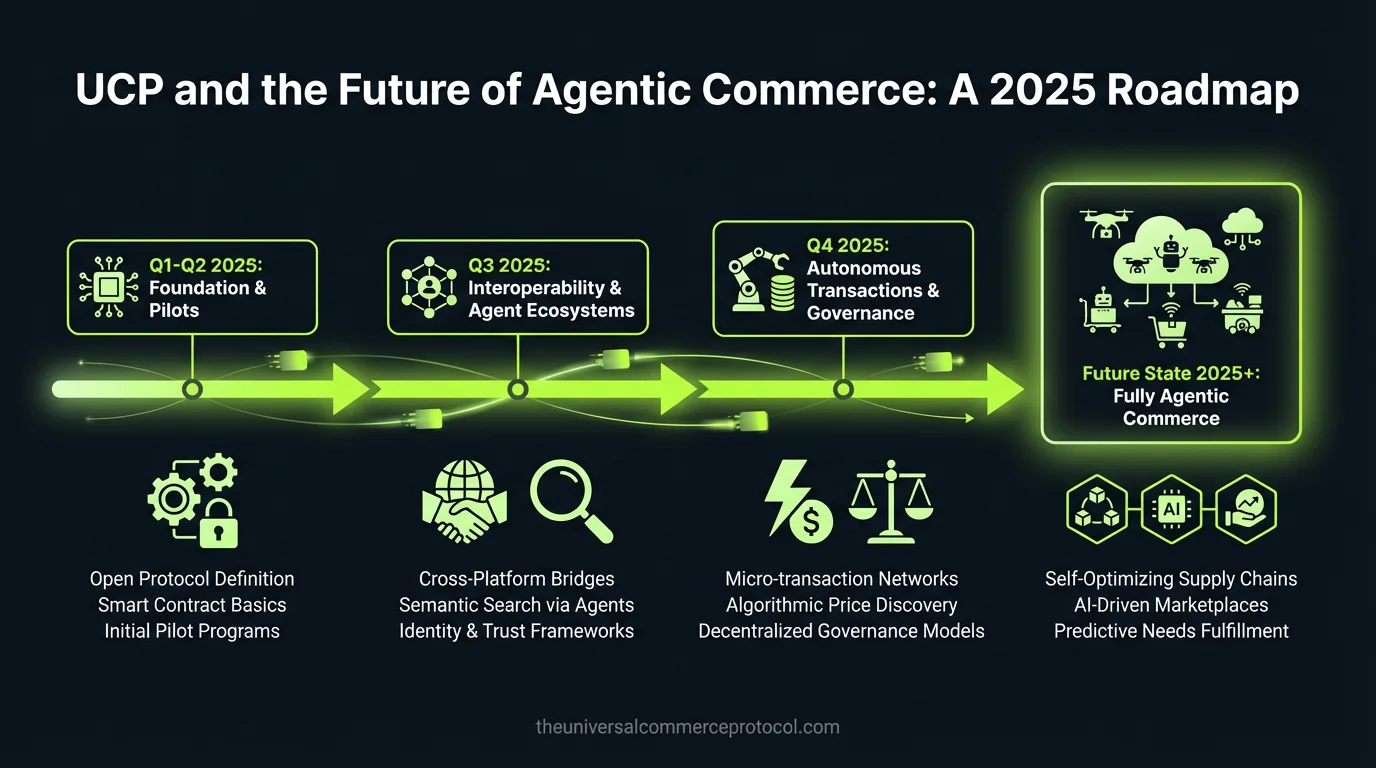
UCP and the Future of Agentic Commerce: A 2025 Roadmap
The commerce landscape is at an inflection point. As artificial intelligence agents become increasingly sophisticated—capable of reasoning, negotiation, and autonomous decision-making—the fragmented nature of today’s commerce infrastructure has become a critical bottleneck. The Universal Commerce Protocol (UCP) represents the standardization layer necessary to unlock agentic commerce at scale. This roadmap synthesizes the convergence of UCP, AI agent architecture, and commerce infrastructure heading into 2025.
The Case for Protocol-Based Agentic Commerce
Traditional e-commerce platforms operate as walled gardens. Shopify stores, Amazon Marketplace, WooCommerce installations, and custom enterprise systems each maintain proprietary APIs, data schemas, and business logic. This fragmentation creates friction for both human users and, increasingly, for autonomous agents attempting to navigate multiple commerce environments simultaneously.
Agentic commerce—where AI agents act as autonomous economic participants—demands interoperability at a level that point-to-point integrations cannot achieve. An agent needs to discover products, verify inventory, negotiate terms, process payments, and manage fulfillment across heterogeneous systems without custom engineering for each platform.
The Universal Commerce Protocol addresses this by establishing:
- Standardized product and inventory representation across all commerce systems
- Protocol-native payment and settlement mechanisms enabling trustless transactions
- Agent-readable business rules and constraints that machines can interpret and execute
- Composable commerce primitives that agents can combine to execute complex workflows
Unlike REST APIs designed for human-driven workflows, UCP is optimized for machine-to-machine commerce at scale, with built-in affordances for autonomous agents to validate transactions, assess risk, and execute settlement without human intervention.
Key Components of the UCP-Agentic Stack in 2025
1. Standardized Commerce Semantics
UCP defines a canonical data model for commerce entities: products, inventory, pricing, orders, and fulfillment. This is not merely schema definition—it’s semantic standardization that allows agents to reason about commerce across different domains.
Leading implementations are already emerging. Shopify’s Hydrogen framework and composable commerce platforms like commercetools have begun adopting protocol-agnostic data models. The Open Catalog Initiative and Schema.org’s commerce extensions provide foundational semantic layers that UCP builds upon.
By 2025, we expect UCP to formalize these semantics into a machine-interpretable ontology, enabling agents to:
- Understand product variants and substitutability
- Reason about pricing strategies and discount applicability
- Evaluate fulfillment options and logistics constraints
- Assess regulatory and compliance requirements by jurisdiction
2. Agent-Native Transaction Primitives
Current commerce APIs are designed for human-initiated transactions. UCP introduces primitives specifically for agent-driven commerce:
- Atomic transactions that agents can execute with guaranteed settlement or rollback
- Escrow and hold mechanisms enabling multi-step agent negotiations
- Conditional execution allowing agents to specify if-then commerce logic
- Batch operations for agents managing portfolios of transactions
Payment rails are being reimagined for this use case. Stripe’s recent expansions into embedded finance, combined with developments in stablecoin infrastructure (USDC, EURC), create conditions for UCP to specify payment flows that agents can execute programmatically with minimal latency.
3. Decentralized Commerce Nodes
UCP adoption accelerates through a distributed network of commerce nodes—infrastructure operators that implement the protocol and expose commerce capabilities to agents.
This model mirrors successful protocol ecosystems:
- Ethereum nodes enable decentralized finance through a shared protocol
- Lightning Network nodes provide payment routing and settlement
- IPFS nodes create distributed content distribution
Commerce nodes will similarly operate as infrastructure providers. Major players are positioning themselves: Shopify’s API infrastructure, WooCommerce’s plugin ecosystem, and emerging composable commerce platforms like Medusa and Saleor are all candidates for becoming UCP nodes.
By 2025, expect to see the first production UCP node networks launched, enabling agents to route transactions through multiple providers for price discovery, inventory aggregation, and fulfillment optimization.
4. Agent Frameworks and Orchestration
UCP is infrastructure; agents are the application layer. Leading AI agent frameworks are evolving to support commerce workflows:
- Anthropic’s Claude with tool use enables agents to call UCP-compliant commerce functions
- OpenAI’s GPT-4 with function calling supports structured commerce transactions
- Specialized frameworks like LangChain and Autogen provide commerce-specific orchestration
- Emerging platforms like Twelve Labs and Replit are building agent-native commerce capabilities
In 2025, we’ll see convergence around UCP-aware agent frameworks—SDKs and abstractions that make it trivial for developers to create agents that can transact across UCP networks.
Use Cases Enabled by UCP-Powered Agents
B2B Procurement Automation
Enterprises can deploy agents to continuously monitor supplier catalogs, negotiate pricing, and execute orders based on inventory thresholds and budget constraints. UCP enables agents to simultaneously query hundreds of suppliers, compare terms, and execute optimal procurement workflows—something impossible with today’s fragmented supplier ecosystems.
Dynamic Pricing and Revenue Optimization
Retailers deploy agents that monitor competitor pricing, demand signals, and inventory levels across UCP networks. These agents autonomously adjust pricing to optimize revenue while maintaining competitiveness. Agents can also negotiate dynamic discounts with other agents representing buyers, creating real-time commerce markets.
Supply Chain Coordination
Agents representing different supply chain participants (manufacturers, distributors, retailers, logistics providers) coordinate through UCP to optimize inventory positioning, reduce lead times, and minimize working capital. This is particularly powerful for industries like fashion and electronics where demand volatility creates significant coordination challenges.
Personalized Commerce Agents
Consumer-facing agents act as shopping assistants, learning preferences and autonomously discovering products across UCP networks. These agents negotiate on behalf of users, aggregate offers, and execute purchases when conditions are met—creating a new category of consumer commerce experience.
Technical Challenges and Solutions
Interoperability at Scale
The primary challenge is achieving genuine interoperability across systems with different technical stacks, compliance requirements, and business models. UCP addresses this through layered abstraction—core protocol semantics with extensible profiles for specific domains (B2B, consumer, regulated industries).
Trust and Settlement
Autonomous agents executing transactions without human oversight raises trust concerns. UCP incorporates cryptographic verification, reputation systems, and settlement guarantees. Integration with blockchain-based settlement (through protocols like Uniswap, Aave, or specialized commerce chains) provides transparent, immutable transaction records.
Regulatory Compliance
Commerce is heavily regulated. Agents must navigate KYC/AML requirements, sales tax, data privacy, and consumer protection laws. UCP includes compliance-aware primitives that encode regulatory requirements as machine-interpretable constraints. Agents check these constraints before executing transactions.
Agent Alignment and Safety
Autonomous agents must be aligned with their principals’ interests and bounded by appropriate constraints. UCP includes governance mechanisms that allow merchants and buyers to specify agent authority limits, approval workflows for high-value transactions, and audit trails for compliance.
Market Evolution: 2025 Outlook
By the end of 2025, expect:
- First production UCP networks launched by major commerce infrastructure providers, supporting 10,000+ merchants
- Agent-driven transactions representing 2-5% of B2B commerce volume in early-adopter verticals
- Major cloud providers (AWS, Google Cloud, Azure) offering managed UCP node services
- Specialized agent platforms emerging to serve procurement, retail, and supply chain use cases
- Regulatory frameworks clarifying liability and compliance requirements for autonomous commerce agents
The convergence of UCP standardization and AI agent capabilities represents a fundamental shift in how commerce infrastructure operates. Rather than humans navigating fragmented platforms, autonomous agents will transact across standardized networks, discovering opportunities, negotiating terms, and executing settlements at machine speed and scale.
This transition won’t happen overnight. Legacy systems will persist. But the economic incentives are powerful: merchants gain access to new customer acquisition channels through agent networks; buyers get better prices and convenience through agent representation; and the overall commerce ecosystem becomes more efficient.
Organizations that understand and adopt UCP early—whether as infrastructure providers, merchant platforms, or agent developers—will capture disproportionate value as agentic commerce becomes the default mode of B2B and increasingly B2C commerce.
FAQ
What is the Universal Commerce Protocol and how does it differ from existing commerce APIs?
The Universal Commerce Protocol is a standardized specification for machine-to-machine commerce designed specifically for autonomous agents. Unlike REST APIs (Shopify, WooCommerce, etc.) built for human-driven workflows with point-to-point integrations, UCP provides a protocol layer enabling agents to discover, negotiate, and execute transactions across heterogeneous commerce systems without custom engineering. It defines standardized semantics for products, inventory, pricing, and settlement—allowing agents to reason about commerce across different platforms as if they were part of a unified network.
How do AI agents use UCP to execute transactions?
Agents interact with UCP through standardized interfaces that expose commerce primitives: product discovery, inventory checking, pricing negotiation, and settlement execution. An agent receives a directive (e.g., “procure supplies at lowest cost”), queries UCP networks to discover available suppliers and pricing, evaluates options against specified constraints, negotiates terms with other agents, and executes atomic transactions through UCP settlement mechanisms. The protocol handles trust, verification, and compliance enforcement, allowing agents to transact with minimal human oversight.
What companies and platforms are implementing UCP in 2025?
While UCP is still emerging, key infrastructure players positioning for agentic commerce include Shopify (through Hydrogen and composable commerce initiatives), commercetools, Medusa, Saleor, and WooCommerce. Payment infrastructure providers like Stripe are enabling agent-native settlement. Cloud providers (AWS, Google Cloud) are beginning to offer managed services for commerce infrastructure. Specialized agent platforms and procurement automation companies are building UCP-aware applications. No single company “owns” UCP—it’s evolving as an open protocol with contributions from commerce platforms, infrastructure providers, and standards bodies.
What are the main risks or challenges with agentic commerce through UCP?
Key challenges include: (1) regulatory uncertainty around autonomous agent liability and consumer protection; (2) trust and settlement guarantees across decentralized networks; (3) agent alignment—ensuring agents act in their principals’ interests without harmful behavior; (4) interoperability complexity across systems with different compliance requirements; (5) market concentration risk if UCP adoption concentrates around a few dominant platforms. Mitigations include layered governance frameworks, cryptographic verification, compliance-aware protocol design, and maintaining protocol openness to prevent monopolistic control.
Frequently Asked Questions
What is the Universal Commerce Protocol (UCP)?
The Universal Commerce Protocol (UCP) is an open standard developed to enable AI agents to autonomously conduct commerce transactions across any platform.
How does UCP enable agentic commerce?
UCP provides standardized APIs and protocols so AI agents can discover products, negotiate terms, and complete purchases without human intervention, working across any compatible commerce platform.
Why should businesses implement UCP?
UCP adoption reduces integration costs, opens revenue channels to AI-driven buyers, and future-proofs commerce infrastructure as agentic purchasing becomes mainstream.
Leave a Reply