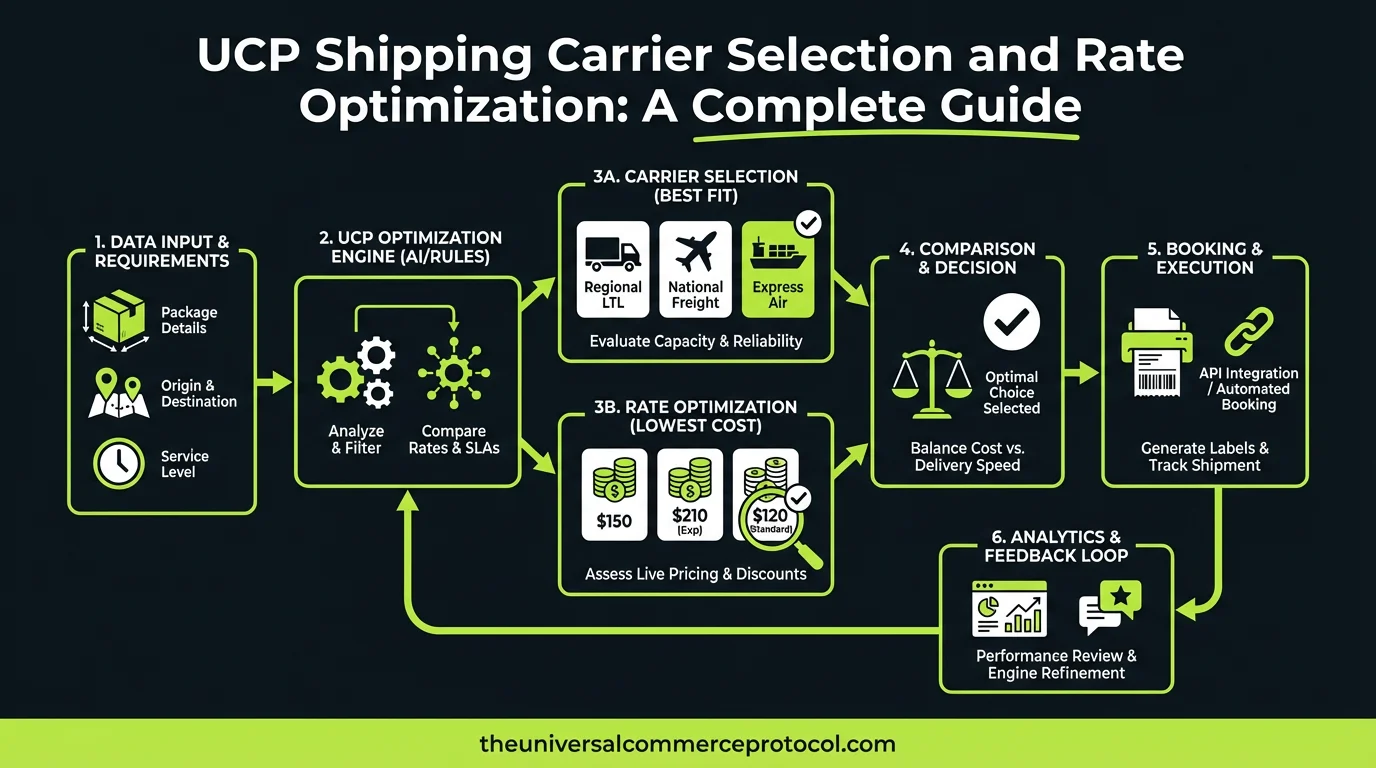
Introduction: Optimizing Shipping in the UCP Ecosystem
Shipping represents one of the largest variable costs in e-commerce operations, often accounting for 15-30% of order fulfillment expenses. The Universal Commerce Protocol (UCP) standardizes how merchants, carriers, and logistics platforms communicate, enabling sophisticated carrier selection and rate optimization strategies that were previously impossible at scale.
Unlike traditional commerce systems where shipping decisions are often manual or rule-based, UCP enables real-time carrier evaluation based on multiple dynamic factors: package characteristics, destination geography, delivery speed requirements, current carrier capacity, and pricing fluctuations. This article explores how merchants and developers can implement intelligent shipping optimization within the UCP framework.
Related articles: UCP Security Best Practices for AI-Driven Commerce • UCP for AI Agents: Ensuring Brand Safety and Data Privacy
Understanding UCP’s Shipping Integration Architecture
The UCP Shipping Data Model
UCP defines standardized data structures for shipping operations that enable interoperability between merchants, carriers, and fulfillment providers. The protocol specifies:
- Shipment Objects: Standardized representation of packages including dimensions, weight, contents, origin, and destination
- Carrier Profiles: Metadata about carrier capabilities, service levels, geographic coverage, and pricing structures
- Rate Quotes: Real-time pricing data from carriers with service level details, delivery windows, and special handling options
- Fulfillment Events: Status updates throughout the shipping lifecycle from pickup through delivery
This standardization eliminates the need for custom integrations with each carrier’s proprietary API, reducing development time and maintenance overhead.
Carrier API Abstraction Layer
UCP implementations typically include an abstraction layer that translates between the UCP shipping specification and carrier-specific APIs. This layer handles the complexity of different carrier requirements—FedEx’s SmartPost differs significantly from UPS Ground, which differs from USPS Priority Mail. The abstraction ensures merchants define shipping logic once and apply it across all carriers.
Developers implementing this layer must account for:
- Different authentication mechanisms (API keys, OAuth 2.0, certificates)
- Rate quote response formats and latency variations
- Carrier-specific restrictions (dimensional weight, hazmat classification, restricted areas)
- Service level naming inconsistencies across carriers
Intelligent Carrier Selection Strategies
Multi-Criteria Decision Making
Rather than selecting carriers based on price alone, sophisticated UCP implementations evaluate carriers across multiple weighted criteria:
- Cost: Total shipping expense including surcharges and dimensional weight charges
- Speed: Estimated delivery time relative to customer expectations
- Reliability: Historical on-time delivery rates and damage statistics for this carrier/route combination
- Capacity: Current carrier availability and pickup scheduling flexibility
- Service Quality: Customer satisfaction scores, tracking accuracy, and exception handling
A merchant selling fragile items might weight reliability and handling quality heavily, accepting higher costs. An e-commerce business operating on thin margins might prioritize cost while maintaining minimum speed thresholds. UCP enables this flexibility through configurable scoring algorithms.
Geographic and Temporal Optimization
Shipping optimization varies significantly by geography and time. A package destined for rural Alaska requires different carrier considerations than one going to downtown Manhattan. UCP systems should implement geographic routing logic that:
- Recognizes regional carrier strengths (regional carriers often outperform nationals in specific areas)
- Accounts for destination accessibility (some carriers don’t serve certain regions)
- Considers seasonal variations in carrier performance and capacity
- Evaluates pickup location proximity to carrier facilities
Temporal optimization considers factors like peak season capacity constraints, day-of-week delivery availability, and cutoff times for same-day or next-day service.
Real-Time Rate Optimization Techniques
Dynamic Rate Quoting
Rather than using static shipping tables, UCP enables merchants to request real-time rate quotes from multiple carriers simultaneously. This approach captures current pricing, which fluctuates based on:
- Fuel surcharges that change weekly
- Seasonal demand variations
- Carrier capacity utilization
- Special promotions and negotiated account rates
Implementing dynamic quoting requires managing API latency—merchants typically set a timeout (500-1000ms) for rate quote responses. Carriers that respond within this window are evaluated; slower responders are excluded or cached results are used. This ensures checkout speed isn’t compromised by shipping optimization.
Negotiated Rate Management
Large merchants negotiate volume-based discounts with carriers that aren’t publicly available. UCP implementations must support account-specific rate cards that override standard pricing. This requires:
- Authentication mechanisms to verify merchant credentials with carriers
- Rate card caching strategies that balance freshness with API call reduction
- Volume tracking to ensure negotiated minimums are met
- Exception handling for shipments that exceed negotiated weight/size limits
Some merchants implement tiered rate optimization where standard customers see one set of options, while loyalty members or bulk purchasers see different carrier selections optimized for their higher-volume status.
Dimensional Weight Pricing Optimization
Most carriers charge based on actual weight or dimensional weight (DW), whichever is greater. Calculating DW (Length × Width × Height ÷ Divisor) varies by carrier—FedEx uses 139, UPS uses 166. For oversized, lightweight items, this dramatically impacts costs.
UCP systems should implement packaging optimization that considers:
- Whether items can be consolidated to reduce DW charges
- Alternative packaging that reduces dimensions while maintaining protection
- Carrier-specific DW divisors to accurately predict final charges
- Breakpoints where upgrading to a different service level becomes cost-effective
Implementation Best Practices
Carrier Integration Architecture
Successful UCP shipping implementations follow these architectural principles:
- Asynchronous Processing: Submit rate quote requests to multiple carriers in parallel rather than sequentially, reducing total latency
- Caching Strategy: Cache carrier rates for 5-15 minutes to reduce API calls while maintaining freshness. Include cache invalidation triggers for capacity changes
- Fallback Logic: If real-time rates aren’t available, fall back to cached rates or estimated rates based on historical data
- Error Handling: Gracefully handle carrier API failures without disrupting checkout. Exclude unavailable carriers from selection
Merchant Configuration
Merchants need intuitive interfaces to configure carrier preferences without technical expertise:
- Carrier Enablement: Toggle specific carriers on/off by region and service level
- Cost Thresholds: Set maximum shipping costs customers will accept before seeing premium options
- Speed Preferences: Define acceptable delivery windows (e.g., “Next Business Day” vs “2-3 Days”)
- Margin Targets: Configure markup percentages on carrier rates to ensure profitability
- Performance Monitoring: Dashboard showing carrier performance metrics, cost trends, and optimization opportunities
Testing and Validation
Before deploying carrier optimization logic to production, thoroughly test with:
- Sandbox Environments: Use carrier sandbox APIs to test rate quoting without incurring charges
- Historical Data: Validate optimization algorithms against past orders to identify cost savings
- Edge Cases: Test with oversized items, hazardous materials, international shipments, and rural destinations
- Performance Benchmarks: Measure latency of rate quote requests to ensure checkout speed targets are met
Advanced Optimization Strategies
Machine Learning for Carrier Selection
Sophisticated merchants implement machine learning models that predict which carrier will perform best for specific shipment characteristics. These models learn from historical data including:
- Delivery performance (on-time delivery, damage rates)
- Cost outcomes (final charges vs. quoted rates)
- Customer satisfaction (tracking accuracy, exception handling)
- Operational factors (pickup availability, label generation speed)
ML models can identify non-obvious patterns—for example, that a specific carrier consistently outperforms on weekend deliveries to suburban areas, enabling smarter recommendations.
Hybrid Fulfillment Optimization
For merchants with multiple fulfillment centers, UCP enables optimization across origin points. The system evaluates shipping from different facilities and selects the combination that minimizes total cost and delivery time. This requires:
- Real-time inventory visibility across fulfillment centers
- Shipping cost comparison from each origin point
- Inventory holding costs vs. shipping cost tradeoffs
Monitoring and Continuous Improvement
Key Performance Indicators
Merchants should track these metrics to evaluate shipping optimization effectiveness:
- Average Shipping Cost per Order: Track trends and identify optimization opportunities
- Carrier Cost Distribution: Monitor which carriers are being selected and why
- On-Time Delivery Rate: Ensure optimization doesn’t sacrifice reliability
- Customer Satisfaction: Monitor shipping-related feedback and complaints
- Rate Quote Latency: Ensure optimization doesn’t slow checkout
Continuous Optimization
Shipping optimization isn’t a one-time implementation. Successful merchants continuously refine their strategies by:
- Analyzing actual vs. quoted shipping costs to identify carrier discrepancies
- Reviewing customer feedback on delivery speed and carrier handling
- Testing new carriers and service levels in limited markets before full rollout
- Adjusting carrier weights and thresholds based on performance data
FAQ: UCP Shipping Carrier Selection and Rate Optimization
Q: How does UCP reduce shipping costs compared to traditional systems?
A: UCP enables real-time rate quoting from multiple carriers simultaneously, dynamic pricing based on current market conditions, and intelligent carrier selection across multiple criteria rather than just price. This typically reduces shipping costs by 5-15% while maintaining or improving delivery speed. The standardized integration also reduces the time and cost of adding new carriers.
Q: What latency is acceptable for rate quote requests during checkout?
A: Most e-commerce best practices recommend keeping total checkout time under 3 seconds. Rate quoting should complete within 500-1000ms. If real-time quotes exceed this threshold, implement caching (5-15 minute TTL) or estimated rates based on historical data. Always provide a fallback mechanism to prevent checkout failures.
Q: How should merchants handle carrier API failures?
A: Implement graceful degradation: (1) Use cached rates from the past 5-15 minutes, (2) Fall back to estimated rates based on historical data, (3) Exclude the unavailable carrier from options, (4) Log failures for monitoring, (5) Never show errors to customers. Consider implementing circuit breaker patterns to temporarily disable carriers with persistent failures.
Q: Can UCP optimize shipping for international orders?
A: Yes, UCP supports international shipping optimization, though it’s more complex. International shipments require customs documentation, duty calculation, and carrier-specific restrictions. The UCP specification includes international shipment objects, but merchants must verify that their carrier integrations support the destination countries and handle customs/duty requirements appropriately.
Q: How do merchants balance cost optimization with customer expectations?
A: Define speed thresholds that align with customer expectations, then optimize within those constraints. For example, if customers expect 2-3 day delivery, only show carriers meeting that requirement, then optimize cost among those options. Use customer segmentation—loyalty members might see faster options, bulk purchasers might see cost-optimized options. Always present delivery time clearly to avoid customer dissatisfaction.
What is the Universal Commerce Protocol (UCP) and how does it relate to shipping?
The Universal Commerce Protocol (UCP) is a standardized framework that enables merchants, carriers, and logistics platforms to communicate efficiently. It allows for sophisticated carrier selection and rate optimization strategies by standardizing how shipping data is exchanged, enabling real-time carrier evaluation based on package characteristics, destination, delivery speed, capacity, and pricing.
How much can shipping costs impact e-commerce operations?
Shipping represents one of the largest variable costs in e-commerce operations, typically accounting for 15-30% of order fulfillment expenses. This makes carrier selection and rate optimization critical for maintaining healthy profit margins.
What factors does UCP consider for intelligent carrier selection?
UCP enables real-time carrier evaluation based on multiple dynamic factors including package characteristics (weight, dimensions, contents), destination geography, delivery speed requirements, current carrier capacity, and pricing fluctuations. This allows merchants to make data-driven shipping decisions.
How does UCP shipping differ from traditional commerce systems?
Traditional commerce systems typically rely on manual or rule-based shipping decisions, while UCP enables real-time, intelligent carrier evaluation and optimization at scale. This allows merchants to adapt to dynamic market conditions rather than relying on static shipping rules.
What are Shipment Objects in the UCP shipping data model?
Shipment Objects are standardized data structures defined by UCP that represent shipping operations. They are part of UCP’s shipping data model that enables interoperability between merchants, carriers, and fulfillment providers by providing a common framework for exchanging shipping information.
Frequently Asked Questions
What is the Universal Commerce Protocol (UCP)?
The Universal Commerce Protocol (UCP) is an open standard developed to enable AI agents to autonomously conduct commerce transactions across any platform.
How does UCP enable agentic commerce?
UCP provides standardized APIs and protocols so AI agents can discover products, negotiate terms, and complete purchases without human intervention, working across any compatible commerce platform.
Why should businesses implement UCP?
UCP adoption reduces integration costs, opens revenue channels to AI-driven buyers, and future-proofs commerce infrastructure as agentic purchasing becomes mainstream.
Leave a Reply