The Licensing Gap No One’s Talking About
Merchants deploying agentic commerce solutions face a critical, under-discussed problem: the licensing and commercial rights frameworks governing the AI agents they depend on are fragmented, opaque, and often buried in service agreements that weren’t written for commerce use.
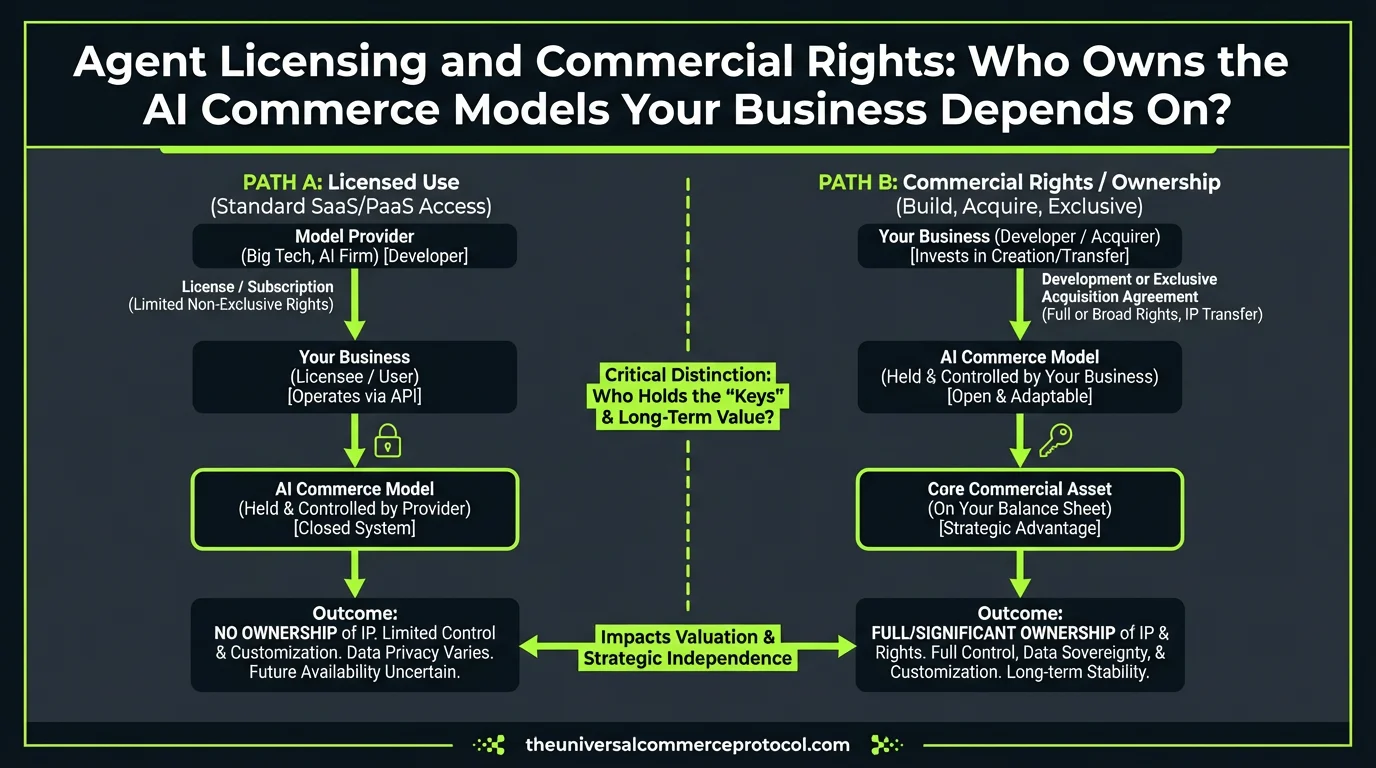
Unlike traditional software licensing—where you know whether you’re buying perpetual rights, SaaS access, or restricted commercial use—AI agent licensing exists in a regulatory gray zone. You may be using Claude, GPT-4, Gemini, or a custom fine-tuned model without understanding whether you own the outputs, whether you can train derivative models, or whether your vendor can change terms tomorrow.
This matters because your agent is operationally critical. It processes customer intent, manages inventory, handles returns, and authorizes payments. If your licensing terms shift or are deemed non-commercial, your entire agentic layer could become non-compliant overnight.
Three Licensing Models in Agentic Commerce Today
1. API-Based Model Licensing (Anthropic, OpenAI, Google)
When you call Claude via Anthropic’s API or GPT-4 via OpenAI’s API, you’re not licensing a model—you’re licensing inference on their infrastructure. Anthropic’s commercial terms explicitly allow agentic commerce use, including autonomous purchasing and refunds. OpenAI’s commercial terms similarly permit ChatGPT and GPT-4 API use for commerce transactions, though conversation logs remain subject to their data retention and privacy policies.
Key restriction: You do not own the model weights. You cannot fine-tune on proprietary data without explicit agreement. You cannot self-host. Your agent’s behavior is dependent on the vendor’s model updates and pricing changes.
Google’s Gemini API for commerce (powering UCP integrations) operates under similar constraints—you access the model through Google Cloud, but commercial rights extend only to the outputs your agent generates, not to the underlying model.
2. Self-Hosted / Open-Source Model Licensing
Merchants using open-source models like Meta’s Llama 2 (now Llama 3.1), Mistral, or fine-tuned variants gain explicit commercial rights to the model weights and outputs. The tradeoff: you own the model, but you pay for inference infrastructure, fine-tuning labor, and ongoing evaluation.
Llama 2’s commercial license explicitly permits agentic systems, including autonomous decision-making and revenue-generating applications. You can fine-tune on proprietary training data, serve the model from your infrastructure, and retain full ownership of agent behavior and outputs.
3. Hybrid / Managed Fine-Tuning (Anthropic Constitutional AI, OpenAI Fine-Tuning, specialized platforms)
Some vendors now offer managed fine-tuning services where you can adapt a base model to your commerce domain while retaining usage rights. Anthropic’s managed fine-tuning service allows merchants to create domain-specific agents that inherit the base model’s safety properties while learning custom commerce rules.
Licensing here is negotiated: you typically own the fine-tuned weights, but the underlying base model remains licensed. Pricing is per-training-run plus per-inference, making this option expensive for high-volume agents.
Four Licensing Risks Merchants Miss
Risk 1: Unilateral Terms Change
OpenAI, Anthropic, and Google retain rights to modify their terms of service. In November 2024, OpenAI clarified that ChatGPT Plus conversation logs could be used for model improvement—a change that created GDPR exposure for European merchants. No merchant had 30 days’ notice. API-based agents operating under these terms inherited that same exposure.
Self-hosted models eliminate this risk entirely. Open-source licensing is immutable.
Risk 2: Data Retention and Competitive Exposure
Most API-based model providers retain query logs for model improvement and safety monitoring. For merchants, this means your agent’s commerce interactions—customer preferences, inventory levels, pricing strategies—may be reviewed by the vendor’s employees or used to train future models.
OpenAI’s API documentation states: “Conversation logs are retained and used for safety and improvement purposes.” Anthropic’s Claude API retains logs for 30 days by default (shorter than GPT-4), but merchants in regulated industries (financial services, healthcare, pharma commerce) may face compliance violations if customer data enters the vendor’s training pipeline.
Commercial or enterprise agreements can restrict data retention, but they’re rarely included in standard tier pricing.
Risk 3: Geographic and Regulatory Fragmentation
Open-source model licensing (Apache 2.0, OpenRAIL, MIT) is jurisdiction-agnostic. API-based licensing is not. OpenAI’s commercial terms differ between US, EU, and UK deployments. Google’s Gemini API licensing for UCP transactions in Europe may have different commercial rights than in North America.
Merchants with multi-region agents face the burden of tracking which model, accessed from which region, under which licensing terms, at any given moment.
Risk 4: Vendor Lock-In Through Agent Training
If you fine-tune a proprietary model (OpenAI, Anthropic) on six months of commerce data—customer preferences, refund patterns, seasonal demand—switching to a different model or vendor becomes expensive. You’ve encoded months of training into a model you don’t own, served through infrastructure you don’t control.
This is intentional design. Vendors benefit from high switching costs. The merchant absorbs the risk.
What Merchants Should Do Now
Audit Your Current Agents
Identify which models power your agentic layer. Is it Claude API? GPT-4? A fine-tuned variant? What does the contract actually say about output ownership, data retention, and commercial use? Most merchants can’t answer this without legal review.
Require Commercial-Grade Agreements
Standard API terms are insufficient. Negotiate or request: (1) explicit ownership of agent outputs, (2) commitments on data retention and non-use for training, (3) 90-day notice for material terms changes, (4) price-lock guarantees for core inference operations.
Enterprise agreements exist for all major vendors. They’re expensive, but cheaper than rebuilding agents under new terms.
Build for Model Portability
Design your agent abstraction layer so the underlying model can be swapped. Use adapter patterns to separate commerce logic from model calls. This way, if you need to move from GPT-4 to Llama 3.1 (or vice versa), you’re changing configuration, not rewriting agents.
Consider Hybrid Architectures
Use API-based models (Claude, GPT-4) for high-reasoning tasks (customer intent understanding, exception handling) and self-hosted open-source models for high-volume, repetitive tasks (inventory lookup, product classification, simple intent routing). This reduces lock-in surface while maintaining reasoning quality where it matters.
The Standards Problem
Neither UCP nor AP2 currently specify licensing or commercial rights frameworks for the agents operating within their protocols. A merchant implementing Google’s UCP with a Gemini agent has no standardized way to declare: “This agent is licensed for commercial use, trained on proprietary data, and cannot be used to train competing models.”
This is a gap that will need filling. As agentic commerce scales, licensing clarity will become a competitive differentiator. Vendors who offer explicit, merchant-friendly licensing terms will win adoption. Those who hide data retention and model ownership in fine print will face regulatory and commercial pressure.
FAQ
Q: If I use Claude API for my shopping agent, do I own the outputs?
A: Yes, you own the outputs your agent generates. You do not own the underlying model. Anthropic’s terms explicitly permit commercial use, including autonomous purchasing. Data retention defaults to 30 days but can be extended with enterprise agreements.
Q: Can OpenAI use my agent’s conversations to train GPT-5?
A: OpenAI’s standard API terms retain logs for “safety and improvement,” which historically has included training data. However, recent clarifications allow customers to opt out of training data use for API calls. Merchants should explicitly request this in their agreement. ChatGPT Plus conversations follow different terms and may be retained longer.
Q: What’s the safest licensing model for a merchant deploying agentic commerce?
A: Self-hosted open-source models (Llama 3.1, Mistral) offer maximum control and explicit commercial rights. The tradeoff is you manage infrastructure and evaluation. For merchants without in-house ML ops, a hybrid approach—using open-source for predictable tasks and API-based models (with commercial agreements) for complex reasoning—balances control and convenience.
Q: Does UCP help with licensing clarity?
A: Not yet. UCP defines the protocol for agent-merchant-platform interaction, but not the licensing or IP rights of the agents themselves. This is a standards gap that will likely be addressed as agentic commerce matures.
Q: If my vendor changes licensing terms, what can I do?
A: Depends on your agreement. Standard API terms allow unilateral changes with notice (usually 30 days). Commercial/enterprise agreements should include change-of-terms clauses, price-lock provisions, and migration windows. If you haven’t negotiated these, you’re exposed.
Q: Can I switch agents mid-deployment if licensing becomes unfavorable?
A: Depends on your architecture. If you’ve built agent logic tightly coupled to a specific model’s APIs, switching is expensive. If you’ve abstracted the model layer, you can retrain and redeploy on a different model in days. Plan for this from day one.
What is the licensing gap in agentic commerce?
The licensing gap refers to the fragmented and opaque frameworks governing AI agents used in commerce. Unlike traditional software licensing with clear terms (perpetual rights, SaaS access, etc.), AI agent licensing exists in a regulatory gray zone. Merchants often don’t understand whether they own outputs, can train derivative models, or face sudden terms changes from vendors.
Why does AI agent licensing matter for my business?
AI agents are operationally critical to modern commerce—they process customer intent, manage inventory, handle returns, and authorize payments. If your licensing terms shift unexpectedly or are deemed non-commercial by your vendor, your entire agentic layer could become non-compliant overnight, disrupting core business operations.
What’s the difference between API-based and proprietary AI model licensing?
API-based model licensing (used by Anthropic, OpenAI, and Google) means you access models through APIs without owning the underlying model. Proprietary licensing typically involves custom fine-tuned models where rights structures vary. The key difference is ownership and control—API access is restricted and vendor-dependent, while proprietary models may offer more commercial flexibility depending on your agreement.
Do I own the outputs generated by AI agents I use?
This depends on your specific licensing agreement with your AI vendor. Many API-based services include output ownership clauses in their terms of service, but these are often buried in lengthy documents and vary by provider. It’s critical to review your service agreement to understand whether you can commercially use, resell, or train derivative models on agent outputs.
What should I look for in an AI agent licensing agreement?
Key areas to review include: clarity on output ownership, commercial use rights, restrictions on derivative training, vendor rights to change terms, data retention policies, and compliance guarantees. Ensure the agreement explicitly covers commerce and transaction use cases, rather than assuming general business terms apply to your agentic operations.
Frequently Asked Questions
What is the Universal Commerce Protocol (UCP)?
The Universal Commerce Protocol (UCP) is an open standard developed to enable AI agents to autonomously conduct commerce transactions across any platform.
How does UCP enable agentic commerce?
UCP provides standardized APIs and protocols so AI agents can discover products, negotiate terms, and complete purchases without human intervention, working across any compatible commerce platform.
Why should businesses implement UCP?
UCP adoption reduces integration costs, opens revenue channels to AI-driven buyers, and future-proofs commerce infrastructure as agentic purchasing becomes mainstream.
Leave a Reply