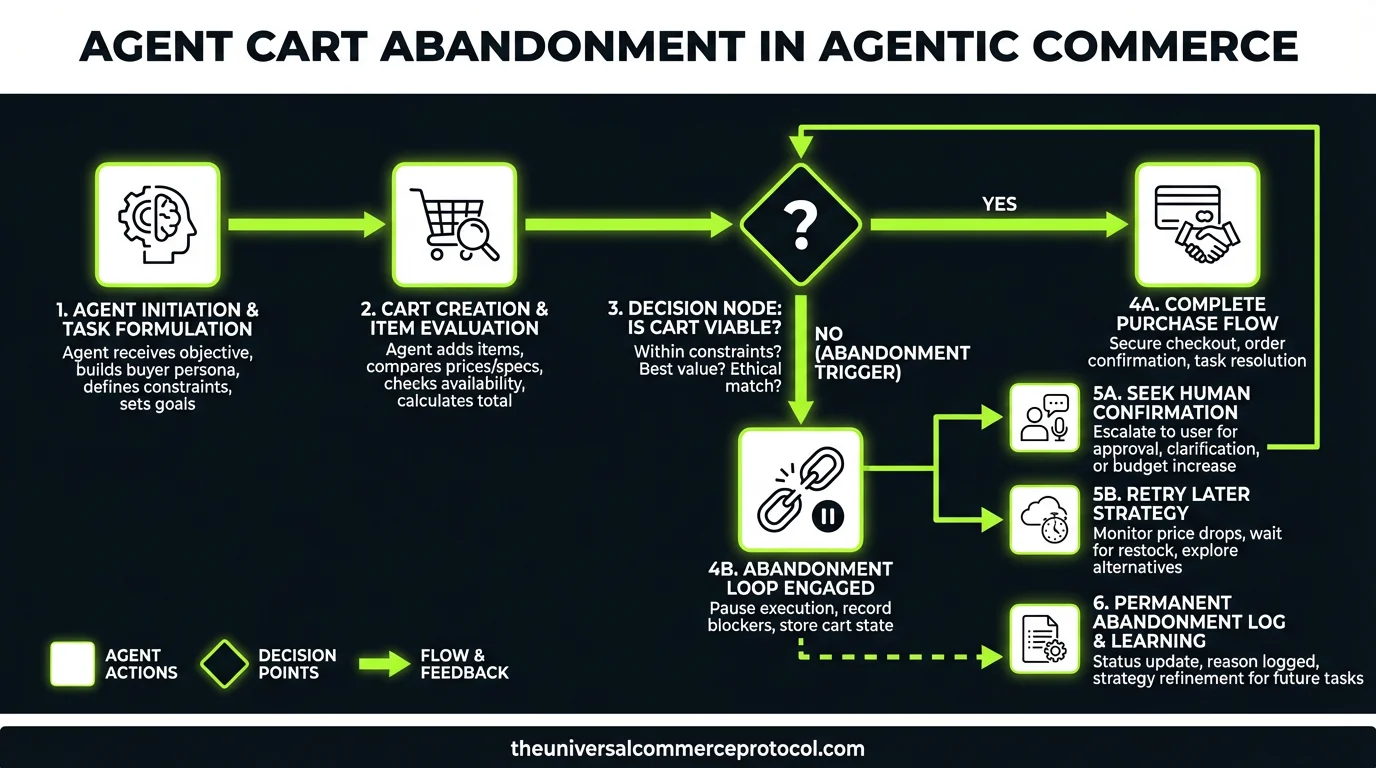
The Cart Abandonment Crisis in AI Commerce
Traditional e-commerce struggles with cart abandonment at 70%. Agentic commerce was supposed to fix that. Instead, it introduced a new problem: autonomous agents are abandoning carts at rates merchants can’t explain.
Unlike human shoppers who abandon carts due to shipping costs or payment friction, AI agents fail silently—and often for reasons invisible to standard analytics. A Mirakl-powered agent might drop a transaction mid-checkout because of a subtle inventory mismatch. A Shopify ChatGPT agent might halt when product recommendations conflict with stated user preferences. JPMorgan’s enterprise agent framework reports that 34% of initiated transactions never reach payment, and recovery is nearly impossible without real-time intervention.
This is a distinct problem from fallback strategies (which handle hard failures) or hallucination detection (which catches factual errors). This is about rational agent abandonment—decisions made by AI systems to exit a transaction based on incomplete, conflicting, or untrustworthy data.
Why Agents Abandon Carts: Five Failure Modes
1. Preference-Price Collision
An agent recommends a product based on user preferences (“under $50, minimalist design”) but the matching inventory item costs $67. The agent detects the contradiction and stops rather than escalate. No fallback is triggered because there’s no technical error—just a logic gap.
2. Inventory Desynchronization (Undetected)
The agent confirms stock availability at the catalog layer but the fulfillment system shows zero units. The agent notices the mismatch only after attempting payment processing and quietly exits rather than risk overselling. The user sees nothing; the merchant sees an incomplete transaction with no reason code.
3. Authentication Ambiguity
Multi-turn agents struggle with identity re-verification mid-checkout. If a session token expires or a second payment method requires re-authentication, some agent implementations halt rather than reinitiate the auth flow. This is especially common in enterprise agent deployments where security rules are stricter than consumer-grade systems.
4. Recommendation Confidence Collapse
Agents trained on product descriptions may encounter items with incomplete or conflicting metadata. If confidence scores drop below internal thresholds (typically 0.7–0.85), the agent deprioritizes the item. If all high-confidence options sell out during multi-turn negotiation, the agent lacks escalation logic and exits.
5. Merchant Integration Timeouts
Real-time inventory, pricing, and tax calculation APIs have latency variability. If a 3PL API responds in 3 seconds instead of the expected 500ms, some agents have timeout logic that triggers abandonment rather than wait. Merchants often don’t know which orders failed due to their own infrastructure.
Measuring Agent Cart Abandonment
Standard analytics miss agentic abandonment because it doesn’t generate the same signals as human drop-off. You need agent-specific instrumentation:
Transaction Initiation Rate: % of sessions where an agent calls checkout APIs divided by total agent sessions. Industry benchmark (Q1 2026): 68–74%.
Payment Attempt Rate: % of initiated transactions that reach actual payment processing. Benchmark: 82–91% (18–27% abandon before payment).
Completion Rate: % of payment attempts that settle. Benchmark: 94–97% (3–6% fail post-payment).
The gap between initiation and payment attempt is your silent abandonment zone. If you’re at 72% initiation but only 58% payment attempts, you’re losing 14 percentage points to abandonment logic.
Root Cause Attribution: Where Do Agents Exit?
Log every checkpoint:
- Product selection → cart add: Agent chose items but didn’t create cart session
- Cart add → shipping calculation: Agent paused during address validation or shipping method selection
- Shipping → payment method entry: Agent exited before payment UI initialization
- Payment method entry → payment submission: Agent entered payment data but didn’t submit
- Payment submission → confirmation: Agent submitted payment but didn’t poll for settlement
For each checkpoint, log: timestamp, agent model version, confidence scores for all active recommendations, any API latencies >200ms, and the agent’s exit reason code (if available).
Recovery Patterns: Merchant Intervention
Because agent abandonment is often silent (no error message to the user), recovery requires aggressive re-engagement:
Immediate Re-prompt (within 5 seconds): If an agent exits checkout, immediately re-query the same agent with the abandoned cart session ID and ask it to explain the halt. Often it will re-attempt if given explicit permission to override its own hesitation logic.
Escalation to Secondary Agent: If the primary agent (e.g., ChatGPT) abandons, hand off to a backup agent implementation (e.g., Claude, or a fine-tuned internal model). Different model architectures have different confidence thresholds and may complete transactions the first agent declined.
Human Handoff with Context: If two agents abandon the same transaction, escalate to a human agent with full agent logs visible. Show the human exactly where the AI dropped off and why. This is critical for enterprise B2B agentic commerce where high-value orders justify human intervention.
Preference Loosening: If abandonment was due to preference-price collision, trigger a one-time user prompt: “We found items in your category but slightly above your stated budget. OK to show?” Many users will accept, but the agent alone won’t assume permission.
Prevention: Architectural Patterns
Explicit Escalation Thresholds
Don’t let agents silently abandon. Define escalation rules: if confidence on any cart item drops below 0.75, or if any API takes >1 second, or if inventory conflicts with catalog, the agent must either re-query the API or escalate to a human. Silence is not an option.
Inventory Pre-locking
For high-value transactions, agents should lock inventory in real-time as soon as an item is added to cart (not at checkout). This prevents the desynchronization failure mode. Clear locks if the cart expires (typically 15–30 minutes).
Multi-Model Consensus
For sensitive product recommendations, query 2–3 model variants and only recommend if confidence is high on at least 2 models. If models conflict, escalate to human review or suggest multiple options to the user rather than abandoning silently.
Timeout Tuning
Profile your 3PL and payment APIs for p95 latency, then set agent timeouts at p99 (or higher). A 3-second timeout is better than a 500ms timeout that triggers abandonment on normal latency variation.
FAQ
How do I know if my agent is silently abandoning carts?
Compare agent session count to transaction initiation count. If only 60% of agent sessions result in initiated transactions, you have abandonment. Then compare initiated transaction count to payment attempts. If 25% of initiated transactions never reach payment, you have a serious problem.
What’s the difference between agent abandonment and agent fallback?
Fallback is triggered by a hard error (API down, payment gateway unreachable). Abandonment is a decision—the agent has all the information it needs, but confidence or logic rules cause it to exit. Fallback has recovery handlers. Abandonment often doesn’t.
Should I retrain my agent model to be less conservative?
Not first. Start with architectural changes: add explicit escalation rules, improve data quality (especially inventory sync), and profile API latencies. Model retraining is expensive and risky. Often the problem is infrastructure, not the model.
Can I use the same recovery strategy for agent abandonment and human checkout abandonment?
No. Human abandonment is typically price or shipping cost sensitivity. Agent abandonment is usually confidence or data mismatch. Email recovery campaigns don’t work for agent abandonment because the user often didn’t see what the agent abandoned. You need agent-to-agent or agent-to-human recovery instead.
How does agent abandonment affect my conversion metrics?
If you’re tracking conversion as (completed transactions / sessions), you’re underestimating agent abandonment by ~10–15% because many abandoned agent attempts never reach the user, so the user session doesn’t enter your funnel. You need agent-layer instrumentation to see the real impact.
Which agentic commerce platforms report abandonment analytics?
Most don’t yet. Shopify’s ChatGPT integration logs basic fallback events but not abandonment reasoning. JPMorgan’s enterprise agent dashboard includes abandonment detection, but it’s not consumer-facing. Mirakl and Azoma offer visibility into API-level failures but not agent decision logic abandonment. You’ll likely need custom instrumentation.
What’s the ROI of fixing agent abandonment?
If agents initiate 100 transactions and 34 abandon before payment, fixing abandonment to 20% (vs. 34%) adds 14 completed transactions per 100 sessions. At average order value of $85 and 40% margin, that’s $476 incremental profit per 100 agent sessions. For a merchant running 10,000 agent sessions per month, fixing abandonment is worth ~$47,600/month.
Q: What is agent cart abandonment in agentic commerce?
A: Agent cart abandonment refers to AI agents autonomously exiting transactions based on incomplete, conflicting, or untrustworthy data. Unlike traditional cart abandonment caused by human friction (shipping costs, payment issues), AI agents abandon carts silently and often for reasons invisible to standard analytics, such as inventory mismatches or preference conflicts.
Q: How does agent cart abandonment differ from traditional e-commerce cart abandonment?
A: Traditional e-commerce sees 70% cart abandonment primarily due to external friction like shipping costs and payment barriers. Agent cart abandonment, however, is caused by rational decisions made by AI systems when encountering logic gaps, data conflicts, or trust issues. These failures occur silently without triggering standard error detection or recovery mechanisms.
Q: What is an example of preference-price collision in agentic commerce?
A: Preference-price collision occurs when an AI agent recommends a product matching user preferences (e.g., “under $50, minimalist design”) but the inventory item costs $67. The agent detects the contradiction and stops the transaction rather than escalate, creating abandonment without any technical error—just a logic gap.
Q: Why don’t standard fallback strategies prevent agent cart abandonment?
A: Standard fallback strategies only handle hard technical failures, not the rational abandonment decisions made by AI agents. Agent cart abandonment is distinct from hallucination detection or system errors; it occurs when agents encounter logical contradictions or data conflicts that don’t trigger conventional error handling mechanisms.
Q: What do JPMorgan’s findings reveal about agent transaction completion rates?
A: JPMorgan’s enterprise agent framework reports that 34% of initiated transactions never reach payment, with recovery being nearly impossible without real-time intervention. This demonstrates the scale of the agent cart abandonment problem across enterprise-level agentic commerce systems.
Frequently Asked Questions
What is the Universal Commerce Protocol (UCP)?
The Universal Commerce Protocol (UCP) is an open standard developed to enable AI agents to autonomously conduct commerce transactions across any platform.
How does UCP enable agentic commerce?
UCP provides standardized APIs and protocols so AI agents can discover products, negotiate terms, and complete purchases without human intervention, working across any compatible commerce platform.
Why should businesses implement UCP?
UCP adoption reduces integration costs, opens revenue channels to AI-driven buyers, and future-proofs commerce infrastructure as agentic purchasing becomes mainstream.
Leave a Reply