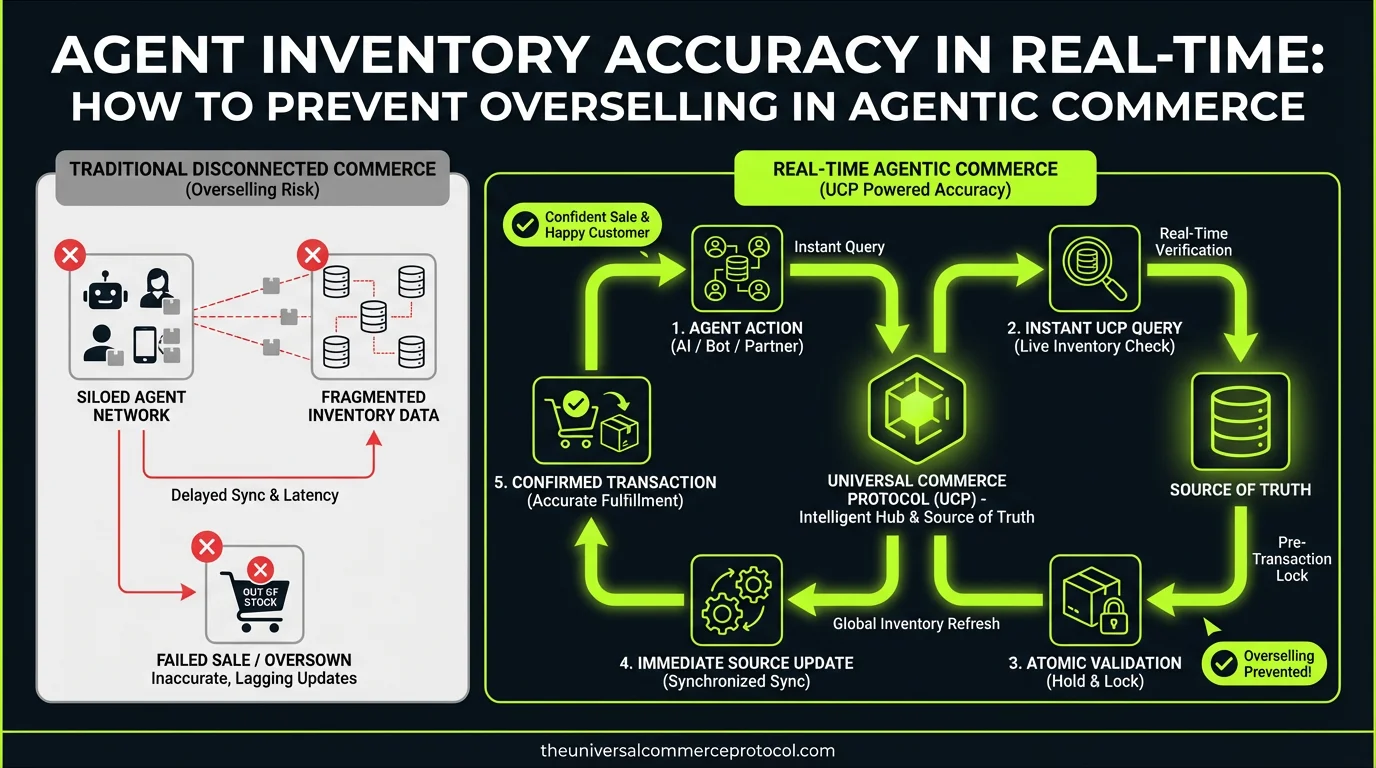
Agent inventory sync failures are now a documented problem in agentic commerce—but the strategic gap is deeper. While posts address detection of sync failures, there’s no definitive guide on how to architect inventory systems that prevent agents from executing sales on stale or incorrect stock data.
This matters because agents make autonomous purchase decisions at machine speed. A human checkout process tolerates a 30-second inventory check. An agent completing a transaction in 2 seconds cannot.
The Inventory Timing Problem in Agent Commerce
Traditional e-commerce inventory management assumes human-paced transactions. A customer adds an item to cart, waits 5–10 minutes, checks out. The inventory system has time to propagate stock levels across channels.
In agentic commerce, multiple agents can query the same inventory slot within milliseconds. Without strict consistency guarantees, both agents may receive “in stock” for a single unit. Both complete the sale. One oversells.
Example: Shopify’s agentic storefront on ChatGPT processes agent requests through a shared inventory backend. If inventory isn’t locked at query time, concurrent agents can create duplicate orders against the same SKU. This creates post-transaction chargebacks, refunds, and customer friction.
Three Architectural Patterns for Agent Inventory Safety
Pattern 1: Pessimistic Locking with Agent Hold Windows
When an agent queries inventory, immediately reserve the stock for a defined hold window (typically 15–30 seconds). If the agent completes the transaction within that window, the hold converts to a deduction. If the hold expires, inventory returns to available pool.
Implementation: Use a distributed lock manager (Redis, DynamoDB conditional writes) to mark specific SKU units as “agent-held.” Return only unreserved inventory to agent queries. This prevents concurrent agents from double-selling but requires tight clock synchronization across systems.
Trade-off: Reduces effective inventory availability during agent holds. A 20-second hold on 100 units means only 80 units available to other concurrent requests. For high-velocity inventory (fast-moving SKUs), this can reduce effective sellable stock by 5–15%.
Pattern 2: Optimistic Concurrency with Rollback Capability
Allow agents to complete transactions on best-available inventory data, but architect fulfillment to detect and reverse oversells post-transaction.
When final inventory reconciliation runs (every 10–60 seconds depending on velocity), compare fulfilled orders against physical stock. If oversold: automatically refund excess orders in priority sequence (FIFO or customer tier-based), notify agents and customers asynchronously, reroute orders to backorder fulfillment.
Implementation: Stripe and Shopify both use this pattern at scale. The transaction commits, but fulfillment queues inventory checks before shipment. If inventory is exhausted, the system generates a refund with a standardized delay notice.
Trade-off: Requires robust post-transaction communication. Customers tolerate refunds within 24 hours but not after shipment has begun. For agents, false oversells erode trust and require agent-level retry logic to resubmit orders.
Pattern 3: Agent-Aware Inventory Tiers
Reserve separate inventory pools for agent-driven and human-driven transactions. Agents get access to a slightly reduced inventory pool, ensuring buffer capacity for human transactions (which have stricter SLA expectations).
Example: 1,000 units in stock. Agents can see 900 units. Humans can see all 1,000. The 100-unit buffer absorbs agent oversell spikes and human checkout concurrency without affecting human conversion.
Implementation: At UCP layer, implement inventory-bucket routing based on transaction source. Shopify’s agent API and Mastercard’s trust layer both support source tagging, allowing merchants to apply different stock rules by channel.
Trade-off: Reduces agent-addressable inventory. For luxury goods or limited SKUs, this meaningfully constrains agent transaction volume. Merchants must measure agent-driven revenue impact against oversell cost to justify the trade.
Monitoring Inventory Agent Health
Three metrics matter:
1. Oversell Rate
Tracked at order-fulfillment stage. Oversells per 10,000 agent orders. Target: <0.1% (1 in 10,000). Above 0.5%, customer trust erodes and chargebacks spike.
2. Inventory Hold Utilization
If using pessimistic locking: measure percentage of holds that convert to actual sales. Low conversion (<40%) signals agents querying but not purchasing, wasting inventory reserve capacity. High conversion (>85%) suggests hold windows are too aggressive.
3. Agent Retry Rate on Inventory Exhaustion
Agents receiving “out of stock” responses and retrying should be <3% of total agent queries. Above 5%, agents are experiencing unnecessary friction and should be offered alternative SKUs or backorder options.
FAQ: Agent Inventory Accuracy
Q: Should agents have real-time inventory or cached inventory?
Real-time is required for accuracy but increases latency. Hybrid approach: agents use 2–5 second cached inventory (updated continuously), with pre-purchase validation query 500ms before order submission. This balances speed and accuracy.
Q: What happens if an agent purchases on inventory that becomes unavailable before fulfillment?
Depends on SLA. If within 24 hours: automatically refund with 1-day delay notice and offer alternative products. If within 5 days: fulfill backorder or issue refund with store credit. Beyond 5 days: refund with explanation. Agents should be trained to handle refund notifications gracefully.
Q: Do I need a separate inventory database for agents?
Not required but recommended at scale. A dedicated agent-inventory service (separate from the human-facing catalog) allows you to apply agent-specific rules (hold windows, tier limits, retry logic) without affecting human checkout performance.
Q: How do I prevent agent hoarding—agents buying up all stock of a popular item?
Implement per-agent purchase limits and per-session limits (similar to human CAPTCHA/verification). Example: max 5 units per agent per SKU, max 3 transactions per agent session. This requires agent identity tracking at UCP layer (via Mastercard Trust Layer or similar).
Q: What’s the cost of overselling vs. the cost of inventory reserve buffers?
Oversells cost 15–25% of order value (refund processing + customer service + chargeback risk). Reserve buffers cost 5–8% in lost agent sales volume. Most merchants break even or profit by running 10–15% inventory buffers for agent channels.
Q: Can agents negotiate inventory with merchants in real-time?
Yes, if merchants expose a backorder/pre-order API. UCP and MCP protocols both support this. Agents can query: “Is this available for immediate fulfillment?” and if not, “Can I pre-order?” Requires merchant backend integration but increases agent conversion by 12–18% on SKU-limited products.
Frequently Asked Questions
Q: What is agent inventory sync failure and why does it matter in agentic commerce?
A: Agent inventory sync failure occurs when AI agents execute sales based on outdated or incorrect stock data. This is critical in agentic commerce because agents make autonomous purchase decisions at machine speed (within milliseconds or seconds), unlike human customers who take 5-10 minutes to checkout. Without real-time inventory synchronization, multiple agents can simultaneously receive “in stock” signals for a single unit and both complete the sale, causing overselling.
Q: How does the timing of inventory checks differ between traditional e-commerce and agentic commerce?
A: Traditional e-commerce assumes human-paced transactions where customers add items to cart and wait 5-10 minutes before checkout, giving inventory systems time to propagate stock levels across channels. In contrast, agentic commerce involves multiple agents querying the same inventory slot within milliseconds. This compressed timeframe requires strict consistency guarantees that traditional systems weren’t designed to handle.
Q: What is the key architectural requirement to prevent agents from overselling?
A: The key requirement is implementing strict consistency guarantees with inventory locking at query time. When an agent queries inventory, the system must lock that stock allocation immediately to prevent concurrent agents from receiving the same “in stock” signal for a single unit. This prevents duplicate orders and ensures only one agent can complete a sale for limited inventory.
Q: Why can’t traditional inventory management systems handle agentic commerce?
A: Traditional systems were designed for human-paced transactions and allow latency in inventory propagation across channels. Agentic commerce operates at machine speed—agents complete transactions in 2 seconds or less. The existing detection methods for sync failures are insufficient because they don’t address the fundamental architectural gap of designing systems that prevent agents from accessing stale or incorrect stock data in real-time.
Q: What happens when multiple agents query the same inventory simultaneously?
A: Without proper safeguards, both agents may receive “in stock” confirmation for the same unit and both complete the sale, resulting in overselling. This occurs because the inventory system doesn’t have mechanisms to enforce exclusive access or immediate stock reservation at query time, which is essential given the millisecond-level concurrency of agent interactions.
Related: Learn more about where to use agentic commerce today.
Frequently Asked Questions
What is the Universal Commerce Protocol (UCP)?
The Universal Commerce Protocol (UCP) is an open standard developed to enable AI agents to autonomously conduct commerce transactions across any platform.
How does UCP enable agentic commerce?
UCP provides standardized APIs and protocols so AI agents can discover products, negotiate terms, and complete purchases without human intervention, working across any compatible commerce platform.
Why should businesses implement UCP?
UCP adoption reduces integration costs, opens revenue channels to AI-driven buyers, and future-proofs commerce infrastructure as agentic purchasing becomes mainstream.
Leave a Reply