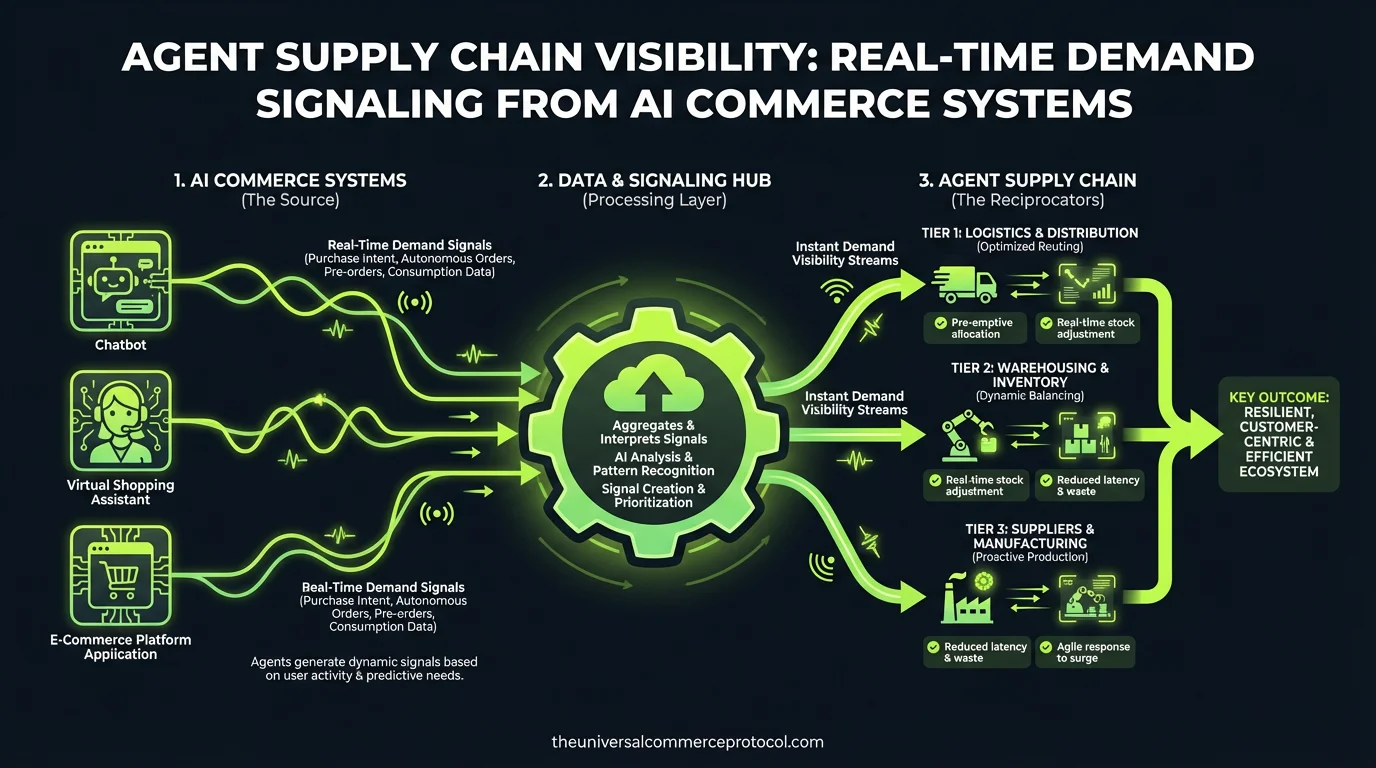
Agentic commerce creates a new demand signal problem. When AI agents autonomously complete transactions across multiple channels, merchants see the order. Suppliers don’t.
This visibility gap costs supply chain teams millions in forecast error, safety stock, and expedited freight. A Gartner survey of 240 CPG and retail supply chain leaders found that 67% lack real-time visibility into agent-driven demand spikes, leading to 18–24% average forecast miss rates.
Why Agent Demand Signals Are Different
Traditional e-commerce demand flows through a merchant’s order management system (OMS) into enterprise resource planning (ERP) to suppliers via EDI or API. The latency is acceptable—orders arrive in batches, forecasts update daily.
Agentic commerce compresses this timeline. Agents transacting on behalf of consumers make purchase decisions in seconds. A Mastercard-enabled agent might trigger 50 transactions per minute across a network of merchants. These aren’t forecasted. They’re autonomous, real-time, and invisible to upstream supply planning until the merchant’s system catches up.
Example: A consumer AI agent (powered by OpenAI or Claude via Universal Commerce Protocol) autonomously buys office supplies from 12 merchants simultaneously. Each merchant receives the order within 2 seconds. The distributor supplying those merchants receives EDI confirmation 4–8 hours later, if the merchant batch-processes orders. By then, the agent has made 1,000 more purchases.
The Cost of Supply Chain Latency in Agentic Commerce
Delayed demand visibility creates three failure modes:
1. Forecast Erosion
Supply planners rely on historical demand patterns and promotional calendars. Agent-driven demand doesn’t fit either. When agents autonomously purchase during off-peak hours or in unexpected quantities, planners see unexplained variance. A midsize food distributor tracking 8,000 SKUs reported a 34% MAPE (mean absolute percentage error) increase in the first quarter after agentic commerce adoption, because agents were bulk-buying inventory management products based on algorithmic price optimization—not consumer seasonality.
2. Safety Stock Inflation
Uncertainty drives buffer stock. When supply planners can’t predict agent-driven demand patterns, they increase safety stock by 15–25%. For a $500M annual procurement business, this adds $7.5–12.5M in working capital tied up in inventory.
3. Expedited Freight and Rush Production
When demand signals arrive late, suppliers can’t schedule production efficiently. A yogurt manufacturer working with Instacart and Amazon Fresh reported that agent-driven micro-fulfillment orders (typically 2–4 units per transaction) created 12% more production changeovers than traditional retail orders. Each changeover triggered 4–6 hours of downtime and quality testing, adding $40–80 per changeover. Across 60 changeovers daily, that’s $2,400–4,800 in daily cost.
Implementing Real-Time Agent Demand Feeds
Direct Agent-to-Supplier APIs
Forward-thinking merchants are building APIs that push agent transaction events to suppliers in real time. Rather than waiting for EDI batches, suppliers receive a webhook or stream event within 500ms of agent purchase confirmation. Platforms like Shopify (with its ChatGPT agentic storefronts) and JPMorgan’s Mirakl partnership are experimenting with event-driven supply chain feeds.
Implementation requirements:
– Merchant system must capture agent transaction events (order ID, product SKU, quantity, timestamp, buyer agent ID)
– Supplier API must accept high-frequency events (100+ events/second for large networks)
– Deduplication logic to prevent duplicate demand signals if orders are replicated across systems
– Filtering rules so suppliers receive only relevant SKUs and quantities
Aggregated Demand Windows
Not all suppliers can consume 100+ events/second. Intermediate aggregation solves this: merchants batch agent transactions into 60-second or 5-minute windows, then push summaries to suppliers. A batch window shows: “8,400 units of Product X purchased by agents in the 2:00–2:05 PM window.” This reduces API call volume by 99% while maintaining decision-quality signal.
Agent Metadata in Demand Signals
The agent’s identity and behavior profile matter. If Demand Signal includes the buyer agent’s attributes (spending velocity, category preference, inventory-to-order ratio), suppliers can forecast more accurately. A cleaning supplies distributor noted that signals from “price-optimization agents” have different demand patterns than signals from “household-replenishment agents.” Including agent type in the feed improved forecast accuracy by 8–12%.
Challenges and Trade-offs
Privacy and Competitive Risk
Sharing real-time agent transaction data with suppliers exposes merchant margins, promotion timing, and customer behavior. Most merchants restrict what data leaves their systems. Selective disclosure (sharing only aggregated volume, not buyer identity) is the practical compromise.
Supplier System Readiness
Mid-market and small suppliers often lack the infrastructure to consume real-time demand feeds. EDI-only suppliers need 6–18 months of IT investment to add API capability. This creates a two-tier supply chain: fast-responding large suppliers get real-time signals; slow, small suppliers get batched EDI as before.
Agent Attribution Complexity
When multiple agents from different platforms purchase the same product, how is the demand signal attributed? Is it associated with Stripe’s agent, Claude’s agent, or the merchant’s internal agent? Without clear attribution, supply planners can’t segment demand by buyer type for forecasting.
Emerging Standards
The Universal Commerce Protocol (UCP) is adding optional demand-signal extensions. Proposals include:
– A standardized agent_demand_event schema that merchants can emit to suppliers
– Agent metadata tagging (agent ID, model, owner, spend velocity)
– Batch and real-time transmission options
– Privacy-safe aggregation rules
Mastercard’s trust layer (launched March 2026 with Google) includes demand-signal forwarding as an optional module, allowing suppliers to subscribe to agent transaction feeds from any merchant on the network.
FAQ
Q: Should my supplier see individual agent transactions or only aggregates?
A: Start with hourly or 4-hourly aggregates. Transition to real-time only if your supplier has proven API stability and you’ve signed data-sharing agreements limiting resale and competitive use.
Q: What if my agent is making purchases my supplier doesn’t want to forecast?
A: Use filtering rules in the demand feed. Tell your supplier: “I’ll send you bulk-order signals but not single-unit emergency purchases.” This keeps their forecast model clean.
Q: How do I prevent agent-driven demand from destabilizing my supplier’s production schedule?
A: Set demand-signal thresholds. If agent volume spikes 40% above the rolling 30-day average, flag it as an outlier rather than a signal. Suppliers can then investigate whether it’s real demand or a systems anomaly.
Q: Does UCP compliance require me to expose agent demand signals to suppliers?
A: No. Demand-signal sharing is optional. But merchants who do share see 8–15% better supplier responsiveness and 6–10% lower expedited freight costs.
Q: How do I handle agent demand from competitors’ customers?
A: Multi-merchant agents (e.g., a price-optimization agent buying from 20 retailers) will generate demand signals your supplier sees from multiple sources. Suppliers should use agent ID as a deduplication key so they don’t double-count the same purchasing agent.
Bottom Line
Real-time agent demand visibility is no longer a nice-to-have—it’s operational necessity as agentic commerce volume grows. Merchants that expose agent transaction feeds to suppliers gain 8–15% better fulfillment speed and avoid the $2.4M+ in annual supply chain friction that comes from demand latency. Start with aggregated feeds and expand to real-time as supplier systems mature.
What is the main visibility gap in agentic commerce supply chains?
The main visibility gap occurs when AI agents autonomously complete transactions across multiple channels. While merchants see these orders, suppliers don’t receive real-time demand signals, creating a disconnect between actual agent-driven purchases and upstream supply planning. This can result in 18-24% average forecast miss rates.
How does agentic commerce differ from traditional e-commerce demand signaling?
Traditional e-commerce follows a batch process where orders flow through OMS to ERP to suppliers via EDI or API with daily forecast updates. Agentic commerce compresses this timeline significantly—AI agents make autonomous purchase decisions in seconds, with agents potentially triggering 50+ transactions per minute. These real-time autonomous transactions aren’t forecasted and remain invisible to upstream supply planning until the merchant’s system catches up.
What are the financial impacts of poor agent demand visibility?
Poor visibility into agent-driven demand spikes costs supply chain teams millions in forecast errors, excess safety stock, and expedited freight charges. According to a Gartner survey of 240 CPG and retail supply chain leaders, 67% lack real-time visibility into agent-driven demand spikes, directly contributing to significant operational inefficiencies.
Why do traditional supply chain systems struggle with autonomous agent transactions?
Traditional supply chain systems were designed for batch processing and predictable order patterns. Autonomous AI agents operate at machine speed with unpredictable behavior, making real-time decisions across multiple merchants and channels simultaneously. This speed and unpredictability exceed the latency tolerance of conventional EDI/API-based demand signaling systems.
How can supply chains adapt to agent-driven demand signals?
Supply chains need real-time visibility solutions that can capture and transmit agent-driven demand signals from merchants to suppliers immediately, rather than waiting for batch updates. Integration of AI commerce systems with supplier networks through protocols like Universal Commerce Protocol enables suppliers to see autonomous transactions as they happen, allowing for dynamic inventory and forecast adjustments.
Frequently Asked Questions
What is the Universal Commerce Protocol (UCP)?
The Universal Commerce Protocol (UCP) is an open standard developed to enable AI agents to autonomously conduct commerce transactions across any platform.
How does UCP enable agentic commerce?
UCP provides standardized APIs and protocols so AI agents can discover products, negotiate terms, and complete purchases without human intervention, working across any compatible commerce platform.
Why should businesses implement UCP?
UCP adoption reduces integration costs, opens revenue channels to AI-driven buyers, and future-proofs commerce infrastructure as agentic purchasing becomes mainstream.
Leave a Reply