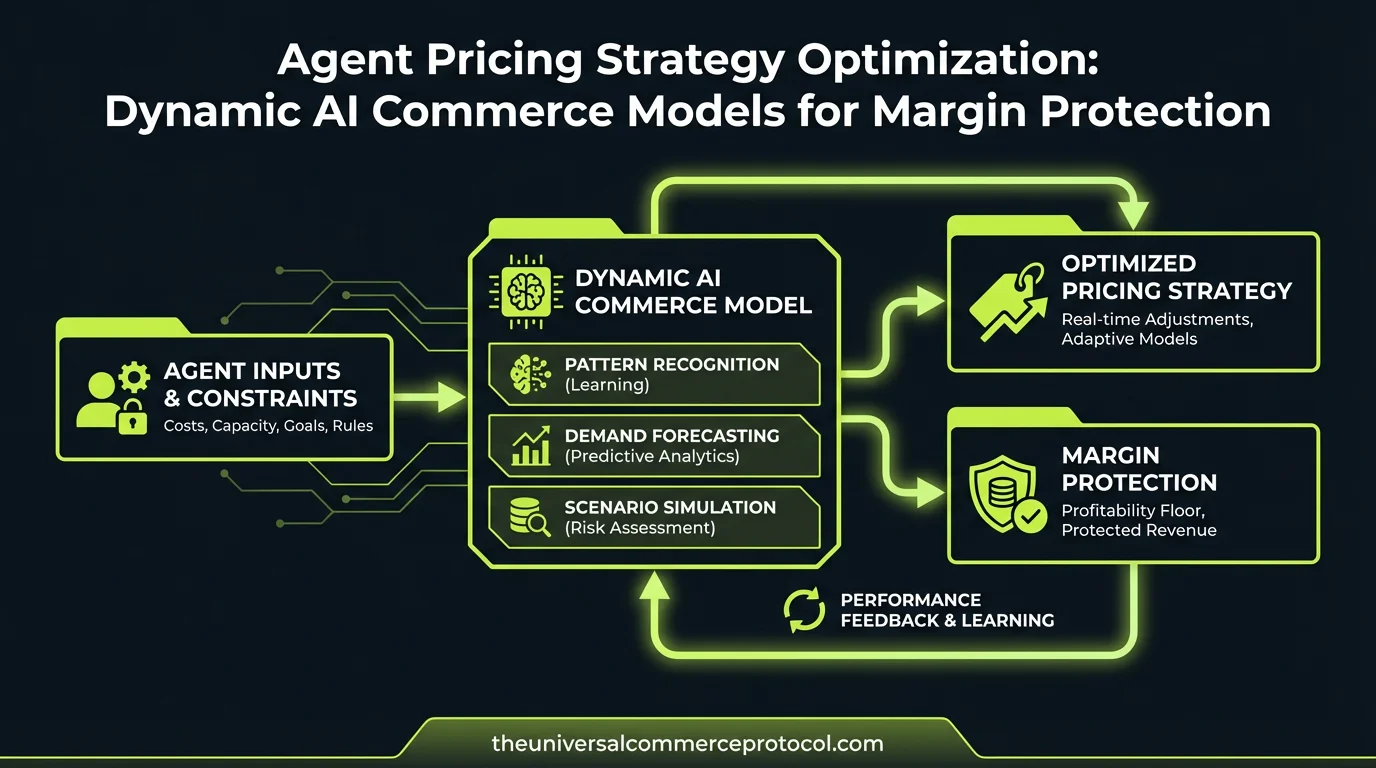
The Pricing Intelligence Gap in Agentic Commerce
While recent coverage has focused on agent observability, compliance, and refund logic, a critical operational gap remains unaddressed: how do merchants prevent AI agents from making economically irrational purchasing decisions that erode margins?
Merchants deploying agentic storefronts have documented cases where agents automatically repurchase inventory at suboptimal prices, accept unfavorable payment terms, or fail to negotiate bulk discounts—decisions that a human buyer would reject in seconds. Unlike inventory sync or chargeback prevention, pricing strategy optimization requires agents to understand merchant cost structure, competitive positioning, and real-time market signals.
Why Standard Commerce Rules Fail for AI Agents
Traditional e-commerce platforms use static price rules: markup percentages, cost floors, competitor price caps. These work for human merchants making deliberate choices. But AI agents operating at scale need dynamic pricing logic that:
- Evaluates supplier cost trajectories: An agent should recognize when a supplier’s historical pricing suggests a bulk discount is incoming, and delay purchase decisions accordingly.
- Factors in carrying costs: A cheaper unit price is economically worse than a premium price with faster sell-through if working capital costs exceed the price difference.
- Monitors competitive price windows: Agents need to understand when a competitor’s price advantage is temporary (clearance) vs. structural (lower supplier cost).
- Incorporates demand elasticity: An agent purchasing inventory for resale must account for price sensitivity—a 5% price reduction may increase demand 20%, justifying higher procurement cost.
Real-World Merchant Pain Points
A mid-market fashion retailer using Shopify’s agentic storefronts reported that its agents were auto-replenishing slow-moving inventory at full wholesale price when historical supplier data showed a seasonal 15% discount window opened in 3–4 weeks. The agent had no mechanism to understand temporal pricing patterns or opportunity cost. Result: $180K in excess holding cost over Q1 2026.
A food-and-beverage distributor integrating with JPMorgan’s AI agent checkout system discovered agents were accepting unfavorable payment terms (net 90 vs. net 30) to secure price cuts on commodity items. Without visibility into the merchant’s cost of capital, agents treated all pricing concessions equally.
Building a Pricing Strategy Framework for Agents
1. Cost Attribution as a First-Class Agent Input
Agents must receive real-time merchant cost data: unit cost, freight, handling, storage per SKU. This should be fed directly into agent decision logic, not as a post-hoc compliance check. Merchants integrating UCP should expose cost via structured schemas that agents can query without human intervention.
2. Temporal Pricing Intelligence
Rather than flat competitor price monitoring, agents need access to:
- Supplier historical pricing (12–24 months) to identify cyclical patterns
- Forward-contracted prices (if available via EDI or API)
- Inventory velocity trends by season/category to model carrying cost impact
Tools like Mirakl (now partnered with JPMorgan on agent checkout) can surface supplier pricing history; agents should use this to make forward-looking replenishment decisions.
3. Margin Guard Logic
Define a decision threshold: agents should escalate any purchase that would reduce unit margin below X% or increase total landed cost above Y% vs. 90-day average. This isn’t a veto—it’s a signal for human review or dynamic renegotiation.
4. Payment Terms Modeling
Agents should evaluate total cost of capital, not just invoice price. A supplier offering net 90 at $100/unit is economically different from net 30 at $100/unit if the merchant’s cost of capital is 8%. This should be baked into agent procurement logic.
Technical Implementation Paths
Via MCP (Model Context Protocol): Anthropic’s MCP framework allows agents to call pricing-strategy tools as first-class resources. A merchant can define an MCP server that exposes: get_cost_floor(sku_id), get_competitor_prices(sku_id, lookback_days), get_payment_terms_impact(net_days, volume). Claude-based agents can invoke these before committing to a purchase.
Via Workflow Automation: Shopify and other platforms can implement conditional agent approval workflows: if an agent’s procurement decision falls outside the pricing envelope, route to merchant for 15-minute review window. This preserves autonomy while protecting margins.
Via RAG (Retrieval-Augmented Generation): Merchants can build agent-accessible knowledge bases containing: supplier contracts, historical pricing, competitive intelligence, margin targets by category. Agents retrieve relevant context before each decision.
Monitoring Pricing Decisions at Scale
Given the observability focus of recent UCP coverage, pricing decisions should be logged separately: not just what agents bought, but why. Track:
- Price paid vs. merchant cost floor (variance %)
- Price paid vs. historical average (variance %)
- Price paid vs. competitor average (variance %)
- Actual carrying cost impact (post-hoc, after sale)
This creates an audit trail that reveals whether agent pricing logic is performing as designed and highlights retraining opportunities.
FAQ
Q: Won’t pricing-aware agents slow down commerce cycles?
A: No. Cost and pricing checks should execute in parallel with availability checks, adding <100ms latency. The risk of a slow decision is far lower than the cost of a bad one.
Q: How do agents handle live market price movements?
A: Agents should cache pricing data for 5–15 minutes (depending on category volatility) and refresh on agent-initiated queries. Highly volatile categories (commodities, fast fashion) warrant sub-5-minute refresh.
Q: Can agents negotiate price with suppliers?
A: Not yet—but agents can flag bulk-buy opportunities and route to procurement teams for real negotiation. Some platforms are experimenting with agent-to-supplier API calls for automated volume discounts, but this remains nascent.
Q: What if supplier pricing data is incomplete?
A: Agents should fall back to conservative heuristics: prefer suppliers with longer contract history, lower variance in pricing, or lower payment-term risk. Incomplete data is no excuse for economically irrational decisions.
Q: How does this interact with agent liability insurance?
A: Merchants should ensure their agentic commerce insurance covers pricing decision errors. Insurers are increasingly requiring merchants to log pricing rationale—which this framework enables.
The Strategic Implication
Agentic commerce only achieves ROI if agents make decisions as economically sound as trained human operators. Pricing strategy is the largest lever for margin protection in procurement and replenishment. The next wave of competitive advantage in agentic commerce belongs to merchants and platforms that embed real-time cost modeling, supplier intelligence, and temporal pricing logic into agent decision loops—not as a compliance afterthought, but as a core pillar of agent architecture.
What is the pricing intelligence gap in agentic commerce?
The pricing intelligence gap refers to the critical operational challenge where AI agents in merchant storefronts make economically irrational purchasing decisions that erode profit margins. These agents may automatically repurchase inventory at suboptimal prices, accept unfavorable payment terms, or fail to negotiate bulk discounts—decisions that human buyers would reject immediately. Unlike inventory synchronization or chargeback prevention, pricing strategy optimization requires agents to understand merchant cost structures, competitive positioning, and real-time market signals.
Why do static price rules fail for AI agents?
Traditional e-commerce platforms use static price rules such as fixed markup percentages, cost floors, and competitor price caps, which work well for human merchants making deliberate choices. However, AI agents operating at scale require dynamic pricing logic that can evaluate supplier cost trajectories, recognize incoming bulk discount opportunities, assess competitive market conditions, and adjust pricing strategies in real-time. Static rules cannot adapt to these complex, changing variables that agents encounter during autonomous operations.
What key capabilities do AI agents need for effective pricing optimization?
AI agents require dynamic pricing logic that can: (1) evaluate supplier cost trajectories to identify when bulk discounts are likely available, (2) understand merchant cost structures and profit margins, (3) monitor competitive positioning and real-time market signals, (4) make purchasing decisions that align with strategic business objectives, and (5) negotiate favorable terms rather than accepting default pricing. These capabilities enable agents to make economically rational decisions similar to experienced human buyers.
How can merchants protect margins in agentic commerce?
Merchants can protect margins by implementing dynamic AI commerce models that go beyond traditional static pricing rules. This involves configuring agents with access to real-time cost data, competitor intelligence, and supplier pricing history. Agents should be programmed to recognize optimal purchasing windows, negotiate bulk discounts, evaluate payment terms for financial impact, and delay purchases when supplier cost trajectories suggest better pricing ahead. This requires a comprehensive pricing strategy optimization framework rather than isolated commerce rules.
What distinguishes pricing strategy optimization from other agentic commerce concerns?
While recent coverage has focused on agent observability, compliance, and refund logic, pricing strategy optimization is unique because it directly impacts merchant profitability through purchasing decisions at scale. It requires agents to understand nuanced business context—cost structures, competitive positioning, and market dynamics—rather than simply executing compliance checks or managing logistics. This makes it a distinct operational concern that must be deliberately addressed in agentic commerce implementations.
Frequently Asked Questions
What is the Universal Commerce Protocol (UCP)?
The Universal Commerce Protocol (UCP) is an open standard developed to enable AI agents to autonomously conduct commerce transactions across any platform.
How does UCP enable agentic commerce?
UCP provides standardized APIs and protocols so AI agents can discover products, negotiate terms, and complete purchases without human intervention, working across any compatible commerce platform.
Why should businesses implement UCP?
UCP adoption reduces integration costs, opens revenue channels to AI-driven buyers, and future-proofs commerce infrastructure as agentic purchasing becomes mainstream.
Leave a Reply