🎧 Listen to this article
📝 Show transcription
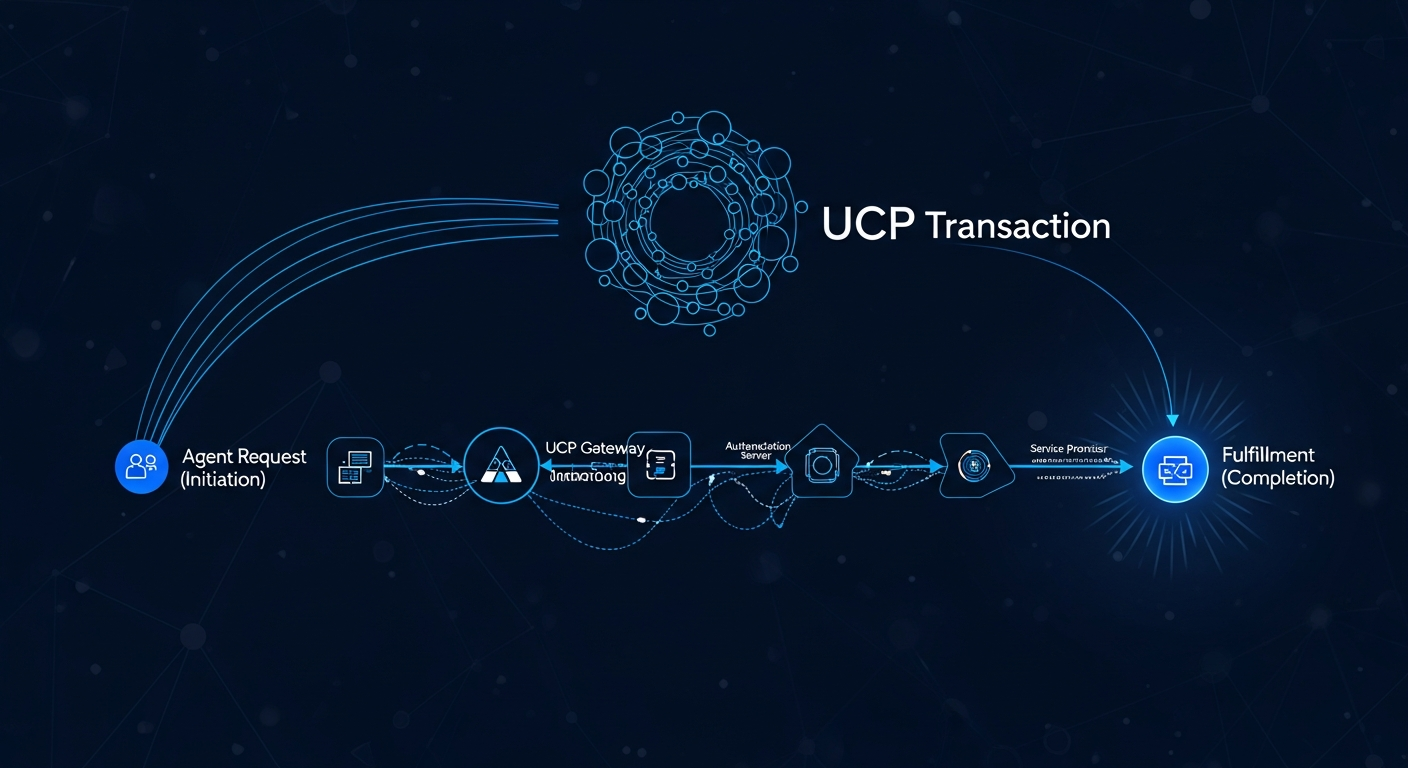
The UCP transaction lifecycle provides a standardized, end-to-end framework for agentic commerce, guiding user interactions from initial intent all the way through to order fulfillment. This robust process ensures seamless interoperability and consistency across diverse commerce ecosystems, making it a vital blueprint for developers, merchants, and strategists building UCP-compliant solutions. Understanding its four core phases—Agent Request, Offer Selection, Order Confirmation, and Fulfillment—is crucial for architecting resilient services.
The journey begins with the Agent Request phase. This is the initial signal from an agent, such as Google Assistant or Search, indicating a user’s intent to make a purchase. An Agent Request is a highly structured message designed to elicit specific commerce outcomes, encapsulating the user’s preferences, context, and desired product or service attributes. Merchants must implement a UCP-compliant endpoint capable of receiving and intelligently parsing these requests to kickstart the commerce flow. With agentic commerce projected to reach a 1.5 trillion dollar market by 2030, adopting these standardized protocols is becoming increasingly urgent.
Agents leverage advanced artificial intelligence to interpret natural language, translating complex user needs into these structured Agent Requests. This involves understanding product categories, specific features, price ranges, delivery preferences, and even contextual information like location or past purchase history. A merchant’s system must be prepared to handle this granularity, often requiring sophisticated mapping to their internal product catalogs and business logic. For example, a user asking for "running shoes under a hundred dollars with free delivery by tomorrow" generates an Agent Request that includes precise product type, price constraints, and fulfillment criteria.
The Agent Request object itself is the foundational data structure for a UCP transaction. It typically contains fields for user identity, geo-location, preferred currency, and, most importantly, a detailed query or items array outlining the user’s desired products or services. Merchants must define their UCP Agent Request handler to validate these incoming requests against their business rules and product availability. This parsing allows merchant backends to search their catalogs, apply filters, and prepare relevant offers. Architectural considerations here include robust API gateway management, initial data validation, and efficient routing to product information and inventory systems, all secured with authentication and rate limiting for production environments.
Following a successful Agent Request, we move into the Offer Selection phase. Here, the merchant’s system’s primary task is to generate and return a set of viable Offer objects. The merchant responds to the Agent Request with a UCP-defined structure containing an array of these offers, complete with pricing and fulfillment details. The agent then presents these curated offers to the user, facilitating the selection process.
The UCP transaction lifecycle is the essential blueprint for a future where commerce is increasingly driven by intelligent agents, demanding a consistent and interoperable approach from every merchant.
⏰ 14 min read
The UCP transaction lifecycle outlines the standardized, end-to-end process for agentic commerce, guiding user interactions from initial intent to order fulfillment. This robust framework ensures seamless interoperability and consistency across diverse commerce ecosystems, making it essential for developers, merchants, and strategists building UCP-compliant solutions. Understanding each phase—Agent Request, Offer Selection, Order Confirmation, and Fulfillment—is paramount to architecting resilient, UCP-compliant services.
TL;DR: The UCP transaction lifecycle standardizes agentic commerce from user request to order fulfillment, ensuring interoperability and consistency across platforms.
Initiating the Transaction: The Agent Request
The UCP transaction lifecycle begins with an AgentRequest, the initial signal from an agent (e.g., Google Assistant, Search, Maps) indicating user intent to purchase. An AgentRequest is a structured message designed to elicit specific commerce outcomes, encapsulating user preferences, context, and desired product or service attributes. Merchants must implement a UCP-compliant endpoint capable of receiving and intelligently parsing these requests to initiate the commerce flow. Industry reports indicate that agentic commerce is projected to grow by over 25% annually, reaching an estimated $1.5 trillion market by 2030, underscoring the urgency for merchants to adopt standardized protocols like UCP.
Agent Capabilities and User Intent
Agents leverage advanced AI to interpret natural language, translating complex user needs into a structured AgentRequest. This involves understanding product categories, specific features, price ranges, delivery preferences, and even contextual information like location or past purchase history. The merchant’s system must be prepared to handle the granularity of this intent, often requiring sophisticated mapping to their internal product catalogs and business logic.
For instance, a user asking for “a pair of running shoes under $100 with free delivery by tomorrow” generates an AgentRequest that includes product type, price constraints, and fulfillment criteria. This demonstrates the agent’s capability to distill nuanced user queries into precise commerce parameters.
The AgentRequest Object Structure
The AgentRequest object is the foundational data structure for a UCP transaction. It typically contains fields for user identity (anonymized or tokenized), geo-location, preferred currency, and, most importantly, the query or items array detailing the user’s desired products or services. Merchants must define their UCP AgentRequest handler to validate these incoming requests against their business rules and product availability.
Consider a simplified AgentRequest for a product search:
json{
  "requestId": "agent-req-12345",
  "agentId": "google-assistant-prod-us",
  "locale": "en-US",
  "currencyCode": "USD",
  "userContext": {
    "location": {
      "latitude": 34.0522,
      "longitude": -118.2437
    },
    "preferences": {
      "deliverySpeed": "STANDARD",
      "sustainabilityOptions": ["carbonNeutralShipping"]
    }
  },
  "query": {
    "text": "running shoes",
    "filters": [
      {
        "type": "PRICE_RANGE",
        "value": {
          "min": { "amount": 50, "currencyCode": "USD" },
          "max": { "amount": 100, "currencyCode": "USD" }
        }
      },
      {
        "type": "CATEGORY",
        "value": "sporting_goods/footwear/running_shoes"
      }
    ],
    "fulfillmentOptions": {
      "deliveryPreferences": {
        "earliestDeliveryDate": "2024-07-20T00:00:00Z"
      }
    }
  },
  "clientCapabilities": [
    "PAYMENT_METHOD_TOKENIZATION",
    "REAL_TIME_OFFER_UPDATES"
  ]
}
This JSON payload demonstrates a structured request for running shoes within a specific price range, with an implicit preference for prompt delivery. Merchant backends must parse this query object to search their catalog, apply filters, and prepare relevant offers. Architectural considerations here include robust API gateway management, initial data validation against UCP schemas, and efficient routing to relevant product information management (PIM) and inventory systems. For production environments, robust authentication (e.g., OAuth 2.0) and rate limiting on the merchant’s UCP endpoint are non-negotiable to prevent abuse and ensure service stability.
Discovering and Selecting Offers: The OfferSelection Phase
Upon receiving an AgentRequest, the merchant’s system’s primary task is to generate and return a set of viable Offer objects. OfferSelection is the phase where a merchant system responds to an AgentRequest by presenting a curated list of viable products or services, complete with pricing and fulfillment details. The agent then presents these offers to the user, facilitating the selection process.
Merchant Response to Agent Request
The merchant’s response to an AgentRequest is a UCP-defined structure containing an array of Offer objects. Each Offer represents a concrete, purchasable item or service that matches the user’s intent. This response must be generated in real-time, reflecting current inventory, dynamic pricing, and accurate fulfillment options.
Studies by leading e-commerce platforms show that a 1-second delay in API response time can lead to a 7% reduction in conversions. For UCP implementations, optimizing response times during OfferSelection is crucial, as agents often expect responses within milliseconds. A slow or inaccurate response directly impacts user experience and conversion rates.
The Offer Object and its Attributes
An Offer object is rich with details, including offerId, productId, productDetails (name, description, images), price (including taxes and discounts), availability, and fulfillmentInfo (shipping options, delivery windows, pickup locations). The merchant must ensure that every attribute is accurate and up-to-date. The agent relies on this structured data to present clear choices to the user.
Here’s an example of an Offer within a merchant’s response:
json{
  "requestId": "agent-req-12345",
  "offers": [
    {
      "offerId": "merchant-offer-sku-789",
      "productId": "sku-789",
      "productDetails": {
        "name": "Nimbus 25 Running Shoes",
        "description": "Lightweight and cushioned for long-distance runs.",
        "imageUrl": "https://example.com/images/nimbus25.jpg",
        "brand": "Ascent Sports"
      },
      "price": {
        "amount": 95.00,
        "currencyCode": "USD",
        "tax": { "amount": 5.70, "currencyCode": "USD" },
        "discount": { "amount": 10.00, "currencyCode": "USD", "description": "Summer Sale" }
      },
      "availability": {
        "status": "IN_STOCK",
        "quantity": 15
      },
      "fulfillmentInfo": [
        {
          "fulfillmentType": "DELIVERY",
          "shippingOptions": [
            {
              "shippingOptionId": "standard-delivery-001",
              "name": "Standard Delivery",
              "cost": { "amount": 0.00, "currencyCode": "USD" },
              "deliveryWindow": {
                "earliestDeliveryTime": "2024-07-22T09:00:00Z",
                "latestDeliveryTime": "2024-07-22T17:00:00Z"
              }
            },
            {
              "shippingOptionId": "express-delivery-002",
              "name": "Express Delivery",
              "cost": { "amount": 15.00, "currencyCode": "USD" },
              "deliveryWindow": {
                "earliestDeliveryTime": "2024-07-21T09:00:00Z",
                "latestDeliveryTime": "2024-07-21T17:00:00Z"
              }
            }
          ]
        },
        {
          "fulfillmentType": "PICKUP",
          "pickupOptions": [
            {
              "pickupOptionId": "store-loc-456",
              "name": "Store A (Downtown)",
              "estimatedReadyTime": "2024-07-20T14:00:00Z"
            }
          ]
        }
      ],
      "returnPolicy": {
        "daysToReturn": 30,
        "returnShippingCost": { "amount": 0.00, "currencyCode": "USD" }
      }
    }
  ],
  "paginationContext": {
    "nextPageToken": "token-for-next-page-of-offers"
  }
}
Agent-Side Offer Presentation and User Interaction
The agent’s role in this phase is to aggregate offers from multiple merchants (if applicable) and present them to the user in an intuitive, actionable manner. This involves filtering, sorting, and highlighting key attributes based on user preferences. Once the user selects an offer, the agent communicates this selection back to the merchant, often with additional user-provided details like shipping address or preferred payment method.
Merchant systems must be designed to handle subsequent requests that refine or confirm a selected offer, potentially involving further API calls to update pricing or fulfillment options based on precise user input. Scalability is critical here, as the merchant’s UCP endpoint might be hit by numerous AgentRequest calls simultaneously, demanding efficient caching strategies and distributed processing to maintain performance.
Securing the Commitment: OrderConfirmation
The OrderConfirmation phase is the pivotal moment where a selected offer transforms into a committed order. OrderConfirmation is the critical stage where a user’s selected offer is validated, payment is processed, and a formal order record is created within the merchant’s system. It is a critical handshake between the agent and the merchant, requiring robust error handling and transactional integrity.
From Selected Offer to Confirmed Order
Once a user selects an Offer and provides necessary details (shipping address, payment method), the agent sends an OrderConfirmationRequest to the merchant. This request effectively signals the user’s intent to purchase the specific items with the specified fulfillment and payment options. The merchant’s system must perform a final check on inventory, pricing, and all other order attributes before confirming. This final validation minimizes post-purchase cancellations due to discrepancies.
The Order Object Structure
Upon successful validation and payment authorization, the merchant responds with a UCP Order object. This object represents the finalized transaction and serves as the single source of truth for the order’s details. It includes the orderId, creationTime, lineItems, totalPrice, paymentInfo, and fulfillmentInfo. It is crucial that the orderId is unique and traceable within the merchant’s internal systems.
Here’s a simplified Order object representing a confirmed purchase:
json{
  "orderId": "merchant-order-ABC-7890",
  "creationTime": "2024-07-20T10:30:00Z",
  "lastUpdateTime": "2024-07-20T10:30:00Z",
  "orderState": "CONFIRMED",
  "lineItems": [
    {
      "lineItemId": "line-item-1",
      "offerId": "merchant-offer-sku-789",
      "productId": "sku-789",
      "quantity": 1,
      "unitPrice": { "amount": 95.00, "currencyCode": "USD" },
      "totalPrice": { "amount": 95.00, "currencyCode": "USD" },
      "productDetails": {
        "name": "Nimbus 25 Running Shoes",
        "imageUrl": "https://example.com/images/nimbus25.jpg"
      }
    }
  ],
  "totalPrice": {
    "amount": 100.70,
    "currencyCode": "USD",
    "subtotal": { "amount": 95.00, "currencyCode": "USD" },
    "tax": { "amount": 5.70, "currencyCode": "USD" },
    "shipping": { "amount": 0.00, "currencyCode": "USD" }
  },
  "paymentInfo": {
    "paymentMethodType": "CREDIT_CARD",
    "paymentToken": "encrypted-token-from-agent",
    "transactionId": "payment-gateway-txn-XYZ-1234"
  },
  "fulfillmentInfo": {
    "fulfillmentType": "DELIVERY",
    "shippingAddress": {
      "addressLine1": "123 Main St",
      "locality": "Los Angeles",
      "administrativeArea": "CA",
      "postalCode": "90001",
      "countryCode": "US"
    },
    "selectedShippingOptionId": "standard-delivery-001"
  },
  "customerInfo": {
    "email": "user@example.com",
    "phoneNumber": "+15551234567"
  }
}
Payment Processing and Authorization within UCP
Payment processing is a critical part of OrderConfirmation. UCP does not directly process payments but provides a secure mechanism for agents to pass payment tokens from the user to the merchant. The agent facilitates the user’s selection of a payment method and securely tokenizes the payment details. This token is then included in the OrderConfirmationRequest.
The merchant’s system is responsible for integrating with its chosen payment gateway (e.g., Stripe, Adyen, Braintree) to authorize and capture funds using this token. Production-grade implementations must handle various payment scenarios, including declines, refunds, and chargebacks, ensuring proper UCP status updates are communicated back to the agent. Differentiating between a mock payment gateway (for testing) and a fully PCI-DSS compliant production integration is paramount. Mock clients can simulate success/failure, but a production system requires full API integration with secure token handling and error propagation.
Delivering Value: The Fulfillment Phase
Once an order is confirmed, the UCP lifecycle transitions into the Fulfillment phase. Fulfillment is the final phase of the UCP transaction lifecycle, encompassing all actions taken by the merchant to deliver the purchased items or services to the user. The UCP facilitates continuous communication between the merchant and the agent, providing status updates that keep the user informed throughout the fulfillment process.
Merchant’s Role in Fulfillment
The merchant’s internal order management system (OMS) and warehouse management system (WMS) drive the actual fulfillment process. This involves picking, packing, shipping, or provisioning digital goods. UCP mandates that merchants provide timely updates on the order’s status, ensuring the agent can accurately inform the user. This integration between UCP and internal systems is often the most complex part of a UCP implementation.
Tracking and Status Updates via UCP
As the order progresses through fulfillment, the merchant must proactively send FulfillmentStatusUpdate messages to the agent. These updates cover key milestones such as “ORDER_SHIPPED,” “OUT_FOR_DELIVERY,” “DELIVERED,” or “CANCELED.” Each update must include the orderId, the new fulfillmentState, and any relevant tracking information or details.
An example FulfillmentStatusUpdate for a shipped order:
json{
  "orderId": "merchant-order-ABC-7890",
  "updateTime": "2024-07-20T14:00:00Z",
  "fulfillmentState": "ORDER_SHIPPED",
  "fulfillmentInfo": {
    "fulfillmentType": "DELIVERY",
    "shippingTracking": {
      "carrier": "FedEx",
      "trackingNumber": "FEDEX-TRACK-12345",
      "trackingUrl": "https://www.fedex.com/track/FEDEX-TRACK-12345"
    },
    "estimatedDeliveryTime": "2024-07-22T17:00:00Z"
  },
  "customerFacingMessage": {
    "title": "Your Order Has Shipped!",
    "body": "Your Nimbus 25 Running Shoes are on their way. Track your package here."
  }
}
Architecturally, this requires the merchant’s OMS/WMS to trigger UCP API calls or send messages to a UCP integration layer when status changes occur. This often involves webhooks or event-driven architectures to ensure real-time propagation of status updates.
Handling Returns and Cancellations
UCP also supports the post-purchase lifecycle, including returns and cancellations. Should a user initiate a return or cancellation via the agent, the agent will send a corresponding request to the merchant. The merchant’s system must process this request, update the order status, and issue refunds as necessary, communicating these changes back to the agent via FulfillmentStatusUpdate or specific return/cancellation UCP messages. A robust UCP implementation considers the entire customer journey, including these critical post-purchase scenarios like partial returns or exchanges, to minimize customer support load and enhance satisfaction.
Architectural Considerations Across the Lifecycle
Implementing UCP requires more than just understanding the protocol’s data structures; it demands careful architectural planning to ensure reliability, security, and scalability.
Idempotency and Error Handling
Every UCP endpoint receiving requests from an agent must be idempotent. This means that processing the same request multiple times (e.g., due to network retries) must produce the same result without unintended side effects. Merchants must implement robust error handling, returning appropriate UCP error codes and descriptive messages for issues like invalid requests, out-of-stock items, or payment failures. This ensures agents can provide meaningful feedback to users and, if necessary, retry operations or guide the user to alternatives.
Security and Authentication
Authentication and authorization are paramount. Merchants expose UCP endpoints to Google’s agents, necessitating secure communication. This typically involves OAuth 2.0 for API access, ensuring that only authenticated and authorized Google services can interact with the merchant’s UCP endpoints. All data in transit must be encrypted (HTTPS/TLS), and sensitive information, especially payment data, must be handled with the highest level of PCI-DSS compliance, using tokenization rather than raw card data.
Scalability and Performance
Agentic commerce implies potentially high request volumes, especially during peak shopping periods. Merchant UCP implementations must be highly scalable, capable of handling concurrent requests for offer generation, order confirmation, and status updates without degrading performance. This often involves cloud-native architectures, auto-scaling groups, content delivery networks (CDNs) for static assets, and efficient database indexing. Latency is critical; slow responses can lead to abandoned carts and poor user experience, directly impacting conversion rates.
Data Privacy and Compliance
Adherence to global data privacy regulations (e.g., GDPR, CCPA) is non-negotiable. Merchants must ensure that personal user data handled within the UCP context is collected, processed, and stored in compliance with these regulations. This includes clear consent mechanisms, data minimization, and secure data storage. Google’s UCP is designed with privacy in mind, often anonymizing or tokenizing user identifiers, but the merchant remains responsible for their own data handling practices and ensuring compliance with local laws.
Key Takeaways
- The UCP transaction lifecycle is a four-phase framework: Agent Request, Offer Selection, Order Confirmation, and Fulfillment.
- Each phase relies on structured data objects (e.g.,
AgentRequest,Offer,Order) for seamless communication between AI agents and merchant systems. - Robust architectural considerations, including idempotency, security, scalability, and data privacy, are essential for successful UCP implementation.
- UCP enables merchants to expand their reach into new agentic commerce solutions, enhancing user experience through standardized, real-time interactions.
- Effective integration with existing ERP, OMS, and payment gateway systems is crucial for translating UCP data into actionable business operations.
Next Steps for Developers
For developers transitioning from conceptual understanding to robust, production-ready UCP implementations, consider the following:
- Deep Dive into UCP Specifications: Consult the official UCP developer documentation for detailed API definitions, data schemas, and best practices. Pay close attention to versioning and deprecation policies.
- Implement Idempotency: Design all UCP-facing API endpoints to be idempotent. Utilize request IDs or unique transaction identifiers to prevent duplicate processing.
- Error Handling Strategy: Develop a comprehensive error handling strategy that maps internal system errors to appropriate UCP error codes, providing clear, actionable feedback to the agent.
- Security Integration: Prioritize secure authentication (e.g., OAuth 2.0 with Google’s Identity Platform) and ensure all sensitive data, especially payment information, is handled via tokenization and adheres to PCI-DSS standards.
- Performance Testing: Conduct rigorous load and performance testing on your UCP endpoints to ensure they can handle anticipated traffic volumes with low latency.
- Monitoring and Alerting: Implement robust monitoring for your UCP integration, tracking request rates, error rates, and response times. Set up alerts for any anomalies.
FAQ Section
Q1: How does UCP handle real-time inventory updates during the OfferSelection phase?
A1: UCP expects the merchant’s response to an AgentRequest to reflect real-time inventory. This means the merchant’s UCP endpoint must integrate directly or asynchronously query their inventory management system (IMS) to retrieve accurate stock levels before generating Offer objects. If inventory changes rapidly, the merchant might implement a short-lived cache or leverage optimistic locking with a final inventory check during OrderConfirmation to minimize discrepancies.
Q2: What are the security implications for payment processing with UCP?
A2: UCP itself does not process payments. Instead, it facilitates the secure exchange of tokenized payment information from the agent (where the user provides details) to the merchant. The merchant is responsible for integrating this payment token with their chosen PCI-DSS compliant payment gateway. This architecture ensures that sensitive cardholder data never directly touches the agent’s systems and minimizes the merchant’s PCI scope by dealing with tokens instead of raw card data.
Q3: Can UCP integrate with existing ERP/OMS systems?
A3: Absolutely. Integrating with existing Enterprise Resource Planning (ERP) and Order Management Systems (OMS) is a fundamental requirement for UCP. Merchants typically build an integration layer or middleware that translates UCP data structures (e.g., AgentRequest, Order, FulfillmentStatusUpdate) into the formats expected by their internal ERP/OMS. This layer handles data mapping, business logic execution, and status synchronization between UCP and the legacy systems, often using APIs, message queues, or webhooks.
Q4: What are common pitfalls in implementing the UCP fulfillment phase?
A4: Common pitfalls include delayed or inconsistent status updates due to poor integration with internal WMS/OMS, insufficient handling of edge cases like partial shipments or unforeseen delays, and a lack of robust error reporting for fulfillment failures. To mitigate these, merchants should ensure real-time synchronization of fulfillment events, implement comprehensive logging and monitoring, and define clear protocols for communicating all possible fulfillment states and exceptions back to the agent.
Q5: How does UCP ensure data privacy throughout the transaction?
A5: UCP is designed with data privacy in mind, adhering to principles like data minimization and secure processing. User identifiers are often anonymized or tokenized where possible. Google’s agents handle user consent for data sharing according to privacy regulations. However, the merchant is ultimately responsible for ensuring their own backend systems and data handling practices comply with relevant data privacy laws (e.g., GDPR, CCPA) for any personal data they receive and process during the transaction lifecycle.
Frequently Asked Questions
What is the Universal Commerce Protocol?
The Universal Commerce Protocol (UCP) is an open standard for AI agent commerce developed by Google and Shopify.
How does UCP enable agentic commerce?
UCP provides standardized APIs and protocols enabling AI agents to autonomously conduct commerce transactions.
Why implement UCP?
UCP reduces development costs, enables new revenue opportunities, and future-proofs your commerce infrastructure.
Leave a Reply