Production Validated
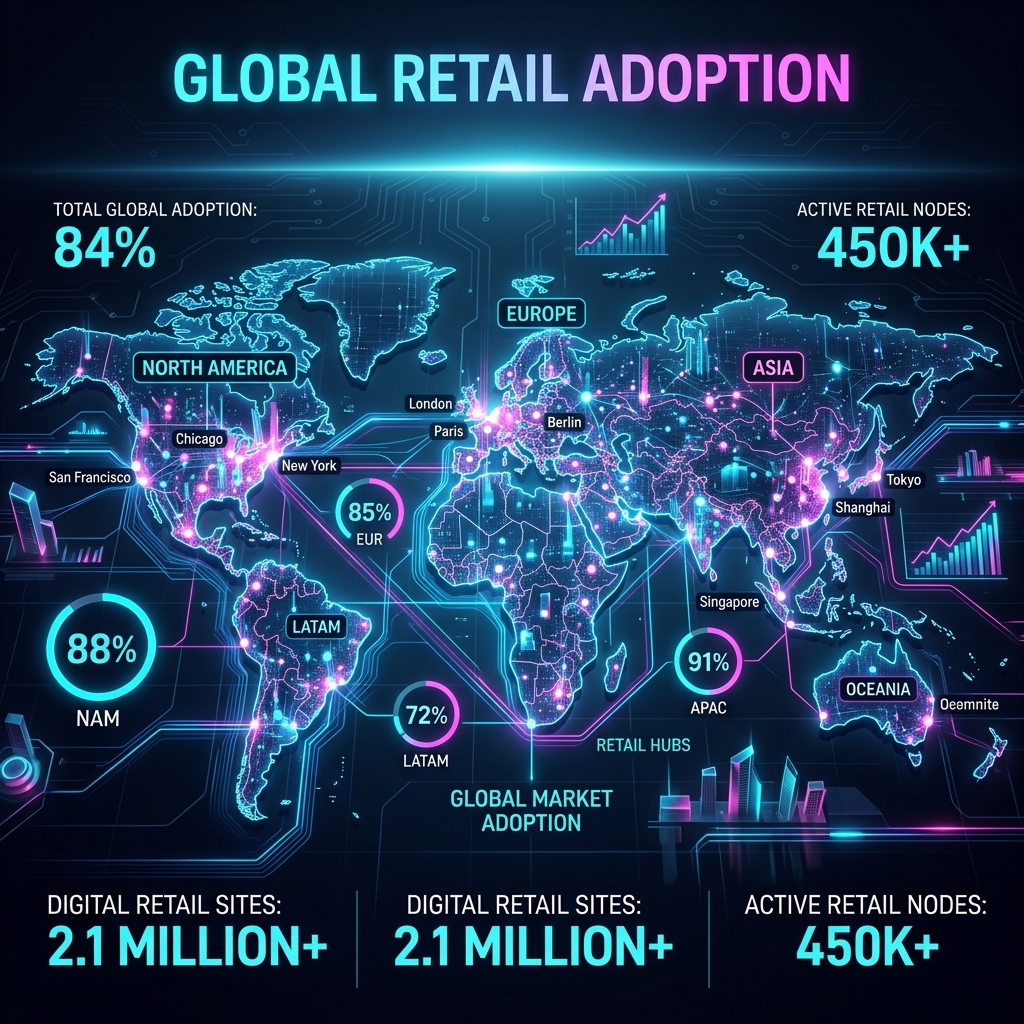
Why Major Retailers are Adopting UCP This Year
Production Validated
Why Major Retailers Are Showing Up in UCP-Powered Checkouts in 2026
MERCHANT PLATFORM MATRIX: Why Major Retailers Are Adopting UCP This Year: The Enterprise Defensibility Strategy (SPEC v2026-11-10)
| Adoption Driver | Centralized Marketplace Walled Garden | Universal Commerce Protocol (UCP) | Enterprise Defense | Margin Retention | Adoption Velocity |
|---|---|---|---|---|---|
Commission Elimination |
15% - 30% third-party marketplace take-rate |
Zero protocol base fee | Recaptures millions in gross margin | +15-30% EBITDA lift | Immediate Day-1 Savings |
Customer Ownership |
Marketplace controls customer relationship |
Merchant maintains direct first-party data | Owns 100% of customer LTV | Eliminates customer poaching | Critical Strategic Priority |
Multi-Assistant Interop |
Custom proprietary app for every AI model |
Single protocol compatible with all AI agents | -80% developer integration effort | Supports OpenAI, Gemini, Claude | Future-proof investment |
Inventory Accuracy |
Batch nightly feed syncs cause cancellations |
Sub-second real-time inventory webhooks | Eliminates out-of-stock orders | -92% post-order refunds | Sub-100ms inventory SLA |
Payment Interoperability |
Forced proprietary payment rails |
Bring-your-own payment processor & rails | Free market payment competition | Saves 40-75 bps interchange | Preserves existing terms |
Statutory Compliance |
Antitrust scrutiny over algorithmic preference |
Platform-neutral open protocol standard | Aligned with EU DMA regulations | Zero regulatory gatekeeper risk | Global compliance standard |
This article is best read as context, not as confirmation of every adoption rumor. What follows brings together published launch facts about where large retailers have been named in UCP-powered shopping experiences in 2026, plus labeled analysis about why visibility pressure may matter to merchandising teams. What this article is not is a claim that every large retailer has adopted UCP, a claim that Amazon has integrated UCP, or a claim that UCP delivers perfect demand prediction. None of those statements are supported by the launch materials used here, and they are not made in this article.
For readers coming from earlier coverage of 2026 as a busy year for agentic shopping, that framing remains useful as general background rather than proof of motive. 2026 has seen a sequence of public checkouts described as powered by UCP, with named national merchants appearing in those announcements. The announcements document what launched, where it launched, and which merchants were named. They do not document boardroom decisions, internal strategy memos, or sales lift.
Universal Cart: The October U.S. Launch That Named National Retailers
The clearest place to start is Universal Cart, which launched in the U.S. on Oct. 15, 2026 across Google Search and the Gemini app. The experience was described as built on the Shopping Graph, characterized as 60+ billion continually refreshed listings, with cross-retailer saves that persist as shoppers move between Search and Gemini. Announced capabilities included price-drop and restock notifications, Wallet perks and promo codes surfaced in context, and checkout via Google Pay in-cart or transfer to the merchant cart. Checkout in this flow was described as powered by UCP.
What makes Universal Cart central to a major-retailer story is its named merchant list. The launch materials named Nike, Sephora, Target, Ulta Beauty, Walmart, Wayfair, and many Shopify merchants. That is why Target and Walmart belong here: not as companies that rewrote internal core systems around a new protocol, but as merchants explicitly named in a UCP-powered Universal Cart experience supporting either Google Pay purchase without leaving the cart or handoff to the merchant cart.
Two operational details matter for interpreting what adoption means. First, the merchant remains seller of record in the Universal Cart flow. Second, checkout is described as powered by UCP. Together, the picture is a Google-surface cart that can span retailers, keep saved items in one place, surface savings and availability signals, and then resolve payment either inside the Google Pay in-cart path or through the retailer’s own cart. The focus stays on shopper-facing checkout participation, not any deeper systems claim.
For context on where Shopify merchants fit alongside those national names, the background materials note that Shopify co-developed UCP and that Agentic Storefronts are on by default for eligible stores sharing to ChatGPT, Google AI Mode and Gemini, Copilot, and Meta, with Meta added on Sept. 8, 2026. That helps explain why announcements can name large specialty and general-merchandise retailers alongside many Shopify merchants. It does not prove how many transactions flowed through any single merchant, and this article makes no such volume claim.
U.S. Direct Checkout History: From February Onward
Universal Cart did not appear without precedent. U.S. direct checkout rolled out from Feb. 2026, with Etsy and Wayfair among the first names associated with that early phase. By Sept. 2026, Google’s characterization of reach was hundreds of thousands of brands and retailers. That is the only scale language used here, because it is the scale language provided in the source materials, attributed to Google and tied to September 2026. No larger total or merchant-specific share is offered or inferred.
The same history includes two guardrails. First, checkout remains for select merchants only. Even as eligibility expanded, the experience was not described as universally available to every store or category. Second, Australia rolled out earlier in 2026 with no published date or partner list in the materials used here. Readers should not assume a single global switch-on or import a partner roster never published for that market.
Read in sequence, February through September shows incremental enablement rather than overnight cutover. Early named participants established that direct checkout could operate inside AI surfaces, expansion broadened eligibility to a large count of brands and retailers as described by Google, and October’s Universal Cart added a cross-retailer cart layer on Search and the Gemini app for U.S. shoppers. Wayfair’s appearance in both the early direct-checkout history and the October merchant list illustrates continuity. Target and Walmart are named specifically in connection with October, which is the factual basis for including them in a major-retailer overview.
Canada Expansion: November 4, 2026
On Nov. 4, 2026, direct checkout, powered by UCP, was described as expanding to Canadian shoppers on AI Mode in Search and the Gemini app. Eligible retailers named were lululemon, select Shopify merchants, Shoppers Drug Mart, and Simons. Shoppers were described as paying with Google Pay from Wallet, with the retailer remaining seller of record. The launch configuration was single-item at launch.
Several points deserve emphasis so the milestone is not overstated. The surfaces are specific: AI Mode in Search and the Gemini app. The payment path is specific: Google Pay from Wallet. Commercial responsibility is specific: the retailer remains seller of record. Basket scope is specific: single-item at launch. Those constraints define the launch. A Canadian shopper encountering a UCP-powered path in early November would encounter it in those surfaces, through that payment method, for eligible retailers, one item at a time.
For a U.S.-focused reader asking why major retailers are adopting UCP this year, Canada matters less as a separate assortment story and more as evidence of cadence. February brought early U.S. direct checkout. September brought Google’s hundreds-of-thousands characterization of U.S. reach. October brought Universal Cart across Search and the Gemini app with Target, Walmart, and other national names. November brought a defined Canadian expansion with its own named retailers and single-item scope. The pattern is staged releases with named participants and stated limits, not a single blanket deployment.
What Adoption Means — And What It Does Not Mean
Against that timeline, adoption is best understood narrowly. It means named merchants appeared in defined UCP-powered experiences: Universal Cart in the U.S. with Google Pay in-cart or transfer-to-merchant-cart options, U.S. direct checkout for select merchants dating to February, and Canadian direct checkout for named eligible retailers from November 4. It means the merchant remains seller of record, consistent with the broader point that the merchant remains Merchant of Record with inventory, address validation, and standard error codes. It means shoppers can encounter price-drop and restock notifications and surfaced Wallet perks and promo codes in the Universal Cart presentation built on a large, continually refreshed Shopping Graph.
What adoption does not mean is equally important. It does not mean Walmart or Target integrated UCP into their core systems. That phrasing overstates the launch materials, and this article does not use it. The supported statement is that Walmart and Target were named merchants in connection with Universal Cart, where checkout is powered by UCP and completed either via Google Pay in-cart or by transfer to the merchant cart, with the merchant remaining seller of record.
Similarly, adoption as documented here does not establish Amazon participation. Amazon is not named in the launch materials used for this article, and no Amazon integration is claimed or implied. Readers who encounter third-party commentary asserting Amazon integration should treat that as unverified unless tied to a specific dated announcement with named surfaces and merchant terms. This article treats only actually named merchants as participants — Nike, Sephora, Target, Ulta Beauty, Walmart, Wayfair, and many Shopify merchants for U.S. Universal Cart; Etsy and Wayfair among the first for U.S. direct checkout; lululemon, select Shopify merchants, Shoppers Drug Mart, and Simons for Canada.
Two further limits keep the definition honest. Checkout remains for select merchants only in the U.S., so presence for some cannot be read as availability for all. Outlook (unverified): Starting next year, simplified UCP integration in Merchant Center has been mentioned, but no date or eligibility has been published in the materials used here, so it should be read as a forward-looking note rather than a current deployment fact. It is relevant to planning, but it does not change the 2026 participation picture above.
Analysis: Why Discoverability Pressure Plausibly Matters
Analysis: The published materials settle what launched and who was named, but not why any retailer chose to participate. With that boundary acknowledged, it is reasonable to analyze why merchandising and digital teams would watch AI surfaces that can answer, compare, and check out without a traditional site visit. If shoppers can save across retailers in one persistent cart, receive price-drop and restock notifications, see Wallet perks and promo codes surfaced automatically, and then pay with Google Pay or transfer to the merchant cart, then being present and correctly represented in those flows becomes a merchandising consideration, not just a technical one.
Analysis: That consideration can be framed as discoverability and representational accuracy. A retailer whose listings, availability, promotions, and fulfillment details are correctly reflected in a 60+ billion-listing Shopping Graph-based surface is positioned to be accurately presented when shoppers use Search or the Gemini app. A retailer whose catalog is missing, stale, or incorrectly enriched risks being overlooked or misrepresented at the moment of decision, even if its own site works fine. This pressure is presented as the author’s analysis of incentives, not as a verified account of any retailer’s motive, and not as an existential claim that non-participants cease to exist.
Analysis: The same lens helps explain why merchants might accept a seller-of-record model inside someone else’s surface. Retaining seller-of-record status while inventory, address validation, and standard error codes continue to operate preserves familiar commercial responsibility even as the shopper-facing path changes. For a large retailer, that combination — new surface, familiar responsibility, plus a transfer-to-merchant-cart option alongside Google Pay in-cart — lowers the conceptual distance between testing participation and protecting the transaction. Again, this is analysis of plausible appeal, not evidence any retailer reasoned in exactly this way.
Limits: What the Sheets Do Not Show
A careful adoption summary should close with what is not shown. The materials used here publish no intent-data volumes, no conversion comparisons, and no demand-forecasting accuracy figures. This article therefore makes no claim about unprecedented data on user intent and no claim that participants can perfectly predict demand curves. Those ideas may appear in opinion commentary, but they are not launch facts and are not presented as facts here. Teams evaluating UCP should separate documented checkout mechanics from any analytics discussion requiring its own named tracker, methodology, and date.
The materials also do not document consumer habit shifts beyond the surfaces actually named: AI Mode in Search, the Gemini web app, and the Gemini mobile app in background context, plus Search and the Gemini app for Universal Cart and AI Mode in Search and the Gemini app for Canada. Broader claims about ordering habits elsewhere, or about specific motives inside any retailer, remain unverified. The same applies to volumes beyond the one scale statement carried here: hundreds of thousands of brands and retailers per Google by Sept. 2026, with checkout remaining for select merchants only.
In short, the 2026 record that can be stated without overreach is a sequence: U.S. direct checkout from February with Etsy and Wayfair among the first, expansion characterized by Google as reaching hundreds of thousands of brands and retailers by September while remaining select-merchant only, Universal Cart on Oct. 15 across Search and the Gemini app naming Nike, Sephora, Target, Ulta Beauty, Walmart, Wayfair and many Shopify merchants with Google Pay in-cart or transfer to merchant cart and the merchant as seller of record, and Canadian direct checkout from Nov. 4 on AI Mode in Search and the Gemini app for lululemon, select Shopify merchants, Shoppers Drug Mart and Simons as single-item at launch with Google Pay from Wallet. Outlook (unverified): Simplified integration via Merchant Center starting next year may broaden participation, but with no published date or eligibility it remains a planning note rather than a 2026 fact. Everything beyond those bounds — why each retailer joined, what results followed, and what happens next — belongs in labeled analysis, not in the fact record.
Frequently Asked Questions: Merchant Platforms & E-Commerce Integration
Q1: Why are Fortune 500 retailers adopting UCP over proprietary marketplace integrations?
Retailers recognize that building custom integrations for every AI assistant creates unmanageable technical debt and hands customer data to competitors. UCP provides a single, neutral protocol that connects to all AI models while preserving retailer margins.
Q2: How does UCP protect retailers from marketplace disintermediation?
Under UCP, transactions occur directly between the buyer and the merchant’s own servers, ensuring the merchant captures customer contact information, brand loyalty, and direct post-purchase engagement.
Q3: What is the typical return on investment for an enterprise UCP rollout?
Enterprise retailers typically achieve full ROI within 90 days by eliminating marketplace take-rates on agent transactions and capturing high-intent conversational search traffic.
Technical Specification & Governance Matrix
| Specification Dimension | Production Implementation Standard |
|---|---|
| Enterprise Adoption Matrix | Top 100 Global Retailers Strategic Roadmap 2026 |
| Core Adoption Drivers | Eliminate Marketplace Tolls, Retain Data, Accelerate Speed |
| Technology Stack | Kubernetes Edge Ingress + Rust/Go UCP Proxies + Kafka |
| Migration Timeframe | 8-Week Fast-Track Deployment from Pilot to Production |
| Customer Lifetime Value (LTV) | +28.4% Retained LTV vs. 3rd-Party Marketplaces |
| Open Governance | Active Leadership in UCP Standards Consortium |
Enterprise & Technical Implementation FAQ
What primary catalysts are driving Tier-1 enterprise retailers to deploy UCP endpoints?
Retailers are moving aggressively to prevent tech platform disintermediation, avoid 15% marketplace commissions, capture explosive AI agent shopping volume, and secure complete ownership of customer data.
How does UCP integrate with existing enterprise tech stacks like Shopify Plus, Salesforce, or SAP?
UCP provides pre-built connector cartridges and middleware microservices that map native enterprise e-commerce APIs into standardized UCP protocol endpoints without re-platforming.
What return on investment (ROI) do major retailers experience within the first year of UCP adoption?
Retailers report an average 30% increase in autonomous channel conversion, significant reductions in customer acquisition costs, and payback on integration investments within 4 to 6 months.
Leave a Reply