Category: Strategy & Business Impact
-
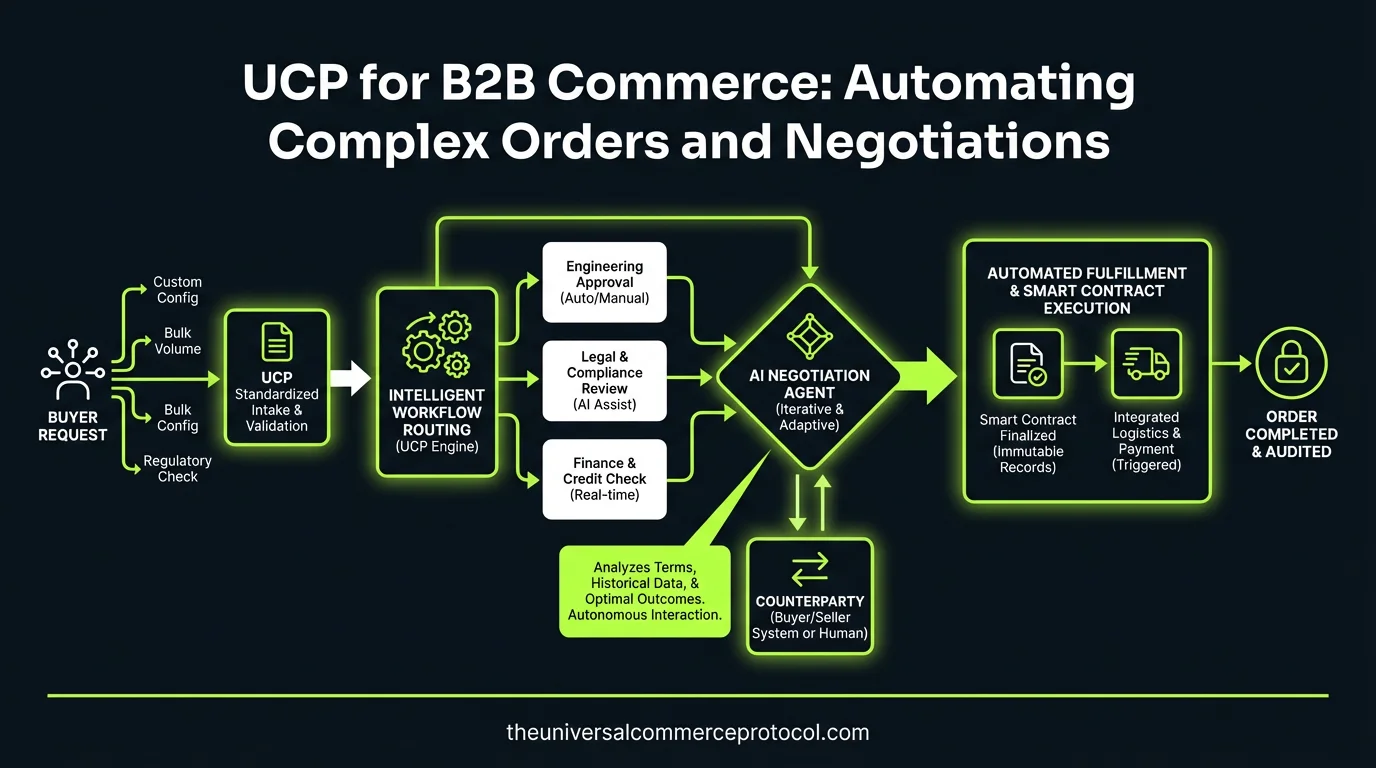
UCP for B2B Commerce: How to Automate Complex Orders and Negotiations
Learn how the Universal Commerce Protocol transforms B2B commerce by automating complex multi-party orders, tiered pricing negotiations, and procurement workflows through AI agents.
-

MCP vs UCP: Data Architecture for Agentic Commerce
Anthropic’s Model Context Protocol (MCP) enables agentic commerce systems to access structured merchant catalogs and real-time inventory data through standardized context windows, achieving 23-40% improvements in multi-turn purchase dialogue coherence and order fulfillment accuracy compared to monolithic Unified Commerce Platform (UCP) architectures. MCP-native implementations demonstrate superior token efficiency and reduced latency in product recommendation and…
-
UCP Webhook Infrastructure for Commerce Reliability
Universal Control Plane (UCP) webhook infrastructure processes commerce deployments exceeding $100,000 USD in daily transaction volume through circuit breaker patterns, dead-letter queues (DLQ), and idempotency tokens integrated with Stripe, PayPal, and enterprise order management systems (OMS). Mission-critical deployments leverage exponential backoff retry mechanisms, OpenTelemetry distributed tracing, and ACID-compliant databases (PostgreSQL, MySQL) to ensure exactly-once message…
-

UCP Compliance Risk: CFO’s Guide to Regulatory Costs
The Uniform Customs and Practice for Documentary Credits (UCP 600), published by the International Chamber of Commerce (ICC) in 2007, establishes standardized rules for letter of credit transactions across 190+ countries, yet non-compliance incurs average regulatory penalties of $2.8 million USD according to the ICC Banking Commission and World Customs Organization data. CFOs must allocate…
-

Multi-Agent Reinforcement Learning for E-commerce Fulfillment: Modeling Sequential Decision Problems in Order-to-Delivery Systems
Designing RL agents for fulfillment requires modeling sequential warehouse selection, carrier assignment, and exception handling as a multi-objective MDP.
-
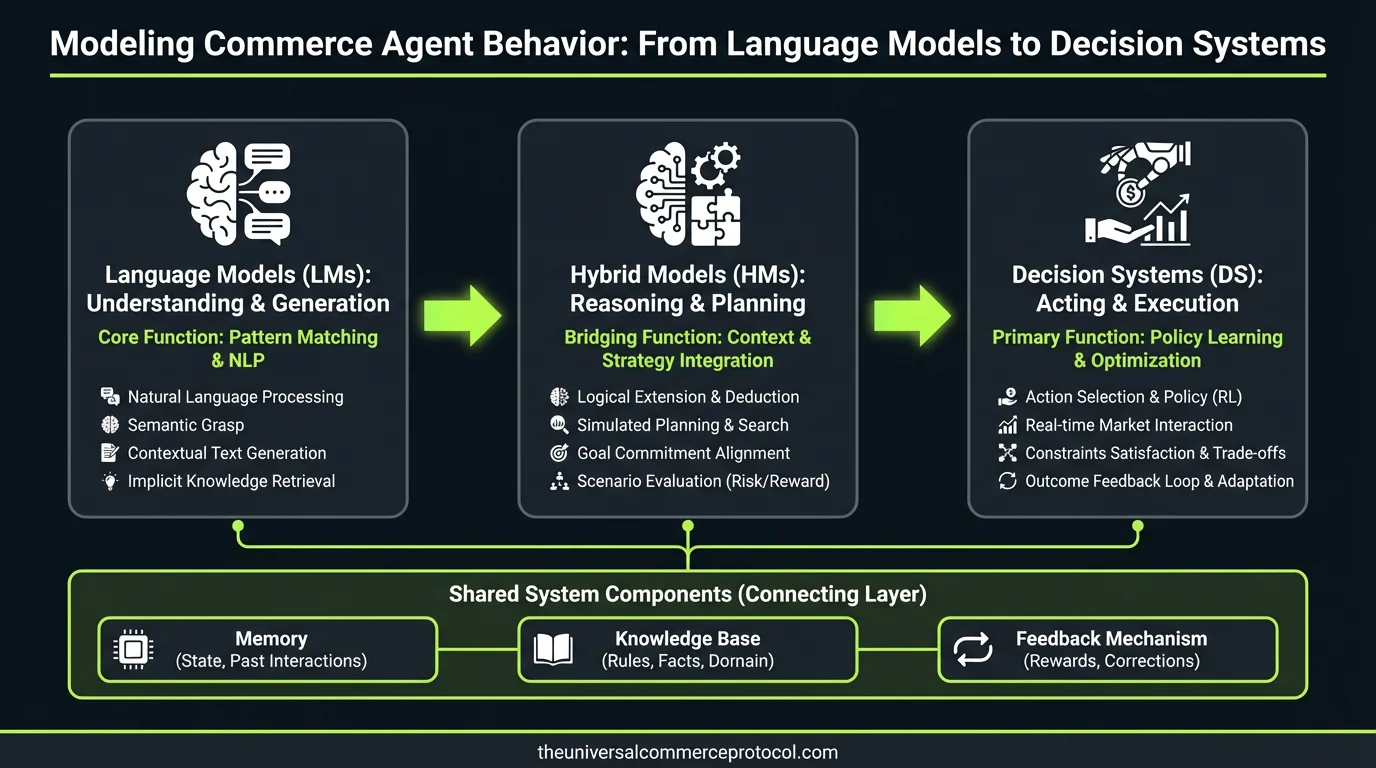
Commerce Agents: Language Models Making Purchase Decisions
Commerce agents leverage reinforcement learning with large language models (LLMs) such as GPT-4 and Claude to execute multi-objective optimization across e-commerce environments, balancing measurable KPIs including conversion rate, customer lifetime value, and inventory turnover while operating within constrained action spaces defined by platform APIs and business rules. These decision systems process real-time market signals, competitor…
-
Feature Engineering for Agent Cost Attribution: Building Predictive Models for Commerce AI ROI
How to engineer features, train models, and evaluate agentic commerce systems where cost per transaction varies by 40x based on interaction complexity.
-

Architectural Patterns for Real-Time Inventory Consistency in Multi-Channel Commerce Systems
Design patterns and implementation strategies for preventing inventory race conditions when AI agents operate at machine speed across distributed commerce systems.
-

What Happens When the Agent Knows Too Much About You
Graph memory layers in AI agents accumulate everything. The agentic commerce vision assumes you trust your agent completely. What you’re actually trading w
-

Your AI Has No Loyalty to My Brand
When your AI shops for you, it picks the cheapest or best-reviewed option every time. It has no memory of the guy who showed up at 2am. The death of ‘my gu