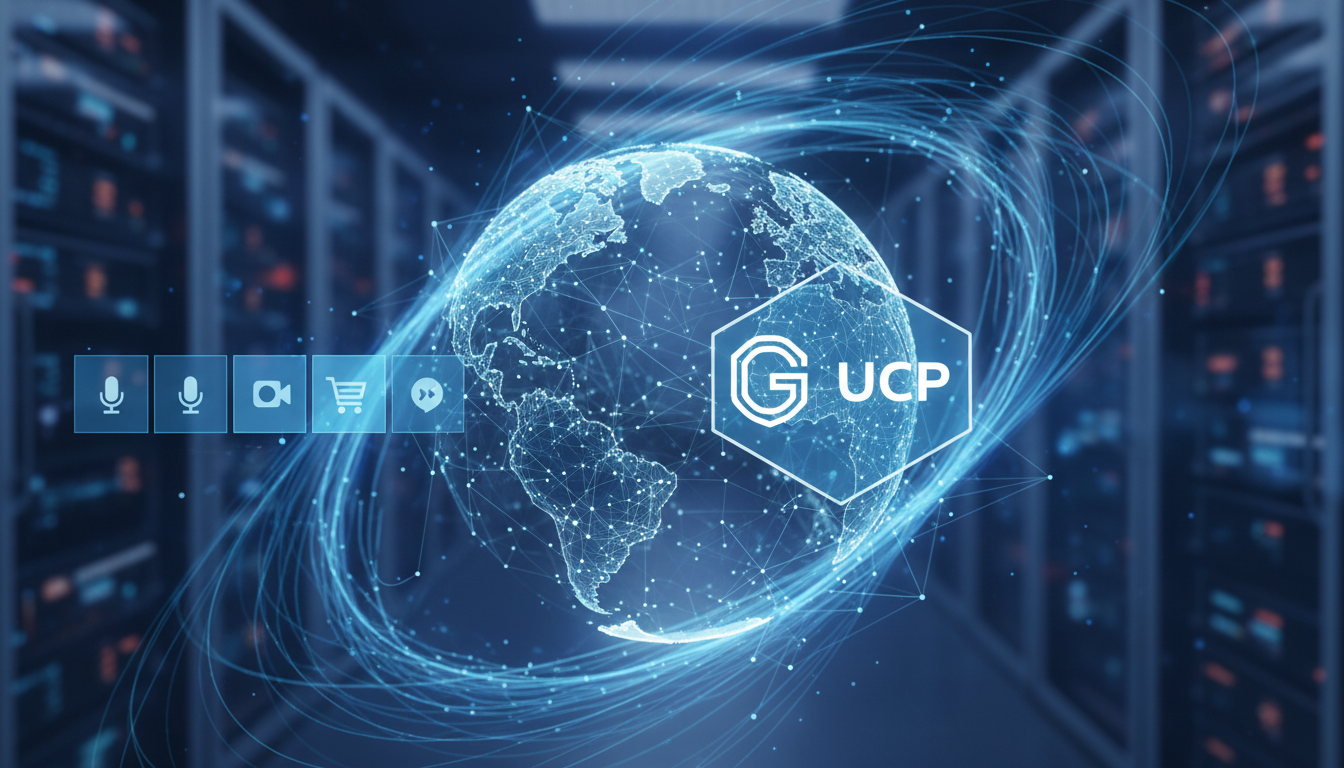
Key Takeaways (Late 2026 Update): The integration of Gemini Live API with UCP enables real-time, voice-driven autonomous shopping. Users can verbally negotiate prices, while UCP handles the backend inventory queries and secure checkout via AP2.
Gemini Live API & UCP: Enabling Real-time Voice & Video Commerce
For the modern Chief Technology Officer, the paradigm of e-commerce is shifting from reactive interfaces to proactive intelligence. We are witnessing the transition from ‘e-commerce’ to ‘agentic commerce,’ where the friction of the checkout funnel is replaced by the fluidity of natural conversation. At the heart of this revolution is the integration between Google’s Gemini Live API and the Universal Commerce Protocol (UCP). This combination allows for a low-latency, multimodal transactional layer that can interpret visual and auditory cues to execute complex commercial tasks in real-time.
The Death of Click-to-Buy
The traditional e-commerce model—characterized by search bars, category filters, and multi-step carts—is fundamentally built on the limitations of the web. It assumes that a user must navigate a graphical user interface (GUI) to declare intent. However, as we move into an era of ambient computing, the ‘click’ is becoming an obsolete metric of engagement. The Gemini Live API, when coupled with UCP, enables a ‘Zero-Click’ environment. In this model, the interface is the world itself. Whether a user is pointing their camera at a pair of sneakers on the street or discussing a recipe via a smart display, the transaction occurs within the flow of the experience, rather than as a redirection to a secondary site.
By leveraging UCP’s interoperability layer, CTOs can move away from siloed shopping apps toward a unified agentic ecosystem. In this new reality, the Gemini agent acts as the primary interface, while UCP handles the translation of high-level intent into the structured protocols required by Google Merchant Center (GMC) and payment gateways like Google Pay. This allows for Native Checkout experiences where the identity, payment method, and shipping logistics are resolved through UCP’s identity-linking signals, removing the need for traditional landing pages entirely.
Multimodal Intent Parsing
The true power of Gemini lies in its ability to process multimodal inputs—simultaneously analyzing video, audio, and text. For a commerce application, this means the agent can perform visual search and sentiment analysis in a single inference cycle. When a user says, ‘I want these, but in a more sustainable material,’ while pointing their camera at a product, Gemini must perform several complex operations: object recognition, attribute extraction, and intent mapping.
| Interaction Layer | Technology Component | UCP Integration Role |
|---|---|---|
| Visual Processing | Gemini Vision Pro | Extracts visual attributes for GMC Product Feed matching. |
| Voice Processing | Gemini Live API | Parses natural language intent and sentiment. |
| Knowledge Retrieval | Model Context Protocol (MCP) | Bridges the LLM to real-time inventory and SKU data. |
| Transactional Execution | Google Pay & UCP | Executes the secure payment and order placement. |
To facilitate this, the Model Context Protocol (MCP) serves as the standardized bridge. MCP allows Gemini to query the merchant’s product catalog with high precision. Instead of a generic web search, the agent uses MCP to access real-time availability, pricing variants, and supplemental feeds within the Google Ecosystem. This ensures that the agent isn’t just ‘hallucinating’ a product suggestion but is offering a valid SKU that is ready for immediate purchase through the UCP transactional layer.
Managing State in Live Streams
One of the primary technical hurdles in real-time commerce is maintaining state. In a live video stream, the context changes every millisecond. The user might move the camera, change their mind about a color, or ask for a price comparison. UCP manages this dynamic state by creating a continuous session token that links the Gemini inference results with the merchant’s backend. This ‘Transactional State Machine’ ensures that if a user says ‘Add that to my cart,’ the protocol knows exactly which frame of the video and which SKU was being discussed.
Native vs. Embedded Checkout Paths
CTOs must decide between Native and Embedded checkout paths. A Native Checkout, facilitated by UCP and Google Pay, occurs entirely within the Gemini interface. The user never leaves the ‘Live’ state. This is ideal for high-impulse, low-friction categories. Conversely, an Embedded Checkout might be used for high-consideration purchases requiring complex configuration (e.g., insurance or custom electronics), where the UCP handoff directs the user to a lightweight webview that retains the agent’s context. UCP’s advantage is its ability to support both, providing the flexibility to transition between an agent-led conversation and a structured checkout flow without losing the session’s data integrity.
Security in Voice Transactions
As commerce becomes more invisible, security becomes more paramount. Voice-activated transactions introduce unique risks, such as unauthorized ‘accidental’ purchases or deepfake audio attacks. UCP addresses these challenges by integrating Google’s advanced Risk Signals and Identity Linking. Every transaction initiated via the Gemini Live API requires a multi-factor handshake. This often involves biometric verification on the user’s primary device (e.g., a fingerprint or FaceID prompt) triggered by the UCP layer when the agent detects a high-value purchase intent.
Furthermore, UCP ensures compliance with local regulations, such as California Prop 65 or GDPR, by injecting these requirements into the agent’s reasoning engine. If a product identified via Gemini Vision requires specific legal disclosures, the UCP metadata feed ensures the agent communicates these before the purchase is finalized. This level of automated compliance is critical for global merchants who cannot afford the liability of unmonitored agentic transactions. By using UCP as the foundational layer, organizations ensure that their AI agents are not just smart, but also secure and compliant with the rigorous standards of the Google Ecosystem.
In conclusion, the marriage of Gemini Live and UCP represents a fundamental shift in the architecture of retail. By shifting from a GUI-centric model to an agent-first model, businesses can capture intent at the moment of inspiration. For the CTO, the roadmap is clear: move beyond the website and start building the protocols for a world where commerce happens at the speed of thought.
Frequently Asked Questions
What is Agentic Commerce?
Agentic commerce represents a shift from traditional reactive e-commerce interfaces to proactive, intelligent systems. Instead of users navigating search bars and category filters, the commerce experience flows naturally through conversation. The Gemini Live API and UCP work together to enable transactions through natural voice and video interactions, eliminating the friction of traditional checkout processes.
How does the Gemini Live API enable real-time transactions?
The Gemini Live API provides low-latency, multimodal communication that can interpret both visual and auditory cues. When integrated with the Universal Commerce Protocol (UCP), it creates a transactional layer capable of executing complex commercial tasks in real-time, allowing users to complete purchases through voice commands or by simply pointing their camera at a product.
What is Zero-Click commerce?
Zero-Click commerce is a transaction model enabled by the Gemini Live API and UCP integration that eliminates the need for traditional clicking interactions. Instead, the entire world becomes the interface—users can point their camera at products on the street or discuss purchases via smart displays, with transactions occurring seamlessly within the natural flow of conversation.
How does the Universal Commerce Protocol (UCP) work with Gemini Live API?
The UCP works alongside the Gemini Live API to create a unified transactional framework. While the Gemini Live API handles real-time voice and video communication with low latency, the UCP provides the commerce protocol layer that processes and executes transactions across this multimodal interface.
Why is traditional e-commerce becoming obsolete?
Traditional e-commerce models were built on the limitations of web interfaces, requiring users to manually navigate GUIs to declare intent through search and clicks. As ambient computing advances and natural conversation becomes the primary interface, these legacy methods create unnecessary friction. Agentic commerce eliminates this friction by enabling transactions within the natural flow of user experience.
Frequently Asked Questions
What is the Universal Commerce Protocol (UCP)?
The Universal Commerce Protocol (UCP) is an open standard developed to enable AI agents to autonomously conduct commerce transactions across any platform.
How does UCP enable agentic commerce?
UCP provides standardized APIs and protocols so AI agents can discover products, negotiate terms, and complete purchases without human intervention, working across any compatible commerce platform.
Why should businesses implement UCP?
UCP adoption reduces integration costs, opens revenue channels to AI-driven buyers, and future-proofs commerce infrastructure as agentic purchasing becomes mainstream.
Leave a Reply