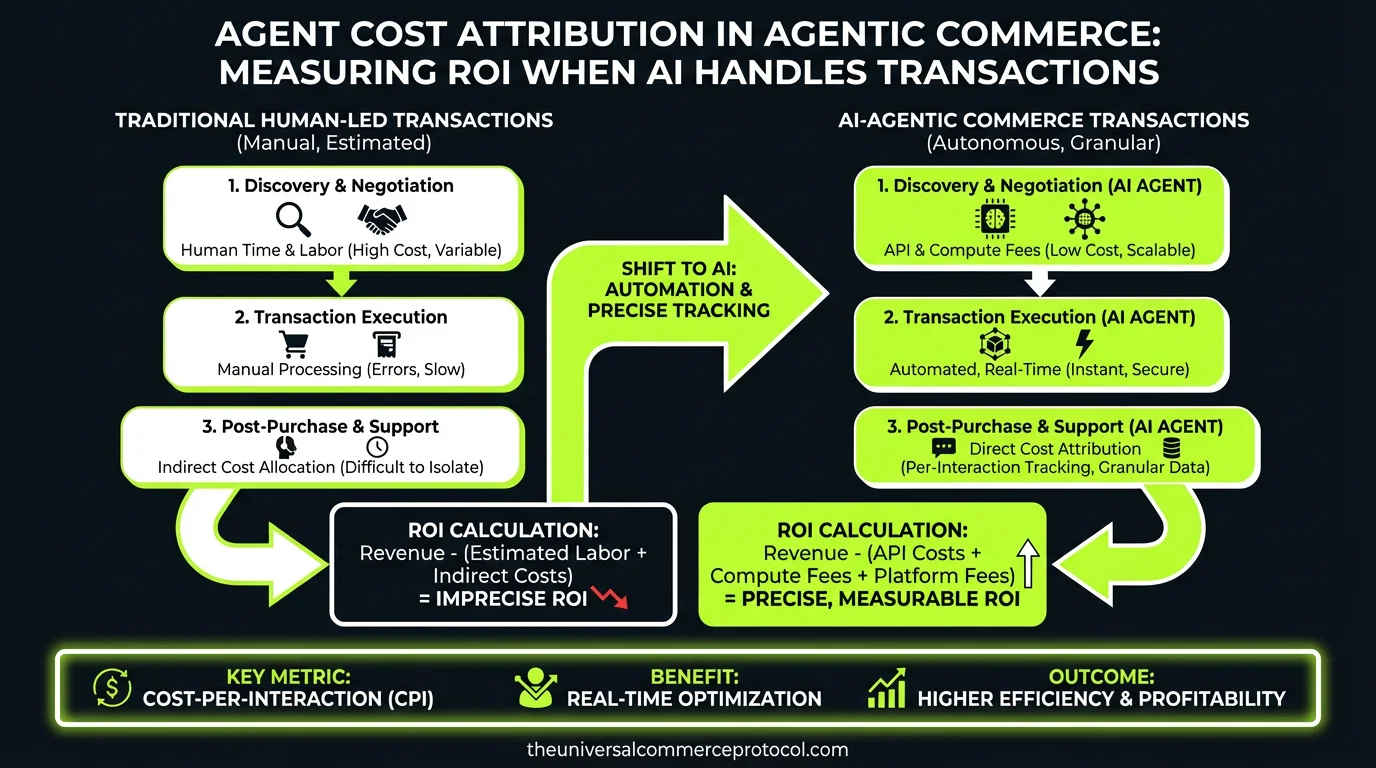
Gap: While 48 posts cover security, compliance, architecture, and hallucination detection, no article addresses the core merchant problem: how do you measure what an AI agent actually costs to run and whether it’s profitable per transaction?
Merchants deploying agentic commerce face a critical blind spot. They can instrument observability, detect fraud, and manage inventory—but they cannot easily answer: What did this agent cost me to complete that purchase?
This gap exists because cost attribution in agentic systems is fundamentally different from traditional commerce infrastructure. An agent doesn’t have a fixed cost per transaction. Its expenses scatter across LLM API calls, vector database lookups, order management system queries, payment gateway fees, and fallback human escalation. A single customer interaction may trigger 15–40 discrete API calls, each with its own latency, token count, and pricing model.
Why Traditional Cost Models Break Down
In 2025, Shopify merchants could calculate transaction cost as: (payment processor fee + hosting cost / transaction volume). Predictable. Linear. Wrong for agents.
An agentic checkout might:
- Call Claude API 3 times to disambiguate product intent (tokens: 2,100 in, 890 out; cost: ~$0.31)
- Query Pinecone semantic search for inventory (reads: 5; cost: $0.02)
- Execute 2 payment authorization calls via Stripe (cost: 2.9% + $0.30 = variable)
- Route to human agent if confidence falls below 0.75 (labor cost: $15–40 sunk)
- Write reconciliation record to data warehouse (compute: $0.06)
Total customer-facing time: 4.2 seconds. Total true cost: $16–18. Order value: $47. Margin erosion: 30–38%.
Traditional analytics dashboards show conversion rate and revenue. They don’t show agent cost per conversion, agent cost per channel, or which customer segments are unprofitable to serve via agent.
Frameworks for Agent Cost Attribution
1. Request-Level Granularity
Start by tagging every external API call with dimensional metadata:
agent_id(e.g., “checkout-agent-v3”)customer_segment(e.g., “repeat-high-ltv”, “new-mobile”)channel(e.g., “google-gemini”, “shopify-native”, “whatsapp”)intent_category(e.g., “size-clarification”, “price-check”, “multi-sku-bundle”)resolution_type(e.g., “agent-resolved”, “human-escalated”, “failed”)timestamp,latency_ms,tokens_in,tokens_out
This lets you calculate: Cost per intent category. If size-clarification intents cost 12¢ on average but price-checks cost 8¢, you can optimize prompts or routing for the expensive ones.
2. Transaction-Level Aggregation
Once a transaction completes (or escalates), sum all API costs, allocate fixed overhead, and attach the total to the order:
- LLM compute: sum all API calls
- Data retrieval: vector DB, inventory queries, customer profile lookups
- Payment processing: interchange + processor fees (pass-through)
- Human labor: if escalated, multiply minutes by burdened cost per minute ($0.50–$2.00)
- Infrastructure overhead: allocate a fraction of monthly Docker, Kubernetes, or serverless costs
Store this as agentic_commerce_cost on every order. Now your accounting team can compare agent margin to human phone support margin.
3. Cohort and Segment Analysis
Bucket transactions by segment and measure:
- Cost per completed transaction (full funnel)
- Cost per escalated transaction (false starts)
- Cost per failed transaction (hallucinations, timeouts)
- Cost per repeat customer vs. new customer
- Cost by device, geography, language, time-of-day
A B2B agent serving enterprise procurement might cost $8–12 per transaction but close 95% of intents. A D2C agent serving impulse mobile buyers might cost $0.60 per transaction but escalate 22% of complex size decisions. Neither is wrong—the segment determines what’s acceptable.
Operational Integration: Where Costs Live
LLM Inference Costs
Every major LLM provider publishes per-token pricing. For March 2026:
- OpenAI GPT-4o: $3.00 per 1M input tokens, $12.00 per 1M output tokens
- Claude 3.5 Sonnet (Anthropic): $3.00 per 1M input, $15.00 per 1M output
- Gemini 2.0 Flash (Google): $0.075 per 1M input, $0.30 per 1M output (via Vertex AI)
A 2,000-token input prompt with 600-token output on Claude costs: (2,000 × 0.000003) + (600 × 0.000015) = $0.015. If an agent makes 3–5 calls per transaction, plan for $0.04–$0.10 in LLM alone.
Batch routing matters. If you route 80% of intents to a cheaper model (Gemini Flash) and only route ambiguous cases to Claude, you can drop effective cost from $0.08 to $0.042 per transaction.
Data and Retrieval Costs
Vector databases (Pinecone, Weaviate, Milvus) charge per query or per stored dimension:
- Pinecone Starter: ~$0.0001 per vector search
- Weaviate Cloud: ~$0.004 per query (regional variations)
Also account for:
- Embedding generation (OpenAI: $0.02 per 1M tokens; Cohere: $0.10 per 1M)
- Inventory database queries (DynamoDB, PostgreSQL, Elasticsearch per-request or per-compute)
- Customer profile hydration (data warehouse scan cost)
For a 5-query agent interaction: ($0.0005 searches) + ($0.008 embeddings) + ($0.002 inventory) = ~$0.011 per transaction.
Payment and Compliance Costs
Stripe, Adyen, and PayPal charge on volume and gateway complexity:
- Standard card processing: 2.9% + $0.30
- 3DS authentication (required in EU): +0.5–1.2% of transaction value
- Fraud detection upgrades: flat +$0.10–$0.25 per transaction or 0.1% of volume fee
An agent authorizing a $100 order incurs: ($2.90 + $0.30) + (3DS if EU: +$0.50–$1.20) = $3.70–$4.40 in payment processing alone.
Implementation: Metrics to Track
Real-Time Cost Dashboard (For Ops/Finance)
- Agent cost per transaction (real-time rolling 1h): median, p95, p99
- Cost by intent category (stacked bar chart)
- Cost vs. margin by segment (scatter, 4-quadrant grid)
- Escalation cost impact: cost differential for human-routed orders
- Cost trend (30-day YoY): are model improvements reducing cost?
Per-Order Tagging (In Order Microservice)
Add these fields to order objects:
agentic_commerce_metadata: {
  cost_breakdown: {
    llm_inference_usd: 0.064,
    data_retrieval_usd: 0.011,
    payment_processing_usd: 3.70,
    human_escalation_minutes: 0,
    infrastructure_allocation_usd: 0.025
  },
  total_cost_usd: 3.80,
  order_value_usd: 47.00,
  agent_margin_pct: 91.9,
  cost_attribution_confidence: 0.98
}
Alerting Rules
- If p95 agent cost per transaction exceeds $X (segment-specific threshold), page the ML ops team
- If escalation rate exceeds Y% for a given agent version, trigger model retraining
- If customer segment Z has <50% agent margin, surface for business decision (agent unsuitable, need price adjustment, or need UX change)
Cost Optimization Tactics
Model Routing and Cascading
Route simple intents to cheaper models first. Only escalate to expensive models if confidence is low:
- Step 1: Query Gemini Flash (cost: $0.0015 for a simple size lookup)
- Step 2: If confidence < 0.80, call Claude (cost: $0.015)
- Step 3: If still < 0.70, escalate to human
This “cascade” strategy can reduce median cost by 35–50% versus always using the best model.
Caching and Semantic Deduplication
If two customers ask “what’s the difference between the 32oz and 40oz bottles,” the agent shouldn’t embed and search twice. Implement request-level caching (Redis) with semantic deduplication (Simhash or embedding distance):
- Cache hit rate target: 15–25% on high-volume intent categories
- Expected cost reduction: 10–18%
Batch Prompting and Few-Shot Optimization
Instead of a 1,500-token system prompt, profile and compress it. Use examples only for the current segment’s intent category. Reduce prompt bloat from 1,500 tokens to 800 tokens = 46% fewer input tokens.
Inventory and Price Cache Freshness Trade-Off
Query live inventory for every request (accurate but expensive). Query a 5-minute-stale cache (cheaper but risky). The optimal strategy: cache for browse/comparison, live query only for checkout. Cost savings: 20–35%.
FAQ: Cost Attribution in Agentic Commerce
Q: How do we allocate sunk costs (server infrastructure, engineering salaries)?
A: Use a monthly overhead rate. If your agentic platform costs $50,000/month to run and processes 1M transactions/month, allocate $0.05 per transaction as infrastructure. Track separately from marginal costs (LLM, payment). This helps board/CFO see true cost of scale.
Q: Should we charge customers a per-transaction agent fee?
A: Rarely. Instead, bake agent cost into product pricing. If your agent margin is 92% and competitor margins are 88%, you have a competitive advantage. Only charge explicit agent fees if you’re a platform selling agent-as-a-service to third-party merchants (e.g., Azoma, Zappi).
Q: What’s a healthy agent cost-to-order-value ratio?
A: Depends on segment. B2C e-commerce: 1–3% of order value. B2B procurement: 2–8% (more complex queries, higher AOV). High-touch luxury: 5–15%. Healthcare/compliance-heavy: 8–20%. Benchmark within your category.
Q: How do we track cost if the agent is running in a partner’s environment (e.g., Google Gemini)?
A: Use event webhooks. Google, Shopify, Anthropic all support callbacks that log cost/latency metadata back to your data warehouse. You own the attribution even if you don’t own the compute.
Q: Which cost categories are hardest to predict?
A: Human escalation. If your SLA requires a callback within 2 hours, escalated orders incur both agent cost AND 20–40 minutes of labor. This creates a “cost cliff.” Monitor escalation drivers (hallucinations, timeout patterns, intent ambiguity) to prevent cost blowups.
Q: Can we use cost attribution for A/B testing?
A: Yes, and you should. Compare cost per transaction across model versions, routing strategies, and prompts. A new agent version might increase conversion by 2% but increase cost by 8%—worth it or not depends on your margin. Cost is a first-class experiment metric, not an afterthought.
Q: How does agent cost compare to human support cost?
A: Human phone support: $25–60 per interaction. Human email support: $8–15 per response. Human chat support: $4–10 per conversation. An agentic agent: $0.50–$5 per resolved transaction, depending on model and domain. Agents are 5–50x cheaper but 10–20% lower satisfaction on complex issues. Hybrid is the mature strategy.
Next Steps for Your Org
- Week 1: Audit your current agent infrastructure for cost observability. Can you tag a single transaction and trace all its API costs? If not, start there.
- Week 2–3: Implement request-level cost capture (LLM, data, payment). Export to data warehouse.
- Week 4: Build cohort analysis: cost by segment, intent, channel, resolution type.
- Week 5+: Optimize using cascade routing, caching, and prompt compression. Measure cost reduction per lever.
Cost attribution isn’t glamorous. It won’t appear in your product roadmap. But it’s the difference between an agent that scales profitably and one that eats margin at scale.
Frequently Asked Questions
- Q: Why can’t traditional cost attribution models work for AI agents in commerce?
- A: Traditional models assume fixed, linear costs per transaction (payment fees + hosting divided by volume). However, agentic commerce is fundamentally different because costs scatter across multiple services: LLM API calls, vector database lookups, order management queries, payment gateways, and human escalation. A single customer interaction can trigger 15-40 discrete API calls, each with different latency, token counts, and pricing models, making traditional linear calculations obsolete.
- Q: What specific costs need to be tracked in agentic commerce transactions?
- A: You need to attribute costs across multiple components including LLM API calls (with per-token pricing), vector database lookups, order management system queries, payment gateway fees, and costs associated with fallback human escalation. Each of these has different pricing structures and may be triggered multiple times during a single transaction, requiring granular tracking at every step.
- Q: How many API calls does a typical agentic checkout generate?
- A: A single customer interaction in agentic commerce may trigger anywhere from 15 to 40 discrete API calls. This distributed architecture makes it challenging to calculate the true cost per transaction, as each call contributes to the total expense in different ways depending on the service provider’s pricing model.
- Q: What is the core merchant problem that existing solutions don’t address?
- A: While existing solutions cover security, compliance, architecture, and hallucination detection, merchants still cannot easily answer the fundamental question: “What did this agent cost me to complete that purchase?” This blind spot prevents merchants from understanding profitability and ROI on a per-transaction basis.
- Q: How does cost distribution affect profitability measurement in agentic systems?
- A: Because costs are distributed across multiple services with different pricing models and triggering frequencies, merchants cannot use simple profitability calculations. They need specialized cost attribution methods that can track and allocate expenses from 15-40 API calls per transaction back to individual customer interactions to accurately measure ROI.
Leave a Reply