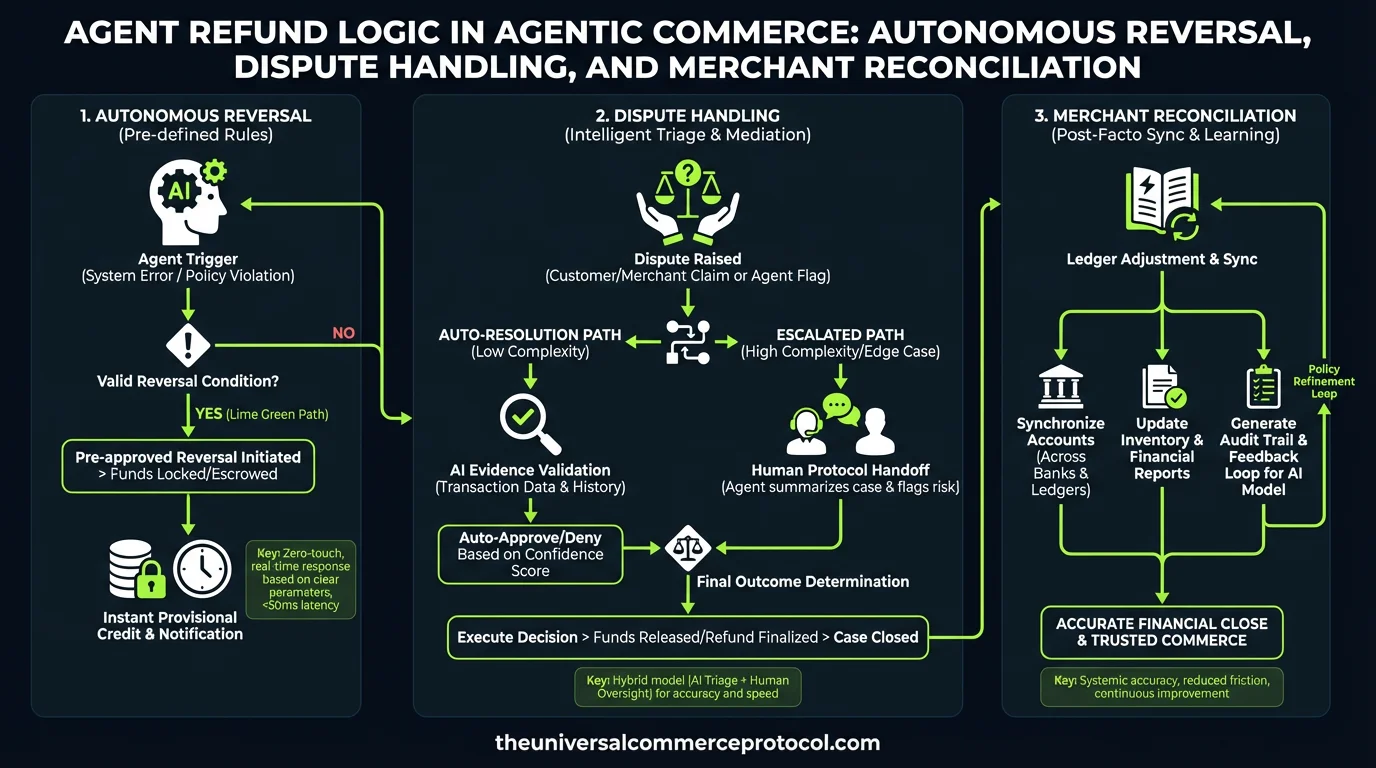
The Refund Problem in Agentic Commerce
Payment failures get monitored. Hallucinations get detected. But refund logic—the inverse operation of purchase—remains largely invisible in agentic commerce architectures. An AI agent that can confidently execute a $50K B2B transaction must also be able to reverse it, handle partial refunds, dispute chargebacks, and reconcile escrow accounts without human intervention. Yet most merchants treating agentic commerce today lack deterministic refund state machines.
The gap is structural. Traditional e-commerce refunds are merchant-initiated (customer requests → support team → manual processing). Agentic refunds must be agent-initiated: the agent discovers a problem, evaluates eligibility, calculates reversal amounts, coordinates with payment processors, notifies consumers, and updates inventory—often in parallel across multiple systems.
Why Refund Logic Matters More Than Purchase Logic
A purchase agent needs speed and accuracy. A refund agent needs speed, accuracy, and reversibility. If a purchase agent hallucinates and buys the wrong SKU, the refund agent must detect this, calculate the correct reversal, handle partial stock re-integration, and prevent duplicate credits. If a chargeback occurs 60 days post-purchase, the agent must reconstruct the transaction state, validate the refund reason, and coordinate with the payment processor’s dispute workflow.
Merchants operating at scale (Walmart, Target, DTC platforms with 100K+ daily agent-initiated orders) cannot afford serial refund processing. Yet parallel refund logic introduces race conditions: two agents both initiating refunds on the same order, or an agent reversing a payment that a human already processed manually.
Core Refund State Machine Architecture
Production refund agents operate across five deterministic states:
1. Detection & Eligibility
Agent receives a trigger: customer complaint, payment failure log, inventory mismatch, or merchant override. Agent queries the original transaction record (order ID, payment method, amount, timestamp, merchant account). Agent verifies refund eligibility: Was the order completed? Is it within the refund window (30/60/90 days by policy)? Is the item returnable? Has a refund already been issued?
Critical: Agent must check a distributed refund ledger, not just the order database. A refund initiated 2 hours ago by a human support agent may not yet be reflected in the transactional database.
2. Reversal Calculation
Full refund or partial? Agent determines scope: item refund only, or item + shipping + tax? Did the customer use a coupon? Does the reversal include restocking fees or payment processor chargebacks?
For B2B orders with volume discounts or for multi-SKU orders where only one item is refundable, the calculation is non-trivial. An agent must reconstruct the original pricing, apply any refund adjustments, and calculate net refund amount.
Example: Order of 100 units at $50/unit with 10% volume discount = $4,500 total. Customer returns 25 units. Refund agent must apply proportional discount ($1,125 base + restock fee deduction) and issue $1,050 credit.
3. Payment Processor Coordination
Agent must route the refund to the correct payment system: card network (Visa, Mastercard), ACH (for bank transfers), PayPal, cryptocurrency, or merchant account escrow. Each has different latency, reversibility windows, and idempotency guarantees.
Card refunds typically post within 3–5 business days. ACH reversals are final after 2 days. PayPal disputes can remain open for 180 days. Cryptocurrency transactions are irreversible.
Agent must initiate the refund with a processor API call (Stripe, Square, etc.) and receive a transaction reference. If the call fails, agent must implement retry logic with exponential backoff and, critically, must not re-issue the same refund on retry (idempotency key required).
4. Multi-System Notification & State Update
Once payment processor acknowledges the refund, agent must atomically update: order status (marked refunded), inventory system (return units to available stock if applicable), customer notification system (send refund receipt), and merchant ledger (deduct from revenue, update reconciliation). Agent must write to a refund audit log (timestamp, amount, reason, processor reference, agent ID) for compliance and chargeback defense.
If any system is unavailable, agent must implement compensation logic: record the pending refund state and retry asynchronously, rather than rolling back the payment processor transaction (which is often irreversible).
5. Dispute & Reversal Handling
Customer files a chargeback claiming they never received the refund, or payment processor denies the reversal request. Agent must query the refund status with processor, retrieve evidence (refund confirmation, proof of delivery, customer communication), and auto-escalate to a merchant dispute team if the chargeback window is open.
Idempotency and Duplicate Prevention
The most common refund failure: two parallel agents both detecting the same problem and both issuing refunds. Merchant receives duplicate credits.
Mitigation: Distributed refund lock. Before initiating a reversal, agent acquires a lock on the order ID in a centralized refund state store (Redis, DynamoDB with conditional writes). Lock TTL is 5 minutes. If lock acquisition fails, agent knows a refund is already in progress and escalates or retries.
Additionally, agent must generate an idempotency key (hash of order ID + refund reason + amount) and pass it to the payment processor API. Processor returns success if the same key is resubmitted, preventing duplicate reversals.
Partial Refunds and Bundled Orders
Most complex scenario: Customer returns 2 of 3 items from an order, one item has a 15% restocking fee. Agent must calculate partial refund, coordinate with inventory system to accept the return, and manage the remaining balance owed by the customer if they originally overpaid.
For bundled or subscription orders (e.g., 3-month plan), agent must determine: Is refund pro-rated to the unused period? Does the customer lose early-termination discounts? Agent queries the original contract terms and applies refund policy rules.
Chargeback and Dispute Workflows
If a customer initiates a chargeback or payment processor initiates a reversal, agent must:
1. Receive notification from processor webhook (chargeback filed, under review, lost, won)
2. Query the original order and any prior refunds
3. If chargeback is invalid (refund was already issued), compile evidence and auto-submit a rebuttal with proof of credit
4. If chargeback is valid (no refund was issued), issue corrective refund and notify processor
5. If chargeback is lost and cannot be reversed, escalate to merchant finance team and deduct loss from merchant account
Major payment processors (Stripe, Square) provide dispute APIs. Agent queries dispute status, retrieves required evidence fields, and auto-uploads proof (refund confirmation, shipping proof, communication logs).
Observability and Reconciliation
Refund agents must be deeply observable. Refund failures are high-cost: a failed reversal can trigger chargebacks, regulatory fines, and customer disputes.
Instrumentation checklist:
- Refund eligibility checks (passed/failed, reason if failed)
- Payment processor API latency (initiation → confirmation)
- Idempotency key collisions (detected duplicates)
- Inventory system reconciliation lag (refund issued vs. units returned)
- Dispute status updates (chargeback filed, under review, resolution)
- Manual escalations (agent routed to merchant review)
Merchants should reconcile agent-initiated refunds daily against payment processor settlement files. Discrepancies (refund issued but not posted, or posted twice) must be flagged and corrected within 24 hours.
Common Refund Agent Failure Modes
Race Condition on Duplicate Refund: Two agents detect the same failed order and both issue refunds. Mitigation: Distributed refund lock + idempotency keys on processor.
Partial Refund Miscalculation: Agent refunds wrong amount due to missing discount context or tax recalculation. Mitigation: Agent reconstructs full order context (line items, discounts, taxes) before calculating reversal.
Chargeback Rebuttal Failure: Agent submits dispute evidence too late or with missing fields. Mitigation: Agent monitors chargeback deadline (typically 10 days from notification) and pre-compiles required evidence immediately.
Escrow Coordination Lag: Agent issues refund before merchant account has sufficient balance in escrow. Mitigation: Agent reserves funds in escrow atomically with refund issuance, or routes refund through merchant credit line if available.
Notification Delays: Customer refund is approved but notification email fails, leading to customer support inquiry. Mitigation: Agent retries notification with exponential backoff and escalates if undeliverable after 3 attempts.
FAQ
Q: Can an agent refund without merchant approval?
A: Policy-dependent. High-confidence scenarios (payment processing error, inventory mismatch detected by agent) may auto-trigger refunds. Warranty or return claims typically require merchant approval or follow a pre-set rule engine. Agents should escalate ambiguous cases.
Q: How long can an agent wait for a refund to settle?
A: Card networks post refunds in 3–5 business days. ACH in 2+ days. Agent should not block the transaction state update; refund is marked “issued” immediately and reconciled asynchronously.
Q: What if the payment method is no longer valid (card closed, account deleted)?
A: Payment processor will reject the refund. Agent must detect this, escalate to merchant, and may issue credit to merchant account or alternative payment method (if customer provided).
Q: Should agents handle subscription refunds differently?
A: Yes. Subscription refunds often pro-rate based on unused periods. Agent must query subscription state (active, paused, canceled), apply pro-rating logic, and may also need to reverse recurring billing authorizations.
Q: How do agents prevent refund fraud?
A: By tracking refund velocity (refunds per customer per day), refund reason distribution, and correlating with chargeback patterns. Agents should also validate that refund reason matches order characteristics (e.g., “never received” but item was delivered).
Q: Can agents issue refunds for orders from third-party marketplaces?
A: Only if agent has API access to the marketplace’s refund system and merchant has delegated authority. Most marketplaces (Amazon, eBay) require marketplace-native refund workflows. Agent should route requests to marketplace and track status.
Leave a Reply