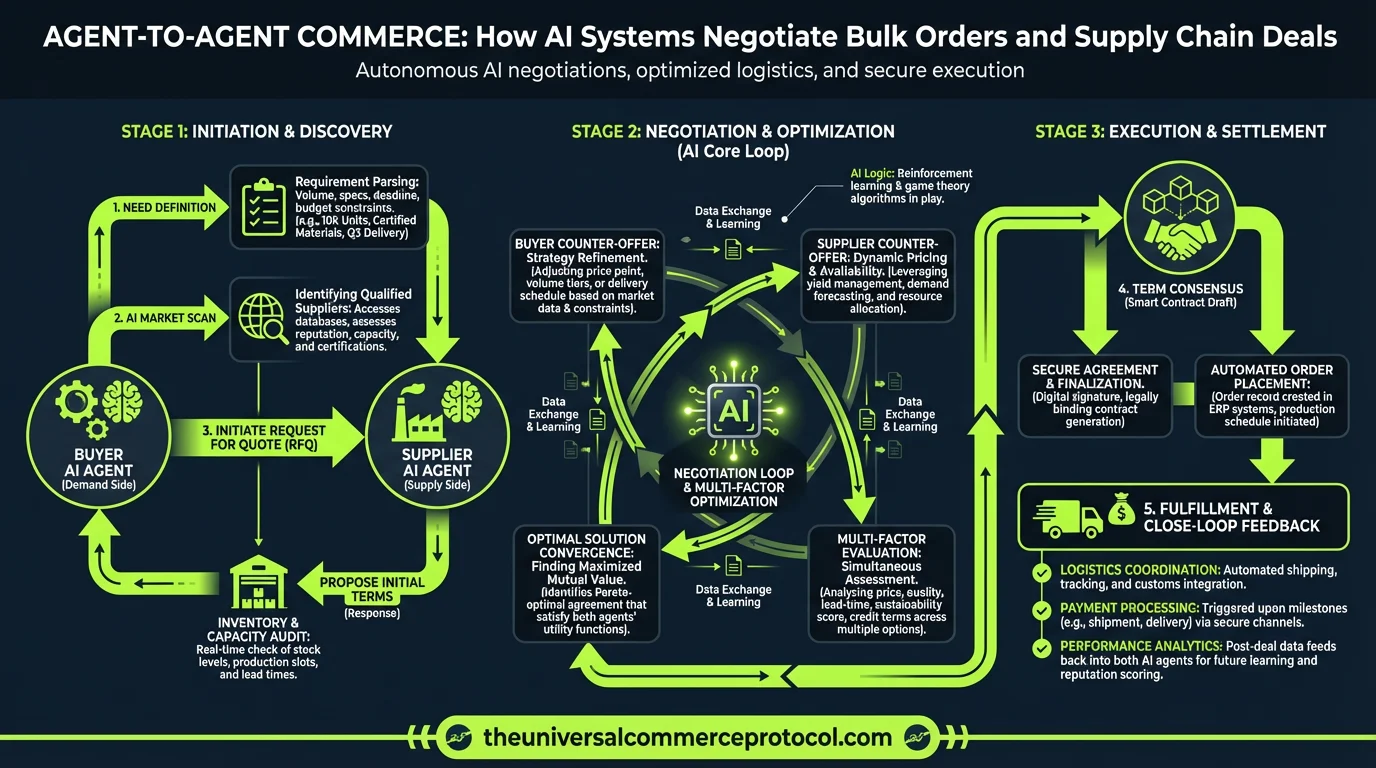
The Universal Commerce Protocol was built to enable AI agents to buy on behalf of consumers. But a new use case is emerging in the shadows: agent-to-agent commerce—where autonomous systems negotiate directly with each other, often without human involvement in real time.
This shift from agent-to-merchant to agent-to-agent creates entirely new operational, compliance, and financial risks that current agentic commerce frameworks don’t address.
What Is Agent-to-Agent Commerce?
Agent-to-agent commerce occurs when one AI agent (representing a buyer) negotiates terms, pricing, delivery, and payment directly with another AI agent (representing a seller) without synchronous human approval at each step.
Example: A procurement agent for a mid-market retailer autonomously negotiates a bulk fabric order with a supplier’s sales agent. The agents exchange quantity commitments, pricing tiers, payment terms, and shipping schedules—then execute the deal within pre-approved parameters.
This differs fundamentally from agent-to-consumer commerce, where human customers remain the economic actors. In agent-to-agent scenarios, the agents themselves become negotiators, and humans review outcomes asynchronously.
Where Agent-to-Agent Commerce Already Exists
Procurement and Supply Chain: Companies like Flexport and Shopify’s procurement tools are experimenting with AI agents that autonomously source materials from supplier networks. These agents compare pricing, lead times, and supplier ratings—then commit to orders within budget thresholds.
Marketplace Bulk Orders: B2B marketplaces (Amazon Business, Alibaba, Global Sources) are enabling merchant agents to negotiate volume discounts directly with seller agents, locking in tiered pricing without human negotiators.
Logistics and Fulfillment: 3PL networks use autonomous agents to negotiate carrier capacity, rates, and service levels in real time—especially for time-sensitive shipments where human negotiation is too slow.
Energy and Commodities Trading: Trading firms use AI agents to negotiate futures contracts, energy purchases, and commodity swaps on behalf of larger institutions. These systems operate at millisecond speeds, far faster than human traders.
Why Agent-to-Agent Commerce Breaks Current Frameworks
Gap 1: Approval Workflows Designed for Single Actors
Current UCP compliance assumes a human decision-maker (the consumer) is central to commerce. Approval workflows track: did the human authorize this purchase? Can the human dispute it?
Agent-to-agent commerce inverts this: two autonomous systems agree on terms, then humans discover the deal is done. If a procurement agent commits to a $500K fabric order based on a misread market signal, the merchant’s finance team finds out after the deal closes—not before.
Gap 2: Liability When Both Parties Are Machines
A merchant’s refund policy protects consumers. A consumer can dispute a charge; a chargeback reverses it. But when two agents negotiate, who bears the loss if the deal goes wrong?
Scenario: Supplier Agent A quotes $2/unit for widgets. Buyer Agent B accepts. Two hours later, Supplier Agent A’s parent company realizes the quote was erroneous (the agent was trained on stale pricing data). The supplier wants to cancel. Buyer Agent B has already restructured its inventory plan around the order.
Current agentic commerce frameworks don’t address: agent-to-agent liability, mitigation bonds, or automated dispute resolution between autonomous systems.
Gap 3: Hallucination Risk Scales Across Organizations
When a consumer-facing agent hallucinates a product detail, the damage is localized: one customer gets the wrong item. When a procurement agent hallucinates a supplier’s compliance certification or delivery capability, the risk cascades: a retailer’s supply chain breaks; downstream orders fail; customers experience stockouts.
Agent-to-agent deals amplify hallucination risk because both systems operate on imperfect knowledge, and errors compound before humans can intervene.
Technical Requirements for Safe Agent-to-Agent Commerce
Mutual Observability Contracts: Before two agents negotiate, they must exchange real-time snapshots of: inventory accuracy, pricing authority limits, and decision-making constraints. This prevents one agent from claiming later that it was misled.
Probabilistic Confidence Scoring: Agents should flag deals below a confidence threshold (e.g., “I’m 67% certain this supplier can deliver on time”). Deals below a human-defined floor require escalation before closing.
Automated Escrow and Reversals: Payment should be held in escrow until both agents confirm deal fulfillment. Rollback mechanisms must trigger if delivery timelines slip or specs diverge.
Agent Identity and Attestation: Each agent must cryptographically prove its authority level (e.g., “I can commit to orders up to $250K”). Forged authority claims should void deals retroactively.
Regulatory Uncertainty
No regulator has yet defined agent-to-agent commerce. Key open questions:
• Who is liable for agent misconduct? The merchant who deployed the agent? The AI vendor? Both?
• What audit trail must exist? Can agents be allowed to negotiate off-chain, then settle on-chain?
• Are agent-negotiated deals enforceable? Can a merchant sue a supplier’s agent, or only the supplier itself?
The SEC, FTC, and state attorneys general have not yet issued guidance. Early movers in procurement and supply chain are operating in a regulatory gray zone.
FAQ
Q: Is agent-to-agent commerce already covered by UCP?
A: No. UCP v1 assumes human consumers are parties to commerce. Agent-to-agent deals involving business-to-business transactions, procurement, and supply chain fall outside current scope. UCP v2 will likely address this, but standards are not yet finalized.
Q: What’s the difference between agent-to-agent and API automation?
A: API automation requires humans to write and approve rules (e.g., “buy 100 units if price < $5”). Agent-to-agent commerce allows agents to negotiate terms that weren’t pre-defined—like custom payment schedules or volume commitments.
Q: Should merchant agents be allowed to negotiate without pre-approval?
A: It depends on the deal size, supplier risk, and market volatility. Procurement agents should operate within budget and supplier authority lists, but absolute pre-approval for every transaction is impractical at scale. Risk-based approval (approving small deals, escalating large ones) is emerging as best practice.
Q: What happens if an agent negotiates a deal that violates company policy?
A: Current merchant systems log agent actions but don’t prevent out-of-policy deals in real time. As agent-to-agent commerce scales, merchants will need policy-aware agents that refuse negotiations outside defined bounds—similar to how trading algorithms refuse trades that violate risk limits.
Q: Are there insurance products for agent-to-agent commerce risks?
A: Early-stage. Some cyber insurance carriers are adding “AI agent liability” riders, but coverage is limited and premiums are high. This market is nascent and will expand as adoption grows.
Q: Could agent-to-agent commerce lead to collusion or market manipulation?
A: Yes. If multiple buyer agents from competing retailers all negotiate with the same supplier agent, regulators may scrutinize whether those agents are pricing collusion. Antitrust agencies are beginning to focus on algorithmic collusion; agent-to-agent commerce is likely to trigger enforcement action if agents are seen to coordinate pricing.
What Merchants Should Do Now
1. Audit agent authority levels: Define hard limits on what deals agents can autonomously commit to. Start conservative.
2. Implement deal review workflows: Even if agents negotiate autonomously, humans should review and approve deals above a threshold before final commitment.
3. Monitor for hallucination patterns: Track cases where agents misquoted supplier specs, pricing, or delivery times. This is your early warning system for agent reliability.
4. Establish agent-to-agent trust anchors: Before deploying procurement agents, require suppliers to attest to their agent’s competency and authority via digital signatures or blockchain-backed credentials.
5. Prepare for regulatory change: Assume regulators will require audit trails, liability chains, and approval workflows for agent-negotiated deals. Build infrastructure now that will survive tighter rules later.
Agent-to-agent commerce is not a distant future. It’s happening in procurement, logistics, and trading today. Merchants who build safe infrastructure now will move faster when standards emerge.
Frequently Asked Questions
- What is agent-to-agent commerce?
- Agent-to-agent commerce occurs when one AI agent (representing a buyer) negotiates terms, pricing, delivery, and payment directly with another AI agent (representing a seller) without synchronous human approval at each step. For example, a procurement agent for a retailer might autonomously negotiate a bulk fabric order with a supplier’s sales agent, exchanging quantity commitments, pricing tiers, payment terms, and shipping schedules—then execute the deal within pre-approved parameters.
- How does agent-to-agent commerce differ from traditional agent-to-consumer commerce?
- In agent-to-consumer commerce, human customers remain the economic actors while AI agents assist them. In agent-to-agent commerce, the AI systems themselves become negotiators, with humans reviewing outcomes asynchronously rather than approving each transaction in real time. This creates a fundamentally different operational model where autonomous systems handle direct negotiations.
- What new risks does agent-to-agent commerce introduce?
- Agent-to-agent commerce creates entirely new operational, compliance, and financial risks that current agentic commerce frameworks don’t adequately address. These include autonomous deal execution without real-time human oversight, potential compliance violations, financial exposure from unauthorized commitments, and challenges in auditing and accountability when agreements are made between systems.
- What types of deals can AI agents negotiate in agent-to-agent commerce?
- AI agents can negotiate various B2B transactions including bulk orders, supply chain deals, pricing agreements, delivery schedules, and payment terms. The agents operate within pre-approved parameters set by their organizations, allowing them to autonomously handle negotiations that would typically require human involvement.
- Why is the Universal Commerce Protocol important for agent-to-agent commerce?
- The Universal Commerce Protocol was initially built to enable AI agents to buy on behalf of consumers. However, it’s now being adapted to support agent-to-agent commerce scenarios, though current frameworks need enhancement to properly address the unique operational, compliance, and financial risks associated with autonomous system-to-system negotiations.
Leave a Reply