The Unspoken Problem: Agents Still Need Human Permission
Every agentic commerce implementation today has a human in the loop—either at authorization, confirmation, or dispute resolution. A customer’s shopping agent browses products, but the customer approves the purchase. A merchant’s inventory agent flags stock, but a human replenishes it. This model works for B2C, but it breaks at scale in B2B and supply chain scenarios.
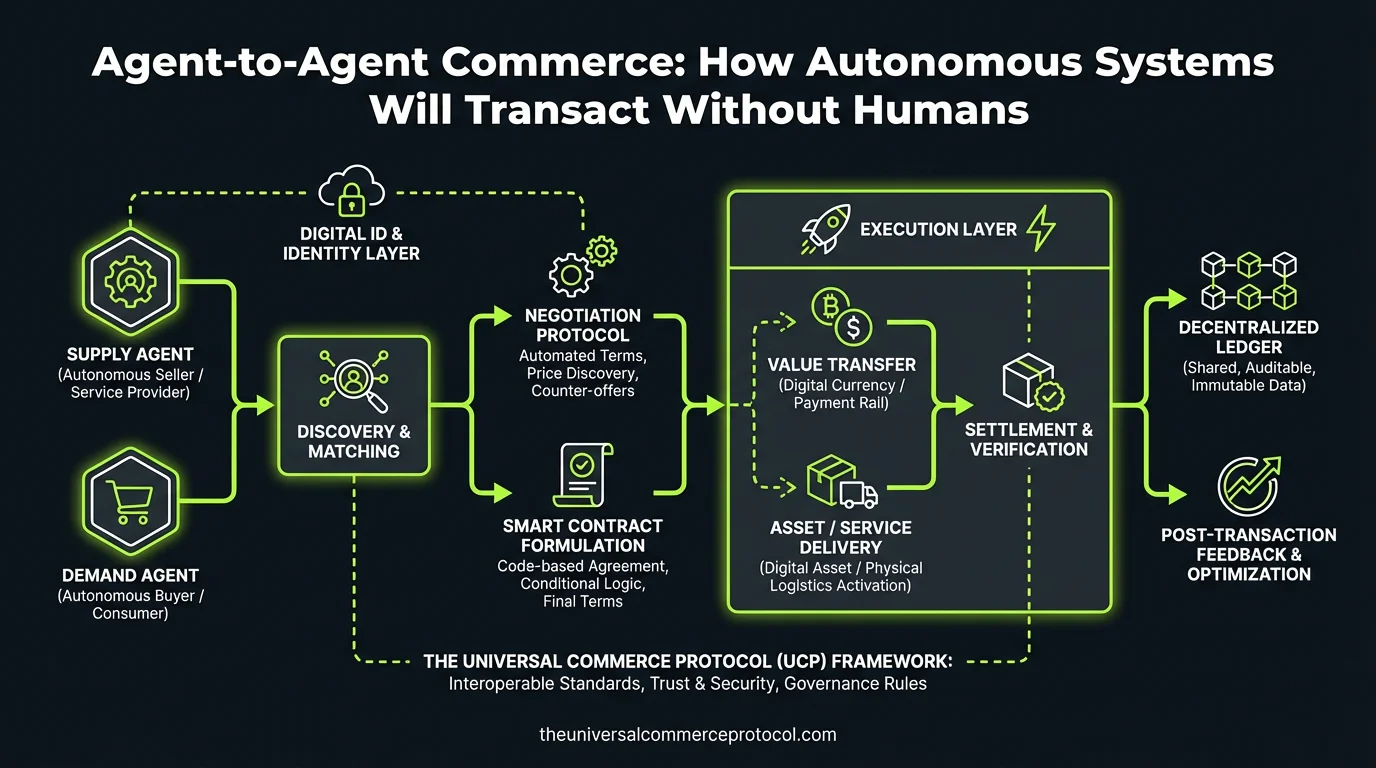
Agent-to-agent (A2A) commerce removes that bottleneck. An automotive parts supplier’s inventory management agent directly negotiates with a manufacturer’s procurement agent. A logistics agent from Shipper A contracts with a fulfillment agent from Provider B. No email threads. No purchase order delays. No human click required.
This isn’t science fiction—it’s the logical next step in agentic commerce maturity, and it introduces an entirely new class of problems: agent liability, contract binding, dispute resolution between non-human parties, and the cryptographic proof required to make it work at scale.
Why A2A Commerce Is Inevitable (And Why It’s Terrifying)
Traditional commerce assumes human judgment at key decision points. But humans are slow. A B2B supplier managing inventory across 200 SKUs and 50 customers cannot manually approve every reorder. A logistics network with dynamic pricing cannot wait for a human to decide which carrier gets which shipment.
Agents can.
Imagine a scenario: A restaurant chain’s demand-forecasting agent predicts a 15% spike in chicken wing sales for Super Bowl Sunday. It autonomously negotiates with three poultry suppliers’ procurement agents simultaneously. Within seconds, contracts are drafted, pricing locked, and delivery windows confirmed—all before any human manager knows a negotiation happened.
This is already happening at scale in financial markets. Trading algorithms execute millions of transactions daily without human intermediation. Commerce is simply behind the curve.
The risk: if agents can transact autonomously, they can also make catastrophic mistakes autonomously. A pricing agent miscalculates margins and locks in thousands of unprofitable orders. A logistics agent overcommits capacity. A supply chain agent cascades a shortage across an entire network in minutes instead of days.
The Technical Requirements for A2A Commerce
1. Verifiable Intent at Machine Scale
Today’s Verifiable Intent systems (like those being built by Mastercard and Google UCP) are designed for human-initiated transactions. A human signs a transaction; a merchant receives cryptographic proof of intent.
A2A systems need bidirectional intent verification. Agent A must cryptographically prove its authorization level to Agent B. Agent B must prove it has the authority to commit resources. This requires:
- Agent identity anchored to legal entities (not just API keys)
- Real-time delegation chains (Agent can act on behalf of Company up to $X value)
- Cryptographic proof of agent training and safety constraints
2. Smart Contract Integration with UCP
Universal Commerce Protocol handles product discovery, pricing, and inventory. But A2A transactions need executable agreements. When a supplier agent commits to a delivery date, that commitment must be automatically enforceable—either through blockchain smart contracts, custodial payment escrow, or regulatory compliance frameworks.
Early implementations are using hybrid models: UCP for catalog and pricing discovery, then chain-jumping to Ethereum or Polygon for contract execution. Payments via stablecoins or traditional rails with instant settlement.
3. Agent Behavior Auditing and Liability Caps
If an agent acts autonomously, who is liable if it breaches? The merchant? The agent vendor? The platform?
Enterprise A2A systems require:
- Real-time transaction logging with cryptographic audit trails
- Pre-set liability caps (Agent X can commit up to $50K without escalation)
- Automated dispute resolution (if disagreement, escalate to human arbitration)
- Insurance or bonding for agent vendors
4. Rate Limiting and Cascade Prevention
A single misbehaving agent could trigger a chain reaction across a supply network. Early systems implement circuit breakers: if an agent’s transaction rate exceeds thresholds, or if its error rate spikes, it auto-pauses and escalates to humans.
Real-World A2A Commerce Scenarios (Coming Soon)
Supply Chain Optimization
A manufacturer’s demand forecasting agent identifies a shortage of a critical component. Rather than emailing suppliers, it simultaneously queries five suppliers’ inventory agents with parameters: quantity needed, price cap, lead time requirement. Suppliers respond with automated offers. The buyer agent selects the best deal, locks contract terms, and triggers payment. Total time: 90 seconds. Human time: zero.
Dynamic Logistics Pricing
A shipper agent with time-sensitive cargo queries five freight agents with weight, destination, and deadline. Freight agents respond with real-time quotes based on current capacity, fuel costs, and route optimization. Shipper picks the best rate. Carrier agent confirms and integrates the pickup into its network. No broker, no negotiation—just machine efficiency.
B2B Marketplace Clearing
A commodity exchange (steel, wheat, raw materials) operates entirely on agent-to-agent bidding. Buyers’ agents place bids; sellers’ agents place asks. A central matching engine clears the market every 100 milliseconds. Settlement happens instantly via tokenized assets or near-instant payment rails. Humans see reports; agents do the work.
Regulatory and Legal Gaps
Law hasn’t caught up. Key open questions:
- Agent contracts: If Agent A signs a contract on behalf of Company A, is that legally binding? Most jurisdictions say yes (principal liability), but dispute resolution is murky.
- Agent liability: If an agent breaches, can the counterparty sue the agent’s vendor? Unclear. Insurance frameworks are nascent.
- Cross-border A2A: If a US agent contracts with a German agent, which law governs? Which court has jurisdiction?
- Financial crime: How do compliance systems (KYC, AML) work when both parties are automated?
Early movers are drafting bespoke A2A agreements that cap liability, require human escalation above thresholds, and use arbitration instead of litigation.
Platform Implications: UCP and Beyond
Universal Commerce Protocol is built for agent-merchant-customer flows. A2A commerce is a logical extension, but it requires:
- Higher cryptographic assurance (machines can’t be fooled by social engineering, but they can be hacked)
- Faster settlement (A2A deals are high-velocity; B2C can afford overnight clearing)
- Real-time compliance checking (anti-monopoly, sanctions screening, rate-limiting across networks)
Google and other UCP backers are quietly working on A2A extensions. The first formal spec will likely emerge in Q3 2026.
The Timing Question: When Do Humans Disappear Completely?
A2A commerce doesn’t mean humans disappear entirely. Rather:
- Routine transactions: Fully autonomous (reorders, standard logistics contracts)
- Novel transactions: Agent proposes, human approves (new supplier, unusual terms)
- Exceptions: Human-driven (breaches, disputes, regulatory flags)
The transition will be sector-specific. Logistics and supply chain will go A2A first (high-volume, low-ambiguity transactions). Insurance and financial services will lag (regulation-heavy, high-stakes).
FAQ
Q: Won’t agent-to-agent commerce eliminate jobs?
A: Yes, for routine transaction processing. But it will create demand for agent trainers, oversight engineers, and dispute arbitrators. Similar to how ATMs didn’t kill banking.
Q: How do you prevent an agent from being hacked and authorizing fraudulent transactions?
A: Multi-signature requirements, real-time anomaly detection, and liability caps. A single agent never has absolute authority.
Q: Can A2A commerce work across different blockchains or payment systems?
A: Yes, but it requires standardization. UCP is one candidate; interoperability layers (like Cosmos or Polkadot) are others.
Q: Who insures A2A transactions if something goes wrong?
A: Still being worked out. Early frameworks use vendor bonding (agent providers post collateral) or transaction-level insurance (similar to trade credit insurance).
Q: When will A2A commerce be mainstream?
A: High-volume B2B sectors (logistics, supply chain, commodities) by 2027. Retail and services by 2029+.
Q: Does A2A require blockchain or crypto?
A: No, but it requires faster settlement and cryptographic proof. Blockchain enables it; traditional banking can also support it with API innovation.
Q: What happens if two agents disagree on contract terms?
A: Escalation protocols. If agents can’t agree within a time window (e.g., 60 seconds), the transaction is flagged and sent to human arbitration or canceled.
Frequently Asked Questions
What is Agent-to-Agent (A2A) Commerce?
Agent-to-Agent commerce is a system where autonomous AI agents transact directly with each other without human intervention or approval. Instead of a human approving each purchase or negotiation, agents from different organizations (like a supplier’s inventory agent and a manufacturer’s procurement agent) autonomously negotiate, agree on terms, and execute transactions in real-time.
How is A2A Commerce Different from Current Agentic Commerce?
Current agentic commerce implementations require human approval at key points—whether at authorization, confirmation, or dispute resolution. A2A commerce eliminates this “human in the loop” requirement, allowing agents to negotiate and transact independently. This is particularly transformative for B2B and supply chain scenarios where speed and scale are critical.
What are the Main Challenges of Agent-to-Agent Commerce?
A2A commerce introduces several new problems: determining agent liability (who is responsible for an agent’s decisions), establishing legally binding contracts between non-human parties, resolving disputes between autonomous systems, and providing cryptographic proof of transactions at scale. These are fundamental challenges that current commerce frameworks don’t address.
What Industries Will Benefit Most from A2A Commerce?
A2A commerce is particularly beneficial for B2B transactions and supply chain management. Examples include automotive parts suppliers negotiating with manufacturers, logistics agents contracting with fulfillment providers, and inventory management systems coordinating restocking across multiple organizations—scenarios where human delays and email threads currently create bottlenecks.
Is Agent-to-Agent Commerce Ready to Implement Today?
While A2A commerce is the logical next step in agentic commerce maturity, significant legal, technical, and security frameworks still need to be established. The core technology is emerging, but widespread implementation requires solutions to liability, contract binding, and dispute resolution between autonomous systems.
Leave a Reply