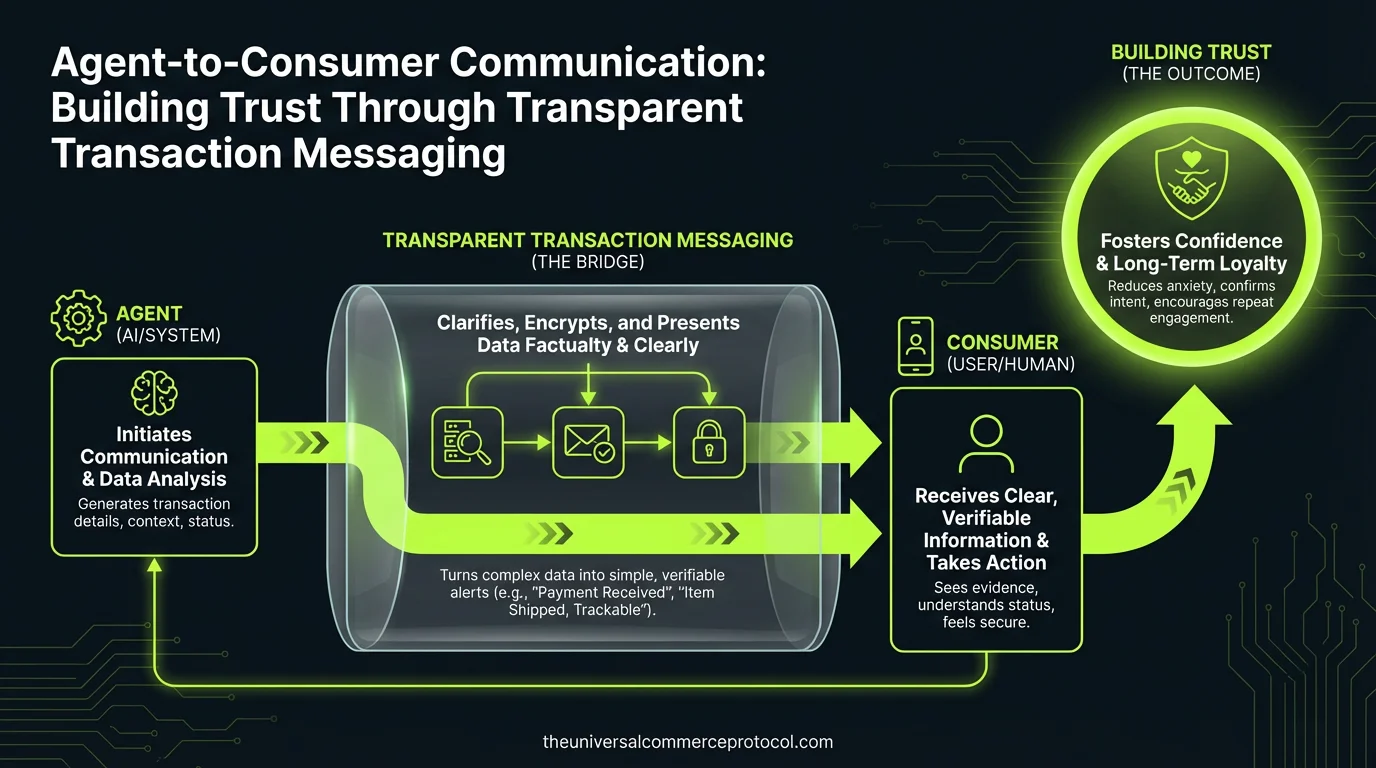
Agentic commerce systems operate at machine speed, making decisions and executing purchases in seconds. But consumers rarely see the reasoning behind those decisions. This information asymmetry—where an AI agent acts on behalf of a human but provides no real-time visibility into what it’s doing—creates friction, liability risk, and erosion of consumer trust.
Unlike human-to-human transactions where a buyer can ask questions mid-purchase, agent-to-consumer commerce lacks a natural communication layer. When an agent selects a supplier, negotiates terms, or encounters a pricing anomaly, the consumer is often left in the dark until the transaction completes or fails.
This gap sits between existing posts on agent-to-merchant communication and agent-to-consumer trust, but it hasn’t been addressed directly: how do you design messaging systems that keep consumers informed without introducing latency, complexity, or decision paralysis?
Why Agent-to-Consumer Messaging Matters
Current agentic commerce workflows treat consumers as passive beneficiaries. An agent acts, a transaction settles, and the consumer receives confirmation email. This worked for simple, low-value transactions, but as agents handle higher-stakes purchases—insurance claims, B2B orders, healthcare procurement—consumers need visibility into the decision logic.
Three problems emerge:
1. Liability exposure: If an agent makes a suboptimal choice (wrong supplier, inflated price, incompatible product variant) without notifying the consumer, who bears the cost? The merchant, the agent platform, or the consumer? Without documented communication, disputes spike.
2. Regulatory compliance: Financial regulators, particularly in EU markets under PSD2 and emerging US guidance, expect transaction transparency. An agent that silently executes a $50K procurement without consumer acknowledgment may violate payment directive requirements that demand proof of authorization.
3. Agent calibration: Consumers don’t trust what they don’t understand. If an agent consistently buys from unexpected suppliers or at prices that seem high, the consumer may disable the agent entirely, defeating its purpose. Real-time messaging allows feedback loops that improve agent behavior.
The Communication Latency Problem
The obvious solution—send the consumer a message before the agent executes—introduces latency. Agentic commerce’s value proposition relies on sub-2-second execution times. Waiting for human approval breaks that advantage.
Mastercard and Google’s trust layer (announced March 2026) attempts to solve this by pre-authorizing agent actions through policy templates. But templates are static. What happens when an agent encounters an edge case—a supplier failure, a price surge, a missing inventory item?
High-latency solutions (email approval, SMS confirmation) don’t scale for multi-agent commerce where decisions happen continuously. Low-latency solutions (silent execution with post-hoc notification) sacrifice transparency.
Three Communication Patterns
Pattern 1: Asynchronous Notification
The agent executes the transaction, then immediately sends the consumer a structured message (push notification, in-app alert, webhook to consumer’s dashboard) with:
- What was purchased and from whom
- Price, delivery terms, and any non-standard conditions
- Why this option was chosen (if it was an outlier from the agent’s baseline)
- A 15-minute dispute window during which the consumer can escalate or cancel
This pattern works for B2C and low-stakes B2B. The downside: if the consumer objects after execution, reversal costs apply (chargeback fees, restocking, supplier penalties). Shopify’s ChatGPT integration likely uses this approach for gift purchases, where the consumer is notified via chat after the agent completes checkout.
Pattern 2: Pre-Execution Summary with Opt-Out
Before the agent acts, it sends a summary to the consumer with a machine-readable decision tree:
- Proposed action (supplier, price, terms)
- Confidence score (e.g., “98% match to your preferences”)
- Flag for any policy deviation (e.g., “price 12% above historical average”)
- One-tap approval or escalation option
If the consumer doesn’t respond within a time window (e.g., 5 seconds for low-value transactions, 60 seconds for high-value), the agent proceeds. This preserves speed while giving consumers a clear veto point.
JPMorgan and Mirakl’s AI agent checkout announcement suggests they’re exploring this for corporate procurement, where a procurement manager can pre-approve agent policies but retain veto rights on outliers.
Pattern 3: Silent Execution with Rollback-Ready Logging
The agent acts without notification, but logs every decision point in an immutable ledger accessible to the consumer. If the consumer later questions the choice, they can query: “Why did you buy from Supplier B instead of Supplier A?” The agent’s reasoning is reconstructed from the ledger (model weights, input features, decision threshold at execution time).
This pattern requires model interpretability infrastructure—the agent must be able to explain its decisions retroactively. It works for routine, high-confidence transactions (reorder identical SKUs, auto-renewal subscriptions) but fails for novel or high-stakes decisions.
Messaging Protocol Design
Regardless of pattern, the message itself must be structured, parseable, and actionable. Key properties:
Standardization: Messages should follow a schema similar to UCP itself—machine-readable, version-controlled, compatible across platforms. A consumer receiving agent notifications from both Shopify and Google should see consistent formatting.
Minimalism: Avoid verbose explanations. A consumer receiving 50 notifications per day from routine agent transactions will ignore all of them. Reserve full explanations for outliers (high-value transactions, policy deviations, failures).
Actionability: Every message should include a specific action (approve, escalate, block future similar transactions). Notifications that only inform without enabling action drive frustration.
Auditability: The message must be cryptographically signed and timestamped. If a consumer later claims they didn’t approve a transaction, the message logs prove otherwise.
Merchant Implications
For merchants, transparent agent-to-consumer messaging reduces chargebacks and returns. If a consumer is notified in real-time that an agent purchased a product and given a dispute window, they’re less likely to claim later that the transaction was unauthorized.
However, messaging also creates operational complexity. Merchants must:
- Integrate with agent notification channels (push, email, SMS, in-app)
- Design fallback messaging if the consumer’s preferred channel is unavailable
- Handle rollback requests during the dispute window (restocking, supplier re-negotiation)
Merchants using Shopify’s ChatGPT integration already handle this implicitly—the notification goes through ChatGPT’s interface, and disputes flow back to the merchant’s return system.
Frequently Asked Questions
Q: Doesn’t real-time messaging defeat the purpose of agents, which is to eliminate friction?
A: Only if you define friction as human involvement. Messaging doesn’t require human approval—it provides visibility. A well-designed notification takes 2 seconds to read and requires zero action in 95% of cases. For the 5% of outliers, the small friction of a decision is offset by reduced refund risk.
Q: How do I handle messaging for low-value, high-frequency transactions?
A: Batch them. Instead of 100 daily notifications for small orders, send one daily digest summarizing agent activity. The consumer can drill into detail if needed, but routine transactions don’t interrupt.
Q: What happens if a consumer never reads the message?
A: Legally, the message itself constitutes notice. If the merchant sent it and it was delivered (verifiable via delivery receipts), the consumer’s failure to read doesn’t nullify their authorization. However, for trust-building, follow up with a summary in next month’s invoice.
Q: Can an agent send different messages to different consumers?
A: Yes, and it should. A sophisticated agent learns whether a consumer prefers detailed explanations or minimal alerts. Some consumers want to know why the agent chose Supplier B over A; others just want confirmation. Agents should personalize the message structure to match consumer behavior.
Q: Who is responsible if the consumer doesn’t see the message due to spam filters?
A: The merchant or platform sending the message. Use authenticated email (SPF, DKIM, DMARC) and avoid spam trigger words. Provide fallback channels—if email fails, push a notification to the consumer’s app or SMS. This is already standard practice for payment processors and e-commerce platforms.
Q: How does messaging interact with agent observability?
A: They’re complementary. Observability is internal—merchants and CFOs monitoring agent decision quality and cost attribution. Messaging is external—consumers seeing those decisions. Both require logging the same events, but at different granularities.
What Comes Next
As agentic commerce matures, expect standardized messaging protocols to emerge. The UCP specification itself may expand to include a communication layer defining how agents notify consumers. Platforms like Shopify and Mirakl will likely embed default messaging templates in their agent SDKs, with merchants able to customize tone and verbosity.
The competitive advantage will go to platforms that get messaging right—transparent enough to build trust, concise enough to avoid alert fatigue, structured enough to integrate with regulatory reporting and dispute resolution.
For now, merchants building agentic commerce systems should treat messaging not as optional (something to add later) but as a core design decision, on par with payment processing and inventory sync.
Frequently Asked Questions
- What is agent-to-consumer communication in agentic commerce?
- Agent-to-consumer communication refers to the messaging systems that keep consumers informed about decisions and actions taken by AI agents on their behalf during transactions. Unlike traditional human-to-human transactions, agentic commerce systems operate at machine speed, and consumers need real-time visibility into what agents are doing to maintain trust and oversight.
- Why is transparency important in AI agent transactions?
- Transparency is critical because agentic commerce systems make decisions and execute purchases in seconds, often without consumer visibility. This information asymmetry can create friction, increase liability risk, and erode consumer trust. When agents select suppliers, negotiate terms, or encounter pricing anomalies, consumers need to understand these decisions to feel confident in the process.
- How does agent-to-consumer messaging differ from traditional transaction confirmation?
- Traditional transactions rely on confirmation emails sent after a purchase completes or fails. Agent-to-consumer messaging goes further by providing real-time communication during the transaction process itself. This allows consumers to see the reasoning behind agent decisions mid-purchase, similar to how they would communicate with a human representative, rather than being left in the dark until settlement.
- What challenges arise from implementing transparent transaction messaging?
- The main challenge is designing messaging systems that keep consumers informed without introducing latency, complexity, or decision paralysis. Developers must balance providing sufficient visibility into agent actions while maintaining the speed and efficiency that makes agentic commerce valuable in the first place.
- How can businesses build consumer trust through agent messaging?
- Businesses can build trust by implementing clear, real-time communication that explains agent decisions, actions taken on behalf of consumers, and any anomalies encountered. This requires designing a natural communication layer between agents and consumers that addresses the information gap and gives consumers the oversight they expect in financial and commercial transactions.
Leave a Reply