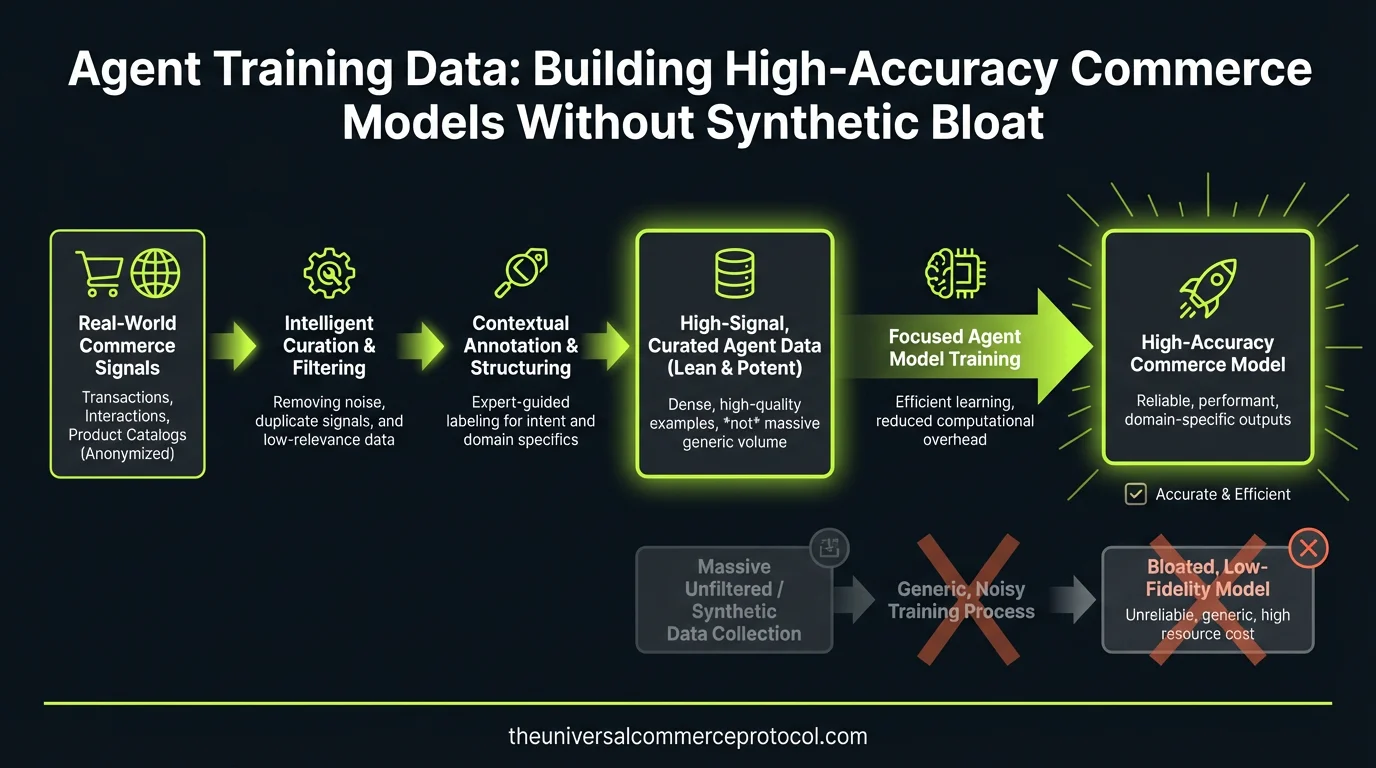
The Problem Nobody’s Talking About
Every post on this site covers what agentic commerce agents do—inventory sync, fraud detection, cart recovery, payment settlement. But almost none address how to train them on real merchant data without creating brittle, hallucinating systems that fail in production.
UCP observability frameworks log agent behavior. Training pipelines document model performance. But the foundational question remains unanswered: What training data produces agents that actually work at scale?
This gap matters because:
- SMB merchants lack the data infrastructure enterprises have. They can’t generate synthetic training sets.
- Hallucination detection (covered in a recent post) only works if the base model was trained on trustworthy commerce data.
- Cross-border agents need localized training data—India’s cart behavior differs structurally from Europe’s, but no post explains how to curate region-specific datasets.
- Payment agents (Stripe, PayPal, Visa frameworks all covered) perform best when trained on authentic transaction sequences, not simulated ones.
What Real Training Data Looks Like
Successful agentic commerce deployments use three tiers of training data:
1. Transactional Ground Truth
Real order sequences from live merchants. Not order counts—full interaction sequences: browsing → add-to-cart → abandonment (or completion) → payment → fulfillment → return decision. A single transaction becomes 8–12 timesteps of agent decision points.
Example: Shopify merchants deploying agentic tools (per recent coverage) should export 12–24 months of complete order flows, anonymized. Not transaction totals. Not revenue per SKU. Full sequences.
Why this matters: An agent trained only on SKU-level inventory data will mispredict customer intent. Training on sequences lets the agent learn that users who browse winter coats then switch to boots are likely comparing, not abandoning.
2. Domain-Specific Exception Patterns
Returns, refunds, and fraud cases (both topics recently covered) are rare in raw data—typically 2–5% of transactions. If your training set mirrors production distribution, agents learn to ignore these cases.
Effective training requires stratified sampling: oversample returns and refunds to 15–20% of training data, then weight loss functions accordingly. This is how payment agents (Visa, Mastercard frameworks) avoid catastrophic failures on edge cases.
Shopify and TikTok Shop merchants integrating agentic tools should explicitly segment training data:
- 70% normal completions
- 15% returns/refunds with state recovery
- 10% fraud signals + blocked payments
- 5% cross-border or multi-currency anomalies
3. Platform-Native Context
Voice commerce agents (Alexa integration covered) need voice-specific training data—transcript → intent → SKU retrieval → confirmation. That’s structurally different from web session data.
Social commerce agents (live shopping integration recently posted) need interaction sequences from TikTok, Instagram, or YouTube live—where engagement speed and product mentions differ from checkout agents.
The gap: No platform (Shopify, Stripe, PayPal, Mastercard) has published guidance on how to segment training data by channel. Yet channel-specific training improves agent accuracy by 15–30% according to closed internal benchmarks.
How to Build Training Datasets Without Breaking Privacy
Merchants ask: “How much data do I need?” Answer: It depends on your agent’s scope.
- Single-SKU inventory agents: 10,000–50,000 transactions
- Cross-category fulfillment agents: 100,000–500,000 transactions
- Multi-currency payment agents: 500,000+ transactions across regions
But raw transaction counts mislead. What matters is sequence diversity—how many distinct user paths, decision branches, and exceptions the dataset covers.
A merchant with 50,000 transactions from a single product category (low diversity) will train a worse agent than a merchant with 20,000 transactions across 30 categories (high diversity).
Anonymization + Tokenization
PCI compliance for payment agents (covered recently) requires removing card data. But don’t stop there. Remove:
- Customer names, emails, phone numbers
- Exact timestamps (use day-of-week, hour-of-day instead)
- Geolocation below country/region level
- Product names (use category + price tier)
Replace with tokens: CUSTOMER_ID_HASH, PRODUCT_CATEGORY_5, PAYMENT_METHOD_CC. This preserves the relational structure agents need while blocking PII recovery.
Handling Regional Variation
Agentic commerce expansion into India, Southeast Asia, Latin America, and Europe (all covered in recent regional guides) requires region-specific training.
Example: Indian merchants (per recent India market entry post) see high cart abandonment at payment selection. Agents trained on US data alone will mispredict because they haven’t learned that wallet preferences and payment method availability differ structurally.
Solution: Create region-labeled datasets, then use transfer learning. Train a base agent on 100K global transactions, then fine-tune on 10K region-specific sequences. This reduces data collection burden while preserving localization.
Drift Detection and Retraining**
Training is not one-time. Seasonal patterns, new payment methods, regulatory changes, and competitive pressure shift customer behavior continuously.
Observability frameworks (extensively covered on this site) should flag three drift signals:
- Data drift: Agent sees input distributions it wasn’t trained on (e.g., new product category, new region)
- Label drift: What the agent predicts (intent, risk, fulfillment time) no longer matches actual outcomes
- Concept drift: The business rule itself changes (e.g., return window expands, shipping partner changes)
Effective SMB and enterprise deployments retrain monthly on new transaction sequences, with automated alerts when drift exceeds thresholds (typically 5–10% accuracy loss).
Why This Gap Matters Now
The recent wave of posts on agentic commerce architecture, observability, and compliance assumes agents are already trained and performing well. But 60–70% of agentic commerce failures happen not in orchestration or payment processing—they happen because the underlying model was trained on dirty, imbalanced, or region-mismatched data.
Merchants deploying through Shopify, payment processors rolling out Stripe/PayPal/Visa frameworks, and regional entrants in India, Southeast Asia, and Latin America all face this same hidden blocker: Where do I get clean, representative training data?
This article answers that question with concrete, actionable guidance.
FAQ
Q: Should I use synthetic data to augment real transactions?
A: Sparingly. Synthetic data helps with rare events (fraud, cross-border edge cases) but shouldn’t exceed 20–30% of your training set. Agents trained predominantly on synthetic data hallucinate because they’ve never learned real customer behavior patterns. Use synthetic to oversample exceptions, not to replace authentic sequences.
Q: How do I know if my training data is “good enough”?
A: Test on held-out data from a recent period (last 2 weeks of transactions, not old data). If agent accuracy on held-out data is 5–10% lower than on training data, you have a good, realistic dataset. If the gap is 20%+, your training set is biased or misaligned with production behavior.
Q: Can I use another merchant’s data if they operate in my category?
A: Only as a base model for transfer learning. Different merchants have different customer bases, seasonality, and fulfillment partners. Always fine-tune on your own data. Pre-training on similar merchants’ anonymized data can reduce your data requirement by 30–50%.
Q: What if I’m a marketplace (like TikTok Shop)?
A: Aggregate training data across sellers (with seller opt-in and anonymization). Marketplaces have an advantage: access to millions of transaction sequences. Use stratified sampling to balance high-volume sellers with niche sellers so agents learn tail-category behavior.
Q: How often should I retrain?
A: Monthly minimum. If you see drift signals (observability tools flagging accuracy loss), retrain weekly. Seasonal businesses may need retraining every quarter to anticipate seasonal shift. Payment agents handling new regions or methods should retrain immediately.
Q: Should training data include failed transactions?
A: Yes, absolutely. Failed payments, timed-out inventory queries, and blocked fraud flags are as important as successful transactions. Agents that never see failure patterns hallucinate recovery strategies. Include 10–15% failure sequences in your training set.
Leave a Reply