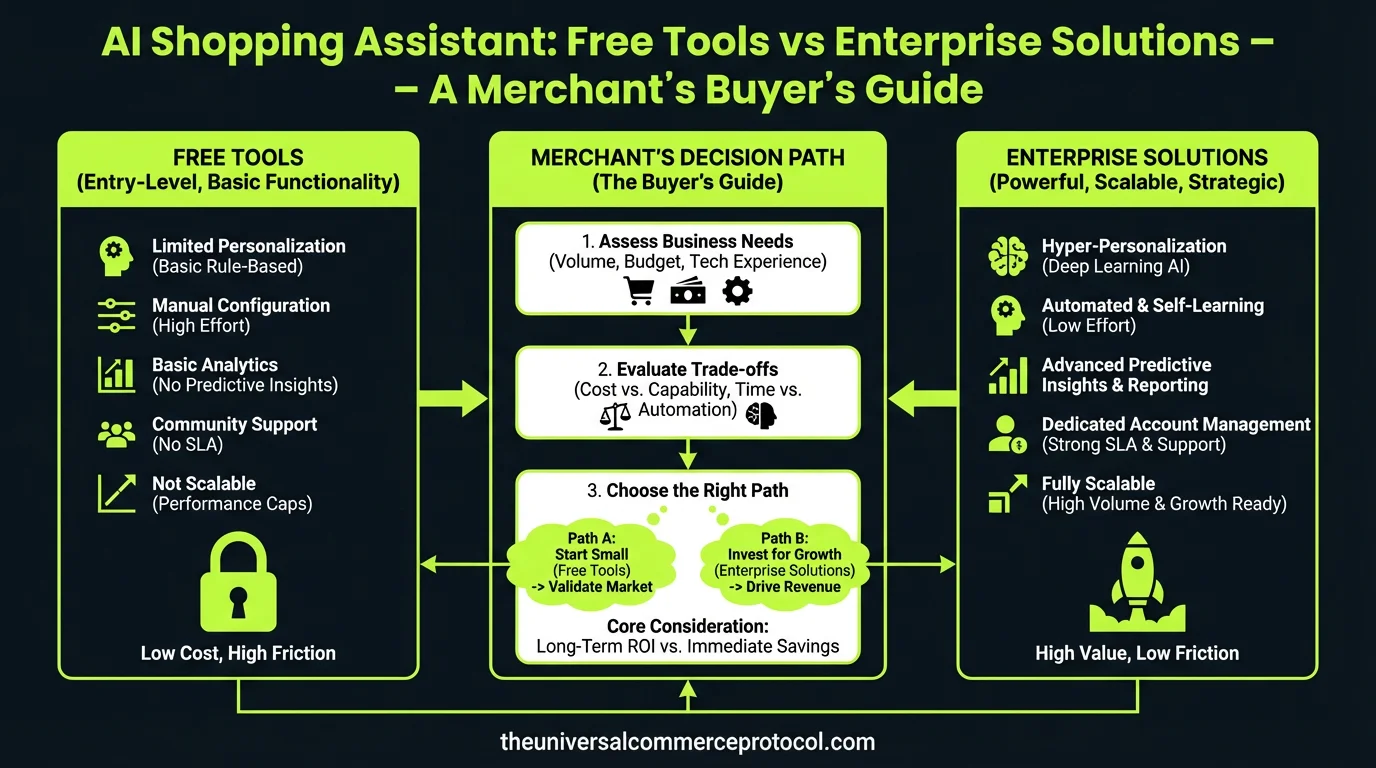
AI Shopping Assistant: Free Tools vs Enterprise Solutions
The ecommerce landscape has fundamentally shifted with the rise of AI shopping assistants. Merchants now face a critical decision: deploy a free, lightweight tool or invest in an enterprise-grade solution. This buyer’s guide helps you navigate that choice by examining what each category offers, their limitations, and how they integrate with modern commerce protocols like the Universal Commerce Protocol (UCP).
Understanding AI Shopping Assistants in Modern Commerce
An AI shopping assistant is a conversational agent that helps customers discover products, answer questions, and complete purchases. These tools leverage large language models (LLMs), retrieval-augmented generation (RAG), and product data integration to provide personalized shopping experiences. In the context of agentic commerce—where AI agents autonomously perform commerce tasks—shopping assistants represent the customer-facing layer of a broader ecosystem.
The Universal Commerce Protocol (UCP) provides a standardized framework for these interactions, enabling seamless data exchange between shopping assistants, inventory systems, payment processors, and fulfillment networks. Understanding UCP compatibility should factor into your evaluation.
Free AI Shopping Assistant Tools: What’s Available
Several platforms offer free or freemium AI shopping assistant capabilities:
- Shopify’s native AI features – Shopify merchants can access built-in AI product recommendations and basic chatbot functionality through Shopify Magic, though advanced customization requires paid apps.
- WooCommerce plugins – Open-source options like MonsterInsights and Elementor include basic AI features, with more advanced functionality available through premium extensions.
- Open-source frameworks – Platforms like Rasa and LangChain provide free, customizable foundations for building shopping assistants, though they require technical expertise and infrastructure investment.
- API-based free tiers – OpenAI’s GPT-4 API, Anthropic’s Claude, and Google’s Gemini offer free trial credits sufficient for small-scale testing but limited for production use.
- Standalone freemium tools – Services like Drift, Intercom, and Zendesk offer free tiers with basic conversational AI, though ecommerce-specific features are limited.
These free options share common characteristics: limited conversation depth, basic product matching, no advanced personalization, minimal integration capabilities, and restricted scalability. Most lack native UCP compatibility, requiring custom development for protocol adherence.
Enterprise AI Shopping Assistant Solutions
Enterprise-grade solutions provide comprehensive, production-ready systems designed for high-volume commerce operations:
- Specialized ecommerce platforms – Tools like Klaviyo, Conversable (acquired by Twilio), and Salesforce Commerce Cloud Einstein include sophisticated AI shopping assistants with deep integration into their ecosystems.
- Dedicated AI commerce providers – Companies such as Algopix, Unbxd, and Bloomreach specialize in AI-driven product discovery and personalization, offering white-label shopping assistant capabilities.
- Headless commerce solutions – Platforms like Contentful, Commercetools, and Medusa provide flexible APIs enabling custom AI shopping assistant development with full control over UCP implementation.
- Custom-built solutions – Enterprise merchants often commission bespoke systems integrating proprietary LLMs, real-time inventory systems, and advanced personalization engines.
Enterprise solutions typically feature multi-turn conversations with context retention, advanced product recommendation engines, real-time inventory synchronization, sophisticated personalization based on behavioral data, comprehensive integration APIs, UCP compliance, security and compliance certifications (SOC 2, GDPR, CCPA), dedicated support, and SLA guarantees.
Key Differences: Free vs Enterprise
Customization and Control: Free tools offer limited customization—you’re constrained by the platform’s default configuration. Enterprise solutions provide extensive customization, including custom conversation flows, branded interfaces, and proprietary business logic implementation.
Integration Depth: Free tools typically integrate with your storefront through basic APIs or plugins. Enterprise solutions integrate deeply with inventory management systems, CRM platforms, payment processors, fulfillment networks, and—critically—support standardized protocols like UCP for interoperability.
Data Privacy and Security: Free tools may store conversation data on third-party servers, raising privacy concerns. Enterprise solutions offer on-premise or private-cloud deployment, data encryption, audit trails, and compliance certifications.
Performance and Scalability: Free tools struggle under high traffic volumes and may experience latency or downtime. Enterprise solutions are architected for scale, with load balancing, redundancy, and guaranteed uptime.
Personalization Sophistication: Free tools provide basic product recommendations based on category or search history. Enterprise solutions leverage customer lifetime value, purchase patterns, browsing behavior, demographic data, and contextual signals for highly targeted recommendations.
Cost Structure: Free tools have zero upfront cost but limited capabilities. Enterprise solutions involve significant investment—typically $10,000 to $100,000+ annually—but deliver ROI through increased conversion rates, average order value, and customer lifetime value.
Evaluating Your Merchant Needs
Company Size and Revenue: Startups and small merchants with limited budgets may begin with free tools, accepting their limitations. Mid-market merchants typically benefit from enterprise solutions’ improved conversion rates justifying the investment. Large enterprises almost always require custom or specialized enterprise solutions.
Product Catalog Complexity: If your catalog contains hundreds of products with straightforward attributes, free tools may suffice. Catalogs with thousands of SKUs, complex variants, and nuanced attributes require enterprise-grade product understanding and matching.
Customer Sophistication: B2C merchants selling commodity products may find free tools adequate. B2B merchants, luxury brands, and businesses serving sophisticated buyers need enterprise-level conversational AI and personalization.
Integration Requirements: If you operate a simple Shopify store, free tools integrate easily. Complex omnichannel operations, custom backend systems, and requirements for UCP compliance necessitate enterprise solutions.
Support and Reliability Needs: Hobbyist shops can tolerate occasional downtime and self-serve support. Revenue-critical operations require 24/7 support, SLAs, and dedicated account management.
The Role of UCP in Your Decision
The Universal Commerce Protocol represents the future of agentic commerce, enabling AI agents to operate seamlessly across multiple platforms and services. When evaluating AI shopping assistants, consider UCP compatibility:
- Does the solution support UCP standards for product data exchange?
- Can it integrate with UCP-compliant inventory and fulfillment systems?
- Does it enable your shopping assistant to operate as an autonomous agent within a UCP ecosystem?
- What’s the vendor’s roadmap for UCP support?
Free tools rarely include UCP support, requiring custom development. Enterprise solutions increasingly incorporate UCP compatibility, positioning your commerce infrastructure for interoperability and future scalability.
Hidden Costs of Free Tools
While free tools have zero licensing costs, consider hidden expenses:
- Development time: Customizing free tools requires engineering resources, often exceeding enterprise solution implementation.
- Infrastructure: Hosting, scaling, and maintaining free tools incurs ongoing operational costs.
- Opportunity cost: Time spent managing free tools diverts resources from revenue-generating activities.
- Conversion impact: Limited AI capabilities may depress conversion rates, costing more in lost sales than enterprise tool licensing.
- Migration costs: Outgrowing free tools requires expensive migration to enterprise solutions.
A merchant with $500K annual revenue might see a 2-3% conversion lift from an enterprise AI shopping assistant, translating to $10,000-$15,000 in additional annual revenue—often exceeding the tool’s cost within the first year.
Implementation Considerations
Time to Value: Free tools deploy quickly but deliver limited value. Enterprise solutions require 4-12 weeks implementation but generate substantial ROI once live.
Team Capability: Free tools require technical expertise you may not possess. Enterprise solutions include professional services and training.
Vendor Lock-in: Free tools built on open standards (Rasa, LangChain) avoid lock-in but require more maintenance. Enterprise solutions lock you into a vendor but provide stability and support.
Hybrid Approaches
Many merchants adopt hybrid strategies: deploy a free tool initially to validate customer demand and gather data, then migrate to an enterprise solution as business scales. This reduces risk while maintaining flexibility.
Alternatively, use free tools for non-critical functions (FAQ answering) while leveraging enterprise solutions for revenue-critical features (product discovery, checkout assistance).
FAQ
Can a free AI shopping assistant match enterprise performance?
Rarely. Free tools lack the training data, computational resources, and integration depth of enterprise solutions. They excel for simple use cases but struggle with complex product matching, personalization, and multi-turn conversations. Enterprise solutions typically achieve 2-4x higher conversion rates for shopping assistance tasks.
What’s the typical ROI timeline for enterprise AI shopping assistants?
Most merchants see positive ROI within 6-12 months. A $30,000 annual investment generating a 2% conversion lift on $1M annual revenue yields $20,000 in incremental profit—breaking even within 18 months while providing ongoing value. Larger merchants see faster ROI.
How important is UCP compatibility when choosing an AI shopping assistant?
UCP compatibility is increasingly important for forward-looking merchants. While not critical for today’s operations, UCP-compliant solutions position you for interoperability with emerging agentic commerce ecosystems. If you plan to operate in multi-vendor environments or leverage autonomous commerce agents, prioritize UCP-ready solutions.
Should I build a custom AI shopping assistant or buy an existing solution?
Build if you have unique requirements, significant technical resources, and differentiation opportunities justifying the investment. Buy if you want faster time-to-market, reduced risk, and access to best practices. Most merchants benefit from buying, customizing existing solutions rather than building from scratch. Custom development makes sense only for merchants with $10M+ revenue and specialized needs.
Leave a Reply