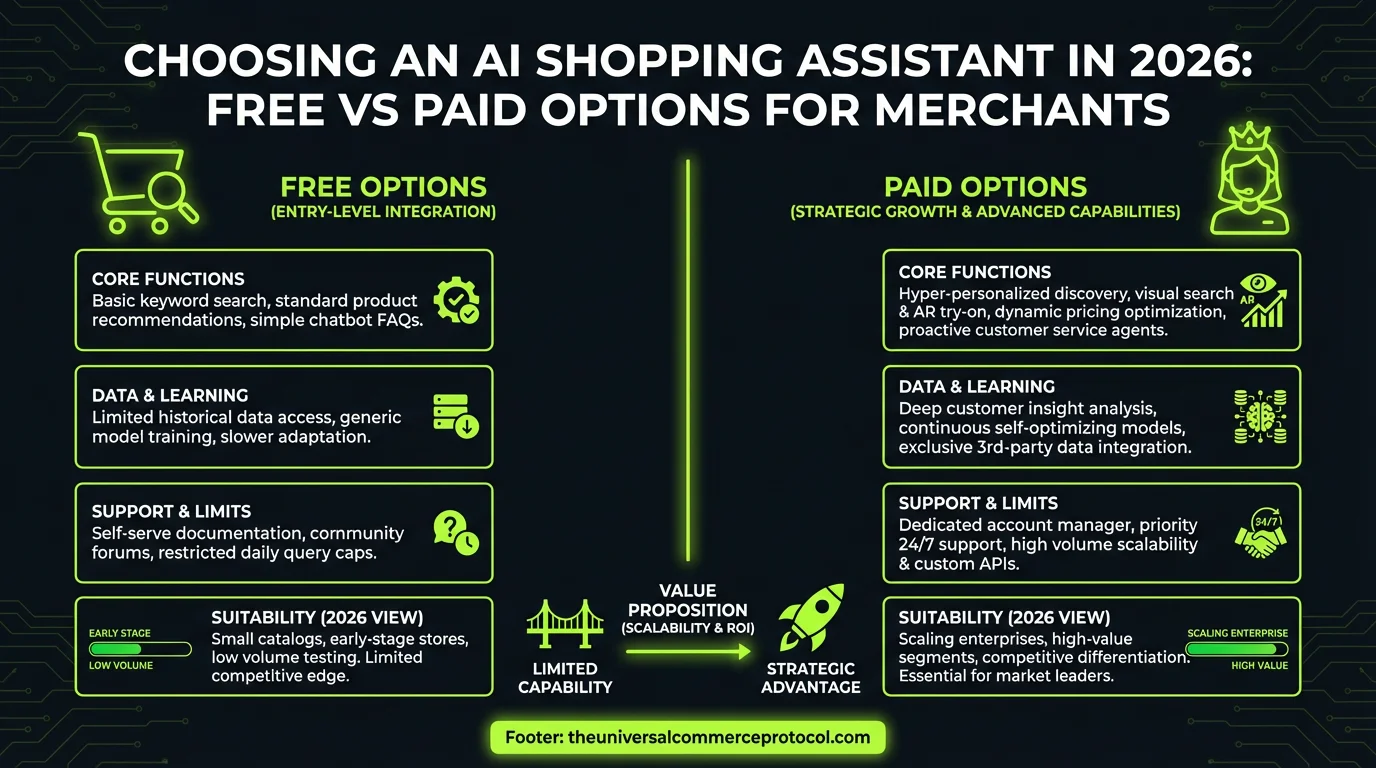
Choosing an AI Shopping Assistant in 2026: Free vs Paid Options for Merchants
The AI shopping assistant market has exploded over the past few years, and by 2026, merchants face more choices than ever before. Whether you’re running a small boutique store or managing a large e-commerce operation, selecting the right AI shopping assistant can significantly impact your customer experience and bottom line. But with countless free and paid options available, how do you decide which is right for your business?
The Rise of AI Shopping Assistants
AI shopping assistants have become essential tools for modern merchants. These intelligent systems handle customer inquiries, provide personalized product recommendations, process orders, and manage returns—all without human intervention. By 2026, nearly 75% of e-commerce platforms have integrated some form of AI shopping assistance, making it a standard expectation rather than a luxury feature.
Related articles: UCP Shipping Carrier Selection & Rate Optimization • UCP Security Best Practices for AI-Driven Commerce
The question is no longer whether to adopt an AI shopping assistant, but which one offers the best value for your specific needs and budget.
Understanding Free AI Shopping Assistants
Free AI shopping assistants have democratized access to advanced customer service technology. These solutions typically offer basic functionality without upfront costs, making them attractive to startups and budget-conscious merchants.
Advantages of Free Options
- Zero initial investment—perfect for testing and learning
- Essential features like basic chatbot functionality and FAQ automation
- Community support and extensive documentation
- No long-term contracts or cancellation fees
- Ideal for low-volume stores with simple customer service needs
Limitations of Free AI Shopping Assistants
- Limited customization and branding options
- Restricted conversation complexity and AI model sophistication
- Minimal analytics and reporting capabilities
- Slower response times during peak traffic periods
- Limited integration with advanced inventory and CRM systems
- May include ads or branding from the provider
- Scaling challenges as your business grows
Free AI shopping assistants work best for merchants just beginning their digital transformation journey or those with straightforward, predictable customer service needs. However, they often become limiting as your business scales.
The Case for Paid AI Shopping Assistants
Paid solutions offer comprehensive features designed for serious merchants looking to maximize customer satisfaction and operational efficiency. By 2026, premium AI shopping assistants have become significantly more sophisticated and affordable.
Key Benefits of Paid Options
- Advanced natural language processing for complex conversations
- Comprehensive personalization based on customer behavior and history
- Seamless integration with your entire commerce ecosystem
- Priority customer support and dedicated account management
- Advanced analytics, insights, and performance metrics
- Multi-channel support (web, mobile, social media, messaging apps)
- Custom training on your specific products and brand voice
- Enhanced security and compliance features
- Regular updates with cutting-edge AI capabilities
Paid AI shopping assistants typically range from $50 to $500+ per month, depending on features, conversation volume, and customization level. While this represents an ongoing investment, many merchants see ROI within the first few months through increased conversion rates and reduced support costs.
Cost-Benefit Analysis for Your Business
Determining whether to invest in a paid solution depends on several factors specific to your operation.
Consider a free AI shopping assistant if:
- Your monthly revenue is under $50,000
- You handle fewer than 100 customer inquiries daily
- Your product catalog is relatively small (under 500 items)
- You’re testing AI capabilities before committing resources
- Your customer service needs are straightforward and predictable
Invest in a paid solution if:
- Your monthly revenue exceeds $100,000
- You receive more than 200 customer inquiries daily
- You operate across multiple sales channels
- You need detailed analytics and performance metrics
- Customer satisfaction scores are critical to your business
- You require custom integrations with your existing systems
Hybrid Approaches in 2026
By 2026, many merchants are adopting hybrid strategies. They start with a free AI shopping assistant to handle basic inquiries, then upgrade specific channels or functions to premium solutions. This approach allows for controlled cost growth while maintaining flexibility.
Some merchants also use free tools for testing new features or markets before deploying paid solutions at scale. This experimental approach reduces risk while maintaining budget discipline.
Making Your Decision
When evaluating AI shopping assistants for your merchant operation, consider these factors:
- Current needs: What specific customer service challenges are you facing?
- Growth trajectory: Where do you expect to be in 12-24 months?
- Integration requirements: What systems must your AI assistant connect with?
- Budget constraints: What can you realistically allocate monthly?
- Support expectations: Do you need vendor support or can you manage independently?
The right choice isn’t necessarily the cheapest option—it’s the one that aligns with your business goals, customer expectations, and financial capabilities. In 2026, the gap between free and paid solutions has narrowed considerably, but paid options still offer significant advantages for growing merchants.
FAQ
Can a free AI shopping assistant handle high-volume stores?
Free AI shopping assistants can technically handle high-volume stores, but they often struggle with performance degradation during peak times. Most free solutions have conversation limits or throttling mechanisms that kick in during heavy usage. For stores consistently handling 500+ inquiries daily, a paid solution is strongly recommended to ensure reliability and response quality.
What’s the typical ROI timeline for investing in a paid AI shopping assistant?
Most merchants report positive ROI within 2-4 months of implementing a paid AI shopping assistant. This comes through reduced support staff hours, increased conversion rates from better customer engagement, and improved customer retention. The exact timeline depends on your current customer service costs and conversion metrics, but the investment typically pays for itself quickly in growing operations.
Can I switch from free to paid AI shopping assistants without losing data?
Yes, most reputable AI shopping assistant platforms support data migration and transition assistance. However, you may lose some conversation history or customization during the switch. It’s best to plan your upgrade during a low-traffic period and work with your new provider’s onboarding team to ensure a smooth transition with minimal disruption to customer service.
Q: Should I choose a free or paid AI shopping assistant for my e-commerce store?
A: The choice depends on your business size and budget. Free AI shopping assistants are ideal for startups and small merchants looking to test the technology with zero initial investment. Paid options typically offer advanced features, better customization, priority support, and higher transaction limits. If you’re running a larger operation or need advanced analytics and integrations, a paid solution is usually worth the investment.
Q: What percentage of e-commerce platforms use AI shopping assistants in 2026?
A: According to current market data, nearly 75% of e-commerce platforms have integrated some form of AI shopping assistance by 2026. This makes AI shopping assistants a standard expectation rather than a luxury feature, meaning they’re becoming essential for competitive e-commerce operations.
Q: What core functions do AI shopping assistants handle?
A: Modern AI shopping assistants handle multiple critical functions including answering customer inquiries, providing personalized product recommendations, processing orders, and managing returns—all without human intervention. These capabilities significantly impact customer experience and operational efficiency.
Q: What are the main advantages of free AI shopping assistants?
A: Free AI shopping assistants offer zero initial investment, making them perfect for startups and budget-conscious merchants. They allow you to test advanced customer service technology without financial risk and can handle basic customer service needs effectively for smaller operations.
Q: How can AI shopping assistants impact my business?
A: Selecting the right AI shopping assistant can significantly impact your customer experience and bottom line. These tools automate customer service, provide personalized recommendations, reduce response times, and improve customer satisfaction while lowering operational costs.
Leave a Reply