The Multi-Currency Problem Agents Can’t Ignore
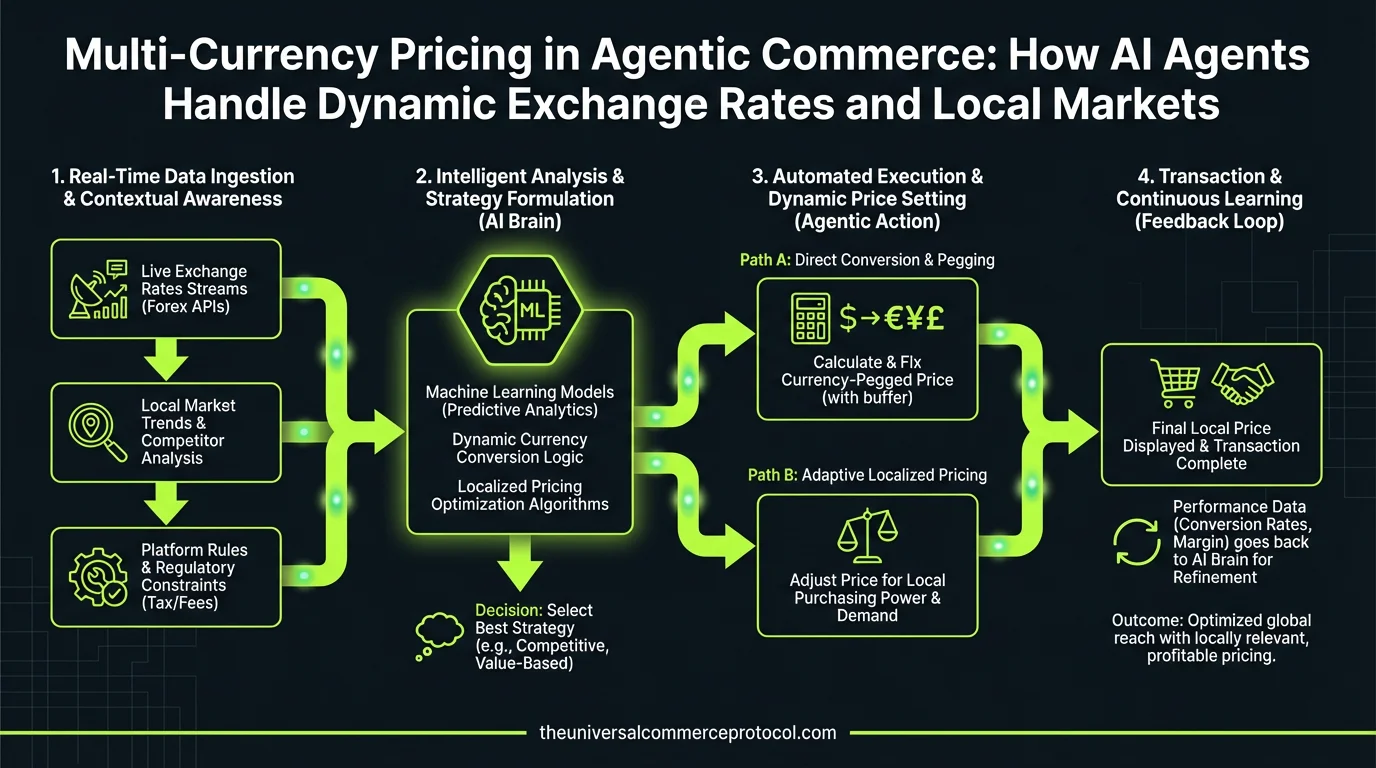
When an AI agent sells a $50 product to a customer in Tokyo, Singapore, and Toronto simultaneously, the pricing isn’t just different—it’s a moving target. Exchange rates shift hourly. Tax obligations vary by jurisdiction. Competitor pricing in local markets creates pressure to adjust on the fly.
Yet the current coverage of agentic commerce treats cross-border payments as a settlement problem (solved by AP2 and UCP infrastructure). Nobody has addressed the upstream pricing decision: how does an agent decide what price to show, when, to whom, and based on what data?
This is not a solved problem. Most merchants today use static currency conversion or rely on payment processors to handle localization at checkout. Agentic systems that make autonomous pricing decisions in real time need a different architecture entirely.
Why Static Conversion Doesn’t Work for Agents
A traditional e-commerce site shows a GBP price and converts it to USD at Wise or Stripe’s posted rate. The customer sees the total before checkout. There’s a moment to confirm.
An agent operating in conversation mode or API-driven transactions doesn’t have that luxury. The agent must:
- Quote a price immediately (within conversational flow or agent response time)
- Hold that quote long enough for the customer to decide (5 seconds to 5 minutes, depending on context)
- Lock in the rate before payment authorization
- Reconcile actual settlement rate with the quoted rate
- Handle the difference (absorb it, pass it to customer, or reject the transaction)
Static rates create arbitrage opportunities. If an agent quotes a fixed daily rate in EUR at 09:00 UTC and the customer converts at 17:00 UTC when the rate has moved 2%, either the merchant loses margin or the customer faces unexpected charges after agreeing on a price—both outcomes break trust.
Building a Rate-Locked Pricing Engine for Agents
Enterprise merchants solving this problem use a pattern: quote generation with time-bounded rate locks.
When an agent (or agent-assisted system) quotes a price to a customer in a non-home currency, it:
- Calls a quote service (internal or third-party API) that pulls live exchange rates from multiple sources (ECB, Bloomberg, Reuters, or aggregators like Exchangerate-API)
- Applies merchant markup—typically 1–3% above interbank rates, depending on payment processor and chargeback risk in that corridor
- Locks the rate for a defined window—usually 30 seconds to 5 minutes, depending on agent architecture and transaction likelihood
- Associates the quote with a UUID and timestamp so payment authorization can reference the original quote
- Returns quoted price + rate lock ID to the agent
- Agent presents price to customer with transparency: “Quoted at 12:34:56 UTC, valid for 120 seconds”
- At payment time, merchant processor retrieves the original locked rate and converts at that rate, not current market rate
Slack’s marketplace, for example, uses rate locks on invoice generation. When a vendor quotes a service, the rate is fixed for 24 hours. This reduces merchant pricing anxiety and improves conversion.
Handling Rate Lock Expiration and Rejection
What happens when a customer takes 3 minutes to confirm a purchase, but the rate lock was only 60 seconds?
Three strategies:
1. Requote and ask for confirmation
The agent detects the lock has expired, fetches a new quote, and tells the customer: “Price updated to €42.15 (was €42.10). Proceed?” This is transparent but creates friction and abandonment risk.
2. Extend the lock silently
The agent has permission to extend the lock up to 2–3 times automatically (resetting the clock each time), assuming the customer is still in active conversation. This works well in synchronous channels (chat, voice) but requires careful design to avoid locking in bad rates if a customer walks away and returns hours later.
3. Honor the original quote with grace buffer
Accept the original rate even if the lock expired, but only if the new rate is within a threshold (e.g., ±0.5%). This is customer-friendly and reduces friction, but requires careful accounting to track the grace buffer cost. Used by Shopify and some travel agents when rebooking near-expiration flights.
Local Taxes and Regional Pricing Complexity
Multi-currency pricing is inseparable from local tax obligations. A €100 product costs €121 in France (21% VAT) but €112 in Spain (12% IVA). An agent quoting prices must also quote tax.
The pattern:
- Agent knows customer location (IP geolocation, billing address, or declared explicitly)
- Tax calculation service (Avalara, TaxJar, or custom rules engine) returns applicable rate for that jurisdiction
- Agent applies tax to base price, quoted in local currency
- If merchant is in different jurisdiction (e.g., UK merchant selling to Germany), reverse-charge rules may apply, removing tax from quote if customer provides VAT ID
Agentic systems must encode this logic before quoting. A naive agent that quotes first and calculates tax later creates compliance risk and customer confusion.
Competitive Pricing and Real-Time Adjustment
Some merchants want agents to adjust prices based on local competitive positioning. If a product is £50 in the UK but competitors in France are selling the equivalent at €54 (vs. the converted €57), should the agent drop the French price to stay competitive?
This is where agentic pricing becomes strategic:
Dynamic pricing agent: Agent queries a competitive intelligence API (Keepa, Prisync, or custom web scraper) to check competitor prices in the target market, applies a discount rule (“stay within 5% of lowest competitor”), and quotes accordingly.
Margin constraints: Agent is configured with minimum margin thresholds per region (e.g., “France: minimum 20% margin, allow dynamic pricing above that”). If competitive pricing would drop below threshold, agent refuses the transaction or escalates to human approval.
Logging and compliance: Every price adjustment must log the reason (rate lock + tax + competitive adjustment), the data source, and timestamp. This is critical for audit, pricing discrimination liability, and agent auditing.
Settlement and Rate Difference Reconciliation
Quote rates, settlement rates, and actual bank rates are three different things.
Example:
- Agent quotes EUR 50 at 1.0950 USD/EUR = $54.75 (locked)
- Customer pays via Stripe in EUR
- Stripe settles at 1.0945 USD/EUR = $54.725 (Stripe’s actual rate at that second)
- Merchant’s bank receives $54.72 (rounding) after Stripe’s 2.9% fee = $53.08
The merchant quoted $54.75 but receives $53.08. Where’s the gap? Stripe’s processing fee, slippage on rates, and rounding.
Mature agentic systems track this and use it for:
- Rate model updates: If actual settlement rates consistently differ from quoted rates, the markup in the quote service is too low
- Merchant reporting: “You lost $0.03 per transaction to rate slippage this month across 4,200 transactions = $126 total”
- Regional strategy refinement: If certain corridors (e.g., USD to INR) are consistently underpriced, the agent can reduce quote frequency or increase markup for those pairs
Integration with UCP and Payment Infrastructure
UCP’s verifiable intent spec doesn’t explicitly address price in local currency, but it should. A verifiable intent that says “customer agreed to price of $50” is ambiguous if the actual quote was in EUR with a locked rate.
Best practice: UCP-compliant quote should include:
- Base currency (merchant’s home currency)
- Quote currency (customer’s preferred currency)
- Exchange rate used and source
- Rate lock timestamp and expiration
- Tax rate and jurisdiction
- All as signed fields in the intent object
AP2 (Agent Payment Protocol) should extend to lock rates across the payment flow, so a rate lock issued by the pricing engine is recognized by the payment processor and enforced at settlement.
FAQ
1. Should agents quote in the customer’s local currency or merchant’s home currency?
Local currency, always. Cross-border conversion is a known friction point in e-commerce. Agents should detect customer location (or ask) and quote in local currency with transparent rate disclosure. Showing a UK customer a price in USD costs 2–4% conversion on average.
2. How long should a rate lock last?
Depends on transaction urgency. Voice commerce: 30–120 seconds (customer is on a call, decision is immediate). Chat agent: 2–5 minutes (customer may pause mid-conversation). Email/async: 24 hours (customer may save the quote and return later). Default to 2 minutes for most synchronous channels.
3. What if exchange rates move sharply during a lock window?
Accept the loss or adjust your markup strategy. A 2% rate movement during a 2-minute lock is rare but possible during central bank announcements or market shock. If this is a frequent problem, reduce lock windows or increase your markup to cover volatility. Most processors offer rate risk insurance for a premium.
4. Can agents show prices in multiple currencies simultaneously?
Yes, but sparingly. Showing 3–4 equivalent prices (USD, EUR, GBP, JPY) can create decision paralysis. Better to show one primary price in local currency plus a small “≈ $X USD” reference. Agents should quote in a single currency to reduce cognitive load.
5. How do I prevent customers from gaming rate locks?
Implement velocity checks: if a customer locks rates 10 times in 5 minutes without converting, flag it. Implement per-customer rate lock limits (e.g., max 3 concurrent locks). Most sophisticated merchants also implement a “price guarantee” time window—if a customer locks a rate and completes purchase within X time, honor it. If they walk away and return in 24 hours, requote.
6. Should agents adjust prices based on customer history or lifetime value?
Legally risky without careful design. Personalized pricing is allowed but must comply with anti-discrimination laws (especially in EU under GDPR). Best practice: implement transparent rules (“loyal customers get 5% discount”) rather than opaque agent-driven adjustments. Log all pricing decisions with the reason for audit.
7. What’s the best data source for live exchange rates?
For high-volume merchants: ECB (European Central Bank) or Federal Reserve APIs (free, official, low-latency). For real-time Forex traders: Bloomberg Terminal or Reuters. For mid-market: Exchangerate-API, XE, or OANDA (reliable, $10–100/month). Build a fallback system: if your primary source is slow, fall back to cached rates from 1 minute ago and add a 0.5% buffer for safety.
Conclusion
Multi-currency agentic commerce requires a pricing engine that merchants and platforms have largely overlooked. As agents make autonomous checkout decisions, the quote-to-settlement journey must be explicit, rate-locked, tax-aware, and fully auditable.
Merchants building agent-driven commerce should implement rate locking at quote time, integrate tax calculation before pricing, and build settlement reconciliation into their observability layer. UCP specifications should evolve to make multi-currency pricing a first-class concern, not an afterthought handled by payment processors.
Frequently Asked Questions
Q: What is the main challenge with multi-currency pricing in agentic commerce?
A: The primary challenge is that exchange rates shift hourly, tax obligations vary by jurisdiction, and competitor pricing in local markets changes constantly. AI agents must make autonomous pricing decisions in real time, which is fundamentally different from static currency conversion used in traditional e-commerce. Agents need to decide what price to show, when to show it, to whom, and based on what real-time data.
Q: Why can’t AI agents use the same static conversion methods as traditional e-commerce?
A: Traditional e-commerce platforms show a price in one currency and convert it at checkout using a posted rate from payment processors like Wise or Stripe. This approach requires a moment for customer confirmation. However, agents operating in conversation mode or API-driven transactions don’t have that confirmation step, and they need to make pricing decisions autonomously without the ability to present options and wait for approval.
Q: How do exchange rate fluctuations impact agentic commerce pricing?
A: Exchange rates move hourly, which means a $50 product shown to customers in Tokyo, Singapore, and Toronto simultaneously will have different real-time values in local currencies. Agents must account for these constant fluctuations to avoid pricing errors, margin compression, or customer dissatisfaction caused by unexpected currency conversion differences.
Q: What data inputs do AI agents need for dynamic pricing decisions?
A: AI agents need access to real-time exchange rates, local tax obligations by jurisdiction, competitor pricing in local markets, and historical conversion data. This combination allows agents to make informed pricing decisions that account for regulatory requirements, market pressures, and currency volatility simultaneously.
Q: Is the current approach of relying on payment processors sufficient for agentic commerce?
A: No. Current merchant solutions treat cross-border payments as a settlement problem handled downstream by payment processors. However, agentic systems that need to make autonomous pricing decisions require a different architecture entirely, as the pricing decision happens upstream before settlement—at the moment the agent quotes or presents the price to the customer.
Leave a Reply