Tag: Business Leader
-
The $12B Fraud Risk Hiding in AI Commerce: CFO’s Guide to Agent Authentication ROI
AI agents executing autonomous purchases create new $12B fraud exposure—but proper authentication delivers 340% ROI through cost reduction and revenue protection.
-
AI Commerce Compliance: The $2.3M Cost of Failed Audits CFOs Must Prevent
Regulatory failures in AI-driven commerce average $2.3M in penalties—here’s how CFOs can build audit-proof systems before regulators arrive.
-
AI Agent Procurement Risks: The $3M Blind Spot Destroying Profit Margins
AI agents making autonomous purchasing decisions are creating unexpected margin erosion and working capital inefficiencies worth millions in losses.
-
The Hidden Financial Risk in AI Commerce: When Your Systems Start Negotiating Million-Dollar Deals
AI agents are now autonomously negotiating B2B deals worth millions—creating compliance gaps and liability risks that could blindside your finance team.
-
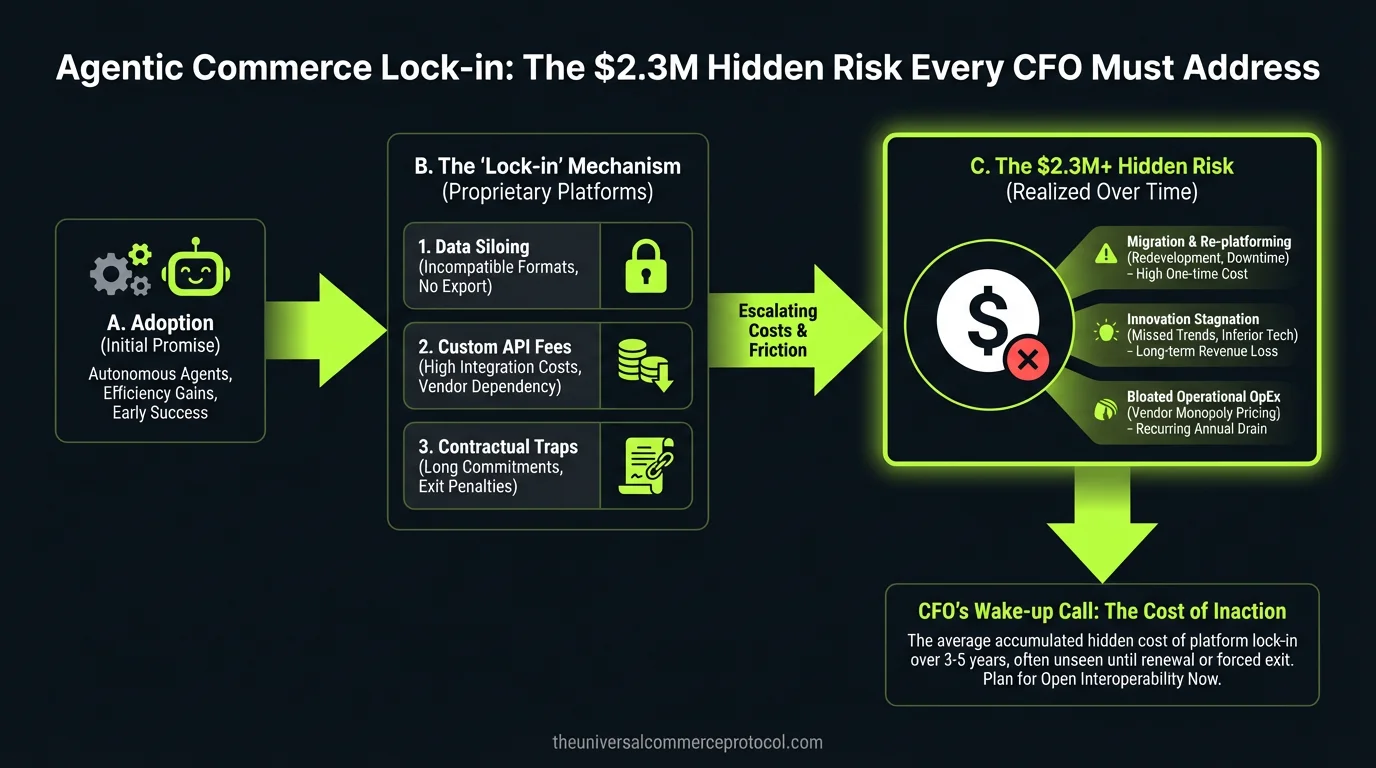
Agentic Commerce Lock-in: $2.3M CFO Risk
Agentic commerce platforms including Salesforce Einstein, Microsoft Copilot for Commerce, and custom LLM implementations impose switching costs exceeding $1.2M–$2.3M for mid-market merchants (annual revenue $50M–$500M), comprising retraining expenses, API integration rework, and operational downtime. CFOs face quantifiable vendor lock-in risk as proprietary agent frameworks become embedded across e-commerce, supply chain, and customer service operations. Organizations…
-
The $2.4M Hidden Cost of UCP Compliance: What CFOs Need to Know About Agentic Commerce Risk
Agentic commerce introduces $2.4M in potential compliance costs and regulatory penalties that could derail digital transformation ROI.
-
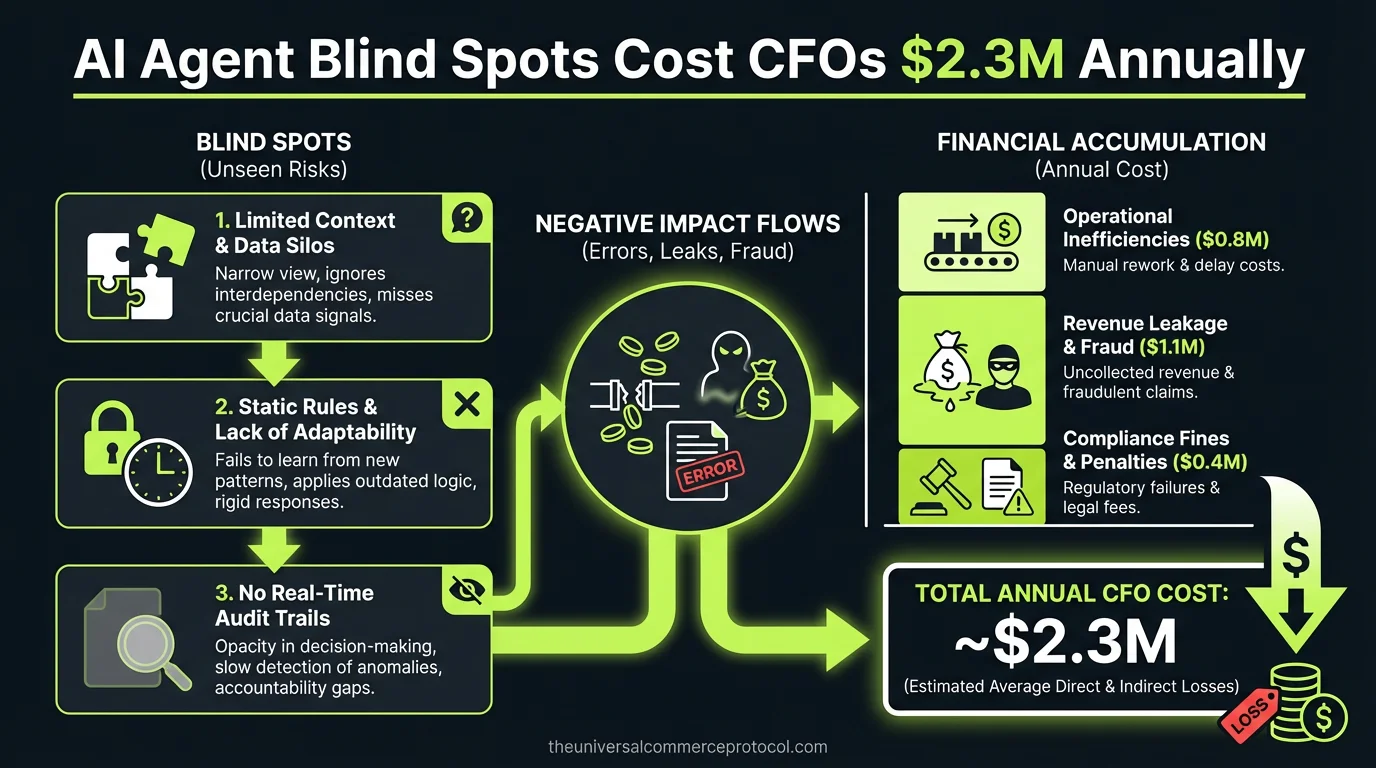
AI Agent Blind Spots Cost CFOs $2.3M Annually
According to enterprise financial technology research, AI agents operating in autonomous commerce decision-making environments without observability infrastructure accumulate average annual financial exposure of $2.3 million through undetected transaction errors, failed reconciliation processes, and systemic blind spots in audit trails. Chief Financial Officers implementing AI agent governance frameworks—including real-time monitoring, decision logging, and anomaly detection systems—can…
-
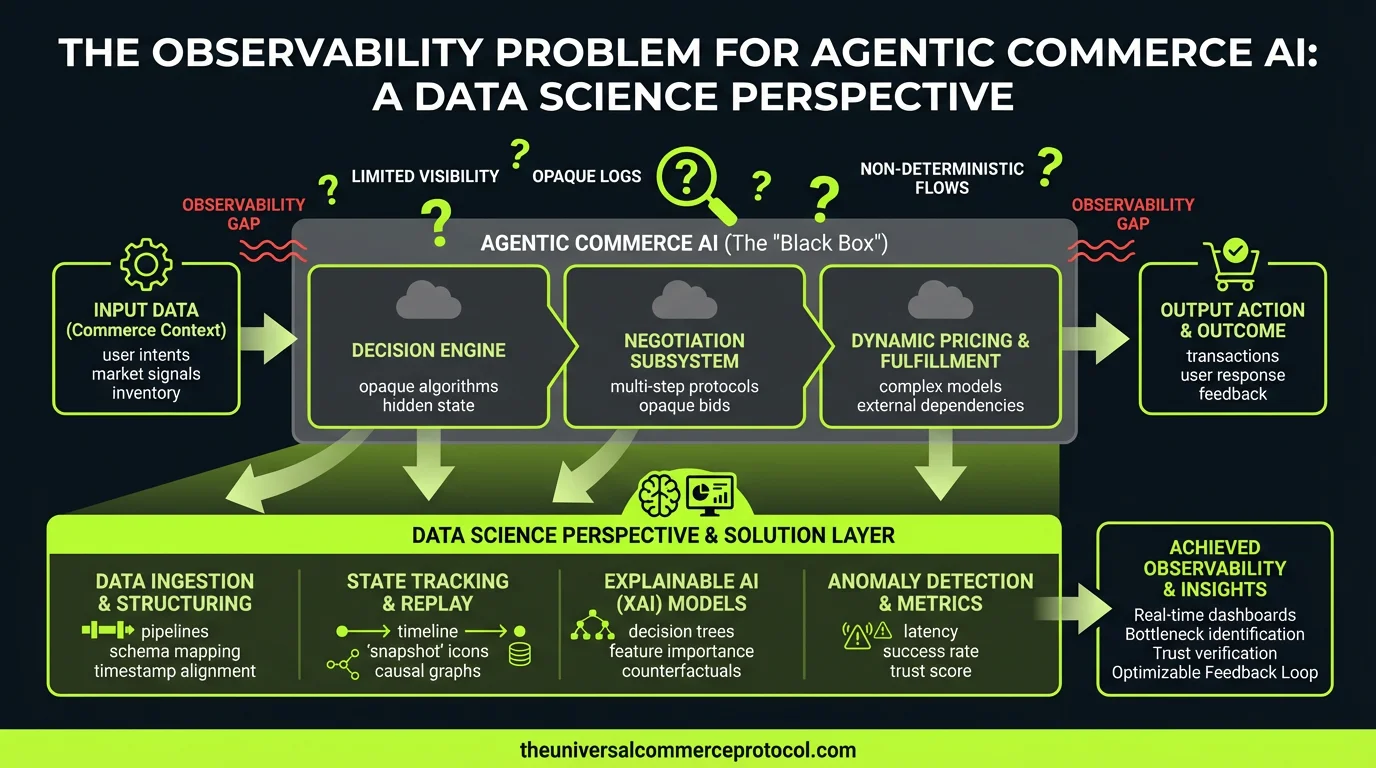
Observability Problem for Agentic Commerce AI
Agentic commerce AI systems processing high-volume transaction workflows require observability frameworks that move beyond traditional ML metrics like precision and recall to capture business-critical signals: transaction success rates, conversion funnel completion, fraud detection accuracy, and latency-induced revenue loss. Data science teams must implement causal inference methodologies and counterfactual analysis to validate decision-making quality across autonomous…
-
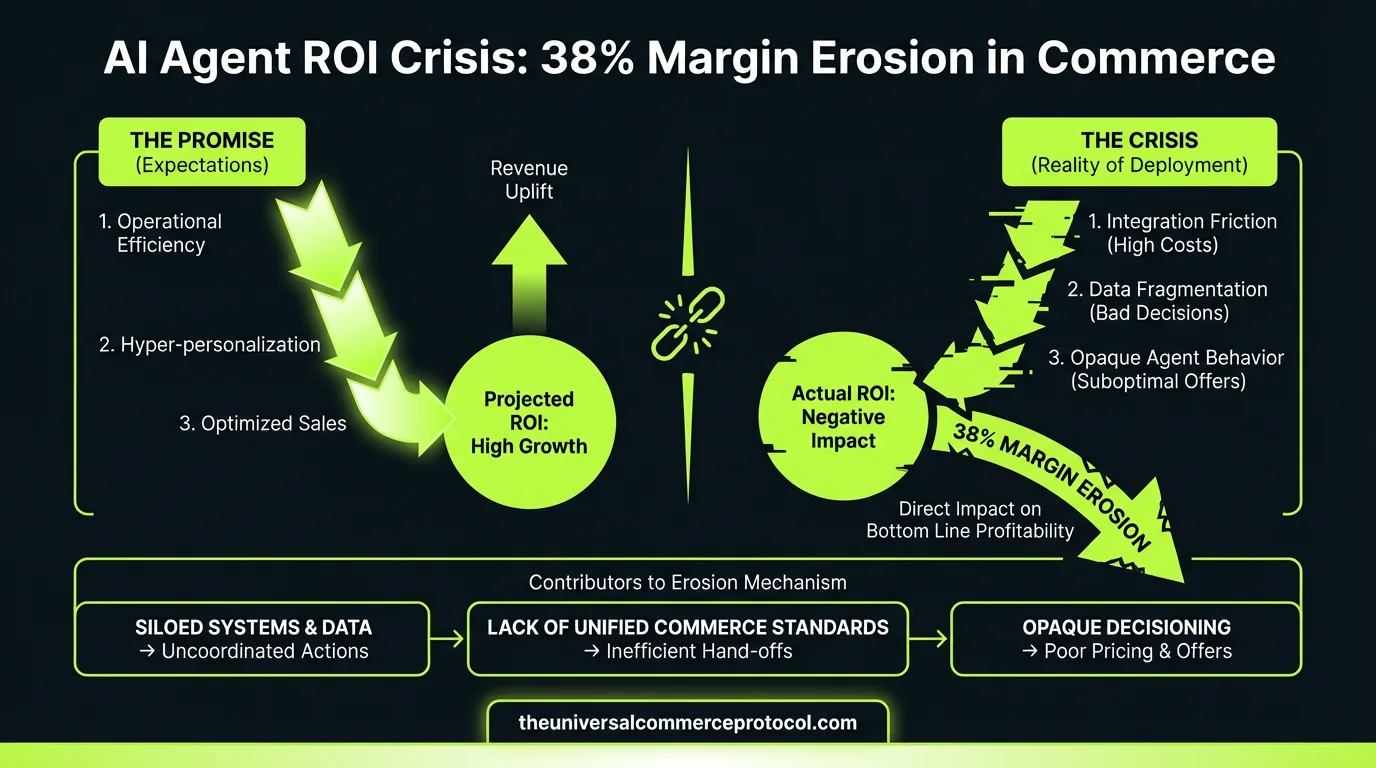
AI Agent ROI Crisis: 38% Margin Erosion in Commerce
Enterprise finance leaders implementing autonomous AI agents in e-commerce and omnichannel retail operations experience documented margin erosion of 30-38% per transaction, primarily driven by unattributed large language model (LLM) inference costs, vector database queries, and API consumption that escape traditional general ledger reconciliation. This cost leakage accelerates in high-frequency transaction environments (>10,000 daily operations) where…
-
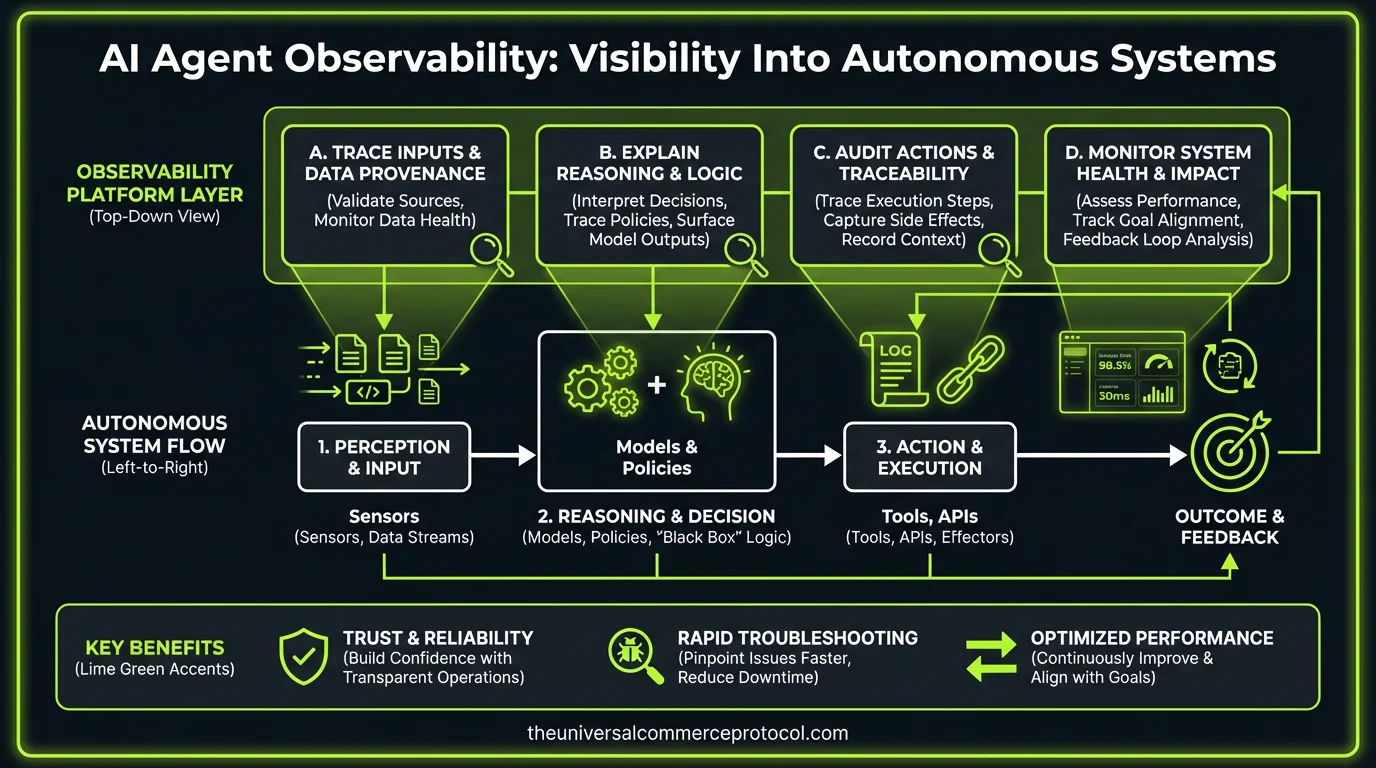
AI Agent Observability: Visibility Into Autonomous Systems
AI agent observability requires specialized monitoring architectures to capture decision-making traces, token consumption, and action sequences across large language models including OpenAI’s GPT-4 and GPT-4o, Anthropic’s Claude, and Meta’s Llama, since traditional APM platforms like Datadog, New Relic, and Dynatrace lack instrumentation for reasoning chains and ReAct pattern execution. Purpose-built observability platforms such as Langfuse,…