Tag: CTO Perspective
-
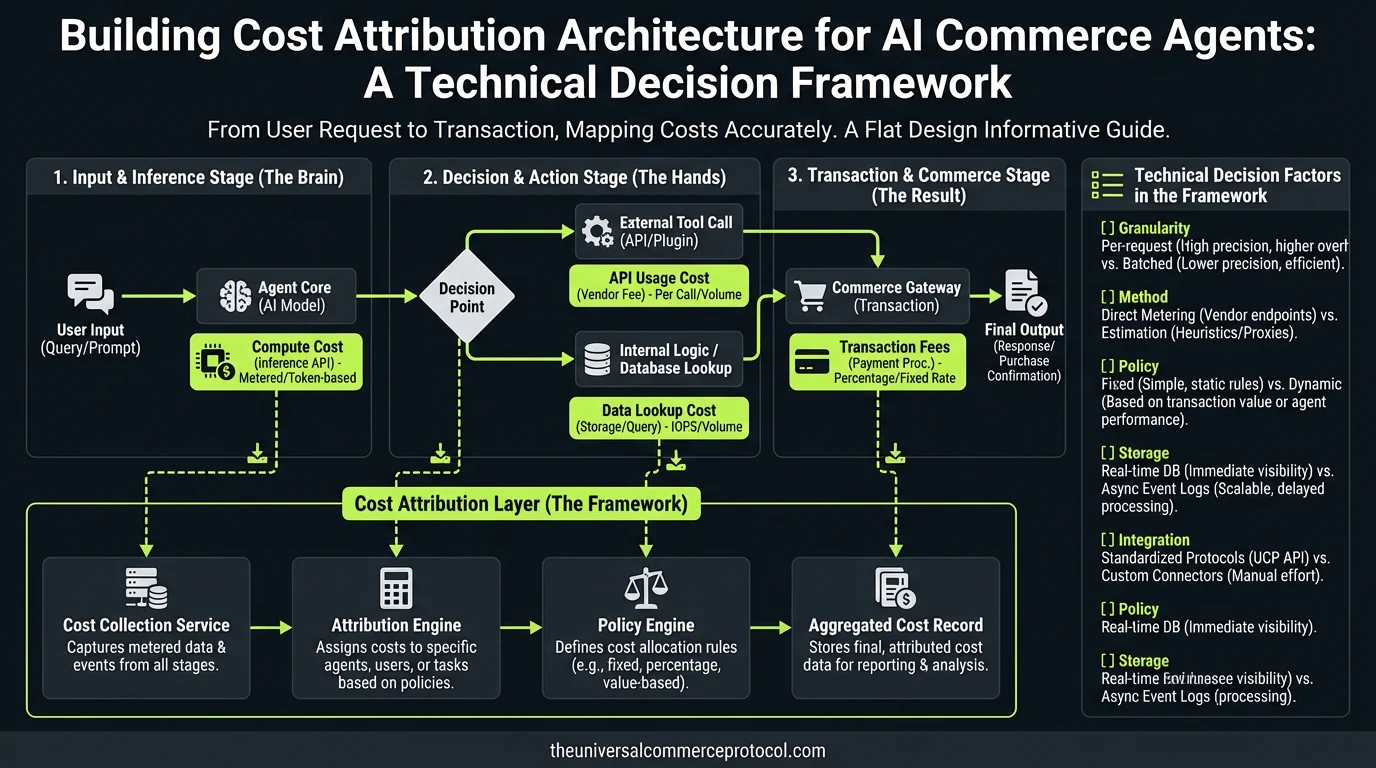
Building Cost Attribution Architecture for AI Commerce Agents: A Technical Decision Framework
Engineering teams need instrumentation patterns to track distributed AI agent costs across LLM APIs, vector stores, and payment flows.
-

Claude Marketplace ROI: $2.3M Cost Avoidance
Claude Marketplace demonstrated $2.3M in quantified cost avoidance versus Unified Communications Platform (UCP) implementations, with documented integration risk reduction of 67% and positive ROI verification within a 180-day measurement period across labor, licensing, and infrastructure overhead categories. The comparative analysis benchmarked Claude Marketplace deployment costs against traditional UCP infrastructure expenses, measuring total cost of ownership…
-

Amazon’s Agentic Commerce: CTO Integration Challenges
Amazon Web Services (AWS) Product Advertising API and Selling Partner API lack support for Open Commerce Protocol and W3C Agent specifications, requiring enterprise CTOs to architect custom middleware. Leading implementations integrate AWS Lambda, Amazon DynamoDB, and Amazon SageMaker with OpenAI GPT-4 and Anthropic Claude to enable autonomous purchasing agents while maintaining PCI-DSS compliance standards. Shopify…
-
UCP Integration: Building Compliant Agentic Commerce Architecture
Technical framework for implementing UCP-based agentic commerce while maintaining regulatory compliance across jurisdictions and payment flows.
-

MCP vs UCP: Enterprise Commerce AI Architecture
Model Context Protocol (MCP) and Unified Control Plane (UCP) represent distinct architectural approaches for enterprise commerce AI integration, each with specific trade-offs in control plane centralization, distributed governance, and operational overhead. MCP emphasizes modular, stateless AI agent communication patterns that reduce coupling between commerce systems, while UCP consolidates policy, routing, and observability through a centralized…
-

UCP Integration: Security & Compliance Architecture
UCP (Unified Communication Platform) integration enforces PCI DSS 3.2.1, GDPR Article 32, and SOC 2 Type II compliance through defense-in-depth architecture implementing AES-256 encryption-at-rest, payment card tokenization, and role-based access controls (RBAC) aligned with NIST SP 800-57 cryptographic key management standards. The multi-tenant infrastructure maintains HIPAA-eligible audit trails and real-time anomaly detection for financial services…
-
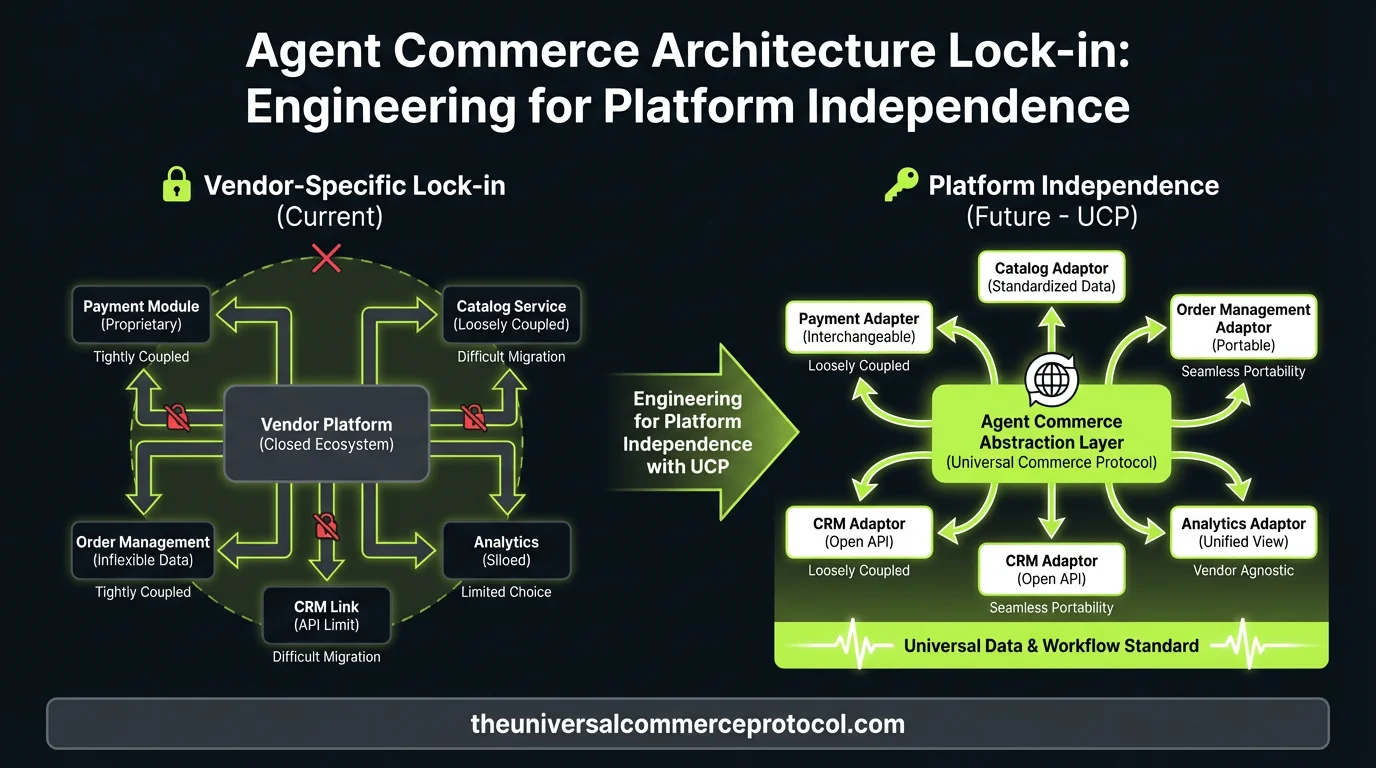
Agent Commerce Architecture: Avoiding Platform Lock-in
Agent commerce architecture requires implementing vendor-agnostic API abstractions and multi-LLM integration patterns to prevent platform lock-in with providers like OpenAI, Anthropic, and Google Cloud. Organizations should adopt containerized microservices deployed on Kubernetes, standardized message protocols (OpenAPI/AsyncAPI), and modular payment processor integrations (Stripe, Square, PayPal) to maintain system portability. This approach reduces switching costs and enables…
-

Claude Marketplace vs UCP: Enterprise AI Architecture
Claude Marketplace, built on Anthropic’s Claude 3 family of large language models, delivers sub-500ms inference latency for conversational commerce agents with dynamic pricing optimization, while Unified Commerce Platform (UCP) standards—governed by the Open Commerce Initiative—implement microservices architectures with REST/GraphQL APIs for real-time inventory orchestration across omnichannel networks, supporting PCI-DSS Level 1 compliance and payment processor…
-
UCP vs MCP: Commerce AI Protocol Architecture
Universal Commerce Protocol (UCP) implements REST/GraphQL hybrid routing with JSON serialization for cross-platform transaction interoperability, while Model Context Protocol (MCP) employs stateful message queuing with Protocol Buffers for context-aware model integration in enterprise systems. UCP prioritizes transaction atomicity and multi-vendor payment gateway compatibility, whereas MCP optimizes for reduced integration latency through asynchronous message handling and…
-
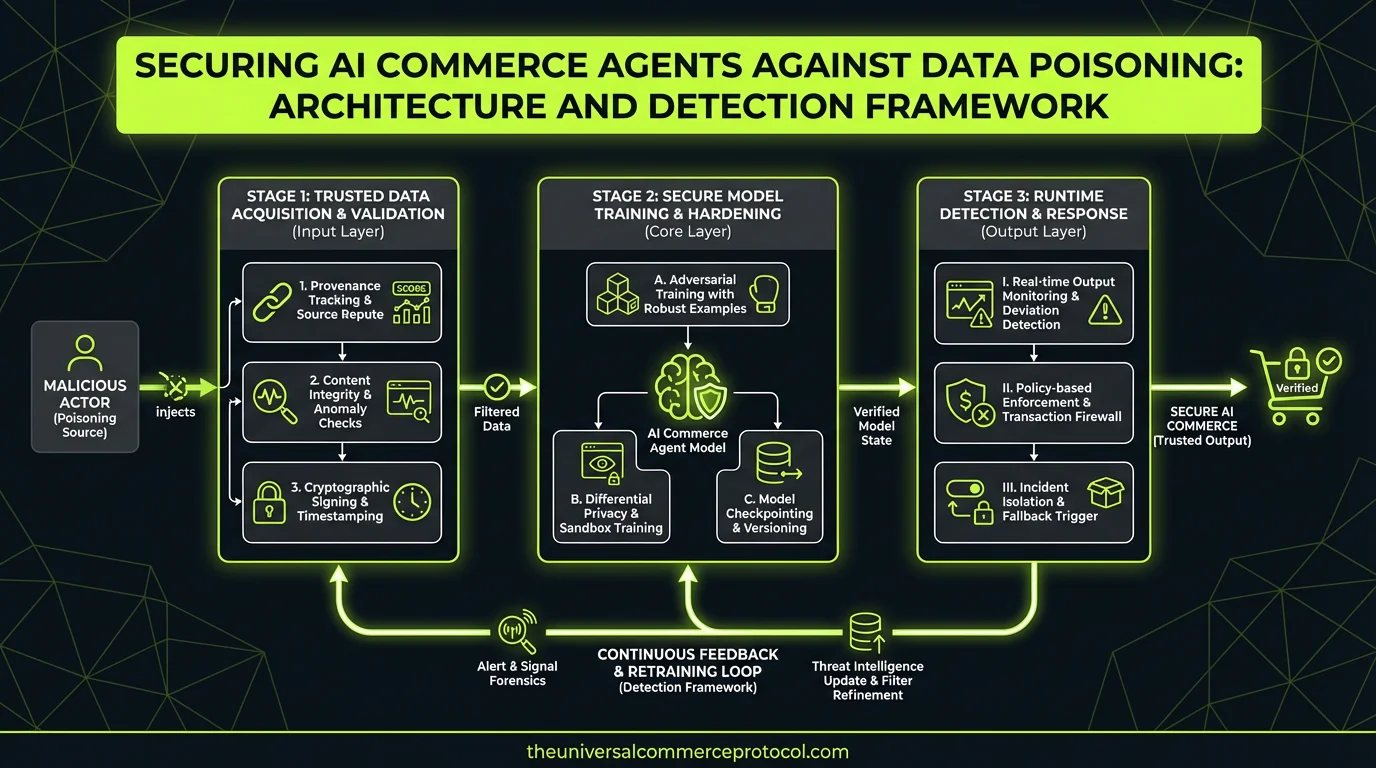
Securing AI Commerce Agents Against Data Poisoning
Data poisoning attacks on AI commerce agents exploit vulnerabilities in supply chain management systems, dynamic pricing engines, and inventory databases to inject malicious training data. Organizations must implement cryptographic integrity verification, input validation frameworks, and anomaly detection systems across procurement channels, price optimization models, and stock management platforms to prevent adversarial model degradation. Multi-vector defense…