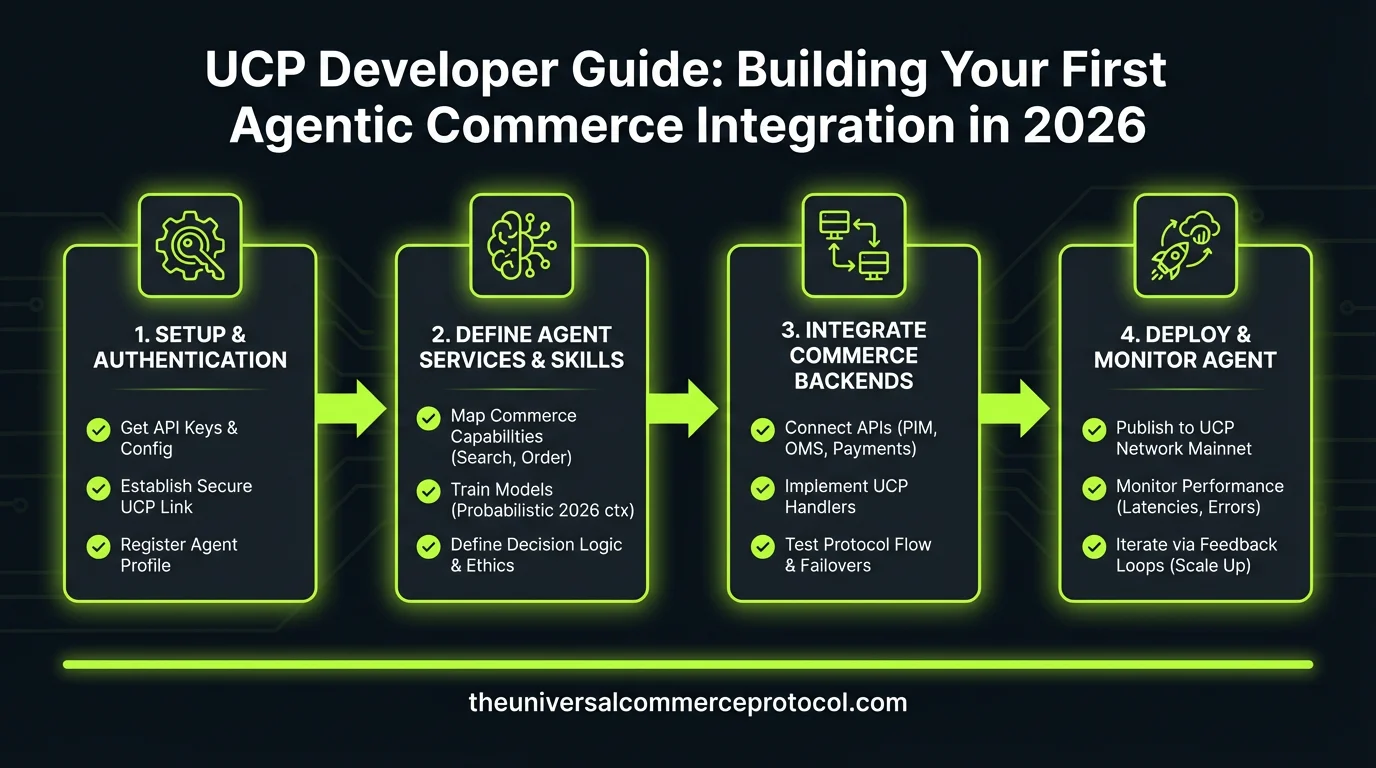
UCP Developer Guide: Building Your First Agentic Commerce Integration in 2026
The Universal Commerce Protocol (UCP) has fundamentally transformed how autonomous agents conduct commerce. As we move deeper into 2026, integrating with UCP and implementing the agent payments protocol is no longer optional for forward-thinking development teams. This guide provides a practical roadmap for developers ready to build their first agentic commerce integration.
Understanding the Agent Payments Protocol Foundation
The agent payments protocol is the backbone of trustless transactions between autonomous agents and merchants. Unlike traditional payment gateways designed for human-initiated purchases, the agent payments protocol enables machines to negotiate, authorize, and settle payments without human intervention. Before building your integration, you need to understand the three core components: agent identity verification, transaction validation, and settlement mechanisms.
The agent payments protocol operates on cryptographic proof-of-authority (PoA) standards established by the UCP specification. Each autonomous agent receives a unique digital credential that proves its legitimacy within the commerce network. These credentials are issued by UCP-certified credential authorities and must be renewed quarterly to maintain compliance with 2026 security standards.
Step 1: Setting Up Your Development Environment
Begin by installing the UCP SDK version 3.2 or higher, released in Q1 2026. The SDK is available through npm, PyPI, and Maven Central repositories. For Node.js environments, run:
npm install @ucp/sdk@latest @ucp/agent-payments-protocol@3.2.0
For Python developers, the equivalent installation is:
pip install ucp-sdk==3.2.0 ucp-agent-payments-protocol==3.2.0
After installation, initialize your project configuration file. The UCP SDK requires a ucp.config.json file containing your merchant identifier, API endpoint preferences, and agent permissions scope. The merchant identifier is a 32-character alphanumeric code provided by your UCP-certified provider when you register your commerce entity.
Verify your installation by running the diagnostic command: ucp-cli diagnose --verbose. This confirms that all dependencies are properly configured and your development machine can communicate with UCP network nodes.
Step 2: Implementing Agent Authentication
Agent authentication is the critical security layer that prevents unauthorized transactions. The agent payments protocol uses a three-factor authentication model: agent credential verification, transaction signature validation, and rate-limit checking.
Implement the authentication middleware in your integration layer:
- Credential Verification: When an agent initiates contact, extract its digital credential from the request header. Validate this credential against the UCP credential authority registry using the
verifyAgentCredential()function. This function checks the credential’s expiration date, revocation status, and permission scope. - Signature Validation: Each transaction request must include a cryptographic signature generated by the agent’s private key. Use the
validateTransactionSignature()method to confirm the signature matches the transaction data and agent identity. - Rate Limiting: Implement per-agent rate limits using the agent payments protocol’s built-in throttling mechanism. Standard limits in 2026 are 100 transactions per minute for standard agents and 500 per minute for enterprise-tier agents.
Here’s a practical authentication implementation pattern:
const ucpAuth = new UCPAuthenticator(config);

const agentRequest = req.headers['x-agent-credential'];

const verification = await ucpAuth.verifyAgent(agentRequest);

if (!verification.isValid) throw new UCPAuthError('Invalid agent credential');
Step 3: Designing Your Transaction Schema
The agent payments protocol requires adherence to the UCP Transaction Schema v2.1, finalized in early 2026. This schema defines how all transaction data must be structured for interoperability across the commerce network.
Essential transaction fields include:
- Transaction ID: A unique 64-character identifier generated by your system
- Agent ID: The authenticated agent’s permanent identifier
- Merchant ID: Your registered UCP merchant identifier
- Amount: Transaction value in ISO 4217 currency codes (USD, EUR, GBP, etc.)
- Timestamp: ISO 8601 format with UTC timezone
- Item Manifest: Detailed product/service descriptions with SKU mappings
- Fulfillment Address: Geolocation data in GeoJSON format
- Payment Method: Specified according to agent payments protocol payment type registry
Validate all transactions against the schema before submission. The UCP SDK provides the validateTransactionSchema() function for this purpose. Schema violations will be rejected at the network level, so validation at the integration point prevents failed transactions and improves performance.
Step 4: Implementing Payment Processing
The agent payments protocol supports multiple settlement models: immediate settlement, batched settlement, and conditional settlement. Most developers in 2026 use batched settlement for cost efficiency, processing transactions in 15-minute windows.
Initialize your payment processor with settlement preferences:
const paymentProcessor = new UCPPaymentProcessor({

  settlementModel: 'batched',

  batchWindow: 900000, // 15 minutes in milliseconds

  failureRetryAttempts: 3,

  webhookEndpoint: 'https://yourdomain.com/webhooks/settlement'

});
Connect your payment processor to your merchant acquirer. Major acquirers like Stripe, Square, and Adyen have released UCP-native connectors in 2026. These connectors handle the translation between agent payments protocol payment instructions and traditional payment processing networks.
Implement webhook handlers to receive settlement confirmations and failure notifications. The agent payments protocol guarantees at-least-once delivery for settlement notifications, so implement idempotency keys to prevent duplicate processing.
Step 5: Testing and Validation
Before deploying to production, thoroughly test your integration using the UCP Sandbox environment. The sandbox provides simulated agents that behave identically to production agents but operate in an isolated network.
Execute these critical test scenarios:
- Successful transaction flow with valid agent credentials
- Rejection of expired or revoked agent credentials
- Signature validation failures and recovery
- Rate limit enforcement and backoff behavior
- Settlement webhook delivery and retry logic
- Concurrent transaction handling under load
Use the UCP CLI testing toolkit to generate synthetic agent requests and validate your responses. Run ucp-cli test-suite --integration-path ./src --verbose --report json to generate a comprehensive test report.
Step 6: Deploying to Production
Production deployment requires UCP certification. Submit your integration code and test results to your UCP-certified provider for security audit. The certification process typically completes within 5-7 business days in 2026.
Upon approval, deploy your integration to production infrastructure. The agent payments protocol requires all production integrations to maintain 99.95% uptime SLA. Implement redundant servers, automated failover, and comprehensive monitoring.
Enable detailed logging for all agent payments protocol transactions. Maintain transaction logs for a minimum of 7 years for regulatory compliance. Integrate your logging system with your UCP provider’s audit dashboard for real-time monitoring.
Step 7: Monitoring and Optimization
After deployment, monitor key performance indicators specific to agentic commerce. Track agent transaction success rates, average settlement time, and payment method distribution. The agent payments protocol provides native metrics through the UCP Analytics API.
Implement alerting for transaction failure rates exceeding 2% or settlement delays exceeding 30 minutes. These thresholds indicate potential issues with your integration or upstream payment processing.
Regularly review your agent payments protocol implementation against the latest UCP specification updates. The protocol receives quarterly updates addressing security enhancements and interoperability improvements. Subscribe to the UCP Developer mailing list to receive notifications of breaking changes.
Common Integration Challenges and Solutions
Developers integrating with the agent payments protocol frequently encounter timestamp synchronization issues. Ensure your server time is synchronized with NTP (Network Time Protocol) to within 1 second. The UCP specification requires timestamp accuracy for transaction validation.
Another common issue is insufficient error handling for network timeouts. The agent payments protocol implements exponential backoff for retry logic. Always catch timeout exceptions and implement your own retry mechanism with jitter to prevent thundering herd scenarios.
Currency conversion complexity arises when agents and merchants operate in different regions. The agent payments protocol requires all amounts to be specified in the merchant’s settlement currency. Implement real-time exchange rate lookups using the UCP Currency Exchange API to accurately convert agent-submitted amounts.
FAQ
What is the agent payments protocol and how does it differ from traditional payment APIs?
The agent payments protocol is a cryptographic framework within UCP that enables autonomous agents to conduct commerce without human authorization. Unlike traditional payment APIs designed for human-initiated transactions with explicit user consent, the agent payments protocol implements machine-to-merchant trust through credential verification, transaction signing, and automated settlement. It supports higher transaction velocity (100+ per minute) and eliminates the need for user interface interaction.
How long does UCP certification typically take for a new integration?
As of 2026, UCP certification for new integrations typically requires 5-7 business days after submission. The timeline includes automated security scanning (2-3 days), manual code review by UCP security engineers (2-3 days), and final approval (1 day). Expedited certification is available for enterprise partners with SLA requirements, reducing the timeline to 2-3 business days for an additional fee.
What compliance and regulatory requirements must my agentic commerce integration meet?
Your integration must comply with PCI DSS Level 1 standards for payment data handling, GDPR requirements for EU customer data, and local financial services regulations in each jurisdiction where you operate. The agent payments protocol handles most compliance requirements natively, but you must maintain audit logs for 7 years, implement data encryption at rest and in transit, and conduct annual security audits. Consult with your legal and compliance teams regarding jurisdiction-specific requirements before launching.
What is the Universal Commerce Protocol (UCP)?
The Universal Commerce Protocol (UCP) is a framework that has fundamentally transformed how autonomous agents conduct commerce. It enables trustless transactions between autonomous agents and merchants, making it essential for forward-thinking development teams building agentic commerce integrations in 2026.
What is the agent payments protocol and how does it work?
The agent payments protocol is the backbone of trustless transactions between autonomous agents and merchants. It enables machines to negotiate, authorize, and settle payments without human intervention, operating on cryptographic proof-of-authority (PoA) standards established by the UCP specification.
What are the three core components of the agent payments protocol?
The three core components of the agent payments protocol are: (1) agent identity verification, (2) transaction validation, and (3) settlement mechanisms. Understanding these components is essential before building your integration.
How does agent identity verification work in UCP?
Each autonomous agent receives a unique digital credential that proves its legitimacy within the commerce network. These credentials are issued by UCP-certified credential authorities and must be renewed quarterly to maintain compliance with 2026 security standards.
Why is integrating with UCP important in 2026?
Integrating with UCP and implementing the agent payments protocol is no longer optional for forward-thinking development teams. As autonomous commerce becomes increasingly prevalent, UCP integration is essential for developers looking to stay competitive and build modern agentic commerce solutions.
Leave a Reply