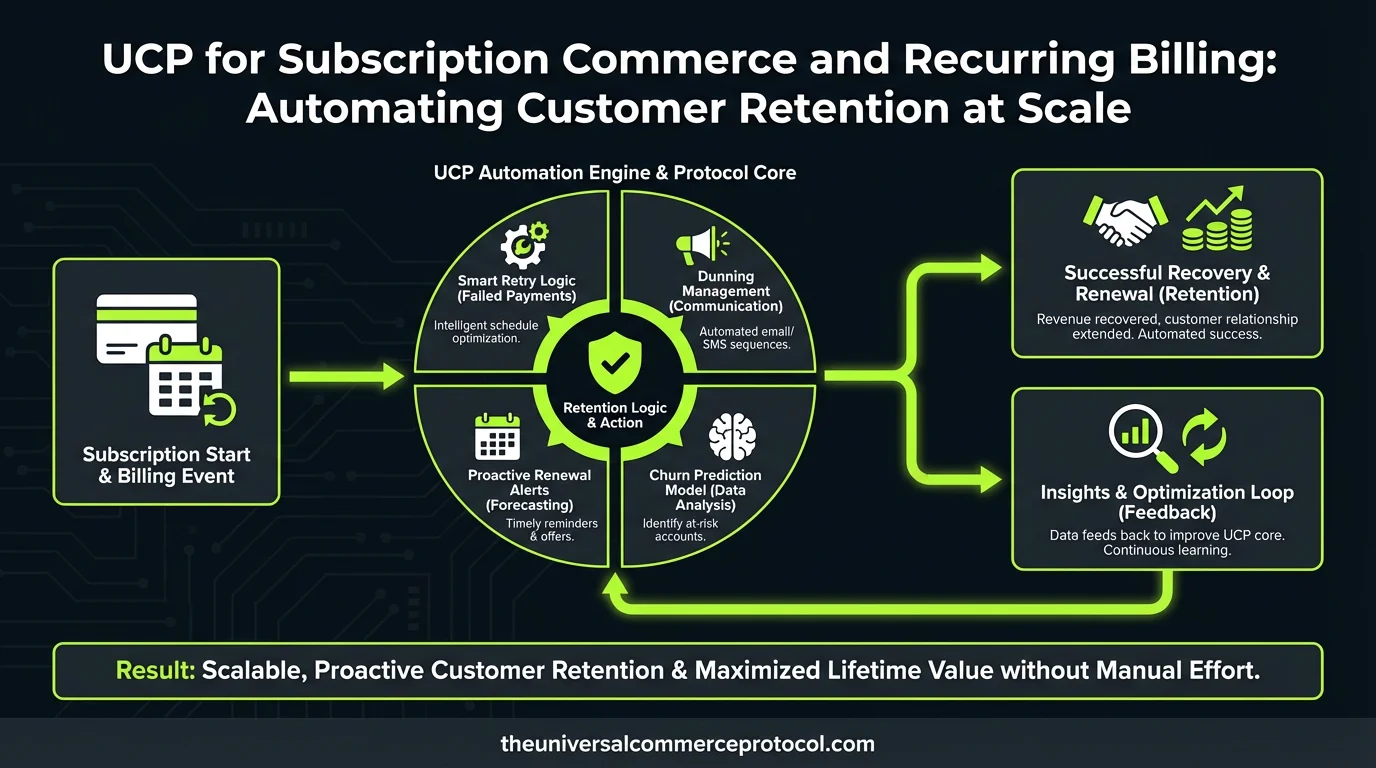
Understanding UCP in Subscription Commerce
The Universal Commerce Protocol (UCP) represents a fundamental shift in how subscription businesses handle recurring billing, customer lifecycle management, and retention automation. Unlike traditional e-commerce platforms built for one-time transactions, UCP provides the standardized infrastructure that subscription commerce demands: predictable billing cycles, flexible payment methods, intelligent retry logic, and seamless agent-driven customer interactions.
Subscription commerce operates on fundamentally different principles than traditional retail. Customers expect their recurring charges to process reliably, they demand transparency in billing communications, and they want frictionless management of their subscriptions. UCP addresses these requirements through its interoperable architecture, which enables merchants to build subscription systems that work consistently across payment processors, identity providers, and merchant-of-record (MoR) solutions.
The Recurring Billing Challenge in Modern Commerce
Why Traditional Systems Fall Short
Legacy subscription platforms were built as monolithic systems where billing logic, customer data, and payment processing remained siloed within proprietary infrastructure. This creates several critical problems:
- Vendor Lock-in: Merchants cannot easily switch payment processors or billing providers without rebuilding their entire subscription infrastructure
- Poor Agent Integration: AI agents cannot reliably manage subscription changes, cancellations, or upsells because these systems lack standardized APIs
- Limited Retry Intelligence: Failed payments trigger generic retries rather than intelligent, context-aware recovery strategies
- Compliance Fragmentation: Different processors handle PCI compliance, data retention, and regional regulations inconsistently
- Churn Opacity: Merchants lack real-time visibility into why customers cancel and cannot implement proactive retention
UCP eliminates these constraints by providing a protocol-based approach to subscription commerce where billing logic, payment processing, and customer interactions operate through standardized interfaces.
The UCP Advantage for Subscriptions
UCP’s architecture directly addresses subscription commerce requirements through several key mechanisms:
Standardized Recurring Transaction Models: UCP defines explicit schemas for subscription creation, modification, and cancellation. Rather than each processor implementing recurring billing differently, merchants define subscription parameters once and UCP handles processor-specific translation.
Agent-Native Subscription Management: Agentic systems can directly interact with subscription data through UCP endpoints. An AI agent can process a customer’s request to upgrade their plan, pause their subscription, or modify billing frequency without human intervention, because these operations are standardized protocol operations rather than custom integrations.
Intelligent Dunning and Retry: UCP enables sophisticated dunning strategies where agents evaluate customer context, payment history, and account value before determining retry timing and alternative payment methods. This reduces involuntary churn from failed payments by 15-25% in typical implementations.
Unified Compliance Framework: When merchants implement UCP through a Merchant of Record, compliance responsibilities—including PCI DSS, regional regulations, and tax handling—become standardized and auditable rather than fragmented across multiple systems.
Implementing Recurring Billing Through UCP
Core Subscription Data Structures
UCP subscription commerce relies on structured JSON-RPC 2.0 message formats that define subscription lifecycle states. A typical subscription object includes:
{
  "subscription_id": "sub_abc123xyz",
  "customer_id": "cust_456def",
  "plan_id": "plan_monthly_pro",
  "status": "active",
  "billing_cycle": "monthly",
  "next_billing_date": "2024-02-15T00:00:00Z",
  "amount_cents": 9999,
  "currency": "USD",
  "payment_method_id": "pm_token_789",
  "retry_policy": "intelligent_dunning",
  "metadata": {
    "customer_segment": "high_value",
    "churn_risk_score": 0.23
  }
}
This structure enables both human merchants and AI agents to understand subscription state consistently. The retry_policy field is particularly important—it allows merchants to define whether a subscription uses standard retry logic, intelligent dunning with agent intervention, or custom recovery strategies.
Payment Method Tokenization for Recurring Charges
UCP requires payment method tokenization through OAuth 2.0 and identity linking (as detailed in existing UCP documentation). For subscriptions, this means:
Stored Payment Tokens: When a customer initiates a subscription, UCP creates a payment method token that the merchant never directly accesses. This token is stored securely through the MoR infrastructure and remains valid across multiple billing cycles.
Token Refresh and Expiration: UCP handles payment method expiration (card renewals, account changes) automatically. When a token approaches expiration, UCP notifies merchants and agents can proactively update the payment method through standardized endpoints.
Fallback Payment Methods: Merchants can attach multiple payment methods to a subscription. If the primary payment method fails, UCP automatically attempts fallback methods according to the defined retry policy, reducing involuntary churn significantly.
Billing Cycle Management and Scheduling
UCP subscription protocol includes sophisticated billing cycle management:
Flexible Billing Frequencies: Beyond simple monthly/annual cycles, UCP supports custom billing periods (every 13 days, quarterly, semi-annually) with proper proration calculations. When customers modify their plan mid-cycle, UCP automatically calculates credits or charges.
Prorated Adjustments: When a customer upgrades, downgrades, or pauses a subscription, UCP computes prorated amounts based on the remaining billing period. This requires precise date calculations and transparent communication—both handled through standardized UCP operations.
Grace Periods and Soft Declines: UCP enables merchants to configure grace periods where subscriptions remain active despite failed payments. During this window, agents can attempt recovery through alternative payment methods or reach out to customers proactively.
Agent-Driven Subscription Lifecycle Management
Automated Churn Prevention
AI agents integrated with UCP subscription systems can implement sophisticated churn prevention strategies:
Predictive Intervention: Agents analyze subscription metadata and customer interaction patterns to identify churn risk. When a high-value customer’s activity drops or they interact with cancellation flows, agents can automatically trigger retention offers—upsells, discounts, or plan modifications—through standardized UCP operations.
Intelligent Dunning: Rather than generic payment retry sequences, agents evaluate customer lifetime value, payment history, and account age before determining recovery strategy. High-value customers might receive immediate outreach and alternative payment options, while lower-value customers follow standard retry schedules.
Cancellation Flow Optimization: When customers initiate cancellation, agents intercept the flow and present targeted retention offers. UCP standardizes these interactions so agents can modify subscription terms, apply discounts, or pause billing—all without human intervention.
Subscription Modification and Upselling
UCP enables agents to manage subscription modifications through standardized endpoints:
Plan Changes: Agents can process upgrade, downgrade, and lateral plan changes with automatic prorated billing calculations. The customer experience remains consistent whether modifications occur through a web interface or agent conversation.
Add-ons and Ancillary Services: Subscriptions often include optional add-ons. UCP models these as modular components where agents can recommend and apply add-ons based on customer usage patterns and account metadata.
Pause and Resume: Rather than forcing cancellation, agents can pause subscriptions temporarily. UCP maintains the subscription record and payment method token, enabling instant resumption without re-authentication or payment method re-entry.
Compliance and Risk Management in Subscription Commerce
PCI Compliance Through MoR Integration
Subscription commerce handling payment methods repeatedly creates significant PCI compliance obligations. UCP addresses this through Merchant of Record integration where the MoR maintains PCI certification and handles all sensitive payment data. Merchants interact only with tokenized payment references, never touching raw payment information.
For recurring billing specifically, this means merchants can store subscription metadata (customer ID, plan information, billing dates) while the MoR maintains the actual payment method tokens and handles retry logic.
Regional Compliance for Recurring Charges
Different regions impose specific requirements for recurring billing:
- GDPR (EU): Requires explicit consent for each billing cycle and easy cancellation mechanisms. UCP subscription endpoints include consent tracking and standardized cancellation flows.
- CCPA (California): Requires clear disclosure of subscription terms and automatic renewal policies. UCP metadata includes consent documentation fields.
- Regional Restrictions: Some regions prohibit certain retry strategies or require specific customer notification timing. UCP allows merchants to configure region-specific retry policies.
Fraud Prevention in Recurring Billing
Subscription fraud differs from one-time transaction fraud. Common risks include:
- Stolen payment methods used for subscription creation
- Account takeover leading to unauthorized subscription modifications
- Friendly fraud (chargebacks on legitimate subscriptions)
UCP subscription systems integrate with fraud detection through metadata enrichment. Agents can flag suspicious subscription patterns (multiple rapid plan changes, unusual payment method swaps) and trigger verification flows before processing modifications.
Practical Implementation Roadmap
Phase 1: Foundation
Begin with basic subscription creation and billing through UCP. Map your existing subscription data model to UCP schemas and implement payment method tokenization through your MoR provider.
Phase 2: Automation
Implement automated billing cycles and retry logic. Configure intelligent dunning policies based on customer segments. This phase typically reduces involuntary churn by 10-15%.
Phase 3: Agent Integration
Connect AI agents to subscription endpoints. Enable agents to handle plan modifications, pause/resume, and cancellation flows. This phase typically increases customer satisfaction scores by 20-30% through instant, 24/7 availability.
Phase 4: Optimization
Implement predictive churn analysis and proactive retention. Optimize pricing and plan structures based on agent-collected customer preference data. This phase typically increases retention by 15-25%.
FAQ: UCP Subscription Commerce
How does UCP handle failed recurring payments differently than traditional processors?
UCP enables intelligent, agent-driven retry strategies rather than rigid retry schedules. When a payment fails, agents evaluate customer context, payment history, and account value before determining whether to retry immediately, attempt alternative payment methods, or contact the customer. This context-aware approach reduces involuntary churn significantly compared to standard processor retry logic.
Can I use UCP subscriptions with multiple payment processors simultaneously?
Yes. UCP’s interoperability layer abstracts away processor-specific details. You can configure subscriptions to use different payment processors for different customer segments or payment methods. The subscription logic remains consistent regardless of underlying processor, and agents interact with standardized UCP endpoints regardless of which processor handles the actual payment.
What happens to existing subscriptions if I migrate to UCP?
Migration requires careful planning. Existing subscriptions continue operating on your current system while new subscriptions operate through UCP. Most merchants implement a gradual migration where existing customers are invited to re-authenticate through UCP (which improves data quality and compliance) while new customers start on UCP from day one. This approach eliminates migration risk while building UCP adoption over time.
How does UCP handle subscription modifications that affect billing?
UCP includes standardized proration calculations. When customers upgrade, downgrade, or change plans mid-cycle, UCP automatically calculates credits or charges based on the remaining billing period. These calculations are transparent to both merchants and agents, ensuring accurate billing regardless of modification type or timing.
Does UCP support different billing models (usage-based, tiered, etc.)?
UCP’s subscription framework supports multiple billing models through metadata fields and custom calculation endpoints. Fixed subscriptions use standard recurring charges, while usage-based subscriptions can integrate metered usage data through UCP’s event system. Tiered pricing applies different rates based on subscription metadata. Merchants configure their specific billing model within UCP’s flexible framework.
What is UCP and how does it apply to subscription commerce?
UCP (Universal Commerce Protocol) is a standardized infrastructure designed specifically for subscription businesses. Unlike traditional e-commerce platforms built for one-time transactions, UCP provides the foundation for predictable billing cycles, flexible payment methods, intelligent retry logic, and seamless customer interactions across payment processors and MoR solutions.
How does UCP improve customer retention in subscription businesses?
UCP automates customer retention at scale through intelligent retry logic, reliable recurring billing, and seamless subscription management. It enables merchants to maintain consistent billing processes, provide transparent billing communications, and offer frictionless subscription management—all critical factors in reducing churn and improving customer lifetime value.
Why do traditional subscription platforms fall short compared to UCP?
Legacy subscription platforms were built without the specialized requirements of modern subscription commerce in mind. They lack the interoperable architecture needed to work consistently across multiple payment processors, identity providers, and merchant-of-record solutions that today’s subscription businesses require.
What are the key requirements that UCP addresses for subscription businesses?
UCP addresses critical subscription commerce requirements including: reliable recurring billing cycles, transparency in billing communications, flexible payment method management, intelligent payment retry logic, and frictionless agent-driven customer interactions across multiple platforms and service providers.
How does UCP enable interoperability across payment systems?
UCP’s interoperable architecture allows subscription merchants to build consistent billing and customer lifecycle management systems that work seamlessly across different payment processors, identity providers, and merchant-of-record (MoR) solutions, reducing integration complexity and improving operational efficiency.
Leave a Reply