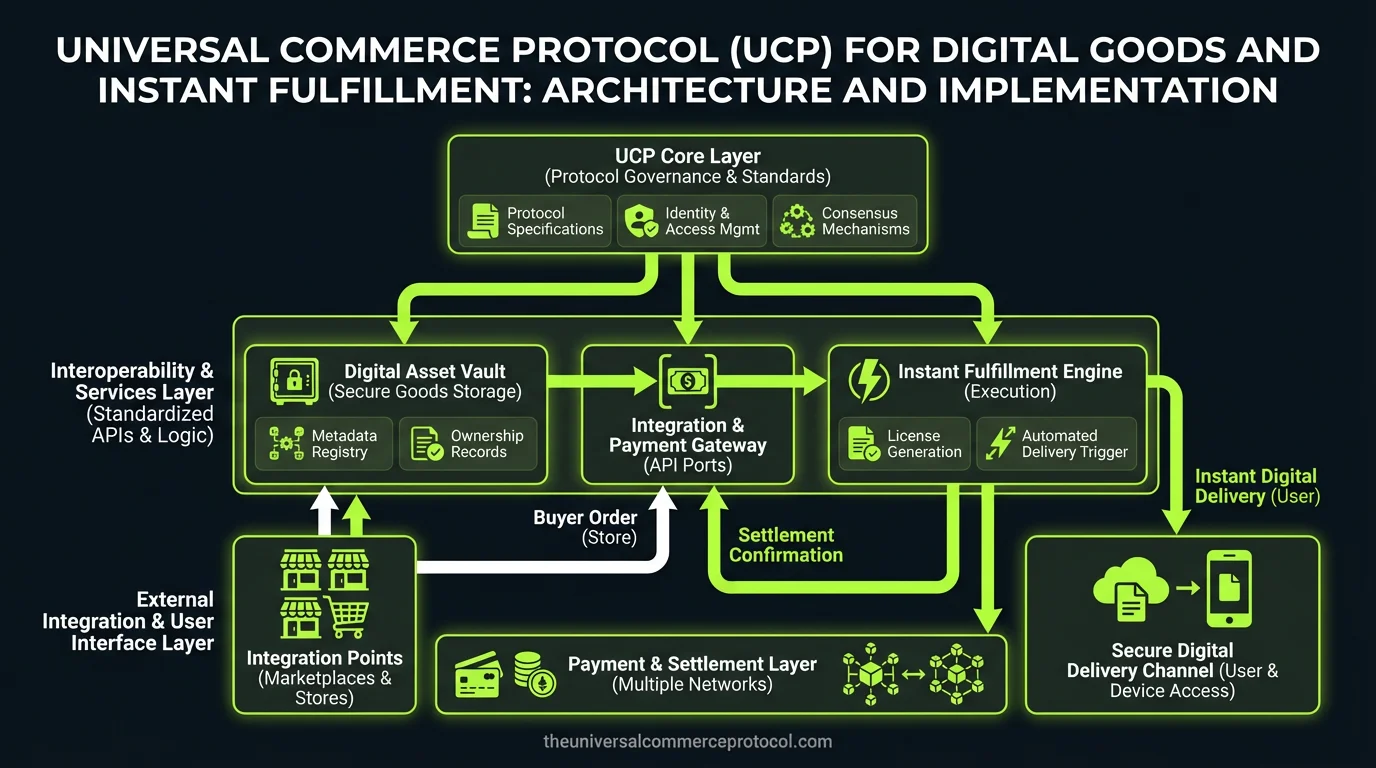
Universal Commerce Protocol (UCP) for Digital Goods and Instant Fulfillment: Architecture and Implementation
The Universal Commerce Protocol (UCP) represents a fundamental shift in how digital goods are bought, sold, and delivered. Unlike physical commerce where fulfillment involves warehousing, logistics, and shipping delays, digital goods require a different approach entirely. UCP standardizes this process, enabling merchants to deliver digital products instantaneously upon purchase confirmation, creating a frictionless experience that traditional e-commerce platforms struggle to match.
Understanding UCP’s Role in Digital Goods Commerce
Digital goods—software licenses, ebooks, video content, music files, in-game items, design assets, and API credentials—represent a growing segment of global commerce. Unlike physical products, digital goods have zero marginal cost, infinite inventory capacity, and can be delivered instantly. However, this potential has been constrained by legacy commerce platforms designed for physical inventory management.
Related articles: UCP Shipping Carrier Selection & Rate Optimization • UCP Security Best Practices for AI-Driven Commerce
UCP decouples the purchase transaction from fulfillment mechanics, creating a standardized interface that allows merchants to:
- Define digital product specifications in machine-readable formats
- Trigger automated fulfillment workflows immediately upon payment confirmation
- Track fulfillment status in real-time across distributed systems
- Handle complex scenarios like conditional delivery, usage limits, and license management
Core Architecture of UCP for Digital Fulfillment
The UCP Transaction Model
UCP transactions for digital goods operate through a four-stage lifecycle:
Stage 1: Product Registration – Merchants register digital goods with product metadata including delivery mechanisms, license terms, and fulfillment endpoints. This metadata is stored in a standardized format that commerce agents and fulfillment systems can interpret consistently.
Stage 2: Order Placement and Payment – When a buyer initiates a purchase, UCP creates an order record containing product identifiers, delivery parameters, and payment information. The protocol ensures payment processing occurs before fulfillment triggers are activated.
Stage 3: Instant Fulfillment Trigger – Upon successful payment confirmation, UCP triggers fulfillment workflows automatically. For digital goods, this means invoking delivery mechanisms—generating download links, provisioning API keys, activating licenses, or streaming content access.
Stage 4: Delivery Confirmation and Audit Trail – UCP logs fulfillment completion with cryptographic proof, creating an immutable record that satisfies compliance requirements and enables dispute resolution.
Fulfillment Mechanisms in UCP
UCP supports multiple fulfillment patterns optimized for different digital good types:
Direct Download Fulfillment – For files (ebooks, software installers, design assets), UCP generates time-limited, single-use download URLs that expire after delivery or after a specified duration. This prevents unauthorized redistribution while ensuring legitimate buyers receive their purchases immediately.
Credential-Based Fulfillment – For API keys, database credentials, or service accounts, UCP triggers provisioning systems that generate unique credentials scoped to the buyer’s account. These credentials are delivered through secure channels and can include usage quotas or IP restrictions.
License Activation Fulfillment – For software licenses, UCP communicates with license management systems to activate seats, extend trial periods, or unlock premium features. License terms—concurrent user limits, expiration dates, feature restrictions—are encoded in the fulfillment payload.
Content Access Fulfillment – For streaming services, video platforms, and subscription content, UCP provisions account access or generates access tokens that grant temporary or permanent content permissions. Token expiration and geographic restrictions can be encoded in the fulfillment response.
Implementation Patterns for Merchants
Webhook-Driven Fulfillment
Most UCP implementations use webhooks to trigger fulfillment systems. When a payment succeeds, the payment processor sends a webhook to the merchant’s fulfillment endpoint with order details. The merchant’s system then executes the appropriate fulfillment action and returns a confirmation response.
Example workflow: Customer purchases a software license → Payment processor confirms transaction → Webhook fires to merchant’s fulfillment API → Fulfillment system generates license key and sends to customer email → System logs fulfillment event with timestamp and confirmation hash → Customer receives license within milliseconds.
The key advantage is reliability: if the initial webhook fails, payment processors retry with exponential backoff, ensuring fulfillment eventually succeeds even during transient system failures.
Asynchronous Queue-Based Fulfillment
For high-volume merchants, webhook-driven fulfillment can create bottlenecks if fulfillment systems experience latency. Queue-based approaches decouple payment confirmation from fulfillment execution:
Payment succeeds → Order record created → Message published to fulfillment queue → Payment immediately confirmed to buyer → Fulfillment workers consume queue messages asynchronously → Digital goods delivered seconds later.
This pattern prevents fulfillment delays from affecting payment confirmation times and allows merchants to scale fulfillment workers independently of payment processing capacity.
Conditional Fulfillment Logic
UCP enables sophisticated conditional fulfillment based on order attributes:
- Geographic Conditions – Deliver different versions of digital goods based on buyer location (language variants, regional compliance requirements)
- Quantity-Based Conditions – Bulk purchases trigger different delivery mechanisms (single download link vs. batch provisioning, tiered license keys)
- Buyer-Status Conditions – Existing customers receive upgrade paths; new customers receive trial versions or onboarding materials
- Time-Based Conditions – Pre-order purchases deliver on release date; subscription renewals deliver updated versions
Instant Fulfillment in Practice: Real-World Scenarios
SaaS License Distribution
A SaaS vendor sells annual licenses through UCP. When a customer purchases, UCP triggers the following sequence: (1) License key generated with expiration timestamp one year forward, (2) Customer account provisioned in the SaaS platform, (3) Admin credentials sent via email, (4) Usage quota initialized, (5) Confirmation logged to audit system. Total time: 200 milliseconds. Customer can log in immediately.
Digital Content Delivery
An online course platform sells video courses. UCP purchase triggers: (1) Video access token generated with 30-day expiration, (2) Course materials compiled into downloadable PDF, (3) Download link created with single-use token, (4) Email sent with access instructions, (5) Analytics event logged for course access tracking. Customer receives email within 5 seconds with immediate access to materials.
API Credential Provisioning
A data API provider sells query credits. UCP purchase triggers: (1) API key generated with scoped permissions, (2) Credit balance initialized, (3) Rate limits configured, (4) Webhook endpoint registered for usage notifications, (5) Documentation customized for customer’s use case. Customer can begin making API calls within 1 second of purchase.
Technical Considerations for Implementation
Idempotency and Deduplication
Fulfillment systems must be idempotent—processing the same order multiple times produces identical results without duplicate deliveries. Implement idempotency by storing order fulfillment state and checking whether an order has already been fulfilled before executing fulfillment logic. Use order IDs as idempotency keys.
Timeout and Retry Strategy
Fulfillment operations can fail due to downstream system unavailability. Implement exponential backoff retry logic with maximum retry limits. For critical fulfillment paths, implement circuit breakers that fail fast if a downstream service is persistently unavailable, allowing the system to notify the buyer and merchant rather than hanging indefinitely.
Delivery Verification
UCP requires proof that digital goods were delivered. For downloads, track that the download link was accessed. For credentials, verify that the customer successfully authenticated. For licenses, confirm activation in the license management system. Log all verification events for compliance and dispute resolution.
Encryption and Secure Delivery
Digital goods often contain sensitive information (API keys, credentials, license files). Transmit these over HTTPS only, encrypt them at rest, and consider implementing zero-knowledge delivery mechanisms where customers prove possession without the merchant seeing the actual credential.
Scaling Digital Fulfillment with UCP
As transaction volume increases, fulfillment systems must scale. Key strategies include:
Horizontal Scaling – Deploy multiple fulfillment worker instances consuming from a shared message queue. Each worker processes fulfillment requests independently, allowing linear scaling with transaction volume.
Caching Strategies – Cache frequently-accessed digital goods (popular ebooks, common license templates) in CDNs or edge networks to reduce generation latency and distribute load geographically.
Batch Fulfillment – For bulk orders, batch fulfillment operations to reduce system overhead. Instead of generating individual credentials one-at-a-time, generate them in batches and deliver as a single payload.
Rate Limiting – Implement per-merchant rate limits to prevent any single customer from overwhelming fulfillment systems. This protects system stability during traffic spikes.
Compliance and Audit Requirements
Digital goods fulfillment creates compliance obligations:
Sales Tax Nexus – Track where digital goods are delivered to determine sales tax obligations. UCP order records should capture buyer location at fulfillment time.
License Compliance – For software licenses, maintain audit trails showing which customers received which license keys, when they were activated, and when they expired. This supports license compliance audits.
Export Control – Some digital goods (encryption software, technical data) face export restrictions. UCP fulfillment systems should validate buyer location against export control lists before delivery.
Fraud Prevention – Implement fraud detection in fulfillment workflows. Flag unusual patterns (bulk purchases from new accounts, geographic anomalies, rapid resale attempts) and implement additional verification for high-risk transactions.
Future Directions: Agentic Digital Fulfillment
Emerging agentic commerce systems will enhance UCP digital fulfillment capabilities. AI agents will autonomously negotiate digital good terms, select optimal delivery mechanisms based on buyer preferences, and optimize fulfillment routing for minimal latency. Agents will also manage post-fulfillment scenarios like license renewals, usage-based billing adjustments, and content updates.
FAQ: UCP Digital Goods and Instant Fulfillment
Q: What’s the difference between UCP fulfillment and traditional e-commerce platforms?
A: Traditional e-commerce platforms were designed for physical goods and treat digital goods as an afterthought. UCP was purpose-built for digital commerce, enabling instant delivery, complex licensing scenarios, and automated provisioning that traditional platforms require extensive custom development to achieve. UCP also standardizes fulfillment interfaces, allowing merchants to switch providers without rewriting fulfillment logic.
Q: How does UCP handle failed fulfillment attempts?
A: UCP implements retry logic with exponential backoff. If fulfillment fails, the system automatically retries after increasing delays (1 second, 2 seconds, 4 seconds, etc.). If all retries are exhausted, the system notifies both the buyer and merchant, typically triggering a refund and manual intervention. Merchants can also configure fallback fulfillment mechanisms (e.g., email-based delivery if API provisioning fails).
Q: Can UCP handle subscription renewals for digital goods?
A: Yes. UCP supports recurring transactions where fulfillment automatically triggers on renewal dates. For subscriptions, UCP can deliver fresh credentials, extend license expiration dates, or provision new access tokens. This automation eliminates manual renewal processes and reduces customer churn from expired credentials.
Q: What security measures protect digital goods during fulfillment?
A: UCP implements multiple security layers: HTTPS encryption for all delivery, time-limited access tokens that expire after delivery, single-use download links, IP-based access restrictions, and audit logging of all access. Merchants can also implement zero-knowledge proofs where customers prove they received digital goods without the merchant seeing the actual content.
Q: How do merchants integrate existing fulfillment systems with UCP?
A: UCP provides webhook APIs that merchants configure to point to their existing fulfillment systems. When UCP receives payment confirmation, it sends a webhook to the merchant’s fulfillment endpoint with order details. The merchant’s system executes their existing fulfillment logic and returns a confirmation. This allows incremental adoption—merchants can run UCP alongside existing systems without full migration.
What is the Universal Commerce Protocol (UCP)?
The Universal Commerce Protocol (UCP) is a standardized framework that enables instant delivery of digital goods upon purchase confirmation. Unlike traditional e-commerce platforms designed for physical products with warehousing and shipping delays, UCP streamlines the process of buying and selling digital products such as software licenses, ebooks, video content, music files, in-game items, design assets, and API credentials.
How does UCP differ from traditional e-commerce platforms?
Traditional e-commerce platforms were designed for physical inventory management involving warehousing, logistics, and shipping delays. UCP decouples the purchase transaction from fulfillment mechanics, creating a standardized interface optimized for digital goods. This allows for instantaneous delivery and eliminates fulfillment constraints that plague legacy commerce systems when handling digital products.
What types of digital goods can be delivered through UCP?
UCP supports a wide range of digital goods including software licenses, ebooks, video content, music files, in-game items, design assets, and API credentials. Essentially, any digital product with zero marginal cost and infinite inventory capacity can be delivered instantly through the UCP framework.
What are the key advantages of using UCP for digital goods commerce?
Key advantages of UCP include instant fulfillment upon purchase confirmation, frictionless customer experience, standardized delivery mechanics, zero marginal cost benefits, and infinite inventory capacity. These features create a significantly better experience compared to traditional e-commerce platforms that struggle with digital goods delivery.
How does UCP enable merchants to improve their digital goods business?
UCP provides merchants with a standardized interface that decouples purchase transactions from fulfillment mechanics. This allows merchants to implement instant delivery systems, reduce operational friction, and leverage the inherent advantages of digital products—such as zero marginal costs and unlimited inventory—creating a more scalable and efficient digital commerce operation.
Leave a Reply