What Is WebMCP?
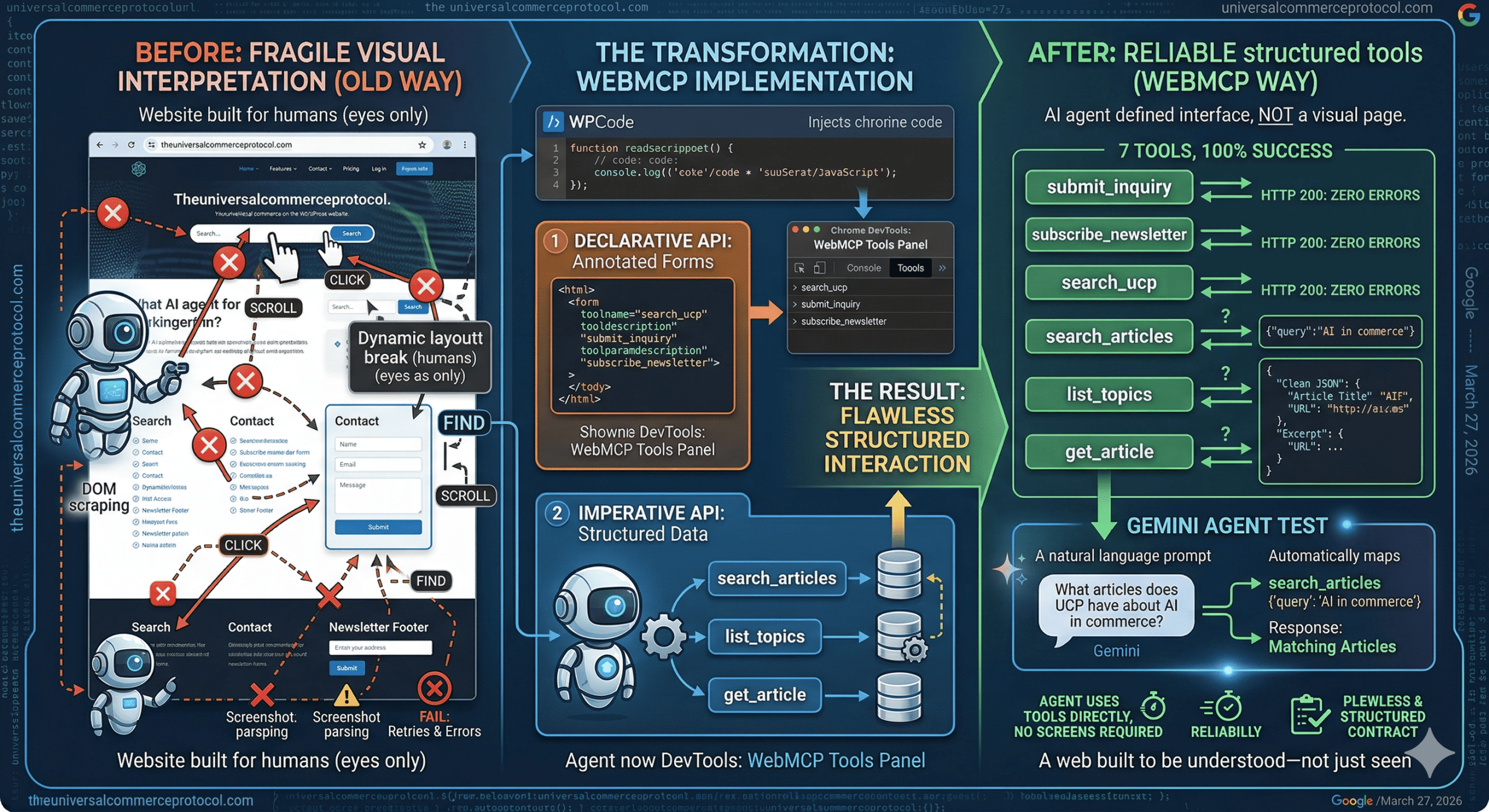
On March 27, 2026, the Google Chrome team released an early preview of WebMCP — a proposed web standard that allows websites to expose structured tools that AI browser agents can call directly. Instead of AI agents screen-scraping a webpage and guessing how to interact with buttons, forms, and navigation, WebMCP lets the site declare exactly what actions are available, what inputs they require, and what the outputs look like. See also: UCP vs ACP vs MCP.
WebMCP is inspired by the Model Context Protocol (MCP) that already powers AI-to-application connections on the server side. The difference is that WebMCP operates entirely in the browser. Any website can now publish its interface as a structured contract that AI agents — including Google’s Gemini, Anthropic’s Claude, and others — can read, understand, and act on without ever needing to parse visual layouts or guess at form field purposes.
Why This Matters for Commerce
The implications for commerce are significant. Consider what happens when an AI agent helps a user book a flight, compare loan rates, or submit a service request. Today, the agent navigates the page visually — clicking fields, reading labels, sometimes entering data in the wrong place and retrying. With WebMCP, the website exposes a structured tool like book_flight or submit_inquiry with a defined schema. The agent calls it directly with structured data. No guessing. No retries. No misread form fields.
This is the same architectural leap that happened when businesses moved from screen-scraping to REST APIs a decade ago. The websites that expose structured tools to AI agents first will be the ones those agents recommend, route users to, and transact through. In a world where a growing share of web interactions are mediated by AI, being machine-readable is not optional — it is a competitive requirement.
How WebMCP Works
WebMCP provides two approaches for website developers:
The Declarative API
The simplest path. Developers add HTML attributes to existing form elements — toolname, tooldescription, and toolparamdescription — that tell the AI agent what the form does and what each field expects. No JavaScript required. A standard WordPress search form or contact form can be annotated in minutes.
The Imperative API
For more advanced interactions, developers register custom JavaScript tools using navigator.modelContext.registerTool(). These tools can do anything — search a database, filter products, retrieve content, trigger actions — and return structured results to the agent. Tools can be registered and unregistered dynamically based on page state, so the agent only sees what is relevant to the current context.
UCP Is Testing WebMCP Now
The Universal Commerce Protocol site is among the first to implement WebMCP in a live environment. Our team is running both the declarative and imperative APIs — annotating existing forms so AI agents can search our content library, and registering custom tools that let agents browse categories, retrieve specific articles, and interact with UCP resources programmatically.
This is not theoretical. The Chrome flag is live in version 146, the Model Context Tool Inspector extension is available for debugging, and we are actively validating tool registration, execution, and agent interaction using Google’s Gemini integration.
What Comes Next
WebMCP is currently an early preview behind a Chrome flag — not production-facing yet. But the direction is clear. Google is building this as a proposed web standard, meaning other browsers with agentic capabilities will be able to implement the same protocol. The Chrome team is actively seeking developer feedback on API shape, use cases, and tooling.
For any business that operates online, the takeaway is straightforward: the web is becoming agent-readable, and the sites that prepare now will have an advantage when AI-mediated browsing becomes the default. WebMCP is how that preparation starts.
We will continue publishing updates as our implementation progresses and as the standard evolves. If you are building on WordPress or any web platform and want to understand how WebMCP applies to your site, follow our coverage here on UCP.
Frequently Asked Questions
What is the Universal Commerce Protocol?
The Universal Commerce Protocol (UCP) is an open standard developed by Google and Shopify that enables AI agents to autonomously conduct commerce transactions across multiple platforms.
How does UCP enable agentic commerce?
UCP provides standardized APIs and protocols allowing AI agents to interact with commerce systems, manage transactions, and understand product catalogs without custom integrations.
Why should I implement UCP?
UCP reduces development time, simplifies AI integration, and unlocks new revenue opportunities through automated commerce capabilities and enhanced customer experiences.
Leave a Reply