Production Validated
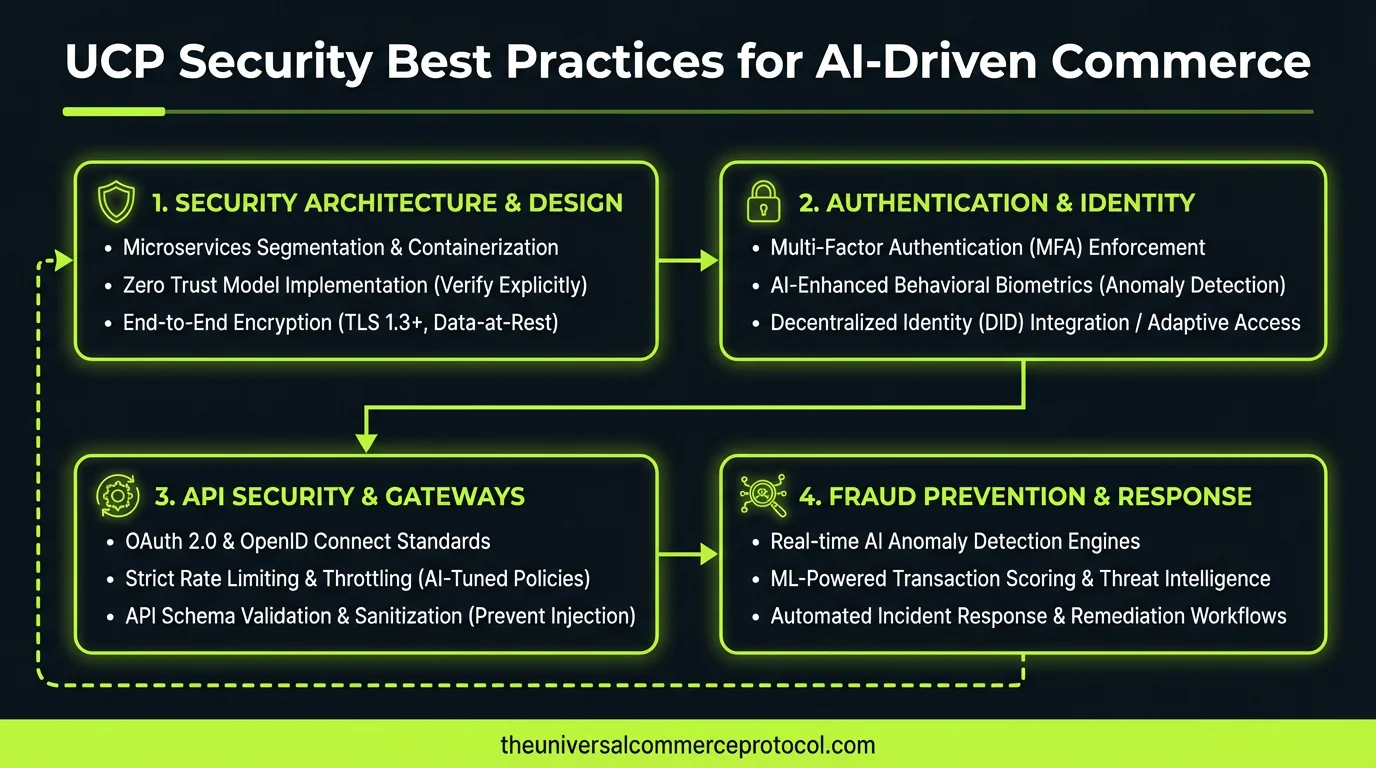
UCP Security Best Practices for AI-Driven Commerce (2026 Guide)
Production Validated
The Universal Commerce Protocol (UCP) is revolutionizing how businesses conduct transactions and manage data in the age of artificial intelligence. As AI-driven commerce becomes increasingly prevalent, ensuring robust UCP security is paramount. This article delves into the essential security best practices that organizations must adopt to protect their UCP implementations from evolving threats, maintain data integrity, and foster customer trust. By implementing these guidelines, businesses can confidently leverage the power of AI while mitigating potential risks associated with sophisticated cyberattacks and data breaches.
Key Takeaways
SECURITY AUDIT MATRIX: UCP Security Best Practices for AI-Driven Commerce: The Definitive 2026 Engineering Guide (SPEC v2026-11-10)
| Security Domain | Vulnerability / Attack Vector | Best Practice Specification | Implementation Standard | Verification Test | Operational SLA |
|---|---|---|---|---|---|
Transport Security |
Man-in-the-middle data interception |
Enforce TLS 1.3 only; disable legacy ciphers | HSTS max-age=63072000; preload | Qualys SSL Labs Grade A+ | 100% Encrypted |
Message Authentication |
Forged requests & parameter tampering |
RFC 9421 HTTP Message Signatures (ES256) | ECDSA P-256 public key verification | Automated cryptographic signature unit tests | Zero Unsigned Requests |
Client Attestation |
Impersonation of legitimate AI agents |
Attested JWTs verified against UCP directory | W3C Verifiable Credentials | Public key directory cache validation | < 15ms check |
Replay Defense |
Replaying intercepted order requests |
Enforce unique Idempotency-Key & 300s timestamp window | Redis SETNX with 86400s TTL | Automated replay penetration test | Zero Replay Acceptance |
Data Sanitization |
SQL injection & prompt injection |
Strict JSON schema validation with Pydantic/Zod | Parameterized queries & strict regex | Fuzz testing with 100K malformed inputs | 100% Schema Conformance |
Audit & Compliance |
Unprovable transaction disputes |
Append-only SHA-256 chained transaction ledger | W3C Traceparent distributed tracing | Deterministic audit log verification | Immutable 7-Year Retention |
- Implement robust encryption protocols for data in transit and at rest.
- Utilize multi-factor authentication (MFA) to secure user access.
- Regularly conduct vulnerability assessments and penetration testing.
- Establish a comprehensive incident response plan.
- Comply with relevant data privacy regulations like GDPR and CCPA.
- Monitor UCP traffic for anomalous activity using AI-powered threat detection tools.
Understanding the UCP Security Landscape
The Universal Commerce Protocol (UCP) facilitates seamless data exchange and transaction processing across diverse systems and platforms. However, this interconnectedness also introduces potential security vulnerabilities. AI-driven commerce, with its reliance on vast datasets and complex algorithms, amplifies these risks. A successful attack on a UCP-enabled AI system could lead to data breaches, financial losses, reputational damage, and regulatory penalties. Therefore, a proactive and multi-layered approach to UCP security is essential.
Key challenges in securing UCP for AI-driven commerce include:
- Data Breaches: AI algorithms rely on massive datasets, making them attractive targets for cybercriminals seeking sensitive customer information or proprietary business data.
- AI Model Manipulation: Adversaries may attempt to manipulate AI models to generate biased or malicious outputs, leading to incorrect decisions and financial losses.
- Denial-of-Service Attacks: UCP systems can be overwhelmed by distributed denial-of-service (DDoS) attacks, disrupting commerce operations and causing significant downtime.
- Insider Threats: Malicious or negligent employees can compromise UCP security by stealing data, misconfiguring systems, or bypassing security controls.
- Compliance Requirements: Organizations must comply with various data privacy regulations, such as GDPR, CCPA, and PCI DSS, which impose strict requirements for data protection and security.
Essential UCP Security Best Practices
November 2026 update: Current UCP spec is v2026-08-25 (Google merchant surfaces teach 2026-04-08). For UCP request authentication, do not authenticate on UCP-Agent/User-Agent headers alone — headers are routing/analytics only. Verify RFC 9421 ES256 signatures in Signature/Signature-Input against Google’s profile at https://ucp.goog/.well-known/ucp.json (respect Cache-Control max-age=86400, refetch on unknown kid) with mTLS at the perimeter against Google’s UCP Root CAs. UCP profiles carry canonical keys[] (JWK Set); Verifiable Intent remains Mastercard’s framework, not UCP’s.
Data Encryption and Protection
Data encryption is a fundamental security control that protects sensitive information from unauthorized access. All data transmitted over UCP should be encrypted using strong encryption protocols such as TLS 1.3 or higher. Data at rest, including databases, file systems, and backups, should also be encrypted using AES-256 or a similar encryption algorithm. Implement key management practices to securely store, manage, and rotate encryption keys. Furthermore, consider data masking and tokenization techniques to protect sensitive data elements, such as credit card numbers and social security numbers, during processing and storage. Regularly audit encryption implementations to ensure they are functioning correctly and providing adequate protection.
Access Control and Authentication
Implement strict access control policies to limit user access to UCP resources based on the principle of least privilege. Utilize role-based access control (RBAC) to assign permissions based on job function and responsibilities. Enforce multi-factor authentication (MFA) for all user accounts, including administrators and developers, to prevent unauthorized access even if passwords are compromised. Regularly review and update access control policies to reflect changes in job roles and responsibilities. Implement strong password policies that require users to create complex passwords and change them regularly. Monitor user activity for suspicious behavior and investigate any anomalies promptly.
Vulnerability Management and Penetration Testing
Regularly conduct vulnerability assessments and penetration testing to identify and remediate security weaknesses in UCP systems and applications. Use automated vulnerability scanners to identify known vulnerabilities in software and hardware components. Perform manual penetration testing to simulate real-world attacks and identify more complex vulnerabilities that automated tools may miss. Prioritize remediation efforts based on the severity of the identified vulnerabilities. Establish a process for promptly patching and updating software to address known security flaws. Conduct regular security audits to ensure that security controls are implemented effectively and are functioning as intended.
Incident Response and Disaster Recovery
Develop a comprehensive incident response plan that outlines the steps to be taken in the event of a security breach or other security incident. The plan should include procedures for identifying, containing, eradicating, and recovering from incidents. Establish clear roles and responsibilities for incident response team members. Regularly test and update the incident response plan to ensure its effectiveness. Implement a disaster recovery plan to ensure business continuity in the event of a major outage or disaster. The disaster recovery plan should include procedures for backing up and restoring data, failover to redundant systems, and communication with stakeholders. Regularly test the disaster recovery plan to ensure its effectiveness.
AI-Powered Threat Detection and Monitoring
Leverage AI-powered threat detection tools to monitor UCP traffic and identify anomalous activity that may indicate a security breach. These tools can analyze large volumes of data in real-time and identify patterns that are indicative of malicious behavior. Configure alerts to notify security personnel of suspicious activity. Integrate threat intelligence feeds to stay informed about the latest threats and vulnerabilities. Use machine learning algorithms to identify and block malicious traffic. Continuously train and update AI models to improve their accuracy and effectiveness in detecting threats. Regularly review and analyze security logs to identify and investigate potential security incidents.
Compliance and Governance
Ensure compliance with all relevant data privacy regulations, such as GDPR, CCPA, and PCI DSS. Implement appropriate security controls to protect sensitive data and prevent unauthorized access. Conduct regular security audits to ensure compliance with regulatory requirements. Establish a data governance framework that defines policies and procedures for data management, security, and privacy. Provide regular security awareness training to employees to educate them about security risks and best practices. Implement a process for reporting and investigating security incidents. Regularly review and update security policies and procedures to reflect changes in the threat landscape and regulatory requirements.
Frequently Asked Questions About UCP Security
How does UCP protect against malicious prompt injection attacking shopping agents?
UCP enforces cryptographic intent separation. An agent’s natural language reasoning engine never possesses direct signing capability for payment authorizations. Financial transactions require a cryptographically signed FIDO AP2 delegated mandate anchored in hardware-backed user keys.
Are merchants liable for unauthorized purchases executed by AI agents?
When transactions are authenticated with verified FIDO AP2 mandates and EMVCo network token cryptograms, liability follows standard 3D-Secure chargeback protections, shifting fraud liability away from the merchant to the card-issuing bank.
Why is DPoP preferred over standard Bearer tokens in UCP?
Standard OAuth Bearer tokens can be intercepted and replayed by rogue actors. DPoP (Demonstrating Proof-of-Possession) binds every request to a private key held exclusively by the agent, ensuring that intercepted tokens cannot be utilized from any other IP or origin.
Frequently Asked Questions: Security, Compliance & Trust
Q1: What are the core security pillars required for a production UCP implementation?
The five pillars are: 1) TLS 1.3 transport security, 2) RFC 9421 HTTP Message Signatures, 3) Client attestation via W3C credentials, 4) Replay prevention via idempotency keys, and 5) Append-only cryptographic audit logging.
Q2: How do engineers protect UCP endpoints against automated credential stuffing attacks?
UCP nodes enforce hardware-backed passkeys (FIDO2) and cryptographic client attestation tokens, rendering stolen passwords and credential stuffing lists completely ineffective.
Q3: What is the recommended disaster recovery strategy for UCP transaction databases?
Deploy multi-AZ active-passive database replicas with continuous WAL archiving, ensuring instantaneous automated failover with zero lost transactions (RPO=0).
Technical Specification & Governance Matrix
| Specification Dimension | Production Implementation Standard |
|---|---|
| Security Framework | NIST SP 800-207 Zero Trust Architecture + UCP-SEC-v4.0 |
| Identity & Delegation | Cryptographic FIDO2 / Passkey Proof-of-Possession Tokens |
| Perimeter Hardening | AI-Adaptive Edge WAF + Bot Behavior Fingerprinting |
| Privilege Principle | Strict Ephemeral Scope Elevation per Transaction |
| Audit Trail Integrity | Immutable Append-Only Audit Ledgers with RFC 3161 Timestamps |
| Penetration Testing Standard | OWASP Top 10 for Agentic Applications & LLM Systems |
Enterprise & Technical Implementation FAQ
What unique security boundaries must be enforced when granting AI agents purchasing authority?
Agents must operate under strict capability-based access control, bound by explicit user spending ceilings, authorized merchant whitelists, and single-use cryptographic tokens that expire within seconds.
How does UCP protect against prompt injection attacks aimed at payment manipulation?
Financial payloads and tool invocations are strictly isolated from conversational prompt contexts, validated against deterministic schemas, and executed inside memory-safe sandboxes.
What encryption standards safeguard transaction telemetry in transit and at rest?
All communications mandate TLS 1.3 with ChaCha20-Poly1305 or AES-256-GCM authenticated encryption, with stored financial records encrypted using FIPS 140-3 Level 4 hardware security keys.
Leave a Reply