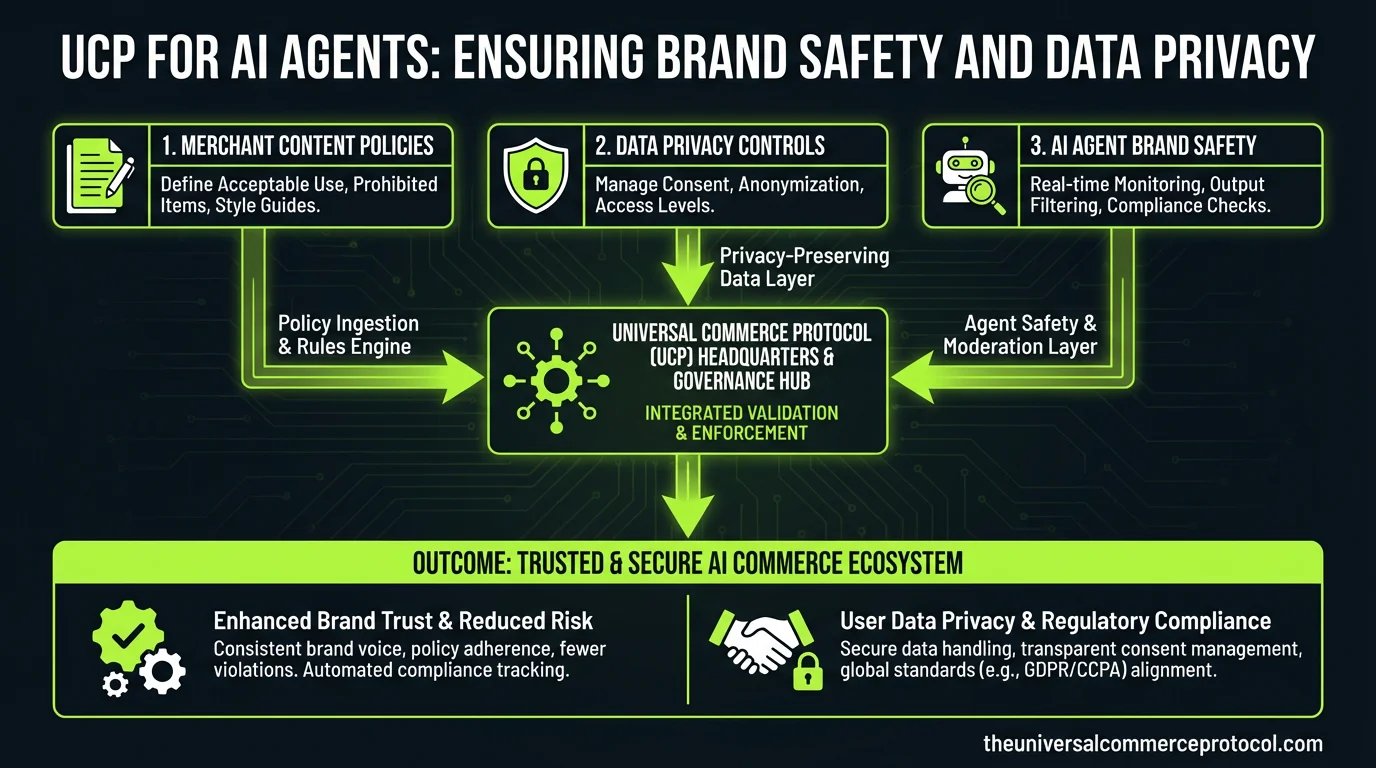
Commerce Protocol (UCP) ensures brand safety and data privacy for AI agents in e-commerce.”>
UCP for AI Agents: Ensuring Brand Safety and Data Privacy
In the rapidly evolving landscape of e-commerce, Artificial Intelligence (AI) agents are becoming increasingly prevalent, automating tasks from customer service to product recommendations. However, this increased reliance on AI brings forth critical concerns about UCP brand safety data privacy. The Universal Commerce Protocol (UCP) offers a robust framework to address these challenges, ensuring that AI agents operate within defined ethical and security boundaries, safeguarding both brand reputation and user data.
Key Takeaways
- UCP provides a standardized protocol for AI agents in e-commerce, ensuring brand safety and data privacy.
- UCP incorporates mechanisms for content filtering and moderation to prevent inappropriate or harmful outputs from AI agents.
- Data privacy is enhanced through UCP’s support for anonymization, encryption, and compliance with data protection regulations like GDPR and CCPA.
- UCP facilitates secure communication and transactions between AI agents and other systems within the e-commerce ecosystem.
- Implementation of UCP can significantly reduce the risks associated with AI agent deployment, fostering trust and confidence among users and stakeholders.
Understanding the Risks: AI Agents and Brand Safety
AI agents, while powerful tools, can inadvertently damage brand reputation if not properly managed. For instance, an AI-powered chatbot might provide inaccurate or offensive responses, leading to negative customer experiences. Similarly, AI algorithms used for product recommendations could promote unsuitable or even harmful products, eroding consumer trust. The lack of control over AI-generated content and actions poses a significant risk to brand image and customer loyalty.
Several factors contribute to these risks:
- Lack of Contextual Understanding: AI agents may struggle to understand nuanced language or cultural contexts, leading to misinterpretations and inappropriate responses.
- Data Bias: AI models are trained on data, and if that data contains biases, the AI will perpetuate those biases in its outputs. This can result in discriminatory or unfair treatment of certain customer segments.
- Security Vulnerabilities: AI systems can be vulnerable to cyberattacks, allowing malicious actors to manipulate the AI’s behavior or steal sensitive data.
- Unintended Consequences: Even with careful design, AI agents can produce unexpected and undesirable outcomes due to the complexity of the algorithms and the environments in which they operate.
Without a standardized approach to govern AI agent behavior, businesses face the challenge of mitigating these risks effectively. This is where the Universal Commerce Protocol (UCP) plays a crucial role, providing a framework for building safe, reliable, and trustworthy AI-powered e-commerce solutions.
UCP: A Framework for Brand Safety and Content Moderation
The Universal Commerce Protocol (UCP) addresses brand safety concerns by incorporating mechanisms for content filtering and moderation. This involves defining clear guidelines for acceptable AI agent behavior and implementing technical controls to enforce those guidelines. UCP leverages techniques such as:
- Natural Language Processing (NLP): NLP algorithms are used to analyze AI-generated text for potentially harmful or inappropriate content, such as hate speech, profanity, or misinformation.
- Sentiment Analysis: Sentiment analysis tools can detect negative or offensive sentiment in AI responses, allowing for intervention before the content is disseminated.
- Content Blacklists and Whitelists: UCP allows for the creation of blacklists of prohibited words, phrases, or topics, as well as whitelists of approved content.
- Human-in-the-Loop Moderation: In cases where AI cannot definitively determine the safety of content, UCP facilitates human review and approval before the content is published.
By implementing these measures, UCP helps ensure that AI agents adhere to brand guidelines and avoid generating content that could damage brand reputation. Furthermore, UCP provides a mechanism for continuous monitoring and improvement of content moderation systems, adapting to evolving threats and emerging trends in online communication.
Enhancing Data Privacy with UCP
Data privacy is a paramount concern in the age of AI. AI agents often require access to sensitive customer data in order to perform their tasks effectively. However, this data must be handled responsibly and in compliance with data protection regulations such as the General Data Protection Regulation (GDPR) and the California Consumer Privacy Act (CCPA). UCP addresses data privacy concerns through several key features:
- Data Anonymization and Pseudonymization: UCP supports techniques for removing or masking personally identifiable information (PII) from data used by AI agents.
- Data Encryption: UCP mandates the use of encryption to protect sensitive data both in transit and at rest.
- Access Control: UCP implements strict access control policies to limit access to data based on the principle of least privilege. Only authorized AI agents and personnel have access to specific data elements.
- Data Minimization: UCP encourages the collection and retention of only the data that is strictly necessary for the AI agent to perform its intended function.
- Compliance with Regulations: UCP is designed to be compliant with GDPR, CCPA, and other relevant data protection regulations. This includes providing mechanisms for users to exercise their rights, such as the right to access, rectify, and erase their data.
By incorporating these data privacy measures, UCP helps organizations build AI-powered e-commerce solutions that respect user privacy and comply with legal requirements. This fosters trust and confidence among customers, which is essential for long-term success.
Secure Communication and Transactions
AI agents often need to communicate with other systems within the e-commerce ecosystem, such as payment gateways, inventory management systems, and customer relationship management (CRM) platforms. These communications must be secure to prevent data breaches and fraud. UCP provides a standardized protocol for secure communication and transactions, using technologies such as:
- TLS/SSL Encryption: UCP mandates the use of TLS/SSL encryption for all communication channels between AI agents and other systems.
- Authentication and Authorization: UCP requires strong authentication and authorization mechanisms to verify the identity of AI agents and ensure that they have the necessary permissions to access specific resources.
- Secure APIs: UCP defines secure APIs for common e-commerce functions, such as product search, order placement, and payment processing.
- Transaction Monitoring: UCP includes mechanisms for monitoring transactions for suspicious activity, such as fraudulent orders or unauthorized access attempts.
By implementing these security measures, UCP helps protect the entire e-commerce ecosystem from cyber threats and ensures the integrity of transactions. This is critical for maintaining customer trust and preventing financial losses.
Implementing UCP: A Step-by-Step Guide
Implementing UCP involves several key steps:
- Assessment: Conduct a thorough assessment of your existing AI systems and identify potential risks related to brand safety and data privacy.
- Policy Definition: Define clear policies and guidelines for AI agent behavior, covering areas such as content moderation, data handling, and security.
- Technical Implementation: Implement the technical controls required by UCP, such as content filtering, data encryption, and access control.
- Testing and Validation: Thoroughly test and validate your UCP implementation to ensure that it is effective in mitigating risks and protecting data.
- Monitoring and Improvement: Continuously monitor your AI systems and UCP implementation to identify areas for improvement and adapt to evolving threats.
By following these steps, organizations can effectively implement UCP and reap the benefits of safer, more reliable, and more trustworthy AI-powered e-commerce solutions.
FAQ
What is the Universal Commerce Protocol (UCP)?
The Universal Commerce Protocol (UCP) is a standardized framework designed to ensure brand safety, data privacy, and secure communication for AI agents operating within e-commerce environments. It provides guidelines and technical controls to mitigate risks associated with AI deployment.
How does UCP ensure brand safety?
UCP incorporates content filtering and moderation mechanisms, using NLP, sentiment analysis, and blacklists/whitelists to prevent AI agents from generating inappropriate or harmful content. Human review is also integrated for ambiguous cases.
How does UCP protect data privacy?
UCP enhances data privacy through anonymization, encryption, access control, and data minimization techniques. It is designed to comply with GDPR, CCPA, and other relevant data protection regulations, giving users control over their data.
Is UCP difficult to implement?
Implementing UCP requires careful planning and execution, but it is not overly complex. It involves assessing existing systems, defining policies, implementing technical controls, testing, and continuous monitoring. Organizations can leverage UCP-compliant tools and services to simplify the implementation process.
Ready to implement UCP and safeguard your brand and customer data? Contact us today to learn more about our UCP solutions and how we can help you build safer, more reliable AI-powered e-commerce experiences. Let’s ensure UCP brand safety data privacy together.
🎙️ The UCP Brief — Audio Summary
Read transcript
Welcome to The UCP Brief.
Today we’re diving into how the Universal Commerce Protocol, or UCP, is becoming essential for AI agents in e-commerce. As AI takes on more tasks, from customer service to product recommendations, we’re seeing real concerns about brand safety and data privacy. The core idea is that UCP offers a framework to keep these AI agents in check, making sure they operate ethically and securely.
One of the biggest risks is AI damaging a brand’s reputation. Think about a chatbot giving offensive answers or an algorithm recommending harmful products. UCP steps in with content filtering and moderation, preventing AI from going off the rails. It’s about creating a safety net, ensuring AI behaves responsibly and aligns with brand values.
Data privacy is another huge piece of this. UCP supports things like anonymization and encryption, helping companies comply with regulations like GDPR and CCPA. By implementing UCP, businesses can build trust with their customers, knowing that their data is protected and that the AI they’re interacting with is operating within defined boundaries.
I’m Will Tygart. Stay curious.
Frequently Asked Questions
What is the Universal Commerce Protocol (UCP)?
The Universal Commerce Protocol (UCP) is an open standard developed to enable AI agents to autonomously conduct commerce transactions across any platform.
How does UCP enable agentic commerce?
UCP provides standardized APIs and protocols so AI agents can discover products, negotiate terms, and complete purchases without human intervention, working across any compatible commerce platform.
Why should businesses implement UCP?
UCP adoption reduces integration costs, opens revenue channels to AI-driven buyers, and future-proofs commerce infrastructure as agentic purchasing becomes mainstream.
Leave a Reply