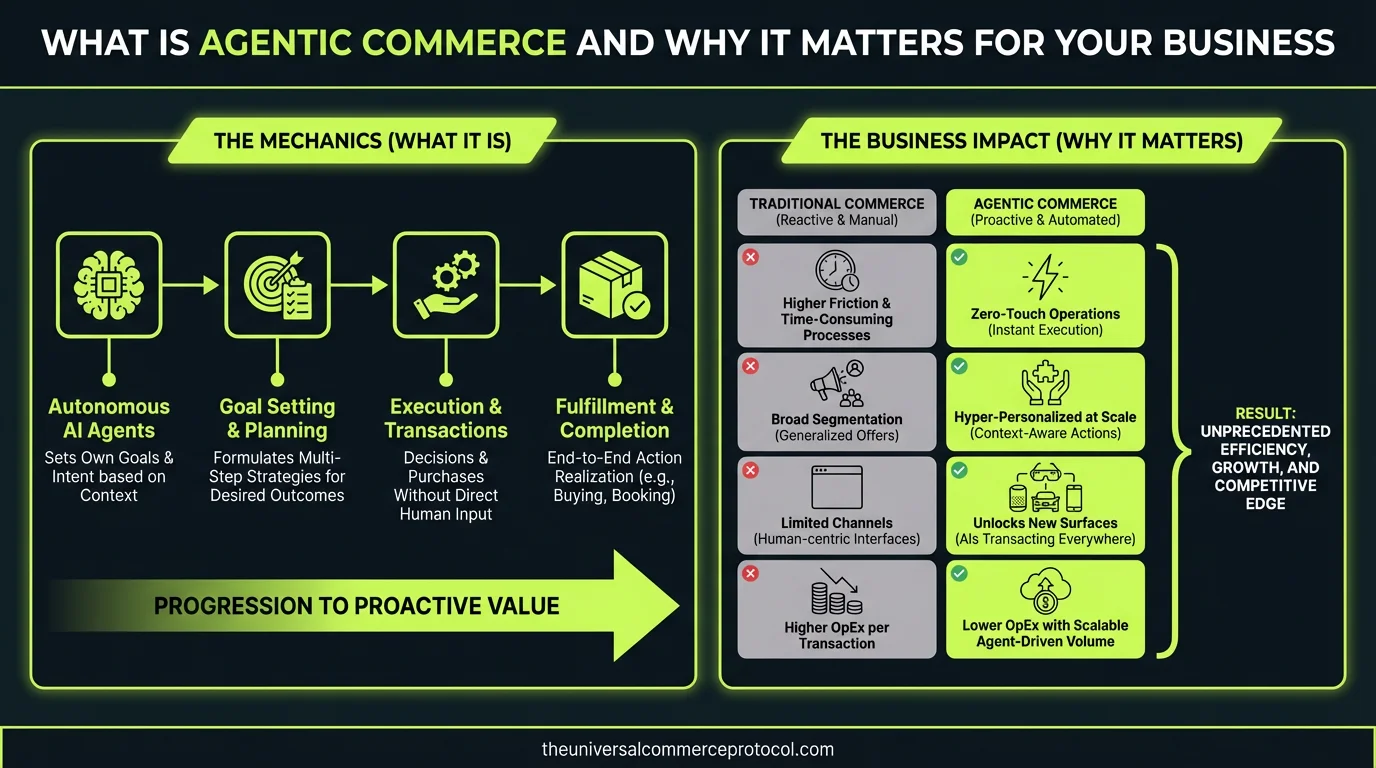
Agentic commerce is the next evolution of online shopping — a model in which AI agents autonomously handle the research, comparison, negotiation, and purchase of products and services on behalf of human users, without requiring the user to manually execute each step.
Unlike traditional ecommerce, where a human navigates a storefront, selects products, enters payment information, and confirms a purchase, agentic commerce delegates those tasks to an AI system. The agent acts with varying degrees of autonomy — from simple price alerts to fully autonomous end-to-end purchasing.
How Agentic Commerce Works
At its core, agentic commerce requires three things: an AI agent with purchasing intent, a structured way for the agent to discover and interact with merchants, and a payment and trust layer that both sides can rely on.
The agent — which may run inside a chatbot, a voice assistant, a browser extension, or a dedicated purchasing app — receives instructions from a user. Those instructions might be explicit (“buy me the cheapest flight to Seattle next Thursday”) or contextual (the agent learns your recurring grocery list and reorders automatically each week).
The agent then queries available commerce infrastructure, compares options, and completes the transaction. In practice, this requires merchants to expose their inventory, pricing, policies, and checkout flows in a format that AI systems can read and act on — which is where protocols like the Universal Commerce Protocol (UCP) become essential.
Why Agentic Commerce Is Happening Now
Three converging trends have made agentic commerce viable in 2026:
Large language models can now take actions, not just answer questions. Models like GPT-4o, Claude, and Gemini can call external APIs, browse the web, and complete multi-step workflows. This transforms AI from an advisor into an executor.
Standardized tool-use protocols are emerging. Anthropic’s Model Context Protocol (MCP) and Google’s Universal Commerce Protocol (UCP) give AI agents a structured way to connect to merchant catalogs, payment processors, and logistics providers — without custom integrations for every platform.
Consumer trust in AI assistance is growing. A December 2025 Forrester Consumer Pulse Survey found that 23% of Gen X US online adults had used ChatGPT to search for products in the prior month. As AI shopping assistants become more accurate and reliable, users are increasingly willing to delegate purchasing decisions.
Real-World Examples of Agentic Commerce in 2026
Google AI Mode: Google’s AI Mode allows users to search for products conversationally and complete purchases directly within the search interface. Google’s UCP provides the underlying protocol connecting Google’s AI to participating merchant checkouts.
OpenAI ChatGPT Shopping: OpenAI introduced native checkout in ChatGPT in September 2025. In early 2026, OpenAI scaled back direct transaction handling and shifted toward merchant-controlled checkout — acknowledging merchants need to retain control over their own customer relationships and brand experience.
Amazon’s Agentic Framework: Amazon’s updated Business Solutions Agreement, effective March 4, 2026, requires AI agents operating on its platform to identify themselves as AI systems. This represents one of the first formal compliance frameworks for agentic commerce behavior.
Shopify Agent Infrastructure: Shopify has built agentic commerce tools exposing merchant catalogs via structured APIs, enabling AI assistants on any platform to browse inventory, check availability, and initiate checkouts from Shopify stores.
The Universal Commerce Protocol (UCP) and Why It Matters
The central challenge in agentic commerce is interoperability. An AI agent needs to interact with thousands of different merchants, each with their own systems, checkout flows, and policies. Without a common protocol, every agent-merchant combination requires a custom integration — a bottleneck that slows adoption for everyone.
The Universal Commerce Protocol addresses this by defining a standard interface for agentic commerce interactions. UCP specifies how an AI agent should discover a merchant’s capabilities, query product data, submit purchase intents, and handle authentication and payment — through a consistent API structure.
Google developed UCP as part of its AI Mode infrastructure and has worked with Shopify, Splitit, Klarna, Stripe, and other commerce platforms to adopt the standard. For merchants, UCP compliance means any UCP-compatible AI agent can transact through their store. For AI developers, it means a single integration pattern works across all UCP-compliant merchants.
Key Players in the Agentic Commerce Ecosystem
AI Platforms: Google (Gemini, AI Mode, UCP), Anthropic (Claude, MCP), OpenAI (ChatGPT, operator framework), Amazon (Alexa+, agent purchasing framework)
Commerce Infrastructure: Shopify (agentic API suite, UCP integration), Stripe (agentic payment APIs), Mastercard (Agent Pay, AI authentication), Visa (AI commerce trust layer)
BNPL and Embedded Finance: Klarna (AI-native BNPL, Stripe partnership), Splitit (UCP-backed installment payments), Affirm (agent-accessible financing APIs)
What Agentic Commerce Means for Merchants
For merchants, agentic commerce represents both an opportunity and a control challenge. The opportunity: AI agents driving traffic and completing purchases with minimal friction. The challenge: agents may choose competitors based purely on price, bypass loyalty programs, or skip upsell opportunities unless merchant policies explicitly govern agent behavior.
Google’s UCP addresses this by giving merchants control over what agents can and cannot do — including setting minimum order requirements, restricting certain product categories from agent purchase, and requiring explicit user confirmation for high-value transactions.
Merchants who implement UCP now are positioning themselves to capture agent-driven traffic as it scales. Merchants who wait risk being invisible to AI shopping agents that rely on structured commerce APIs to discover products.
Frequently Asked Questions
What is the difference between agentic commerce and traditional ecommerce?
Traditional ecommerce requires a human to navigate, select, and purchase. Agentic commerce delegates those steps to an AI agent acting on the user’s behalf.
Is agentic commerce safe for consumers?
Leading protocols including UCP and MCP include authentication, transaction confirmation, and dispute mechanisms. Amazon now requires agents to identify themselves, creating accountability.
What is the Universal Commerce Protocol?
UCP is an open standard developed by Google that defines how AI agents discover, interact with, and transact through merchant storefronts — enabling any UCP-compatible agent to shop any UCP-compliant merchant.
Do I need to implement UCP to participate in agentic commerce?
Merchants on Shopify with native UCP support are automatically accessible to UCP-compatible agents. Merchants on other platforms will need direct UCP implementation as agent-driven traffic grows.
When will agentic commerce be mainstream?
It already is in early form. Google AI Mode, ChatGPT shopping, and Alexa+ purchasing are live products. Industry analysts project agent-initiated purchases will represent 10–15% of ecommerce transactions by 2028.
Related: Configure /.well-known/ucp Discovery Endpoint for AI
Frequently Asked Questions
What is the Universal Commerce Protocol (UCP)?
The Universal Commerce Protocol (UCP) is an open standard developed to enable AI agents to autonomously conduct commerce transactions across any platform.
How does UCP enable agentic commerce?
UCP provides standardized APIs and protocols so AI agents can discover products, negotiate terms, and complete purchases without human intervention, working across any compatible commerce platform.
Why should businesses implement UCP?
UCP adoption reduces integration costs, opens revenue channels to AI-driven buyers, and future-proofs commerce infrastructure as agentic purchasing becomes mainstream.
Leave a Reply