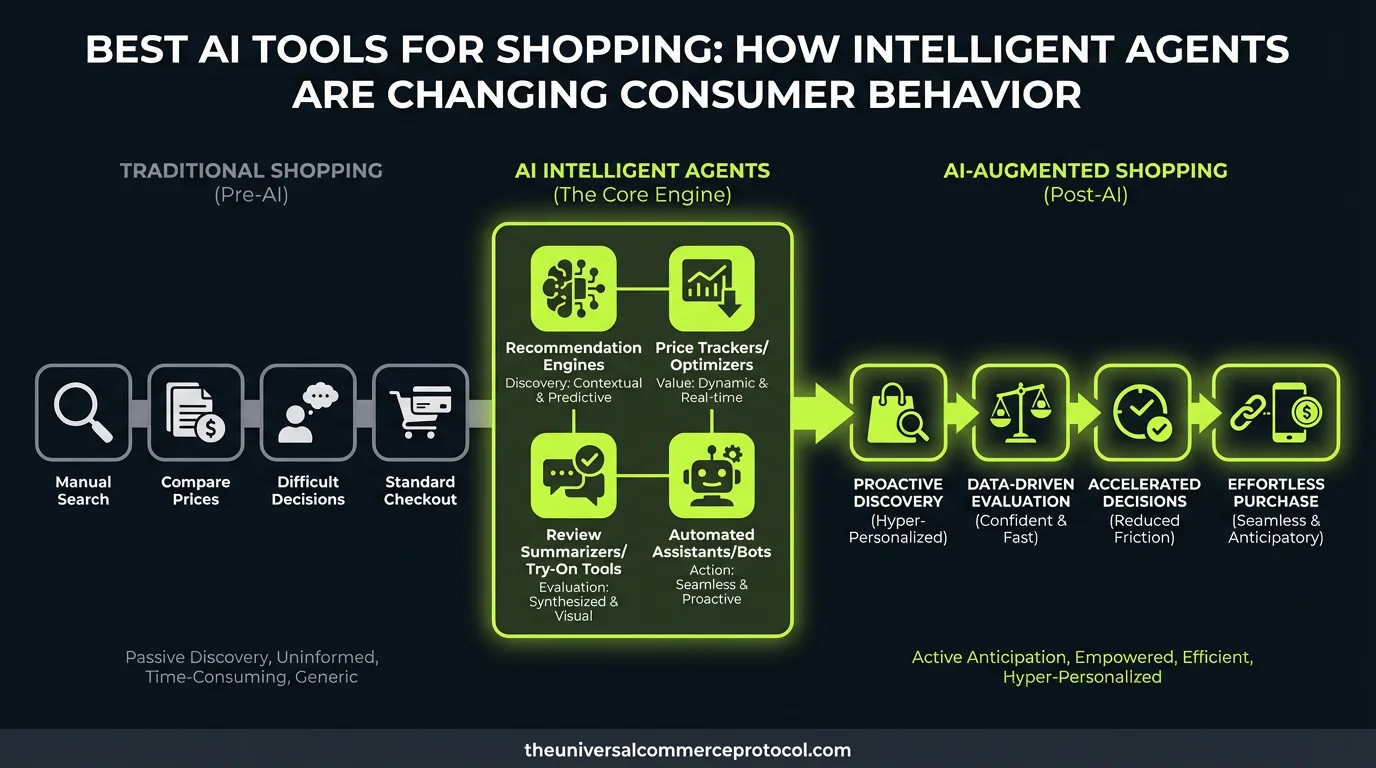
Best AI Tools for Shopping: How Intelligent Agents Are Changing Consumer Behavior
The retail landscape is undergoing a fundamental transformation. Rather than consumers browsing websites or apps manually, intelligent AI shopping agents now handle product discovery, comparison, negotiation, and purchase execution autonomously. This shift represents more than incremental improvement—it’s a structural change in how commerce happens, powered by agentic AI systems and standardized protocol layers like the Universal Commerce Protocol (UCP).
The Rise of Agentic Shopping: From Search to Autonomous Commerce
Traditional e-commerce required human intervention at every step: search, compare, evaluate reviews, check prices across sites, apply coupons, and finally purchase. Today’s AI shopping agents collapse this workflow into seconds, operating autonomously on behalf of the consumer.
Companies like OpenAI (through ChatGPT’s shopping integrations), Google (Shopping Graph and Generative AI features), and Amazon (Alexa shopping capabilities) have invested heavily in agentic commerce. Meanwhile, specialized platforms including Instacart, Shopify‘s AI tools, and emerging startups like Perplexity AI are building purpose-built shopping agents that understand intent, context, and user preferences at scale.
What distinguishes these modern tools is their ability to reason across multiple data sources—comparing prices, checking inventory, reading reviews, verifying shipping policies, and executing transactions—all without explicit user commands for each step.
Key AI Shopping Tools Compared
1. OpenAI ChatGPT + Shopping Integrations
Capabilities: Natural language product discovery, merchant partnerships, price lookups, and purchase recommendations. ChatGPT can now browse the web and access real-time pricing data through plugins and integrations with retailers.
Strengths: Conversational interface, multi-step reasoning, no specialized training required from users.
Limitations: Depends on merchant partnerships; not all retailers are integrated; lacks deep personalization without account linking.
2. Google Shopping Graph & Generative AI
Capabilities: Real-time product availability, pricing, reviews, and merchant information across millions of SKUs. Google’s AI Overviews now synthesize shopping information directly in search results.
Strengths: Massive data coverage, integration with Google Search, Maps, and YouTube; trusted merchant data; local inventory visibility.
Limitations: Primarily informational; less autonomous purchasing; heavily merchant-dependent for data accuracy.
3. Amazon Alexa & Dash
Capabilities: Voice-activated shopping, one-click reordering, subscription management, smart home integration, and predictive purchasing for frequently bought items.
Strengths: Deeply integrated with Amazon ecosystem; voice interface; seamless checkout; Prime membership leverage.
Limitations: Primarily Amazon-focused; limited cross-merchant comparison; privacy concerns around voice data.
4. Perplexity AI Shopping Assistant
Capabilities: Real-time web search combined with AI reasoning, product recommendations, price comparisons, and availability checking across multiple retailers.
Strengths: Independent platform; cross-merchant comparison; transparent reasoning; no algorithmic bias toward owned properties.
Limitations: Newer platform; smaller merchant integration network; monetization model still evolving.
5. Shopify AI & Merchant Tools
Capabilities: Personalized product recommendations, dynamic pricing, inventory optimization, and AI-powered customer service for millions of Shopify stores.
Strengths: Powers independent retailers; democratizes AI access; merchant-centric approach.
Limitations: Fragmented experience across stores; no unified cross-merchant agent; relies on merchant implementation.
How Agentic Commerce Changes Consumer Behavior
The emergence of shopping agents is reshaping fundamental consumer habits:
- Reduced Decision Friction: Agents handle comparison shopping, eliminating the need to visit multiple sites. Consumers get curated recommendations in seconds rather than minutes.
- Impulse Control: With agents filtering by price, reviews, and specifications, consumers make more deliberate purchases. Impulse buying decreases when friction increases.
- Loyalty Fragmentation: Agents are merchant-agnostic. They’ll recommend the best option regardless of brand loyalty, disrupting traditional customer retention strategies.
- Privacy-Behavior Tradeoff: Agents that learn preferences require data sharing. Consumers increasingly accept this tradeoff for convenience, but with growing privacy concerns.
- Autonomous Replenishment: Predictive agents handle routine purchases without conscious decision-making, shifting e-commerce toward passive subscription models.
The Protocol Layer: Universal Commerce Protocol (UCP)
The fragmentation of AI shopping tools creates a critical problem: each platform speaks a different language. One agent uses REST APIs, another GraphQL, a third proprietary protocols. This incompatibility limits agent capability and merchant reach.
The Universal Commerce Protocol addresses this by providing a standardized, agent-first layer for commerce transactions. UCP enables:
- Interoperability: Any shopping agent can communicate with any merchant system using the same protocol, similar to how HTTP standardized web communication.
- Autonomous Execution: Agents can execute complex transactions (negotiate prices, apply rules, confirm inventory, process payments) without human intervention or custom integrations.
- Merchant Accessibility: Small retailers gain access to agent networks without building proprietary APIs. UCP democratizes agent commerce.
- Trust & Verification: Standardized protocols enable cryptographic verification, reducing fraud and ensuring transaction integrity.
- Data Sovereignty: Merchants retain control over pricing, inventory, and customer data while agents access only what they’re authorized to see.
Unlike platform-specific integrations (Shopify APIs, Amazon MWS, eBay APIs), UCP operates at the protocol layer—below any specific platform. This is analogous to how email works: users can switch email providers while keeping the same address because SMTP, IMAP, and POP3 are open standards.
Real-World Scenarios: AI Agents Using UCP
Scenario 1: Price-Sensitive Shopper A consumer tells their AI agent: “Find me the best laptop under $1,200 with at least 16GB RAM, available for delivery tomorrow.” The agent queries thousands of merchants simultaneously using UCP, filters by specifications and availability, compares prices, checks reviews, and presents three options with one-click purchase capability. The entire process takes 3 seconds.
Scenario 2: Loyalty Program Optimization A shopper’s agent negotiates loyalty points redemption across multiple retailers. Rather than manually checking each program, the agent uses UCP to query point balances, redemption rates, and upcoming promotions, then executes the highest-value redemption automatically.
Scenario 3: Merchant Inventory Matching A small fashion retailer using UCP can now be discovered by any shopping agent, not just those with direct integrations. An agent looking for “sustainable wool sweaters” finds the retailer’s inventory through UCP, checks real-time stock, negotiates bulk pricing, and places an order—all without the retailer building custom APIs.
Challenges and Considerations
Data Privacy: Agentic systems require access to personal preferences, purchase history, and sometimes payment information. UCP must balance agent capability with privacy protection through granular permission systems.
Merchant Margins: Autonomous price comparison intensifies competition, potentially squeezing retailer margins. Merchants must compete on service, quality, and experience rather than information asymmetry.
Fraud Prevention: Standardized protocols increase attack surface. UCP implementations must include robust authentication, transaction verification, and dispute resolution mechanisms.
Regulatory Compliance: Different jurisdictions have varying rules for automated transactions, consumer protection, and data handling. Protocol-level standards must accommodate regional requirements.
The Future of AI Shopping and Protocol Standards
As agentic commerce matures, we’ll see convergence around open standards like UCP. The winners won’t be individual platforms but those who control the protocol layer—similar to how TCP/IP, HTTP, and DNS became foundational to the internet.
Expect integration between major platforms: OpenAI agents accessing Shopify stores, Google Shopping Graph powering independent agents, and Amazon Alexa interoperating with non-Amazon merchants—all through standardized protocols.
The most significant shift will be from “where do I shop?” to “what do I need?” Agents will answer the latter question by querying all available merchants simultaneously, making the shopping platform itself invisible to consumers.
FAQ
1. How do AI shopping agents differ from traditional price comparison sites?
Traditional price comparison sites (like Google Shopping, PriceGrabber) are passive information tools—they display results that users must evaluate and click through. AI shopping agents are active, autonomous systems that understand context, make recommendations, negotiate terms, and can execute purchases independently. They reason across multiple criteria simultaneously and learn from user preferences over time, whereas comparison sites simply aggregate static data.
2. What is the Universal Commerce Protocol and why does it matter?
The Universal Commerce Protocol (UCP) is a standardized, open protocol layer that enables any AI agent to communicate with any merchant system for transactions. It matters because it removes the need for custom integrations between each agent and each retailer. UCP democratizes agent commerce—small merchants can be discovered by agents without building proprietary APIs, and agents can scale to millions of merchants without individual integrations. It’s foundational infrastructure for agentic commerce, similar to how HTTP standardized web communication.
3. Will AI shopping agents eliminate jobs in retail and customer service?
Agents will automate routine tasks like product discovery and order placement, but will likely create new roles in agent management, merchant optimization, and personalized service. Retailers who adapt by focusing on experience, curation, and service differentiation will thrive. Those competing purely on price and convenience will face pressure. The transition will be disruptive but historically, automation creates more jobs than it eliminates—though often in different sectors.
4. How do I know if an AI shopping agent is recommending products fairly?
Look for transparency in how recommendations are ranked. Open-protocol agents (using standards like UCP) are more likely to be neutral than proprietary systems with financial incentives to favor certain merchants. Ask: Does the agent own inventory? Does it have exclusive partnerships? Can you see the reasoning behind recommendations? Agents from independent platforms (like Perplexity) tend to have fewer conflicts of interest than those from retailers (Amazon, Walmart). Regulatory frameworks around AI transparency will increasingly require disclosure of recommendation logic.
Frequently Asked Questions
What is the Universal Commerce Protocol (UCP)?
The Universal Commerce Protocol (UCP) is an open standard developed to enable AI agents to autonomously conduct commerce transactions across any platform.
How does UCP enable agentic commerce?
UCP provides standardized APIs and protocols so AI agents can discover products, negotiate terms, and complete purchases without human intervention, working across any compatible commerce platform.
Why should businesses implement UCP?
UCP adoption reduces integration costs, opens revenue channels to AI-driven buyers, and future-proofs commerce infrastructure as agentic purchasing becomes mainstream.
Leave a Reply