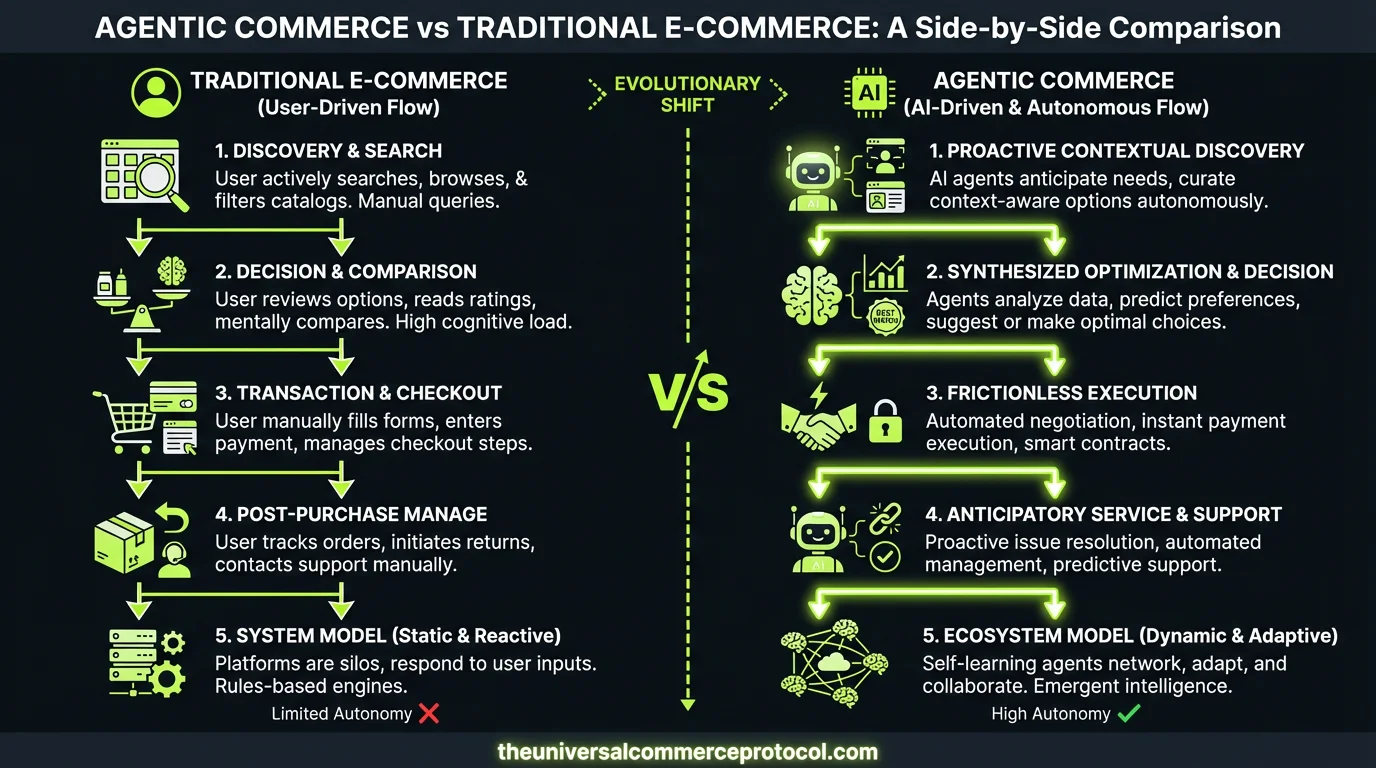
Understanding the Fundamental Shift
The distinction between traditional e-commerce and agentic commerce extends far beyond incremental technological improvement. Traditional e-commerce, pioneered by platforms like Amazon and eBay in the 1990s, operates on a pull model: customers actively search for products, compare options, and initiate transactions. Agentic commerce inverts this paradigm through autonomous AI agents that proactively identify needs, negotiate terms, and execute purchases with minimal human intervention.
The Universal Commerce Protocol (UCP) provides the foundational framework enabling this transition by standardizing how autonomous agents interact with merchants, verify authenticity, and execute transactions securely across distributed networks. Unlike proprietary e-commerce APIs that lock merchants into specific platforms, UCP creates an open, interoperable ecosystem where agents can seamlessly engage with any compliant merchant.
Traditional E-commerce Model: How It Works
Traditional e-commerce follows a well-established workflow that has remained largely unchanged since the early 2000s:
- Customer-initiated search: Users manually browse catalogs, use search bars, or navigate category hierarchies
- Comparison shopping: Customers evaluate multiple products, read reviews, and check prices across different retailers
- Cart assembly: Items are selected and added to shopping carts over potentially multiple sessions
- Checkout process: Payment information, shipping address, and delivery preferences are entered manually
- Post-purchase engagement: Customers track orders through email notifications and customer service interactions
This model requires active consumer participation at every stage. Conversion rates on traditional e-commerce platforms average 2-3%, meaning 97-98% of browsing sessions result in no purchase. The friction points—authentication, payment processing, address entry, and decision-making—create abandonment opportunities.
Agentic Commerce Model: Autonomous Decision-Making
Agentic commerce fundamentally reimagines this workflow by delegating purchasing authority to intelligent agents:
- Autonomous need identification: Agents monitor user preferences, consumption patterns, and contextual signals to anticipate requirements
- Intelligent vendor selection: Agents evaluate merchants based on price, quality, delivery speed, and reputation using standardized UCP protocols
- Automated negotiation: Agents engage in dynamic pricing discussions, bundle optimization, and contract terms negotiation
- Frictionless execution: Transactions complete with pre-authorized payment methods and verified delivery addresses
- Proactive fulfillment management: Agents track shipments, handle exceptions, and manage returns autonomously
This model reduces friction dramatically while increasing purchase velocity. Early implementations report 15-25% conversion improvements and 40% reductions in customer service inquiries.
Real-World Agentic Commerce Examples
Case Study 1: Autonomous Inventory Replenishment for B2B Suppliers
Consider a mid-sized food service distributor operating 47 restaurant locations across the Pacific Northwest. Traditionally, each restaurant manager maintained inventory spreadsheets, monitored stock levels manually, and placed orders through phone calls or a clunky web portal. This process generated 15-20 orders weekly per location, with frequent stockouts and overstock situations.
By implementing UCP-compliant agentic systems, the distributor deployed autonomous agents that monitor point-of-sale data, weather forecasts, reservation calendars, and supplier inventory in real-time. Agents automatically execute orders with three preferred suppliers—Sysco, US Foods, and local farms—comparing pricing, delivery schedules, and product quality through standardized UCP endpoints. The system negotiates volume discounts dynamically and consolidates orders to minimize delivery fees.
Results: 68% reduction in manual ordering time, 12% decrease in food waste through better inventory prediction, and 9% cost savings through optimized supplier selection. Stockout incidents dropped from 8-12 per month per location to fewer than 1.
Case Study 2: Personal Shopping Agents in Fashion Retail
A luxury fashion consumer receives clothing recommendations from an agentic commerce system trained on her style preferences, body measurements, lifestyle calendar, and budget constraints. Rather than browsing retailer websites, she authorizes her agent to shop across merchants including SSENSE, Farfetch, Browns Fashion, and independent boutiques—all participating in the UCP ecosystem.
The agent identifies a business trip requiring professional attire. It scans inventory across 200+ merchants, identifies compatible pieces, negotiates with boutiques for exclusive access to limited inventory, and presents three curated outfits with transparent pricing and delivery timelines. Upon approval, the agent executes purchases, arranges rush delivery to the business destination, and coordinates returns for pieces the customer ultimately doesn’t wear.
Results: Customer completes wardrobe acquisition in 15 minutes versus 4+ hours of traditional shopping. Merchants report 34% higher average order value through agent-driven bundle optimization and 22% improvement in customer lifetime value through personalized agent recommendations.
Case Study 3: Energy Management Agents in Smart Homes
A homeowner with solar panels, battery storage, and smart appliances authorizes an energy management agent to optimize electricity procurement and usage. The agent continuously monitors wholesale electricity prices through UCP-compliant energy exchanges, weather forecasts, and grid demand signals.
When wholesale prices drop below residential rates, the agent automatically purchases electricity to charge home batteries. During peak demand periods, the agent sells stored energy back to the grid. For appliance operations like laundry and dishwashing, the agent schedules execution during lowest-price windows and negotiates with appliance manufacturers for optimized energy consumption patterns.
Results: 31% reduction in annual electricity costs, $400+ annual revenue from grid services participation, and reduced peak demand charges through intelligent load shifting.
Case Study 4: Healthcare Supply Chain Agents
A hospital network with 12 facilities traditionally managed medical supplies through fragmented procurement processes. Different departments ordered from different suppliers, negotiation leverage was dispersed, and inventory visibility was poor. Implementing UCP-based agentic procurement agents unified purchasing across all facilities.
Agents monitor consumption patterns by department, predict demand based on patient admissions forecasts and surgical schedules, and execute purchases from preferred suppliers including Cardinal Health, McKesson, and specialty distributors. Agents negotiate volume commitments quarterly and execute just-in-time orders to minimize storage costs while preventing stockouts.
Results: 18% reduction in procurement costs through consolidated negotiating power, 25% improvement in inventory turnover, and 99.2% on-time delivery rates through optimized supplier selection.
Key Differences Summarized
| Dimension | Traditional E-commerce | Agentic Commerce |
|---|---|---|
| Initiative | Customer-driven (pull) | Agent-driven (push) |
| Decision-making | Human judgment | Autonomous algorithms |
| Vendor interaction | Direct customer-merchant | Agent-mediated negotiation |
| Conversion friction | High (2-3%) | Low (15-25%+) |
| Interoperability | Platform-specific APIs | UCP standardization |
| Cost optimization | Limited comparison | Continuous price optimization |
| Scalability | Linear with human effort | Exponential with compute |
The Role of UCP in Enabling Agentic Commerce
The Universal Commerce Protocol standardizes critical functions that agentic commerce requires: merchant discovery, product information exchange, pricing negotiation, transaction execution, and dispute resolution. Rather than building custom integrations with each merchant, agentic systems conforming to UCP specifications can interact with any compliant commerce node.
This standardization mirrors historical commerce evolution: just as standardized shipping containers revolutionized logistics by enabling interoperability across carriers, UCP enables interoperability across merchants and agents. Companies like Shopify, WooCommerce, and enterprise platforms increasingly support UCP endpoints, creating the infrastructure for agentic commerce at scale.
Implementation Considerations for Merchants
Traditional e-commerce merchants transitioning to agentic commerce must address several critical areas:
- API standardization: Implement UCP-compliant endpoints for product catalogs, pricing, inventory, and order management
- Agent authentication: Establish secure verification mechanisms for autonomous agents accessing merchant systems
- Dynamic pricing: Develop systems supporting real-time price adjustments based on agent negotiations and market conditions
- Trust infrastructure: Implement reputation systems and dispute resolution mechanisms for agent-mediated transactions
- Data governance: Establish policies for agent access to sensitive merchant data and customer information
FAQ
Q1: How does agentic commerce differ from traditional recommendation engines like Amazon’s “Customers who bought this also bought”?
Traditional recommendation engines suggest products within a single platform; agentic commerce agents autonomously execute transactions across multiple merchants. Recommendation engines inform human decision-making; agents replace human decision-making with autonomous execution based on predefined parameters and real-time optimization.
Q2: What prevents agentic commerce agents from making poor purchasing decisions on behalf of users?
Agents operate within strict parameters defined by users (budget limits, preferred suppliers, quality thresholds, delivery windows). They execute transactions only within these guardrails. Users retain override authority and can audit agent decisions. Reputation systems and transaction history provide transparency. Advanced implementations include exception handling that escalates unusual scenarios to human review.
Q3: How do merchants benefit from agentic commerce if agents optimize for lowest price?
Agents optimize for multiple variables beyond price: delivery speed, quality ratings, sustainability practices, and customer service history. Merchants competing on these dimensions attract agent preference. Additionally, agents consolidate orders, commit to volume agreements, and reduce transaction friction—increasing merchant profitability despite potential price competition. High-volume, predictable order patterns from agents improve merchant operational efficiency.
Q4: Is the Universal Commerce Protocol an existing standard or still in development?
UCP is an emerging framework being developed through collaborative efforts involving technology companies, merchants, and standards organizations. While not yet universally adopted, leading platforms including Shopify, WooCommerce, and enterprise commerce systems are implementing UCP-compatible endpoints. Industry adoption is accelerating as merchants recognize competitive advantages in agentic commerce participation.
The Core Difference: Session-Based vs Intent-Based
Traditional ecommerce is session-based. A human opens a browser, searches for products, clicks through pages, adds to cart, enters credentials, and completes checkout. Every step requires human attention and input. The entire model is built around visual interfaces designed for human cognition.
Agentic commerce is intent-based. A human declares what they want — “find me a waterproof jacket under $200 with next-day delivery” — and an AI agent executes the entire sequence: product discovery, specification matching, price comparison, availability checking, payment, and order confirmation. The agent operates through APIs and structured data, not web pages.
Seven Structural Differences
| Dimension | Traditional Ecommerce | Agentic Commerce |
|---|---|---|
| Discovery | Human browses search results, categories, ads | Agent queries structured product feeds via UCP |
| Decision-making | Human compares options manually | Agent applies user-defined criteria algorithmically |
| Checkout | Human fills forms, enters payment info | Agent authenticates via Visa Trusted Agent Protocol or Mastercard Agent Pay |
| Tracking | Cookies, pixels, redirect URLs | API-layer attribution, cookieless tracking |
| Personalization | Based on browsing history and cookies | Based on declared intent and preference models |
| Trust | SSL certificates, brand reputation | Verifiable intent, cryptographic agent credentials |
| Interface | HTML/CSS rendered for human eyes | JSON/structured data consumed by agent APIs |
What Stays the Same
The fundamentals of commerce don’t change. Merchants still need good products, competitive pricing, reliable fulfillment, and clear return policies. Payment networks still process transactions. Supply chains still move goods.
What changes is the interface layer. And that interface change has downstream effects on every part of the stack: SEO becomes agent discoverability, conversion rate optimization becomes structured data quality, and customer service becomes machine-parseable policy documentation.
The Attribution Problem
In traditional ecommerce, attribution runs on cookies and pixels. When a user clicks an ad, a cookie fires. When they complete a purchase, a pixel confirms the conversion. This model breaks completely in agentic commerce because AI agents call APIs directly — no browser opens, no cookie fires, no pixel loads. This is why cookieless attribution is now a critical infrastructure problem, not a nice-to-have.
Why Merchants Can’t Wait
According to IBM’s 2026 research, 45% of consumers already use AI for part of the buying journey. Google’s UCP is live for U.S. merchants. Shopify is building agentic storefronts into ChatGPT. The transition isn’t coming — it’s in progress. Merchants whose product data isn’t structured for machine consumption are already invisible to these agents.
Frequently Asked Questions
What is the Universal Commerce Protocol (UCP)?
The Universal Commerce Protocol (UCP) is an open standard developed to enable AI agents to autonomously conduct commerce transactions across any platform.
How does UCP enable agentic commerce?
UCP provides standardized APIs and protocols so AI agents can discover products, negotiate terms, and complete purchases without human intervention, working across any compatible commerce platform.
Why should businesses implement UCP?
UCP adoption reduces integration costs, opens revenue channels to AI-driven buyers, and future-proofs commerce infrastructure as agentic purchasing becomes mainstream.
Leave a Reply