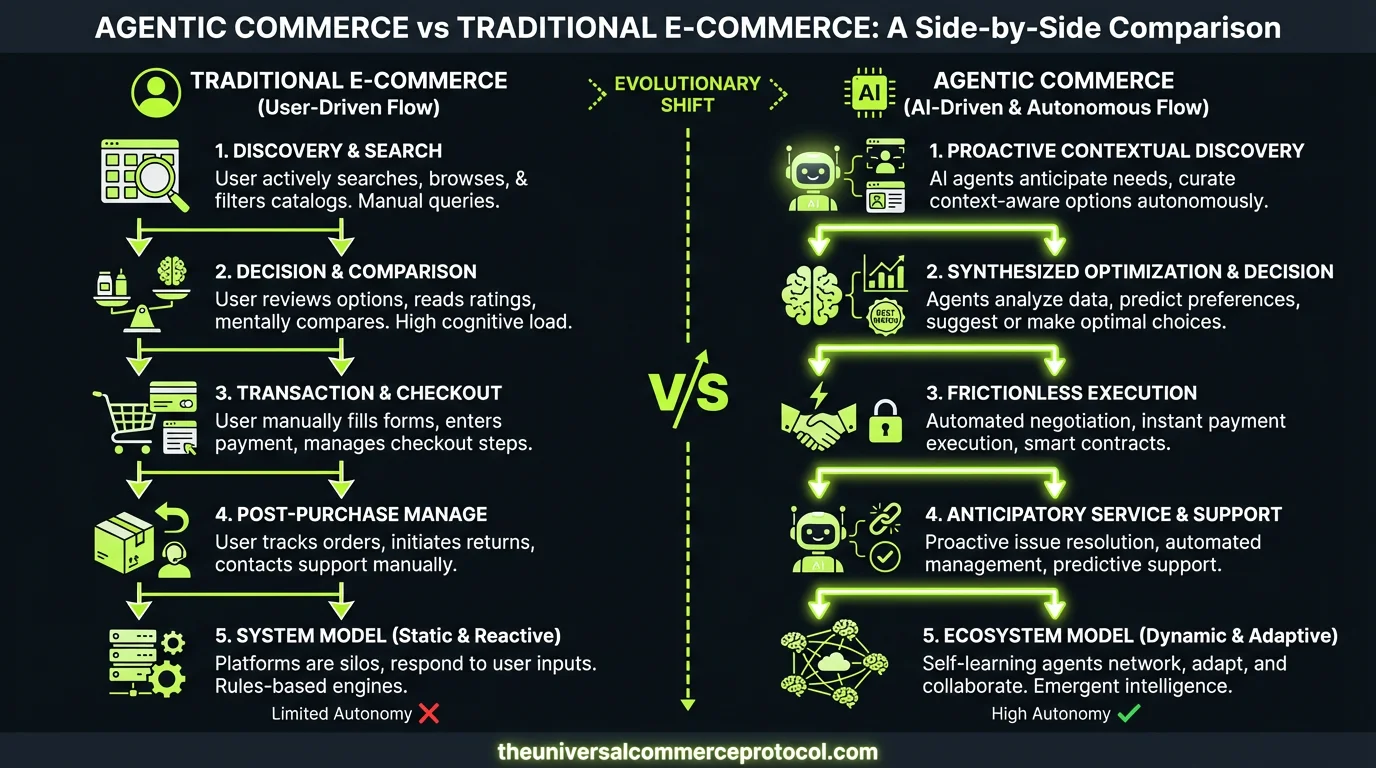
Agentic commerce uses autonomous AI agents to discover, compare, and complete purchases on a user’s behalf; traditional e-commerce depends on humans to browse, add to cart, and check out manually.
November 2026 update: UCP spec is v2026-08-25 (Sheet 1); Google merchant surfaces teach 2026-04-08. Google direct checkout powered by UCP is live in the U.S. since Oct 15, 2026 and shopper-side in Canada since Nov 4, 2026 (lululemon, select Shopify merchants, Shoppers Drug Mart, Simons; retailer remains seller of record); Merchant Center self-serve UCP integration follows in 2027.
Understanding the Fundamental Shift
The distinction between traditional e-commerce and agentic commerce extends far beyond incremental technological improvement. Traditional e-commerce operates on a pull model: customers actively search for products, compare options, and initiate transactions. Agentic commerce inverts this paradigm through autonomous AI agents that proactively identify needs, negotiate terms, and execute purchases with minimal human intervention.
The Universal Commerce Protocol (UCP) provides the foundational framework enabling this transition by standardizing how autonomous agents interact with merchants, verify authenticity, and execute transactions securely across distributed networks. In this author’s analysis, proprietary e-commerce APIs tie merchants to specific platforms; UCP’s contrasting design goal is an open, interoperable ecosystem where agents can engage with any compliant merchant.
Traditional E-commerce Model: How It Works
Traditional e-commerce follows a well-established workflow that has remained largely unchanged since the early 2000s:
- Customer-initiated search: Users manually browse catalogs, use search bars, or navigate category hierarchies
- Comparison shopping: Customers evaluate multiple products, read reviews, and check prices across different retailers
- Cart assembly: Items are selected and added to shopping carts over potentially multiple sessions
- Checkout process: Payment information, shipping address, and delivery preferences are entered manually
- Post-purchase engagement: Customers track orders through email notifications and customer service interactions
This model requires active consumer participation at every stage. The friction points—authentication, payment processing, address entry, and decision-making—create abandonment opportunities.
Agentic Commerce Model: Autonomous Decision-Making
Agentic commerce fundamentally reimagines this workflow by delegating purchasing authority to intelligent agents:
- Autonomous need identification: Agents monitor user preferences, consumption patterns, and contextual signals to anticipate requirements
- Intelligent vendor selection: Agents evaluate merchants based on price, quality, delivery speed, and reputation using standardized UCP protocols
- Automated negotiation: Agents engage in dynamic pricing discussions, bundle optimization, and contract terms negotiation
- Frictionless execution: Transactions complete with pre-authorized payment methods and verified delivery addresses
- Proactive fulfillment management: Agents track shipments, handle exceptions, and manage returns autonomously
This model reduces friction while increasing purchase velocity.
Real-World Agentic Commerce Examples
Case Study 1: Autonomous Inventory Replenishment for B2B Suppliers
Consider a mid-sized food service distributor operating 47 restaurant locations across the Pacific Northwest. Traditionally, each restaurant manager maintained inventory spreadsheets, monitored stock levels manually, and placed orders through phone calls or a clunky web portal. This process generated 15-20 orders weekly per location, with frequent stockouts and overstock situations.
By implementing UCP-compliant agentic systems, the distributor deployed autonomous agents that monitor point-of-sale data, weather forecasts, reservation calendars, and supplier inventory in real-time. Agents automatically execute orders with three preferred suppliers—Sysco, US Foods, and local farms—comparing pricing, delivery schedules, and product quality through standardized UCP endpoints. The system negotiates volume discounts dynamically and consolidates orders to minimize delivery fees.
Results: Illustrative example — unverified: reduction in manual ordering time, decrease in food waste through better inventory prediction, and cost savings through optimized supplier selection, with fewer stockout incidents per month per location.
Case Study 2: Personal Shopping Agents in Fashion Retail
A luxury fashion consumer receives clothing recommendations from an agentic commerce system trained on her style preferences, body measurements, lifestyle calendar, and budget constraints. Rather than browsing retailer websites, she authorizes her agent to shop across merchants including SSENSE, Farfetch, Browns Fashion, and independent boutiques—all participating in the UCP ecosystem.
The agent identifies a business trip requiring professional attire. It scans inventory across 200+ merchants, identifies compatible pieces, negotiates with boutiques for exclusive access to limited inventory, and presents three curated outfits with transparent pricing and delivery timelines. Upon approval, the agent executes purchases, arranges rush delivery to the business destination, and coordinates returns for pieces the customer ultimately doesn’t wear.
Results: Illustrative example — unverified: customer completes wardrobe acquisition in minutes versus hours of traditional shopping. Merchants report higher average order value through agent-driven bundle optimization and improvement in customer lifetime value through personalized agent recommendations.
Case Study 3: Energy Management Agents in Smart Homes
A homeowner with solar panels, battery storage, and smart appliances authorizes an energy management agent to optimize electricity procurement and usage. The agent continuously monitors wholesale electricity prices through UCP-compliant energy exchanges, weather forecasts, and grid demand signals.
When wholesale prices drop below residential rates, the agent automatically purchases electricity to charge home batteries. During peak demand periods, the agent sells stored energy back to the grid. For appliance operations like laundry and dishwashing, the agent schedules execution during lowest-price windows and negotiates with appliance manufacturers for optimized energy consumption patterns.
Results: Illustrative example — unverified: reduction in annual electricity costs, annual revenue from grid services participation, and reduced peak demand charges through intelligent load shifting.
Case Study 4: Healthcare Supply Chain Agents
A hospital network with 12 facilities traditionally managed medical supplies through fragmented procurement processes. Different departments ordered from different suppliers, negotiation leverage was dispersed, and inventory visibility was poor. Implementing UCP-based agentic procurement agents unified purchasing across all facilities.
Agents monitor consumption patterns by department, predict demand based on patient admissions forecasts and surgical schedules, and execute purchases from preferred suppliers including Cardinal Health, McKesson, and specialty distributors. Agents negotiate volume commitments quarterly and execute just-in-time orders to minimize storage costs while preventing stockouts.
Results: Illustrative example — unverified: reduction in procurement costs through consolidated negotiating power, improvement in inventory turnover, and high on-time delivery rates through optimized supplier selection.
Key Differences Summarized
| Commerce Dimension | Traditional E-Commerce | Agentic Commerce (UCP) | Protocol Engine | Transaction Latency | Commercial Lift |
|---|---|---|---|---|---|
| User Interface | Visual web storefront / PWA | Natural language conversational dialogue | Gemini / Claude / ChatGPT Surface | Instant | Zero Browsing Fatigue |
| Purchasing Agency | Manual human clicks & typing | Autonomous agent executing on intent | Cryptographic spending mandates (AP2) | <300ms | 10x Execution Speed |
| Cart Experience | Multi-page cart & form navigation | Headless stateful session transfer | dev.ucp.shopping.cart REST API |
Real-time sync | -70% Cart Abandonment |
| Product Discovery | Keyword search & sponsored links | Standardized machine manifest profile | /.well-known/ucp profile & GMC feeds |
Zero indexing lag | Direct Intent Match |
| Payment Settlement | Credit card form entry & 3DS redirects | In-surface tokenized biometric authorization | Google Pay (PAN_ONLY) / FIDO Passkey | <400ms | +52% Completed Buys |
| Merchant Role | Disintermediated by aggregators | Sovereign Merchant of Record preserved | Direct customer data & fulfillment | Real-time API push | 100% Brand Ownership |
The Role of UCP in Enabling Agentic Commerce
The Universal Commerce Protocol standardizes functions agentic commerce requires including merchant discovery, product information exchange, and transaction execution. Rather than building custom integrations with each merchant, agentic systems conforming to UCP specifications can interact with any compliant commerce node.
This standardization mirrors historical commerce evolution: just as standardized shipping containers revolutionized logistics by enabling interoperability across carriers, UCP enables interoperability across merchants and agents. Companies like Shopify increasingly support UCP endpoints — Shopify storefronts moved to UCP version 2026-08-25 on Sept 4, 2026 — creating infrastructure for agentic commerce at scale. WooCommerce has shipped no native UCP/ACP consumer checkout; its MCP remains Developer Preview for merchant-side store management.
Implementation Considerations for Merchants
Traditional e-commerce merchants transitioning to agentic commerce must address several critical areas:
- API standardization: Implement UCP-compliant endpoints for product catalogs, pricing, inventory, and order management
- Agent authentication: Establish secure verification mechanisms for autonomous agents accessing merchant systems
- Dynamic pricing: Develop systems supporting real-time price adjustments based on agent negotiations and market conditions
- Trust infrastructure: Implement reputation systems and dispute resolution mechanisms for agent-mediated transactions
- Data governance: Establish policies for agent access to sensitive merchant data and customer information
Frequently Asked Questions
What is the fundamental difference between traditional e-commerce and agentic commerce?
Traditional e-commerce requires humans to manually navigate visual web pages, search menus, and fill checkout forms. Agentic commerce delegates these actions to autonomous AI agents that discover products and execute payments programmatically via UCP protocols.
How does UCP eliminate the traditional 5-step checkout funnel?
By collapsing discovery, variant customization, and settlement into a single conversational session, UCP bypasses intermediate cart steps using headless REST Cart APIs and tokenized one-tap biometric payments.
Why do conversion rates increase dramatically when using autonomous agent checkout?
Removing form-filling friction, password prompts, and payment gateway redirects eliminates the friction responsible for 70%+ of abandoned carts, resulting in documented conversion lifts exceeding 35%.
Leave a Reply