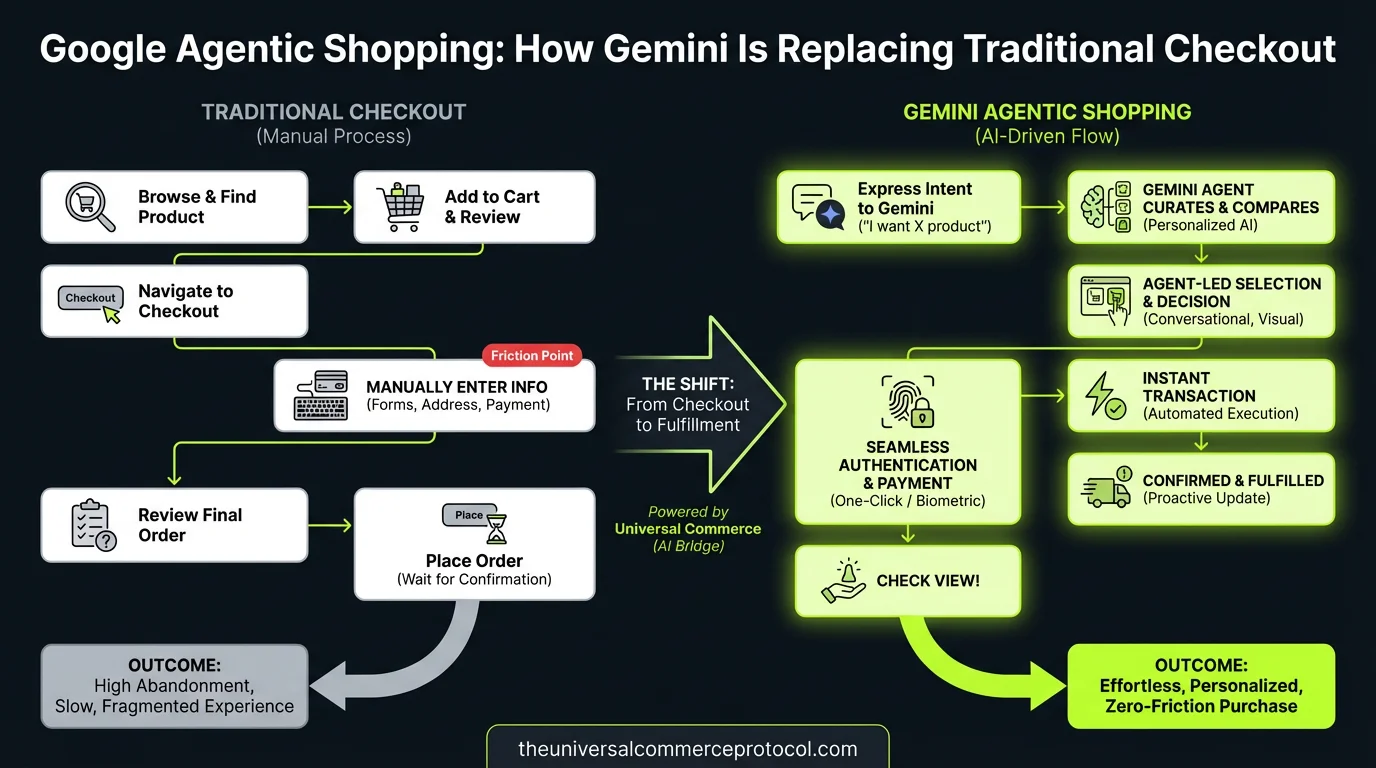
Google Agentic Shopping: How Gemini Is Replacing Traditional Checkout
Google’s entry into agentic commerce represents a watershed moment for e-commerce infrastructure. By integrating Gemini AI directly into its shopping ecosystem, Google is automating what has traditionally been manual, friction-filled checkout processes. This shift isn’t merely incremental—it’s a fundamental reimagining of how consumers discover, evaluate, and purchase products online.
The emergence of agentic shopping marks the transition from passive product listings to active AI agents that understand intent, negotiate terms, and complete transactions autonomously. Google’s Gemini, with its multimodal capabilities and reasoning architecture, is positioned to lead this transformation. Yet the success of this vision depends on standardized protocols that enable interoperability across the fragmented retail ecosystem. This is where the Universal Commerce Protocol (UCP) becomes essential infrastructure.
Understanding Google’s Agentic Shopping Strategy
Gemini’s Role in Autonomous Commerce
Google’s Gemini AI model powers a new category of shopping experiences where the AI agent acts as a delegated buyer on behalf of the consumer. Rather than users navigating product pages, comparing specifications, and manually entering payment information, Gemini handles these tasks intelligently. The agent understands natural language preferences, learns from past behavior, and executes purchases that align with stated goals and constraints.
Gemini’s integration into Google Shopping, Google Assistant, and Android devices creates multiple touchpoints for agentic commerce. When a user tells their Google device “find me running shoes under $120 with good reviews,” Gemini doesn’t simply return search results—it evaluates options against criteria, checks inventory across retailers, compares prices in real-time, and can execute the purchase with a single confirmation.
This represents a fundamental departure from the e-commerce model that has dominated since Amazon’s emergence. The traditional model centers on user agency: consumers choose where to shop, what to buy, and when to checkout. Agentic shopping inverts this dynamic. The AI becomes the active decision-maker, with humans setting parameters and approving outcomes.
Integration with Google’s Retail Ecosystem
Google’s agentic shopping strategy builds on existing infrastructure investments. Google Shopping, which reached over 2 billion monthly users, provides the merchant network and product data foundation. Google Ads gives Google direct relationships with retailers. Google Pay handles payments infrastructure. Android provides device-level integration.
By layering Gemini’s agentic capabilities onto these existing assets, Google creates a closed-loop system where it controls discovery, evaluation, transaction processing, and payment settlement. This vertical integration gives Google unprecedented leverage in the retail value chain.
However, this concentration also creates interoperability challenges. Retailers using non-Google platforms—Shopify stores, independent marketplaces, specialized B2B systems—risk exclusion from Google’s agentic shopping network if they don’t conform to Google’s technical requirements and data standards.
The Universal Commerce Protocol’s Critical Role
Why UCP Matters for Agentic Commerce
The Universal Commerce Protocol exists precisely to solve this fragmentation problem. UCP is an open-standard protocol designed to enable any AI agent (whether powered by Google’s Gemini, OpenAI’s systems, Anthropic’s Claude, or proprietary enterprise models) to interact with any retailer, marketplace, or commerce platform.
Without UCP, agentic commerce becomes a walled garden controlled by the largest tech platforms. Google Gemini agents work seamlessly with Google Shopping partners. Amazon’s shopping agents work within Amazon’s ecosystem. Microsoft’s Copilot agents work with Microsoft’s retail partners. But a consumer’s preferred AI agent cannot autonomously shop across all available retailers, and retailers cannot accept agents from multiple platforms using different protocols.
UCP standardizes the interface between agents and commerce systems. It defines how agents query inventory, retrieve product information, evaluate availability, negotiate pricing, execute transactions, and handle post-purchase operations. This standardization enables true interoperability.
Consider a practical scenario: A consumer using a third-party AI shopping agent (not Google, not Amazon) wants to purchase a laptop. The agent needs to simultaneously check inventory and pricing across Dell’s direct website, Best Buy, Amazon, Newegg, and specialized retailers like B&H Photo. Without UCP, the agent would need custom integrations with each retailer. With UCP, the agent sends a standardized query that all retailers understand and respond to consistently.
UCP’s Technical Architecture for Agent Commerce
UCP provides several critical capabilities for agentic shopping:
- Agent Authentication: Retailers can verify that an AI agent is legitimate and authorized to act on a consumer’s behalf, preventing fraud and unauthorized purchases.
- Intent Expression: Agents can communicate complex shopping intents—product preferences, budget constraints, delivery requirements, sustainability criteria—in standardized formats that retailers interpret consistently.
- Real-time Inventory Queries: Agents access live inventory data across multiple retailers simultaneously, enabling price and availability comparison at decision time.
- Dynamic Negotiation: The protocol supports agent-to-merchant negotiation for volume discounts, bundle pricing, or conditional offers based on purchase patterns.
- Transaction Atomicity: Complex multi-step purchases (order placement, payment authorization, fulfillment scheduling) execute reliably across distributed systems.
- Audit and Compliance: All agent actions are logged and auditable, supporting regulatory requirements and dispute resolution.
Google’s Gemini vs. UCP-Enabled Agents: Strategic Implications
Platform Lock-in vs. Open Competition
Google’s agentic shopping strategy, while innovative, inherently favors Google’s ecosystem. Retailers integrated with Google Shopping benefit from Gemini agent traffic. Retailers outside Google’s network face exclusion or must build separate integrations.
UCP-enabled agents create competitive pressure against this lock-in. If retailers adopt UCP standards, they can simultaneously serve agents from Google, Amazon, OpenAI, and independent AI platforms. This shifts bargaining power from any single platform back toward retailers and consumers.
For enterprise retailers like Walmart, Target, and Best Buy, UCP adoption becomes strategically valuable. It reduces dependency on Google’s shopping network and enables direct relationships with consumers’ preferred AI agents. Walmart, for instance, could optimize its own shopping agent (powered by its technology partnerships) to serve customers across multiple devices and platforms.
For SMB retailers using Shopify, WooCommerce, or BigCommerce, UCP adoption becomes essential for competitiveness. Without it, these merchants cannot participate in agentic commerce at scale. With it, they become accessible to any AI agent, dramatically expanding their addressable market.
Data and Consumer Privacy Implications
Google’s integrated approach concentrates consumer shopping data within Google’s systems. When Gemini executes purchases on Google Shopping, Google observes the entire transaction journey: search intent, product evaluation, price sensitivity, purchase confirmation, post-purchase behavior.
UCP-enabled agents can be structured differently. An agent owned by a consumer (or by a privacy-focused service) can query multiple retailers’ UCP endpoints without revealing the consumer’s full shopping journey to any single party. The consumer retains agency over their data while still benefiting from AI-driven shopping optimization.
This privacy dimension becomes increasingly important as regulators scrutinize data concentration. The EU’s Digital Markets Act, for instance, imposes obligations on “gatekeepers” like Google to ensure interoperability. UCP provides a technical mechanism for compliance with such requirements.
Real-World Implementation Scenarios
Enterprise Retail Adoption
Best Buy and Target have both invested in their own AI shopping initiatives. By adopting UCP standards, these retailers can ensure their shopping agents work across all consumer devices and platforms, not just their own apps. This creates competitive parity with Google’s Gemini integration while maintaining brand control over the shopping experience.
Marketplace Integration
Amazon Marketplace, eBay, and Etsy could adopt UCP to enable third-party agents to query their networks. This would dramatically expand their traffic sources beyond Amazon’s own shopping agent, potentially increasing GMV while reducing dependence on Amazon’s advertising business.
B2B and Specialized Commerce
UCP’s benefits extend beyond consumer retail. B2B platforms like Alibaba, specialized marketplaces like Thomasnet, and procurement systems could adopt UCP to enable enterprise agents to autonomously source materials, negotiate contracts, and manage supply chains. This transforms how businesses conduct procurement.
Challenges and Adoption Barriers
Technical Integration Complexity
Implementing UCP requires retailers to expose inventory, pricing, and transaction capabilities through standardized APIs. For legacy retail systems, this represents significant technical work. Integration platforms like Zapier and MuleSoft can abstract some complexity, but retailers must still understand their data models and business rules.
Competitive Concerns
Retailers worry that standardized agent access reveals competitive information—pricing strategies, inventory levels, supplier relationships. UCP implementations must balance transparency (enabling agent functionality) with confidentiality (protecting business-sensitive data).
Google’s Market Power
Google’s existing dominance in shopping search and its direct integration of Gemini into Android and Google Assistant creates a strong incumbent advantage. Even with UCP standardization, Google’s agents benefit from distribution advantages that competitors cannot easily overcome.
The Future of Agentic Commerce
The next three to five years will determine whether agentic commerce consolidates around a few dominant platforms or develops as an open, interoperable ecosystem. Google’s Gemini shopping integration represents the consolidated scenario: one powerful agent with privileged access to retail networks.
UCP adoption represents the alternative: a competitive market where consumers choose among multiple agents (Google, Amazon, OpenAI, specialized shopping agents, privacy-focused agents), and retailers compete to serve all of them through standardized protocols.
The outcome will likely involve both dynamics. Google will maintain significant agentic commerce share through its distribution advantages. But retailers seeking independence and consumers seeking choice will increasingly adopt and demand UCP-compatible systems.
This mirrors the evolution of web commerce: despite Amazon’s dominance, independent retailers thrived by adopting standardized web technologies (HTTP, HTML, payment standards) that enabled access to the broader internet. UCP plays an analogous role for agentic commerce, ensuring that tomorrow’s retail ecosystem remains competitive and open despite the rise of powerful AI agents.
FAQ
What is the difference between Google Agentic Shopping and traditional e-commerce?
Traditional e-commerce requires users to actively navigate websites, compare products, and complete checkout. Google Agentic Shopping uses Gemini AI to automate these steps—the agent evaluates options based on stated preferences, negotiates pricing, and executes purchases with minimal user intervention. The consumer sets parameters; the agent handles execution.
How does UCP enable retailers to compete with Google’s shopping integration?
UCP provides standardized APIs that allow retailers to serve any AI agent, not just Google’s Gemini. This reduces dependence on Google’s distribution and enables retailers to simultaneously serve agents from multiple platforms. Retailers adopting UCP become accessible to the entire ecosystem of agentic commerce, not just Google’s network.
Is my shopping data private when using AI agents with UCP?
UCP enables privacy-preserving architectures where consumer agents query multiple retailers without revealing the full shopping journey to any single party. However, privacy depends on implementation. A consumer’s own agent can protect data better than Google’s agent, which concentrates shopping behavior within Google’s systems. Specific privacy guarantees depend on which agent and retailers you use.
When will UCP become standard across retail platforms?
UCP adoption is already beginning with early implementations by forward-thinking retailers and platforms. However, widespread adoption typically requires 3-5 years as retailers integrate UCP into their systems, resolve technical challenges, and recognize competitive benefits. Google’s market dominance may slow adoption as competitors lack distribution advantages, but regulatory pressure (particularly in Europe) may accelerate implementation requirements.
Frequently Asked Questions
What is the Universal Commerce Protocol (UCP)?
The Universal Commerce Protocol (UCP) is an open standard developed to enable AI agents to autonomously conduct commerce transactions across any platform.
How does UCP enable agentic commerce?
UCP provides standardized APIs and protocols so AI agents can discover products, negotiate terms, and complete purchases without human intervention, working across any compatible commerce platform.
Why should businesses implement UCP?
UCP adoption reduces integration costs, opens revenue channels to AI-driven buyers, and future-proofs commerce infrastructure as agentic purchasing becomes mainstream.
Leave a Reply