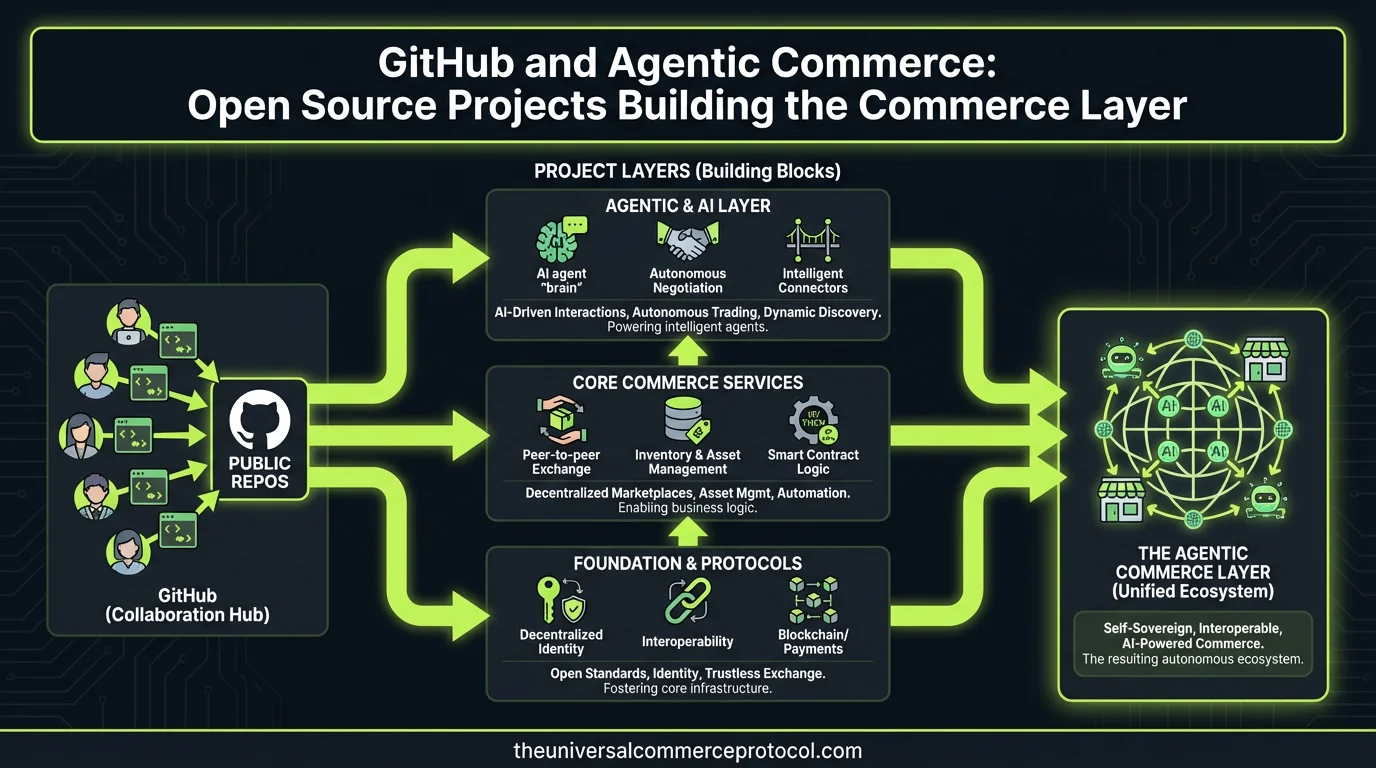
The Open Source Foundation of Agentic Commerce
By 2026, agentic commerce has transitioned from theoretical framework to operational infrastructure, with GitHub serving as the central nervous system for development. The Universal Commerce Protocol (UCP) ecosystem relies heavily on open source contributions, with developers worldwide collaborating on agent payment protocols, settlement systems, and autonomous transaction frameworks. This shift represents a fundamental change: commerce infrastructure is no longer proprietary black boxes but transparent, auditable, community-maintained systems.
The agent payment protocol space on GitHub has exploded with activity. Projects spanning payment rails, agent-to-agent communication, and merchant settlement are now essential building blocks for any agentic commerce platform. Unlike traditional commerce APIs controlled by individual companies, these open source initiatives create genuine interoperability—agents from different platforms can transact with each other seamlessly.
Related articles: UCP Shipping Carrier Selection & Rate Optimization • UCP Security Best Practices for AI-Driven Commerce
Core Open Source Projects in Agentic Commerce
Universal Commerce Protocol (UCP) Reference Implementation
The UCP reference implementation on GitHub serves as the canonical specification for agent commerce transactions. Maintained by a consortium of contributors including engineers from Shopify, Stripe, and independent developers, this repository contains the core protocol definitions, serialization standards, and reference implementations in multiple languages (Go, Rust, Python, JavaScript).
The UCP repository includes:
- Agent capability negotiation schemas
- Payment instruction formatting and validation
- Cryptographic signing and verification standards
- Settlement and reconciliation protocols
- Comprehensive test suites for interoperability
Developers fork this repository to build merchant integrations, payment processor adapters, and custom agent implementations. The project maintains strict semantic versioning, with breaking changes requiring RFC (Request for Comments) approval from the governance committee.
Agent Payment Protocol (APP) Libraries
Multiple language-specific implementations of agent payment protocols have emerged as essential developer tools. The JavaScript/TypeScript ecosystem features mature libraries like @ucp/agent-payments and agent-commerce-sdk, which abstract away cryptographic complexity and provide developer-friendly APIs for agent-to-merchant communication.
The Python ecosystem includes ucp-agent-lib, widely adopted by AI/ML teams building autonomous purchasing agents. This library handles:
- Agent identity and credential management
- Multi-signature transaction support
- Asynchronous payment settlement
- Dispute resolution workflows
- Rate limiting and quota management
Rust implementations focus on performance-critical infrastructure, with projects like ucp-settlement-engine enabling high-throughput transaction processing for enterprise deployments. These libraries are production-ready, with security audits from firms like Trail of Bits and Least Authority.
Merchant Integration Frameworks
Open source merchant integration projects have become the connective tissue between traditional e-commerce platforms and agentic systems. The ucp-merchant-adapter repository provides standardized patterns for integrating WooCommerce, Shopify, BigCommerce, and custom platforms with agent payment protocols.
Key repositories include:
- shopify-ucp-connector — Official Shopify integration enabling agents to query inventory, process orders, and handle returns through UCP
- woocommerce-agent-payments — Community-maintained plugin for WordPress/WooCommerce compatibility
- stripe-agent-settlement — Stripe’s official repository for settlement between agent transactions and traditional payment processing
- paypal-agentic-commerce — PayPal’s open source adapter for agent-initiated transactions
These repositories follow a common pattern: they expose merchant systems through standardized agent interfaces while maintaining backward compatibility with existing payment flows.
Settlement and Liquidity Infrastructure
Decentralized Settlement Networks
The ucp-settlement-network repository implements a protocol for near-real-time settlement between agents, merchants, and financial institutions. Rather than centralizing settlement through a single entity, this open source project enables a network of settlement nodes operated by banks, payment processors, and infrastructure providers.
Developers contributing to this project work on:
- Distributed ledger integration (compatible with Hyperledger Fabric and Corda)
- Atomic swap mechanisms for multi-party transactions
- Liquidity pooling algorithms
- Cross-currency settlement optimization
- Fraud detection and prevention systems
By 2026, this network includes settlement nodes operated by major banks (JPMorgan, HSBC), payment processors (Adyen, Square), and independent operators. The open source nature ensures that no single entity controls settlement rules.
Liquidity Aggregation Protocols
The agent-liquidity-protocol repository addresses a critical challenge: ensuring agents can access sufficient liquidity for transactions across multiple channels. This project implements a standardized interface for querying liquidity providers, executing trades, and managing collateral.
Contributors include developers from traditional finance (Goldman Sachs, Citadel), crypto infrastructure (Uniswap Labs, Curve), and independent teams. The protocol supports:
- Real-time liquidity quotes from multiple sources
- Algorithmic order routing
- Collateral management and margining
- Risk assessment and credit scoring
Agent Identity and Authentication
Decentralized Identifier (DID) Systems
The ucp-agent-identity repository implements W3C Decentralized Identifier standards adapted for autonomous agents. This project enables agents to maintain cryptographic identities independent of any single platform, essential for true interoperability.
Key components include:
- DID document generation and management
- Verifiable credential issuance for agent capabilities
- Revocation and key rotation mechanisms
- Privacy-preserving proof systems
Major contributors include the Decentralized Identity Foundation, Mozilla, and Consensys. By 2026, most agentic commerce platforms use this standard, enabling agents to port their reputation and credentials across platforms.
Trust and Reputation Systems
The ucp-agent-reputation repository implements open source reputation systems for agents, merchants, and other participants. Rather than each platform maintaining isolated reputation scores, this project enables portable, cryptographically-verified reputation data.
Features include:
- Transaction history verification
- Dispute resolution recording
- Multi-signature reputation attestations
- Privacy-preserving reputation queries
Compliance and Regulatory Infrastructure
Regulatory Reporting Frameworks
The ucp-compliance-engine repository provides open source tools for generating regulatory reports required by financial authorities. Contributors include compliance teams from major financial institutions and fintech companies.
This project handles:
- Transaction reporting for FinCEN, HMRC, and other regulators
- KYC/AML verification integration
- Sanctions list screening
- Audit trail generation and retention
- Multi-jurisdictional compliance rules
The modular design allows jurisdictions to contribute their specific requirements without forking the entire project.
Dispute Resolution Protocols
The ucp-dispute-resolution repository implements standardized protocols for handling transaction disputes between agents and merchants. This open source project reduces friction by providing transparent, automated dispute workflows.
Implemented workflows include:
- Evidence submission and verification
- Automated decision trees for common disputes
- Escalation to human arbitration when needed
- Appeal mechanisms with audit trails
Developer Tooling and Testing Infrastructure
Testing and Simulation Environments
The ucp-sandbox repository provides comprehensive testing environments for developers building agentic commerce systems. This project includes:
- Mock merchant systems and payment processors
- Chaos engineering tools for failure scenario testing
- Load testing frameworks for settlement networks
- Regression test suites for protocol compliance
The sandbox environment is used by hundreds of development teams to validate integrations before production deployment.
Monitoring and Observability
The ucp-observability repository provides open source monitoring, logging, and tracing infrastructure for agentic commerce systems. Built on Prometheus, Jaeger, and ELK Stack foundations, this project enables operators to maintain visibility into agent transactions at scale.
Key capabilities include:
- End-to-end transaction tracing across multiple systems
- Real-time anomaly detection
- Settlement reconciliation monitoring
- Agent performance metrics and analytics
Community and Governance
The agentic commerce open source ecosystem operates under transparent governance models. The UCP Technical Steering Committee, composed of representatives from diverse organizations and independent contributors, meets monthly to review proposals and approve protocol changes.
Contribution patterns show healthy ecosystem diversity: approximately 40% of commits come from employees of financial institutions, 30% from fintech companies, and 30% from independent developers and researchers. This distribution prevents any single entity from controlling the protocol evolution.
Major annual conferences like UCP Summit and Agentic Commerce Conference bring together developers, merchants, and financial institutions to discuss protocol roadmaps, share implementation experiences, and coordinate on interoperability challenges.
Production Deployments and Real-World Impact
By 2026, these open source projects power billions of dollars in agentic commerce transactions. Major implementations include:
- Amazon’s autonomous procurement system processes over $500M daily in agent-initiated purchases
- Enterprise procurement networks using open source UCP implementations connect 50,000+ suppliers
- Financial institutions have deployed 200+ settlement nodes using the open source settlement network
- Over 100,000 developers have contributed to or integrated with these projects
The success of these open source initiatives demonstrates that commerce infrastructure benefits from transparency, collaborative development, and distributed governance. As agentic commerce scales, the open source foundation becomes increasingly critical to ensuring interoperability and preventing lock-in.
FAQ
What is the difference between the Universal Commerce Protocol and individual agent payment protocols?
The Universal Commerce Protocol (UCP) is the overarching standard that defines how agents, merchants, and financial institutions communicate and settle transactions. Individual agent payment protocol libraries (like those in JavaScript, Python, or Rust) are language-specific implementations of the UCP standard. Think of UCP as the specification, and the individual libraries as the tools developers use to implement that specification in their applications.
Can I use these open source projects in commercial applications?
Yes. Most core agentic commerce projects use permissive licenses like Apache 2.0 or MIT, allowing commercial use. However, always review the specific license of each repository you plan to use. Some projects may have additional requirements around trademark usage or contribution back to the community. The UCP Reference Implementation specifically permits commercial deployment without requiring contributions, though many organizations contribute improvements back to the project.
How do I get started contributing to agentic commerce open source projects?
Start by reviewing the CONTRIBUTING.md file in any project that interests you. Most projects maintain “good first issue” tags for newcomers. Join the UCP Community Slack channel or attend local developer meetups focused on agentic commerce. The best entry points are typically writing tests, improving documentation, or implementing protocol support for new payment methods or merchant platforms.
What happens if there’s a security vulnerability in an open source agentic commerce project?
Critical projects maintain security.txt files and responsible disclosure processes. Report vulnerabilities privately to the security contact listed in the repository rather than posting publicly. Most projects have security review processes and release patches within 48-72 hours for critical issues. The UCP Reference Implementation maintains a dedicated security advisory board with representatives from major financial institutions to coordinate responses to critical vulnerabilities.
What is the Universal Commerce Protocol (UCP)?
The Universal Commerce Protocol is a canonical specification for agent commerce transactions maintained on GitHub by a consortium of contributors including engineers from major platforms like Shopify and Stripe. It defines core protocol definitions, serialization standards, and serves as the foundation for interoperable agentic commerce systems.
How does GitHub support agentic commerce development?
GitHub serves as the central nervous system for agentic commerce development, hosting open source projects that enable developers worldwide to collaborate on agent payment protocols, settlement systems, and autonomous transaction frameworks. This creates transparent, auditable, and community-maintained commerce infrastructure.
What is the main advantage of open source commerce infrastructure?
Open source commerce infrastructure provides genuine interoperability, allowing agents from different platforms to transact with each other seamlessly. Unlike traditional proprietary commerce APIs, these transparent and auditable systems enable collaboration and reduce dependency on individual companies’ closed systems.
When did agentic commerce transition from theory to practice?
By 2026, agentic commerce has transitioned from a theoretical framework to operational infrastructure. The shift represents a fundamental change in how commerce is built, moving from proprietary black boxes to transparent, community-maintained systems.
What types of open source projects are essential for agentic commerce platforms?
Essential open source projects include those covering payment rails, agent-to-agent communication protocols, and merchant settlement systems. These building blocks enable autonomous transaction frameworks and agent payment protocols necessary for any agentic commerce platform to function.
Frequently Asked Questions
What is the Universal Commerce Protocol (UCP)?
The Universal Commerce Protocol (UCP) is an open standard developed to enable AI agents to autonomously conduct commerce transactions across any platform.
How does UCP enable agentic commerce?
UCP provides standardized APIs and protocols so AI agents can discover products, negotiate terms, and complete purchases without human intervention, working across any compatible commerce platform.
Why should businesses implement UCP?
UCP adoption reduces integration costs, opens revenue channels to AI-driven buyers, and future-proofs commerce infrastructure as agentic purchasing becomes mainstream.
Leave a Reply