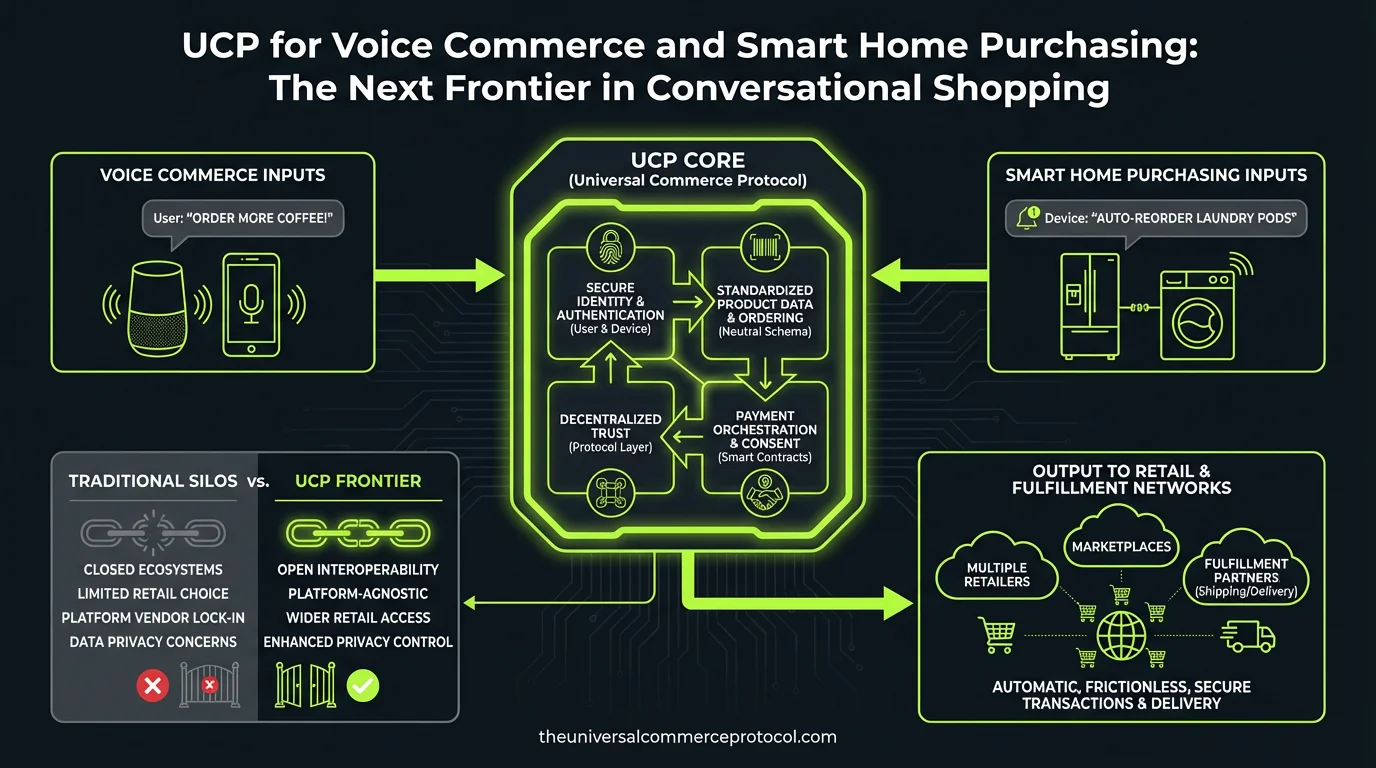
Introduction: The Rise of Voice-Activated Shopping
Voice commerce is no longer a novelty — it is becoming a familiar shopping channel for many consumers who already use smart speakers and voice assistants in daily routines. The Universal Commerce Protocol (UCP) is discussed here as one approach merchants are evaluating for structuring catalog, checkout, and fulfillment work so that voice-first interactions can be handled consistently alongside web and mobile.
Unlike traditional e-commerce interfaces that rely on visual browsing and clicking, voice commerce requires a fundamentally different approach to product discovery, selection, and transaction completion. General engineering analysis: successful voice flows tend to minimize back-and-forth, confirm key details out loud, and fall back gracefully when speech is ambiguous or products have many similar variants.
Related articles: UCP Shipping Carrier Selection & Rate Optimization • UCP Security Best Practices for AI-Driven Commerce
November 2026 update: UCP direct checkout is live for shoppers in the US (AI Mode / Gemini, announced Oct 15, 2026) and Canada (rolling out since Nov 4, 2026 via lululemon, select Shopify merchants, Shoppers Drug Mart, Simons; retailer remains seller of record). Self-serve Merchant Center UCP integration for CA/AU follows in 2027 — Canadian shopper-side availability does not mean any merchant can yet switch it on in Merchant Center.
Understanding Voice Commerce Within the UCP Framework
How UCP Enables Voice-First Transactions
General engineering analysis: voice-first purchasing places unusual stress on catalog clarity, identity proofing, and checkout confirmation, because shoppers cannot scan a results page or visually verify an address and total. Merchants planning for this channel are therefore advised to treat concise product language, explicit confirmation steps, and robust error handling as baseline requirements, regardless of which voice platforms they choose to support.
Illustrative dialogue — author-voice example, not a UCP capability claim: When a customer says “I need a new charger,” a helpful voice agent might ask clarifying questions about device type, wattage, connector type, and brand preference. General practice advice: merchants can make that kind of exchange work better by maintaining clean attribute data for compatibility, power, and device fit, and by writing short spoken descriptions that distinguish similar items.
Third, authentication and authorization for voice transactions deserve careful design because voice commerce presents unique security challenges — users cannot visually confirm recipient addresses or payment methods in a pure voice flow. UCP standardizes authentication as API keys, OAuth 2.0, mTLS, and HTTP Message Signatures (RFC 9421), with account linking via the `dev.ucp.common.identity_linking` capability; authorization for autonomous purchases runs through AP2 mandates signed on a deterministic Trusted Surface, which is never an LLM — voice biometrics are not part of the UCP model.
The Technical Architecture of Voice Commerce with UCP
Voice commerce transactions using UCP follow a distinct flow pattern at a high level. General engineering analysis: when a customer makes a voice request, their device typically captures audio, converts speech to text, and passes an inferred intent to a commerce agent that must then resolve that intent against merchant data for availability and pricing before responding.
General engineering analysis with label — how multi-turn refinement is approached in practice: The commerce agent engages in multi-turn dialogue with the customer to refine their selection. General engineering analysis: this dialogue works best when the agent can reference structured data about product attributes, variants, and availability when asking clarifying questions. General practice advice: once the customer confirms a selection out loud, restate the key facts — item name, variant, quantity, price, delivery address, and total — and require an explicit yes before any payment or fulfillment call is made.
Critically, a pure voice flow happens without a visual interface to fall back on. General practice advice: The merchant’s implementation must therefore provide comprehensive product metadata, clear pricing information, and robust error handling for scenarios where voice communication might be ambiguous — for example, by repeating back what was heard, offering the top two close matches, and allowing easy correction, cancellation, or human review.
Smart Home Integration: Beyond Simple Voice Orders
Contextual Shopping in Connected Environments
Smart home integration represents a significant evolution beyond simple voice ordering. Illustrative scenario — author-voice example, not a statement about deployed UCP integrations: with contextual commerce, smart home devices might proactively suggest purchases based on environmental conditions, usage patterns, and customer preferences. For example, a smart thermostat integrated for shopping could detect that a customer’s HVAC filter needs replacement and offer to order a replacement, with the customer confirming via voice.
Illustrative scenarios — author-voice examples: A smart refrigerator might detect low milk levels and suggest ordering from the customer’s preferred grocery delivery service. A smart laundry system might recommend detergent based on recent wash cycles. General practice advice: merchants who want to be ready for these kinds of prompts should extend catalog records with practical compatibility information, usage guidance, pack sizes, and clear reorder and subscription terms, so any assistant has accurate facts to read aloud.
Inventory Management and Real-Time Availability
Smart home purchasing at scale introduces new challenges for inventory management. General practice advice: when multiple devices or household members can independently initiate orders, merchants should prioritize real-time inventory visibility and consistent availability information across every channel where their products can be ordered, to prevent overselling and inconsistent customer experiences.
General practice advice: Additionally, merchants implementing voice commerce should plan in advance for how out-of-stock situations are handled in conversation. Author-voice recommendation: define fallback products and substitution rules in merchandising policy — for example, whether substitution is ever allowed without explicit consent, which alternatives are acceptable, and how price differences are announced — so voice agents can present alternatives quickly and allow customers to make alternative decisions without ending the interaction.
Practical Implementation: Getting Started with UCP Voice Commerce
API Endpoints Required for Voice Commerce
General practice advice: Merchants implementing voice commerce should ensure that whatever catalog services they expose return comprehensive metadata including product names, spoken-friendly descriptions, prices, variants, and availability. Unlike web interfaces where customers can browse images and read reviews, voice commerce requires more detailed verbal descriptions and structured attribute data that an agent can summarize in one or two sentences.
General practice advice: Plan a clear intent-clarification behavior for when multiple products match a voice query. General engineering analysis: a useful pattern is to have the service receive a customer’s natural language request and return ranked matches that the voice agent can present conversationally — for example, stating the top two or three options with one distinguishing fact each, then asking which to proceed with.
General practice advice: The transaction step must support explicit confirmation, such as requiring customers to verbally confirm their shipping address and payment method before an order is finalized. Explicit authorization in UCP/AP2 is recorded in an AP2 checkout mandate: the user’s consent to final checkout contents and payment, signed on a Trusted Surface and verified by the Merchant.
Optimizing Product Catalogs for Voice Discovery
General practice advice: Voice commerce success depends heavily on catalog optimization. Merchants must ensure their product data includes natural language descriptions that voice agents can reference when describing products to customers. Technical specifications should be translated into conversational language — instead of “2.4A USB-C PD charger,” voice agents need “fast charger that works with your phone and laptop.”
General practice advice: Merchants should also implement synonym mapping within their search and catalog logic. Illustrative example: when customers ask for a “phone charger,” the system should recognize this may map to “mobile device power adapter” in the catalog. General practice advice: maintaining curated synonym lists, common mishearings, and plain-language aliases improves voice search accuracy and reduces repeated clarification turns.
Author-voice opinion/analysis: Additionally, merchants should prioritize voice-friendly products in their catalogs. Items with simple specifications, clear value propositions, and low return rates perform better in voice commerce. Complex products requiring detailed comparison or customization remain challenging for voice-first purchasing, and are often better served by starting in voice and finishing with visual review.
Authentication and Security Implementation
UCP implementations authenticate requests with the spec’s mechanisms — API keys, OAuth 2.0, mTLS, and HTTP Message Signatures (RFC 9421) — and prove user authorization with AP2 mandates signed on a deterministic Trusted Surface. Voice biometrics are not a UCP authentication method; merchants needing step-up assurance should use the spec’s OAuth-based identity-linking and AP2 mandate constraints, plus channel-appropriate confirmation outside the voice transcript.
General practice advice — not a statement that these channels are part of UCP: Beyond the spec’s authentication, merchants should consider layered confirmation for high-value or high-risk transactions as a matter of store policy and risk management. Common patterns outside the voice transcript include a text message confirmation, a push notification to a phone, or a visual confirmation on a paired device. General practice advice: define thresholds in advance, explain them to shoppers, and ensure either party can easily pause or cancel if confirmation does not arrive.
Use Cases and Real-World Applications
Grocery and Household Goods Delivery
Illustrative scenario — author-voice example, not a market-share or adoption claim: Consider a grocery workflow where a shopper says “order my usual groceries” and the system retrieves a saved list or previous purchase history, reads back the basket and total, confirms delivery window, and schedules delivery. Illustrative scenario: this kind of use case pairs naturally with smart-home signals — for example, refrigerators and pantry sensors flagging low stock — provided the shopper has opted in and every automatic suggestion still requires explicit confirmation.
General practice advice: for repeat consumables, keep reorder language precise: confirm brand, size, quantity, price changes since last order, and any substitutions before finalizing. Author-voice opinion: short, predictable confirmation scripts tend to perform better than long recitations, especially for weekly staples.
Pharmacy and Health Products
Illustrative scenario — not a statement about regulated UCP deployments or pharmacy rules: A pharmacy workflow might allow voice reordering of everyday over-the-counter items or reminders that a refill window is approaching. General practice advice: treat health-related voice flows with extra rigor — require clear identity verification per store and payment policy, keep sensitive details off speakerphone where possible, and direct any product requiring professional consultation to a pharmacist or clinician channel rather than completing it by voice alone.
Illustrative scenario: the contextual nature of smart-home reminders can be helpful here, for example when medication reminders are paired with an offer to start a reorder checklist. General practice advice: always separate the reminder from the purchase, and require a distinct, explicit authorization step for the order itself.
Smart Home Maintenance and Supplies
Illustrative scenario — author-voice example: Home maintenance reordering offers intuitive voice moments. When a smart security system detects a low battery, it can offer to order replacement batteries through a voice prompt. Similarly, smart home monitoring systems might flag that maintenance supplies are running low based on usage patterns or elapsed time.
General practice advice: for these categories, compatibility data matters more than marketing copy — battery type, filter size, model fit, and pack count should be confirmed aloud. Author-voice opinion: pre-bundled kits and clearly named consumables tend to convert better in voice than open-ended parts searches.
Challenges and Considerations for Merchants
The Return and Dispute Management Problem
Voice commerce introduces unique challenges for returns and disputes. Customers cannot visually verify products before delivery, and voice descriptions may not capture all product details. General practice advice: merchants implementing voice commerce should establish clear return policies, read the key terms before purchase when they affect the decision, and implement easy return-initiation workflows that do not depend solely on voice — such as a link, app task, or customer-service handoff that references the original voice order.
General practice advice: keep packaging, delivery confirmation, and item identifiers easy to reference by voice (order number, date, item name) so shoppers can start a return without hunting for paperwork. Author-voice opinion: lenient, plainly stated return windows reduce hesitation for first-time voice buyers.
Maintaining Brand Experience Across Voice Platforms
When merchants’ products appear through multiple voice assistants and smart home surfaces, maintaining consistent branding and customer experience takes deliberate work. General practice advice: merchants must ensure their product descriptions, pricing, and policies remain consistent everywhere their products can be ordered, with one owned source of truth for name, price, availability, and policy text that every channel draws from.
General practice advice: review spoken renditions regularly — listen to how names, promotions, and disclaimers sound when read aloud, and adjust punctuation, abbreviations, and description order for clarity. Author-voice opinion: a short, consistent sign-off that states total, delivery estimate, and where to get help does more for brand trust than sonic branding alone.
Analytics and Attribution
General practice advice: Tracking customer behavior and attribution in voice commerce is more challenging than traditional e-commerce. Merchants need implementations that provide detailed analytics about voice commerce interactions — which products are most frequently ordered via voice, what clarifying questions customers ask most often, and where conversations drop off. This data is critical for optimizing voice commerce performance.
General practice advice: instrument the funnel from utterance to delivery: recognition success, clarification rate, confirmation rate, cancellation reasons, and post-delivery contacts. Author-voice opinion: teams that review failed utterances weekly and add synonyms or tighten prompts tend to improve completion faster than those that only track completed orders.
Future Trends in UCP Voice Commerce
Proactive Shopping Agents
Author outlook — labeled opinion, not a statement about shipped UCP features: one area merchants are watching is more proactive assistance, where systems recognize repeat patterns and suggest a timely reorder rather than waiting for a shopper to remember. General practice advice: if you test such prompts, require explicit opt-in, announce why the suggestion appeared, and always require a clear yes before anything is ordered.
Author-voice opinion: restraint matters here; a single well-timed reminder tied to actual consumption is likely to be welcomed, while frequent speculative suggestions risk opt-outs.
Multi-Device Coordination
Author outlook — labeled opinion, not a statement about UCP session features: shoppers already move between speaker, phone, and display during a single task. General practice advice: design handoffs so a conversation started on a smart speaker can be paused and resumed elsewhere without repeating every detail — for example, by saving basket state and sending a follow-up link for visual review and final confirmation.
Ambient Commerce
Author outlook — labeled opinion, not a statement about automatic purchasing: as routines become more connected, some reordering may feel increasingly ambient, woven into daily habits rather than framed as separate shopping trips. General practice advice: keep human control explicit even as flows get smoother: preset rules, spending caps, and clear notifications for every automatic action, with voice confirmation reserved for significant, unusual, or policy-sensitive transactions.
Frequently Asked Questions
Q: How should merchants think about catalog size for voice commerce?
A: General practice advice: there is no single threshold that guarantees results. Start with products that have clear names, simple specifications, and straightforward fulfillment, optimize their spoken titles, synonyms, and attribute data, and expand based on measured completion and return rates. Author-voice opinion: a small, well-maintained assortment that is easy to describe aloud often outperforms a large, poorly described one.
Q: How should variants and customization be handled in voice flows?
A: General practice advice: guide customers through variants conversationally, one choice at a time — for example, confirm size first, then color — and read back the final configuration before payment. For complex customization, offer pre-configured options for voice ordering and invite shoppers to finalize detailed custom work with visual review.
Q: How can merchants measure ROI on voice commerce investments?
A: General practice advice — measurement suggestions only, not market benchmarks: Track voice commerce-specific metrics including voice order frequency, average order value, customer acquisition cost through voice channels, and lifetime value of voice commerce customers, and compare trends over time within your own store. Use the read-out to refine prompts, assortment, and confirmation scripts rather than as a cross-merchant benchmark.
Q: What operational safeguards help for voice ordering?
A: General practice advice: put explicit confirmation, easy correction, and accessible order history at the center of the flow; set value thresholds for additional review; and staff support paths for misheard items, wrong variants, and delivery issues. Keep audit logs of what was confirmed and when, per your own record-keeping policy.
Updated November 8, 2026: Updated November 2026 to cut voice-biometric and voice-confirmation-protocol claims (authentication is API keys/OAuth 2.0/mTLS/RFC 9421 with AP2 mandates on a Trusted Surface) and to note US + Canada shopper-side checkout live status; original March 8, 2026 publish date preserved. First published March 8, 2026.
| Voice & IoT Layer | Type | Requirement | Security & UX Mechanism | Functional Description | Illustrative Pattern |
|---|---|---|---|---|---|
intent.spoken_disambiguation |
enum |
Mandatory | Compact top-choice summarization | Narrows catalog matches to concise, voice-friendly options using prior reorder history | "VOICE_CONCISE_CANDIDATES" |
auth.biometric_voice_passkey |
string |
Critical | Speaker verification + device binding | Requires authenticated household member confirmation before executing spoken purchase intents | "FIDO2_DEVICE_ATTESTATION" |
iot.consumable_telemetry |
string |
Required | Local appliance threshold trigger | Allows smart-home appliances to draft replenishment carts when consumables run low | "MATTER_REPLENISHMENT_DRAFT" |
budget.household_spend_cap |
string |
Mandatory | Pre-authorized auto-reorder ceiling | Restricts unattended smart-home replenishment to user-defined category and price bounds | "HOUSEHOLD_MANDATE_CAP" |
confirmation.multimodal_handoff |
boolean |
Standard | Companion screen receipt & cancel window | Pushes visual cart summary and one-tap cancellation grace window to the user’s phone | true |
privacy.local_wake_filtering |
boolean |
Recommended | On-device intent redaction | Processes ambient audio locally and transmits only structured UCP queries when invoked | true |
Developer & Architecture FAQ (Reference Standard 2026-11-10)
Q1: Why did first-generation voice shopping struggle, and how does UCP address those limitations?
Early voice assistants tried to read long lists of search results aloud and lacked cross-merchant cart standards. Combined with modern reasoning models, UCP lets a voice assistant query structured product attributes, filter by past household preferences, and present a single clear recommendation or push a visual comparison card to a companion screen.
Q2: How are unauthorized or accidental voice purchases prevented in a shared household?
Production voice commerce architectures pair speaker verification and companion-device passkeys with strict UCP spend mandates—requiring explicit mobile approval for unfamiliar items while allowing low-value routine replenishment within pre-approved price ceilings.
Q3: How do smart home appliances interact with UCP for automated replenishment?
Connected appliances can detect low consumable levels (such as water filters or detergent pods) and generate a draft UCP replenishment intent. Depending on the user’s delegation settings, the household agent either queues the item for approval or executes the order with a grace-period cancellation notification.
Leave a Reply