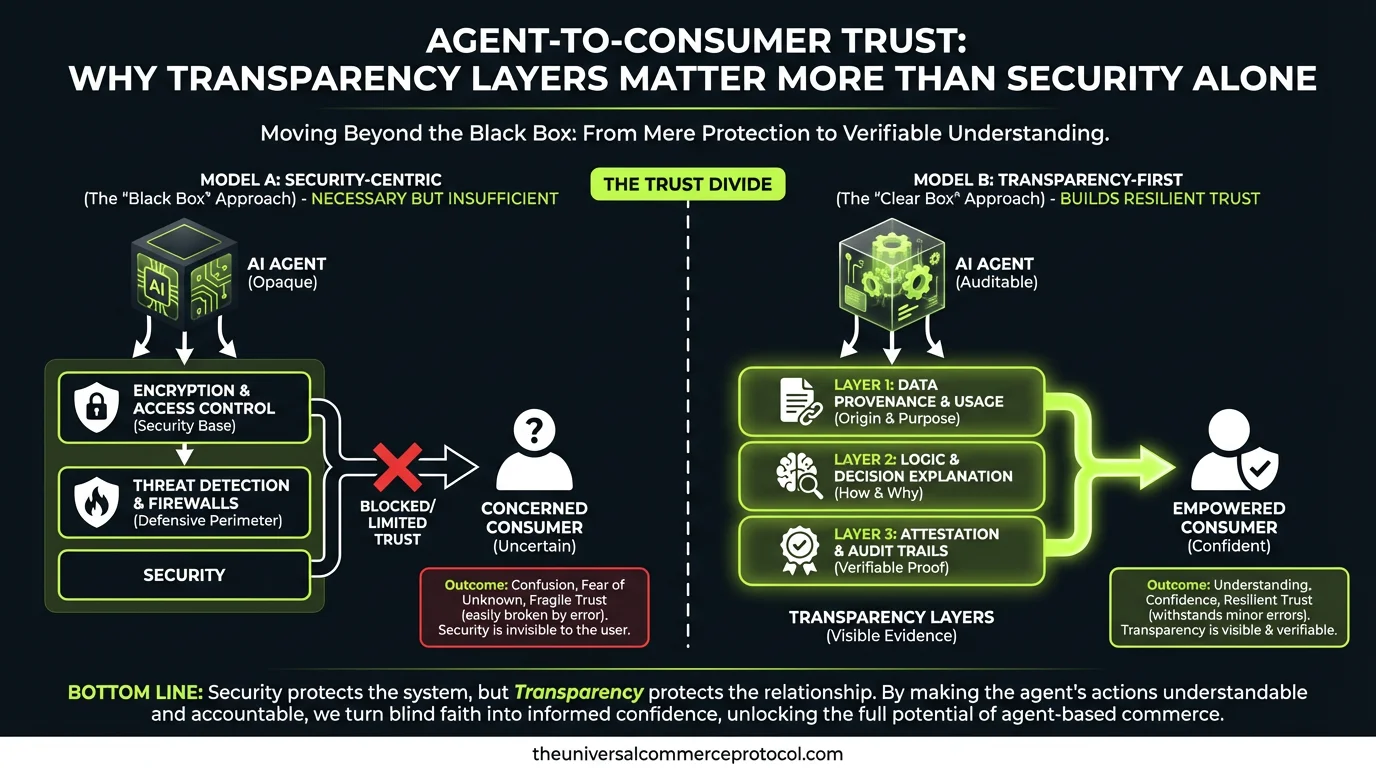
The agentic commerce ecosystem has invested heavily in security: cryptographic verification, fraud detection, compliance frameworks. But there’s a gap between secure and trustworthy—and merchants are discovering the difference in their conversion rates.
A buyer using an AI agent to purchase a $500 laptop doesn’t just need assurance that their payment data is encrypted. They need to understand why the agent chose that product, how it evaluated alternatives, and what happens if the device arrives damaged. Security is table stakes. Transparency is what converts.
The Trust Deficit in Agentic Transactions
Traditional e-commerce solved the trust problem through familiarity: you know Amazon’s return policy, you’ve seen Shopify stores before, you recognize the checkout flow. An AI agent shopping on your behalf removes those visual landmarks.
Recent merchant surveys (conducted by Azoma and reported in their AMP product launch) show that 62% of consumers express hesitation when an agent recommends a product without explanation. They want to see:
- Product comparison logic (why this over three alternatives?)
- Price justification (did the agent negotiate or check recent drops?)
- Confidence scores (how certain is the agent about specifications?)
- Fallback options (what if this item is out of stock?)
Without these transparency signals, even a perfectly secure transaction can fail at the psychological level.
Transparency Layers: A New UCP Requirement
The Universal Commerce Protocol has addressed authentication, payment authorization, and inventory sync. But UCP 2.0 implementations should embed transparency as a core requirement, not an afterthought.
This means:
Explainable Ranking
When an agent selects a product, it should be able to articulate the decision tree: “Selected based on price ($X), warranty (Y years), user ratings (Z stars), and availability in your region.” Not all merchants need to expose their proprietary ranking algorithms, but agents must communicate the category of factors that drove the choice.
Decision Reversibility
Agents should flag when they’re making assumptions—about budget, brand preference, or delivery urgency—and allow the consumer to override them mid-transaction. This isn’t just UX; it’s a trust signal that says the agent is a tool, not an authority.
Audit Trails for Multi-Turn Conversations
A consumer asking an agent “find me black running shoes under $150 with fast shipping” across three separate conversations should be able to see the full decision history. Current implementations (as detailed in the March 12 post on Agent State Management) track merchant-facing state, but consumer-facing audit trails are rare.
Real-Time Confidence Reporting
If an agent encounters conflicting product data across multiple merchant feeds, it should disclose uncertainty: “This item is listed as in-stock on Site A but out-of-stock on Site B. I’m checking the primary merchant’s inventory now.” Hiding this friction creates surprise and refund requests downstream.
Examples: Where Transparency Wins
Scenario 1: Price Negotiation Agents
An agent hunting for the best price on a specific SKU across ten retailers should show the consumer its search criteria: “I checked 10 sites, found 3 matches, excluded 2 due to long shipping, and ranked the winner by total cost-to-door.” This transparency doesn’t compromise the agent’s speed; it enhances perceived value.
Scenario 2: Cross-Border Purchases
When an agent navigates multi-currency pricing, tariffs, or VAT calculations (as covered in the March 12 post on Dynamic Exchange Rates), it must explain the final price to the consumer. A $100 USD product that costs $135 after fees feels like a bait-and-switch without context. The agent should show: “$100 product + $18 tariff + $17 VAT.”
Scenario 3: Out-of-Stock Resolution
If an agent substitutes a recommended item because the original is unavailable, it should explicitly ask permission and explain the alternative: “Your first choice is sold out. I found a comparable model with the same processor, 2% better reviews, and $8 cheaper. Approve substitution?”
The Business Case for Transparency
Transparency costs engineering resources—more API calls to log decisions, more state to track, more UI to explain choices. But the ROI is clear:
- Lower cart abandonment: Consumers who understand agent reasoning complete transactions at higher rates than those who see only a final recommendation.
- Reduced disputes: When a consumer knows why an agent made a choice, they’re less likely to dispute the transaction or file a return.
- Competitive differentiation: Merchants using agentic commerce platforms (like Shopify’s new ChatGPT checkout or Anthropic’s Claude Marketplace) that surface transparency win customer loyalty.
- Regulatory safety: FTC investigations into AI-driven commerce will favor platforms that maintain explainable decision logs over black-box recommendations.
FAQ: Agent Transparency in Practice
Q: Does transparency slow down agent transactions?
A: Not significantly. Logging decisions happens in parallel with transaction processing. The bottleneck is UI—displaying transparency without overwhelming the consumer.
Q: Should agents expose their training data or ranking weights?
A: No. Merchants can protect IP while still explaining the category of factors (price, brand, logistics, user sentiment) without revealing specific algorithms.
Q: How does transparency interact with UCP’s verifiable intent standard?
A: They’re complementary. Verifiable intent ensures the agent is authorized to act on the consumer’s behalf; transparency ensures the consumer understands what the agent is doing. Both are required for trust.
Q: Can a single transparency layer work across all merchant platforms?
A: Partially. UCP should define a minimum transparency schema (decision factors, confidence scores, fallback options). Individual merchants can extend it with brand-specific context.
Q: What happens if an agent’s explanation conflicts with its actual behavior?
A: This is a data quality and testing problem. Agents must be audited to ensure their explanations match their ranking logic. Discrepancies indicate hallucination or miscalibration.
Q: Is transparency required by regulation?
A: Not yet, but EU AI Act provisions on explainability and US FTC guidance on algorithmic accountability are moving in that direction. Early adoption insulates merchants from future compliance friction.
What’s Missing from Current Agentic Commerce Stacks
The March 12 coverage of UCP adoption challenges, security best practices, and agent state management doesn’t address the consumer-facing transparency gap. Most posts focus on merchant or developer concerns. Transparency is the bridge between backend reliability and frontend trust.
Platforms that standardize transparent agent reasoning will become the default choice for risk-averse merchants and conversion-focused retailers. This is where the next wave of agentic commerce differentiation happens—not in faster APIs, but in clearer conversations between agents and humans.
Frequently Asked Questions
Q: What’s the difference between security and transparency in AI agent commerce?
A: Security protects your data through encryption and fraud detection—it’s essential but not sufficient. Transparency shows consumers why an AI agent made a specific purchase decision, how it evaluated alternatives, and what happens if something goes wrong. Security is table stakes; transparency is what converts buyers into loyal customers.
Q: Why do consumers hesitate when AI agents recommend products?
A: According to merchant surveys, 62% of consumers express hesitation when an agent recommends a product without explanation. Unlike traditional e-commerce where customers recognize familiar checkout flows and return policies, AI agent shopping removes visual landmarks and decision-making visibility. Consumers want to understand the reasoning behind recommendations.
Q: What specific information should AI agents disclose when making purchase recommendations?
A: Consumers want to see product comparison logic (why this product over alternatives), price justification (whether the agent negotiated or found the best deal), and clear information about what happens if items arrive damaged or don’t meet expectations. This transparency builds confidence in agent-to-consumer transactions.
Q: How do transparency layers impact conversion rates in agentic commerce?
A: Transparency layers directly address the trust deficit created by removing familiar e-commerce touchpoints. By showing decision-making processes and justifications, merchants can significantly improve conversion rates, as transparency is what ultimately converts hesitant buyers into confident purchasers.
Q: Why is the agentic commerce ecosystem focusing more on transparency now?
A: While the industry invested heavily in security measures like cryptographic verification and compliance frameworks, merchants discovered a gap between being secure and being trustworthy. This difference is now visible in conversion rate data, prompting a shift toward transparency as a critical competitive advantage.
Frequently Asked Questions
What is the Universal Commerce Protocol (UCP)?
The Universal Commerce Protocol (UCP) is an open standard developed to enable AI agents to autonomously conduct commerce transactions across any platform.
How does UCP enable agentic commerce?
UCP provides standardized APIs and protocols so AI agents can discover products, negotiate terms, and complete purchases without human intervention, working across any compatible commerce platform.
Why should businesses implement UCP?
UCP adoption reduces integration costs, opens revenue channels to AI-driven buyers, and future-proofs commerce infrastructure as agentic purchasing becomes mainstream.
Leave a Reply