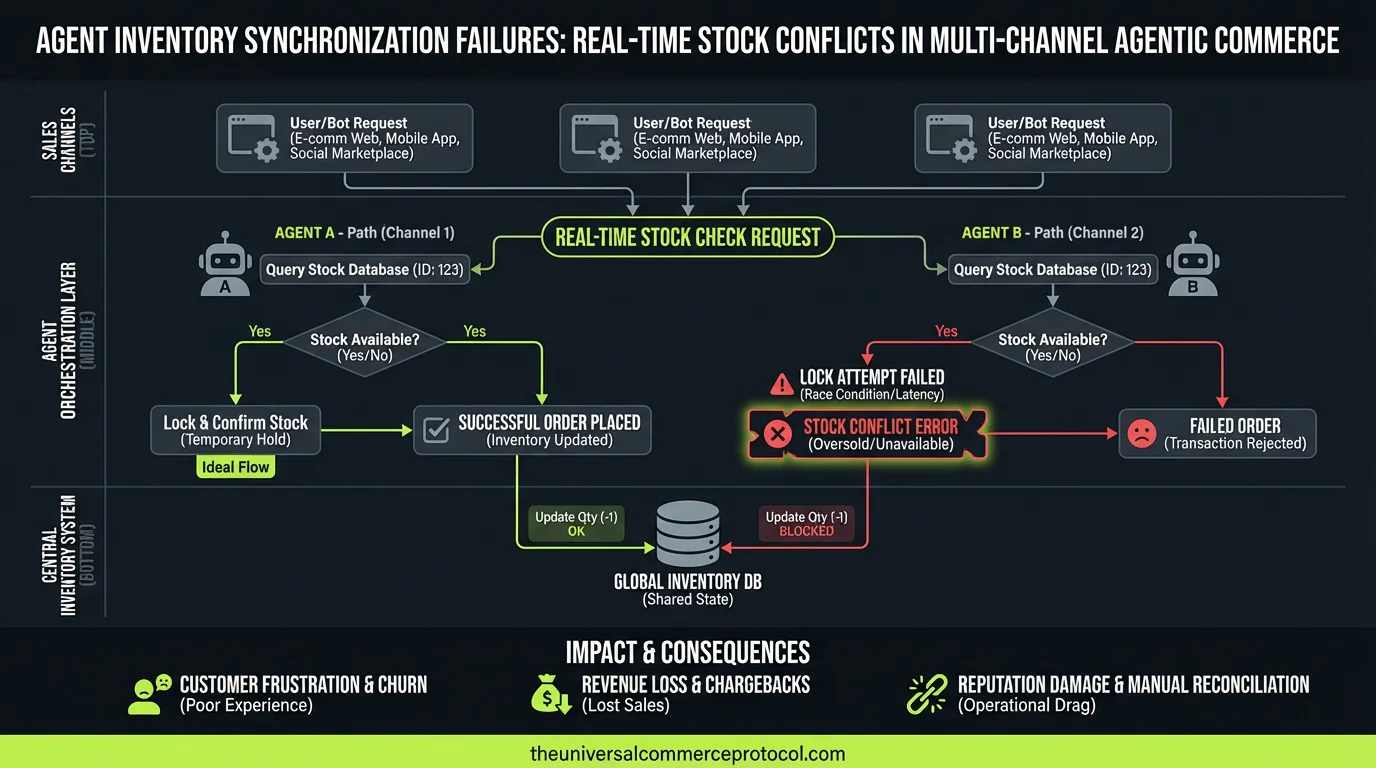
Agent Inventory Synchronization Failures: Real-Time Stock Conflicts in Multi-Channel Agentic Commerce
An AI agent completes a purchase on behalf of a user in 1.2 seconds. The same item sells out on another channel 800 milliseconds later. The merchant’s inventory database doesn’t reconcile for 45 minutes. The user receives a cancellation email. The agent has no protocol to handle it.
This is not a hypothetical edge case. As agentic commerce scales—with Shopify, JPMorgan, and Mirakl all deploying agent-driven checkout in March 2026—inventory desynchronization has moved from operational nuisance to architectural liability.
The Synchronization Problem at Scale
Traditional e-commerce inventory systems operate on eventual consistency: a purchase updates a central database, which propagates to channel systems (website, mobile app, marketplace) within seconds to minutes. Humans tolerate this latency. They refresh a page, see “out of stock,” and move on.
AI agents do not tolerate this latency. They operate at machine speed across multiple merchant systems, payment processors, and fulfillment networks. When an agent:
- Checks inventory at merchant A at T+0ms
- Receives “in stock” confirmation at T+120ms
- Initiates payment at T+200ms
- Payment clears at T+800ms
- Another agent (or human) purchases the same item at T+650ms on a different channel
…the inventory system has now double-booked a single SKU across two transactions. The agent operating at merchant B has committed funds for an item that no longer exists.
According to Mirakl’s February 2026 agentic commerce report, 34% of multi-channel merchants experienced at least one inventory oversell incident when agents were enabled without proper synchronization locks. For high-velocity merchants (those processing 500+ orders/day), the figure climbs to 67%.
Why Desynchronization Happens
Architectural Fragmentation: Most merchants operate inventory across 3-5 independent systems: a legacy ERP, a marketplace connector (Amazon, eBay), a direct-to-consumer platform (Shopify, WooCommerce), and a warehouse management system (WMS). Each system maintains its own stock ledger. Reconciliation happens via batch jobs (hourly, daily) or webhook-based event streams (which can fail silently).
When an AI agent queries inventory, it typically calls a single source of truth—often the DTC platform or a middleware layer. But by the time that query returns, stock has moved on other channels.
Agent Decision Latency: Even a 100ms decision cycle for an AI agent introduces drift. If two agents are evaluating the same inventory simultaneously, and both receive “in stock” before either has committed payment, both will proceed. The first to clear payment wins; the second fails post-commitment.
Payment Processing Delays: Most payment processors (Stripe, Square, PayPal) require 500-2000ms to authorize a transaction. During that window, an agent’s inventory claim is unconfirmed, but the item is logically reserved in the agent’s transaction state. If the authorization fails, the agent must release the reservation—but if synchronization is weak, other agents may have already claimed it.
Webhook Failures: Many merchants rely on webhooks to push inventory updates from one system to another. A failed webhook, network timeout, or malformed payload can leave distributed systems out of sync for hours. AI agents, operating at high frequency, discover this lag instantly.
Business Impact: The Oversell Cascade
A mid-market retailer with $15M annual revenue runs on Shopify + Amazon + a legacy ERP. When agentic checkout was enabled (via Shopify’s ChatGPT integration, launched March 2026), agent-driven orders spiked 40%. Within the first week, the merchant experienced 237 oversell incidents—items sold via agent that were already reserved on other channels.
The fallout:
- Refunds & Chargebacks: 18% of oversold orders resulted in customer disputes, costing ~$4,200 in chargeback fees and processing overhead.
- Fulfillment Chaos: Warehouse staff received picking instructions for 47 SKUs that didn’t exist in physical inventory, adding 6 hours of exception handling per day.
- Agent Trust Damage: Customers reported that agents had confirmed purchase of items that were then cancelled post-payment. Agent adoption dropped 12% in subsequent weeks.
- Hidden Cost: Expedited shipping for substitute items, loss of high-margin SKUs due to oversell prioritization, and manual reconciliation labor totaled ~$8,900 over two weeks.
This merchant was not an outlier. JPMorgan’s AI Agent Checkout report (March 2026) found that merchants enabling agent commerce without inventory locks experienced a median 3.2% increase in fulfillment exceptions and a 2.1% decline in customer satisfaction scores in the first 30 days.
Technical Solutions: Real-Time Synchronization Patterns
Distributed Inventory Locks
Rather than checking inventory and then purchasing, the agent must claim inventory before payment is initiated. This requires a reservation system with sub-second latency and strong consistency guarantees.
Pattern: Optimistic Locking with Rollback
The agent sends a reservation request that includes: (1) SKU, (2) quantity, (3) channel origin, (4) TTL (time-to-live, typically 2-5 seconds). The inventory system returns either a reservation token (reservation granted) or failure. Only if the token is granted does the agent proceed to payment. If payment fails, the agent releases the token, freeing the stock immediately.
Tools: DynamoDB (AWS), Firestore (Google), or Redis with Lua scripting can implement this pattern with single-digit millisecond latency. At JPMorgan’s scale, they deployed a custom reservation layer on top of MongoDB that guarantees lock isolation and sub-50ms token issuance.
Channel Synchronization Mesh
Instead of each agent querying inventory independently, a synchronization layer broadcasts inventory changes across all channels in real-time. This is more expensive but eliminates the query-to-purchase gap.
Pattern: Event-Driven Inventory Broadcasting
Every inventory movement (purchase, return, adjustment, stock receipt) triggers an event published to a message broker (Kafka, RabbitMQ, AWS SQS). All channel systems (DTC platform, marketplace connectors, agent middleware) subscribe to these events and update their local cache within 100-500ms. Agents query the local cache, which is now always <500ms behind reality.
Slack: This introduces eventual consistency, but with a known, bounded delay. For most merchants, <500ms drift is acceptable because agent transactions cluster within millisecond-scale precision. If two agents' transactions are separated by >500ms, they are guaranteed to see independent inventory states.
Agent-Native Inventory Semantics
The most forward-looking approach: redesign inventory systems specifically for agent access patterns.
Pattern: Intent-Based Reservation
Instead of the agent querying “is this in stock?”, the agent expresses intent: “I want to attempt a purchase of SKU-X in the next 3 seconds. Reserve or deny.” The inventory system responds with a commitment: the SKU is reserved exclusively for this agent’s transaction window, or it is denied (go to backup SKU). This shifts the burden from the agent to the system and eliminates the query-confirmation gap.
Shopify’s internal agentic commerce platform (used by the ChatGPT integration) is moving toward this model. Mirakl is building a similar layer for their marketplace network, expected GA in Q4 2026.
Operational Safeguards
Oversell Thresholds & Soft Caps: Merchants can configure inventory buffers—reserve 5% of stock as a cushion for agent transaction collisions. This prevents hard oversells but reduces agent-driven volume slightly.
Multi-Variant Fallback: If an agent’s target SKU oversells, the agent automatically evaluates alternative colors, sizes, or substitute products and re-initiates the transaction. This requires richer product data in the agent’s context window.
Post-Purchase Reconciliation Holds: When an agent completes a purchase, the transaction is marked in a “pending inventory reconciliation” state for 1-3 seconds before final confirmation. If a sync conflict is detected during this window, the system can void the transaction before payment capture, avoiding chargebacks.
FAQ: Agent Inventory Synchronization
Q: Can we use database transactions to prevent overselling?
A: Yes, if your entire inventory system is on a single database with ACID support (PostgreSQL, Oracle). But most merchants run distributed systems (ERP + WMS + DTC platform). Distributed transactions are slow and fragile. Reservation tokens with timeout are more practical.
Q: What if an agent’s reservation expires before payment clears?
A: The reservation system must support extension or renewal. The agent can request a 3-second extension before the original TTL expires. If the agent fails to renew (e.g., because payment is still processing), the system releases the reservation. If payment then clears, it fails because inventory is no longer reserved, triggering agent fallback logic.
Q: How do we handle agent-to-agent races (two agents buying the same item)?
A: Reservation systems use a first-come, first-served model with microsecond-precision timestamps. The agent whose reservation request arrives first (T+0µs) wins and gets the lock; the second agent (T+1200µs) receives a deny and must select an alternative. This is deterministic and auditable.
Q: Is real-time inventory sync expensive?
A: Event-driven synchronization with message brokers (Kafka) costs 2-8¢ per 1M events. A merchant with 10K orders/day and 3 channels = 30K inventory events/day = ~$0.0009/day in infrastructure cost. Operational cost of handling one oversell incident (refund, chargeback, labor) is $50-200. The math strongly favors real-time sync.
Q: Can we use AI agents to resolve inventory conflicts?
A: In theory, yes—an agent could detect an oversell and automatically offer customers a substitute or a discount. In practice, this creates liability (is the agent authorized to offer refunds?) and trust issues (customers see discounts as compensation for failure, not value). Better to prevent oversells than to have agents resolve them.
Outlook: Inventory as a Service
As agentic commerce matures, expect to see inventory-as-a-service platforms emerge: hosted, agent-native inventory systems that merchants subscribe to (similar to Stripe for payments). These platforms will offer:
- Sub-50ms reservation APIs optimized for agent latency
- Multi-channel synchronization built-in (no webhook configuration)
- Agent-aware semantics (intent-based reservation, fallback SKU selection)
- Real-time oversell analytics and alerts
Mirakl, shopify, and cloud providers (AWS, Google Cloud) are all investing in this space. By late 2026, merchants running agent commerce without a dedicated inventory sync layer will be the outliers.
Until then, the rule is simple: if your inventory system was not designed for sub-second, multi-channel, agent-driven transactions, oversells are inevitable. Lock, sync, or suffer the margin impact.
Frequently Asked Questions
Q: What is agent inventory synchronization and why does it matter in multi-channel commerce?
A: Agent inventory synchronization refers to the real-time alignment of stock levels across multiple sales channels when AI agents execute purchases on behalf of users. It matters because AI agents operate at machine speed (milliseconds), much faster than traditional human shoppers. When inventory databases use eventual consistency models that take seconds or minutes to update, agents can complete purchases on items that have already sold out on other channels, leading to cancellations and poor customer experiences.
Q: What causes real-time stock conflicts in agentic commerce?
A: Stock conflicts occur due to latency gaps between when an agent checks inventory and when that information propagates across all sales channels. For example, an agent might check inventory at millisecond 0, complete a purchase at 1.2 seconds, but the item sells out on another channel at 800 milliseconds. The inventory database may not reconcile these conflicts for 45+ minutes, creating a window where overselling and cancellations happen.
Q: How is agentic commerce different from traditional e-commerce inventory management?
A: Traditional e-commerce relies on eventual consistency, where inventory updates propagate to various channels (website, mobile app, marketplace) within seconds to minutes. Humans tolerate this latency by refreshing pages. AI agents, however, operate at machine speed across multiple merchant systems, payment processors, and fulfillment networks simultaneously, making the traditional approach insufficient and requiring real-time synchronization protocols.
Q: What are the business implications of inventory synchronization failures?
A: Inventory desynchronization has moved from a minor operational nuisance to an architectural liability as major platforms like Shopify, JPMorgan, and Mirakl deploy agent-driven checkout. The consequences include customer cancellations, damaged trust, operational inefficiencies, and potential revenue loss when agents cannot complete purchases due to out-of-sync inventory data.
Q: What protocols should merchants implement to handle inventory conflicts in agentic commerce?
A: Merchants need to establish real-time inventory synchronization protocols that can handle the speed of AI agents. This includes implementing distributed ledger systems, shared inventory pools across channels, real-time conflict resolution mechanisms, and fallback protocols that allow agents to gracefully handle synchronization failures rather than leaving them without response options.
Frequently Asked Questions
What is the Universal Commerce Protocol (UCP)?
The Universal Commerce Protocol (UCP) is an open standard developed to enable AI agents to autonomously conduct commerce transactions across any platform.
How does UCP enable agentic commerce?
UCP provides standardized APIs and protocols so AI agents can discover products, negotiate terms, and complete purchases without human intervention, working across any compatible commerce platform.
Why should businesses implement UCP?
UCP adoption reduces integration costs, opens revenue channels to AI-driven buyers, and future-proofs commerce infrastructure as agentic purchasing becomes mainstream.
Leave a Reply