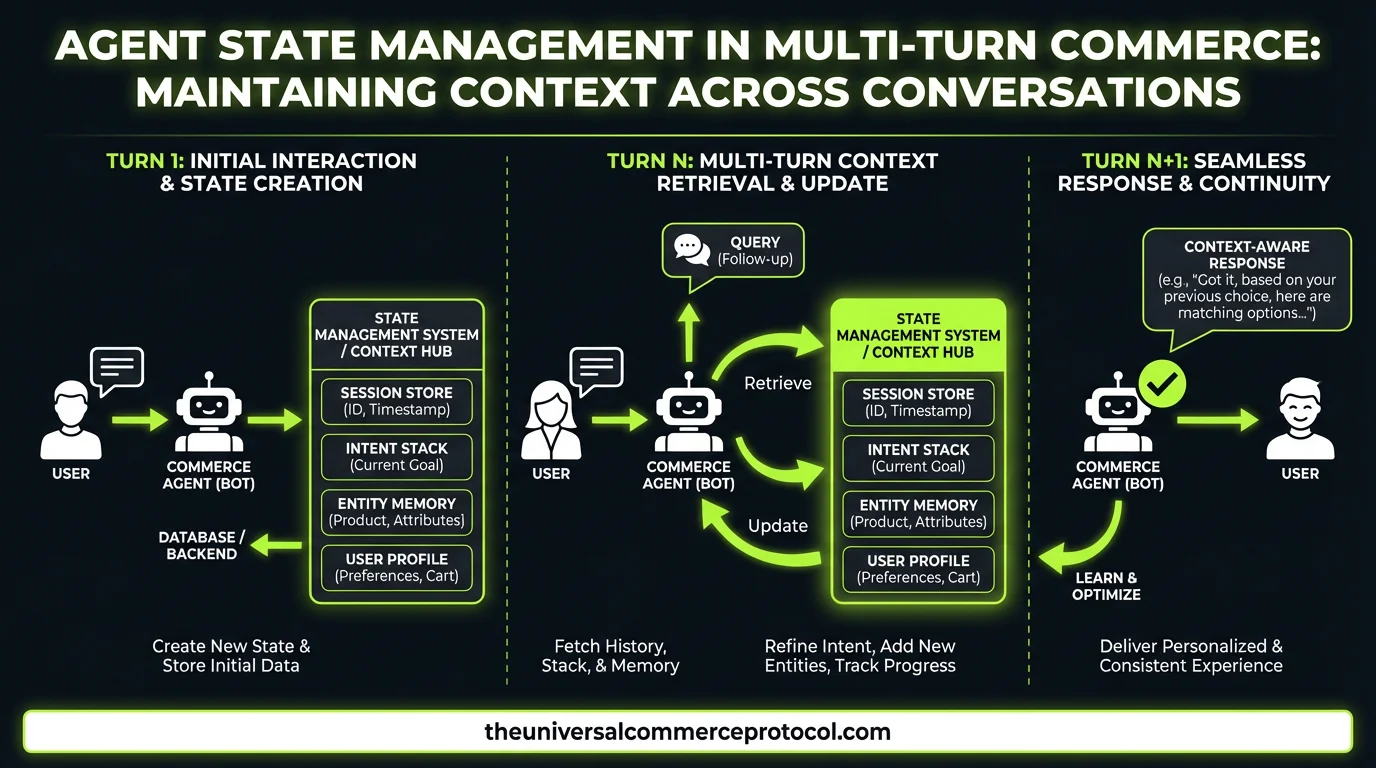
The State Management Crisis in Agentic Commerce
While session management covers the infrastructure layer, state management addresses a deeper problem: how does an AI agent remember what happened in a five-turn conversation, apply user preferences consistently, and avoid contradicting itself when a merchant’s inventory changes mid-conversation?
A customer asks an agent to find running shoes under $100. The agent finds three options. The customer asks “what’s the return policy on the blue one?” Three minutes later, they ask “can I get it in size 12?” If the agent’s state isn’t properly maintained, it may forget which shoe is “the blue one,” lose the customer’s price constraint, or hallucinate a return policy that changed since the first query.
This gap sits between session management (connection persistence) and observability (monitoring). It’s about what the agent actually remembers and how it constructs decisions across turns.
State Layers in Agentic Commerce
Conversation State: The explicit message history and referenced entities (products, prices, policies mentioned in this conversation). Most LLM frameworks handle this via context window management, but commerce-specific state—like “customer selected SKU-4821 at $87.99″—requires explicit tracking.
User State: Cross-conversation preferences: saved payment methods, shipping address history, loyalty tier, past returns, preferred brands. This persists across sessions and should inform every agent decision. A premium member asking “which one’s fastest to ship?” should see expedited options first, and the agent should know they’ve returned items before (relevant for return policy confidence).
Transaction State: Real-time data about what’s in stock, current prices, active promotions, and merchant policies. A product’s price can change mid-conversation. Its availability can drop from 47 units to 3. Return windows may have just expired. Agents must know whether they’re operating on stale data.
Agent Decision State: Why did the agent recommend this product? What constraints were applied? If the customer asks “why not that cheaper option?”, the agent should retrieve the reasoning (“it has 47 fewer reviews” or “it ships in 2 weeks vs. 2 days”), not hallucinate an explanation.
Where State Management Fails Today
Context Window Overflow: Including full message history, user profile, inventory snapshot, and decision rationale in every prompt quickly exceeds token limits. Claude 200K and GPT-4 Turbo 128K are large, but a 15-turn conversation with 10 product comparisons, user data, and real-time inventory creates redundancy. Naive systems truncate history, losing earlier constraints.
Stale Data Injection: User state and transaction state retrieved at turn 1 are outdated by turn 5. A product that was in stock is now sold out. A price that was $89 is now $99. An agent making decisions on stale data will recommend items that no longer match the conversation’s constraints, then defend the recommendation with outdated facts.
State Hallucination: Agents often invent state to fill gaps. “You mentioned you wanted red” (customer never said that). “This has free shipping” (promotion ended). “It’s our top seller” (no data). Without explicit state tracking, agents confabulate to maintain coherence.
Cross-Turn Contradiction: Agent says “this shoe has a 60-day return window” in turn 2, then in turn 4 says “it has a 30-day window.” Both statements came from different API calls or different training data. Without state canonicalization, agents contradict themselves, eroding trust.
User State Leakage: Privacy violation risk. An agent inadvertently references another customer’s saved address, or discloses that a user has returned items frequently. State isolation between customers and sessions is non-negotiable.
Architectural Patterns for State Management
Structured State Object: Rather than embedding all state in the prompt, maintain a JSON state object that the agent can read and write. Example:
{"conversation_id": "abc123", "user_id": "user_456", "current_intent": "find_running_shoes", "constraints": {"max_price": 100, "preferred_brands": ["Nike", "Adidas"], "shoe_width": "wide"}, "candidates": [{"sku": "4821", "name": "Nike Pegasus", "price": 87.99, "in_stock": true, "decision_reason": "matches_price_and_brand_constraint"}], "user_preferences": {"loyalty_tier": "gold", "past_return_count": 2}, "last_inventory_check": "2026-03-13T14:22:00Z"}
The agent references this object rather than reconstructing state from memory. Between turns, only changed fields are updated, reducing token usage and preventing drift.
Just-In-Time Data Refresh: Don’t load all inventory and user data upfront. Instead, refresh specific data points when the agent’s decision hinges on them. If the agent is about to recommend SKU-4821, check inventory and price in real-time. If it’s about to explain a return policy, fetch the current policy from the merchant API. This trades latency (typically 100–200ms per call) for accuracy.
State Versioning and Rollback: If a user says “actually, forget that—I want to go back to the blue shoe option,” can the agent revert to a previous state? Implement state snapshots at each significant decision point (product selected, constraint added, question asked). This enables “undo” and also provides audit trails for dispute resolution.
Explicit Reasoning Logging: When an agent makes a choice, log the reasoning: “filtered 1,200 shoes → 47 matching price constraint → 12 matching brand constraint → 3 matching width constraint → recommended top-rated option.”) This reasoning becomes part of the state object. If the customer challenges the recommendation, you can replay the decision logic.
Multi-Merchant State Complexity
A single agent shopping across five merchants faces state explosion. Product A on Merchant 1 costs $79. Same product on Merchant 2 costs $85. Return policy differs. Shipping time differs. Stock levels are independent.
Maintain separate transaction state per merchant, but unified user state and conversation intent. The agent should know “customer wants lowest price” across all merchants, but also track “Merchant 1 inventory check at 2:22pm, Merchant 2 at 2:19pm.” Stale data from one merchant shouldn’t contaminate recommendations from another.
State and Compliance
Regulators will ask: “Why did your agent recommend this product?” Answer: retrieve the state object from that conversation. “Was the customer informed of the return policy?” Check the decision reasoning log. “Did the agent have access to accurate inventory data?” Review the timestamp on the last transaction state refresh.
State management is compliance infrastructure. It’s auditable, reproducible, and defensible in dispute resolution.
FAQ
Q: How much storage does per-conversation state add?
A: A typical conversation state object is 5–15 KB (structure + 10–20 product references + user data). A 1M-conversation system requires 5–15 GB of state storage. Manageable in any database, but requires cleanup policies (delete state after 90 days, or archive to cold storage).
Q: Should state updates be synchronous or asynchronous?
A: Critical updates (inventory, price, user authentication) must be synchronous—the agent waits for confirmation. Non-critical updates (user preference learning, recommendation tuning) can be asynchronous, but must not block the response.
Q: How do you handle conflicting state updates?
A: Implement last-write-wins for most fields, but with reservation for inventory (inventory decrements must use atomic transactions, not last-write). For user preferences, newer explicit actions override older implicit inferences.
Q: Can state be compressed to reduce token usage?
A: Yes. Instead of “previous 8 turns of conversation,” pass a 1-paragraph summary of conversation intent and constraints. Instead of full user profile, pass only relevant fields (width preference, return history) omitting data the current decision doesn’t need. This requires a summarization step, but cuts token usage 30–50%.
Q: What happens if state becomes inconsistent?
A: Implement a state reconciliation routine that fires every N turns or after high-latency operations. It re-fetches transaction state (inventory, price) from authoritative sources and flags any contradictions. If a contradiction is found, the agent should disclose it (“I found conflicting information; let me re-check”) rather than hide it.
Q: How do you prevent state leakage between customers?
A: Isolate state by user_id + session_id composite key. Implement row-level security at the database layer. Log all state reads for compliance. Code reviews must catch any cross-customer state references.
What is state management in agentic commerce?
State management in agentic commerce refers to how AI agents remember and maintain information across multiple conversation turns. It addresses the critical problem of ensuring agents consistently apply user preferences, avoid contradicting themselves, and adapt to changes (like inventory updates) that occur during conversations. This goes beyond simple session management to include what the agent actually remembers and how it constructs decisions across interactions.
Why is state management important in multi-turn conversations?
State management is crucial in multi-turn conversations because without proper state tracking, agents can lose critical context. For example, if a customer asks about running shoes under $100, then refers to “the blue one” minutes later, the agent needs to remember which shoe was discussed and maintain the original price constraint. Without proper state management, agents risk forgetting context, hallucinating information, or providing contradictory responses.
What are the main state layers in agentic commerce?
One key state layer is Conversation State, which includes the explicit message history and referenced entities such as products, prices, and policies mentioned within the conversation. Most modern LLM frameworks manage this through context window management, though commerce-specific requirements often demand more sophisticated approaches beyond standard implementations.
How does state management differ from session management?
Session management covers the infrastructure layer—connection persistence and technical continuity. State management, however, addresses a deeper problem: what the agent actually remembers and how it constructs decisions. While session management keeps the connection alive, state management ensures the agent maintains accurate context about user preferences, mentioned products, constraints, and policies throughout the conversation.
What problems can occur without proper state management in commerce?
Without proper state management, several problems can occur: agents may forget which products were discussed, lose user constraints (like budget limits), hallucinate information (such as incorrect return policies), contradict themselves across turns, and fail to adapt when merchant inventory or policies change mid-conversation. These failures directly impact customer experience and transaction completion rates.
Frequently Asked Questions
What is the Universal Commerce Protocol (UCP)?
The Universal Commerce Protocol (UCP) is an open standard developed to enable AI agents to autonomously conduct commerce transactions across any platform.
How does UCP enable agentic commerce?
UCP provides standardized APIs and protocols so AI agents can discover products, negotiate terms, and complete purchases without human intervention, working across any compatible commerce platform.
Why should businesses implement UCP?
UCP adoption reduces integration costs, opens revenue channels to AI-driven buyers, and future-proofs commerce infrastructure as agentic purchasing becomes mainstream.
Leave a Reply