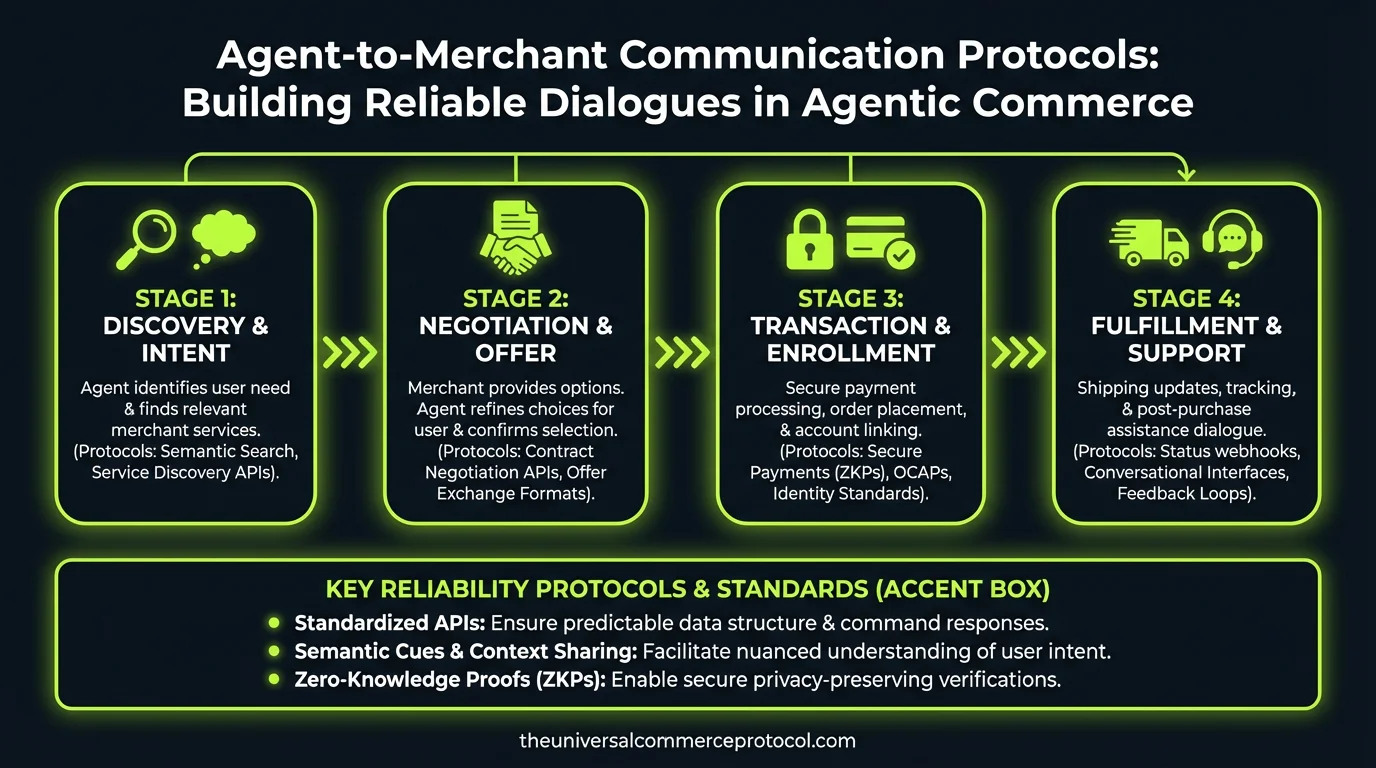
The Silent Infrastructure Problem Nobody’s Talking About
You have agent hallucination detection. You have inventory desynchronization safeguards. You have fraud detection at payment time. But what happens when your AI agent asks your merchant system a question and never gets a clear answer back?
This is the agent-to-merchant communication gap—and it’s costing retailers real revenue in failed transactions, confused agents, and eroded buyer confidence.
Unlike agent-to-agent commerce (where both parties are automated systems with compatible instruction sets) or agent-to-buyer interactions (where natural language flexibility is acceptable), agent-to-merchant communication requires something different: a reliable, semantically unambiguous channel where misinterpretation costs money.
Why Standard APIs Aren’t Enough
Your REST API was built for human developers. It returns 200 OK when a product search completes, 404 when nothing matches, 500 when something breaks. An AI agent consuming that API has to infer business logic from HTTP status codes. It’s like trying to negotiate a contract by reading error messages.
A proper agent-to-merchant protocol needs to:
- Explicitly confirm intent before action. Before an agent reserves inventory, the merchant system should confirm it understood the request, the quantity, the SKU variant, and the hold duration.
- Signal confidence levels. If inventory data is 2 hours stale, the agent needs to know. If a price was last updated 30 seconds ago, that’s different from 30 days ago.
- Provide structured, parseable explanations for failures. Not “Error: Database connection lost.” Rather: “Inventory unavailable for SKU-4521: primary warehouse offline, secondary warehouse has 3 units available, cross-regional fulfillment adds 2 days.”
- Enable agent retry logic with merchant-provided guidance. The merchant system should tell the agent whether to retry immediately, after a delay, or never.
Real-World Communication Breakdown: A Case Study
A mid-market apparel retailer integrated with Claude’s shopping agent. The agent correctly identified customer intent (winter coat, size M, under $150). But the retailer’s inventory API returned availability as a simple boolean—true or false—without color/size details.
The agent hallucinated. It told the buyer: “We have 3 coats in stock.” The customer ordered. The agent reserved inventory. But the actual system had 0 coats in black/M and 3 coats in navy/L. The reservation failed silently. The agent never received explicit notification and proceeded to payment. The buyer got a cancellation email 6 hours later.
The merchant blamed the agent. The agent platform blamed the retailer’s API design. The buyer blamed both and left a one-star review.
Better protocol: The retailer’s system returns: "availability": {"status": "partial", "available_variants": [{"color": "navy", "size": "L", "count": 3, "fulfillment_days": 2}], "requested_variant": {"color": "black", "size": "M", "status": "unavailable"}, "agent_action_recommended": "suggest_alternatives_or_notify_backorder"}
Now the agent has explicit, actionable information and can respond appropriately.
Core Components of an Agent-Merchant Protocol
1. Explicit Confirmation Handshake
Before reservation, payment, or fulfillment instruction, the agent and merchant system exchange:
- Agent intent summary (what it’s trying to do)
- Merchant acknowledgment + extracted parameters (what it understood)
- Agent confirmation or correction
- Merchant final approval or rejection with reason code
This is synchronous, logged, and auditable.
2. Data Freshness Metadata
Every response includes a data_timestamp and freshness_confidence. If inventory was synced 5 minutes ago from a real-time feed, confidence is high. If it’s cached from 2 hours ago, the agent knows to weight alternatives higher or offer a backorder option explicitly.
3. Structured Error Taxonomy
Instead of generic error codes, merchant systems return standardized error types:
TRANSIENT_UNAVAILABLE— retry after 30 secondsOUT_OF_STOCK_PERMANENT— do not retry; suggest alternativesSYSTEM_DEGRADED— fall back to manual reviewAUTHENTICATION_FAILED— re-authenticate and retryRATE_LIMITED— back off exponentially
4. Agent State Mutation Logging
Every time an agent makes a change (reserve inventory, apply a discount, add to cart), the merchant system returns a transaction ID, timestamp, and immutable record. If the agent later needs to reverse or audit that action, the log is the source of truth.
5. Graceful Degradation Signals
If the merchant system is experiencing partial outage, it explicitly tells agents: “Real-time inventory unavailable; falling back to batch-synced data from 30 minutes ago. Proceed only if customer accepts 24-hour fulfillment window.”
Who’s Building This (and Who Should)
Shopify’s expanded Hydrogen framework has early protocol elements. Stripe’s Agent SDK includes structured response templates. But no vendor has published a comprehensive, platform-agnostic merchant-agent communication standard yet.
The gap exists because most agent integrations are still point-to-point: one agent, one merchant, custom handshakes. As agent variety explodes (Claude, Gemini, OpenAI’s operators, custom enterprise agents), merchants will demand a single protocol that works across all of them.
Getting Started: Three Implementation Tiers
Tier 1: Minimum (for pilot projects)
Add a confirmation_required field to your API responses. If true, the agent must send back an explicit acknowledgment before proceeding. Log all confirmations.
Tier 2: Production-Ready
Implement the handshake flow above. Add data freshness metadata. Return structured error codes. Version your API for backward compatibility with non-agent clients.
Tier 3: Enterprise
Build a dedicated agent communication layer. Use message queues for async operations. Implement distributed transaction logging. Add circuit breakers for system degradation. Monitor agent-to-merchant latency and error rates separately from human API traffic.
FAQ
Q: Isn’t this just OpenAPI 3.1 with better documentation?
No. OpenAPI describes endpoints. A merchant-agent protocol describes the conversation flow, state mutations, error recovery, and data confidence semantics. OpenAPI is the vocabulary; this is the grammar and conversation rules.
Q: Do I need to rewrite my API?
Not immediately. Add a new /v2/agent namespace to your API that implements the protocol. Your legacy /v1 human-facing API stays as-is. Gradually route agent traffic to v2.
Q: What if my merchant system is partially offline during a conversation?
The protocol explicitly handles this with degradation signals. The agent can choose to fail the transaction, escalate to human review, or offer the buyer a modified experience (e.g., backorder confirmation).
Q: Who defines the error codes and response structures?
This is the open standard question. Currently, each platform invents its own. Expect IETF or a commerce-focused standards body to propose a standard within 12 months.
Q: Does this slow down transactions?
The confirmation handshake adds latency (typically 50–200ms). But it prevents silent failures that cost far more. Most merchants see net speedup because fewer transactions fail and require manual recovery.
Q: Can I implement this without changing my merchant system code?
Partially. You can build an adapter layer (middleware) that sits between your API and agents. It translates your legacy API responses into protocol-compliant messages. Not ideal long-term, but viable for quick deployment.
Q: What about real-time vs. batch agent interactions?
The protocol supports both. Real-time agents use synchronous handshakes. Batch agents can use asynchronous acknowledgment with webhook callbacks. The merchant system declares its capability in the protocol negotiation phase.
Frequently Asked Questions
Q: What is the agent-to-merchant communication gap?
A: The agent-to-merchant communication gap occurs when an AI agent queries a merchant system but doesn’t receive a clear, unambiguous answer. Unlike agent-to-agent commerce (where both parties are automated) or agent-to-buyer interactions (where natural language flexibility is acceptable), agent-to-merchant communication requires reliable, semantically unambiguous channels where misinterpretation directly costs money through failed transactions, confused agents, and eroded buyer confidence.
Q: Why are standard REST APIs insufficient for agent-to-merchant communication?
A: Standard REST APIs were designed for human developers and communicate through HTTP status codes (200 OK, 404, 500, etc.). AI agents must infer business logic from these codes, which creates ambiguity. A proper agent-to-merchant protocol needs explicit business logic acknowledgment, guaranteed delivery semantics, and semantic clarity—features that standard APIs don’t inherently provide.
Q: What are the key requirements for a reliable agent-to-merchant protocol?
A: A proper agent-to-merchant protocol should include: explicit business logic responses, guaranteed delivery semantics, semantic clarity in all communications, unambiguous error handling, and structured acknowledgment mechanisms. These elements ensure that AI agents can accurately interpret merchant responses and take appropriate actions without costly misinterpretations.
Q: How does agent-to-merchant communication differ from agent-to-agent commerce?
A: Agent-to-agent commerce involves two automated systems with compatible instruction sets that can negotiate using shared protocols. Agent-to-merchant communication, however, requires translating between an AI agent’s inference patterns and a merchant’s existing business logic systems, making clear semantic standards essential rather than optional.
Q: What are the business impacts of poor agent-to-merchant communication?
A: Poor communication protocols lead to failed transactions, confused agents taking incorrect actions, inventory desynchronization despite safeguards, and eroded buyer confidence. These issues represent direct revenue loss and require investment in proper communication infrastructure beyond basic fraud detection and hallucination monitoring.
Leave a Reply